|
India’s economic momentum has continued to strengthen, supported by steady growth, easing inflation and improving export performance. Recent government data indicates that domestic demand remains resilient, while exports are gaining traction across key sectors such as engineering goods, electronics and pharmaceuticals. At the same time, softer inflation has helped create a stable and supportive environment for businesses and exporters. Together, these trends underline India’s growing competitiveness and its ability to sustain growth despite global trade uncertainties.
As Indian exports expand globally, building strong brands has become as important as scaling volumes. Today’s global buyers increasingly look for products with a clear origin, credible quality and a story they can trust. Our feature article, Heritage-Led Storytelling: Elevating India’s Exports, draws on insights from leaders across beauty, design and handcrafted goods to show how Indian brands are using heritage not as nostalgia, but as a structured narrative backed by transparency, craftsmanship and consistency. This approach helps exporters stand out in crowded markets and move towards premium positioning.
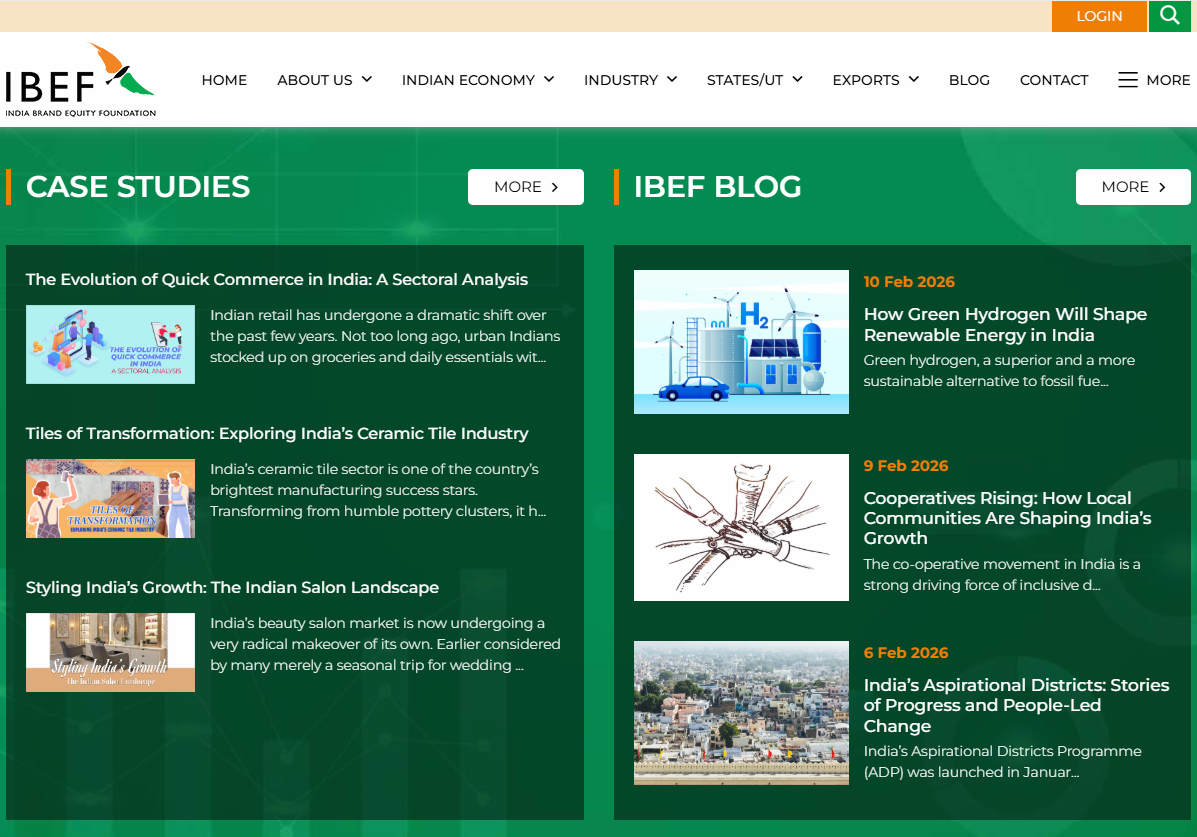
Beyond the feature, this edition brings together multiple lenses on India’s globalisation journey. we present case studies of Balaji Wafers and Himadri Speciality Chemicals Ltd., offering grounded perspectives on how Indian companies are navigating international expansion. We examine market opportunities across Germany, Canada, the UK and the Gulf Cooperation Council (GCC), while IBEF’s Blogs and Case Studies continue to track broader economic trends, evolving consumer markets, policy shifts and export trajectory. The edition concludes with a focused review of India’s evolving trade architecture, covering agreements with the GCC, the UK, the European Union and the United States. From the India-United Arab Emirates Comprehensive Economic Partnership Agreement (CEPA) and the India-Oman CEPA to the India-UK Comprehensive Economic and Trade Agreement (CETA), the India-EU Free Trade Agreement (FTA) and the India-US Interim Trade Agreement, we examine how tariff rationalisation, services integration and sustainability commitments are reshaping India’s global trade partnerships. Together, these perspectives aim to equip Indian businesses for sustainable international growth.
|