Industry Trends
Market Insights
India’s merchandise exports have remained resilient despite a challenging global environment, with demand pressures and trade uncertainties continuing to weigh on international commerce. In FY25, India’s total merchandise exports recorded marginal growth of 0.11% YoY, reflecting stability rather than broad-based expansion. This steady performance has been supported by stronger engagement with select developed markets, where India’s export basket is increasingly shifting towards value added and manufacturing-led products.
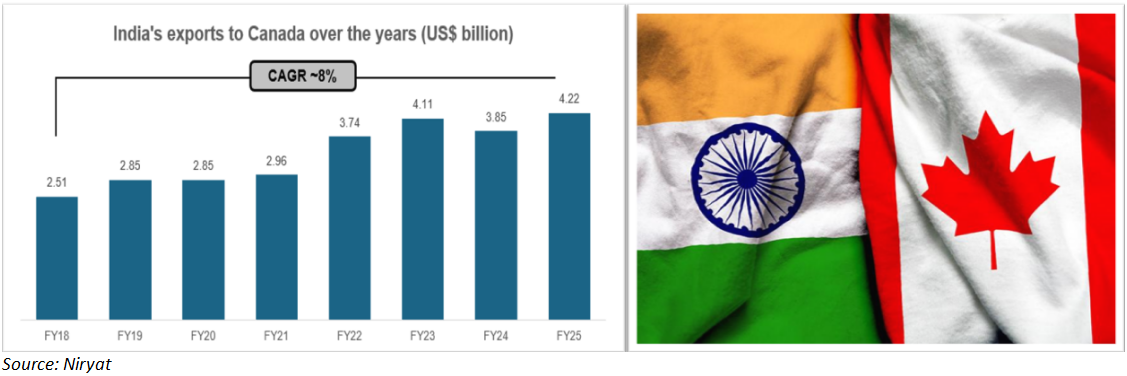
Canada and Germany stand out as two such markets, reflecting different but equally important dimensions of India’s evolving trade profile. India’s exports to Canada have shown a clear upward trend in recent years growing at a Compound Annual Growth Rate (CAGR) of 7.7% from FY18 to FY25, signalling improving market penetration and sustained demand, while exports to Germany have expanded steadily, recording a CAGR of around 2.80% between FY18 and FY25. In this section, we take a closer look at the key commodities driving this growth and examine how Indian exporters are capitalising on opportunities in these markets.
India-Germany
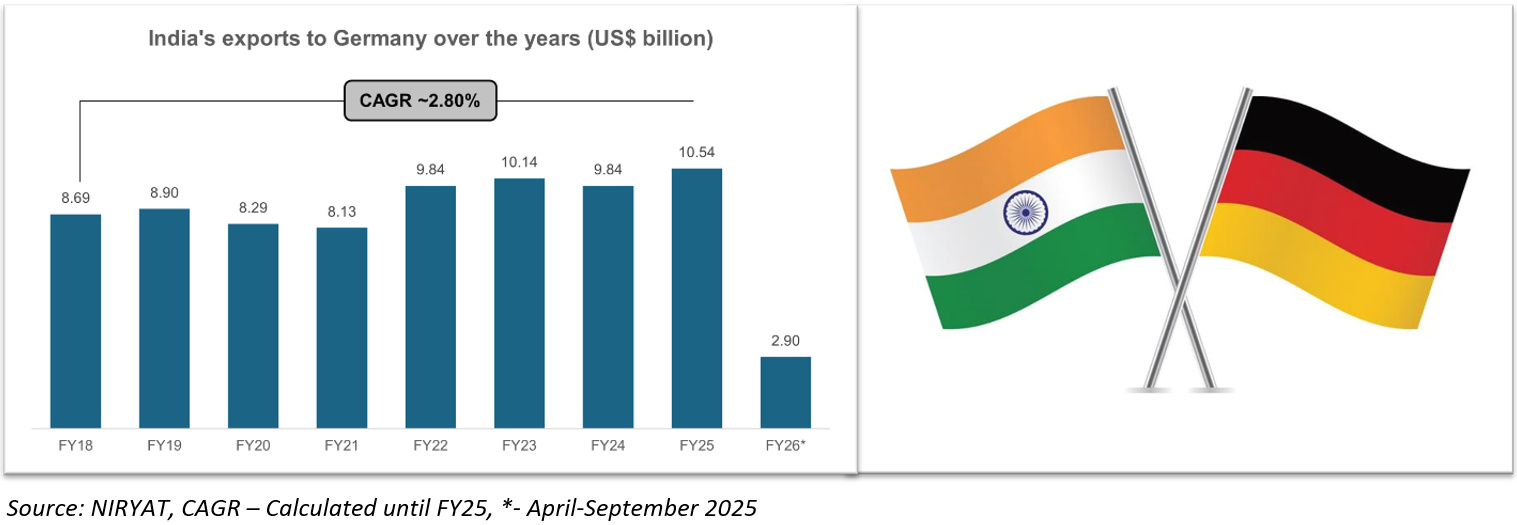
India’s goods exports to Germany have shown steady growth over the past few years, reflecting the depth of the India Germany strategic economic partnership. Exports increased from US$ 8.69 billion in FY18 to US$ 10.54 billion in FY25, registering a CAGR of ~2.80%. This gradual but consistent rise underlines India’s strengthening position in the German market, supported by competitive manufacturing capabilities and a diversified export basket. Germany remains one of India’s most important trading partners within the European Union, with bilateral trade continuing to expand across goods and services.
A key driver of this trade momentum has been the resilience of engineering goods exports, which have consistently formed the backbone of India’s exports to Germany. Engineering goods accounted for ~38.79% of India’s exports in FY18 and increased to ~40.19% in FY25, reaching US$ 4.23 billion. Germany held a 3.63% share in India’s total engineering goods exports in FY25, ranking as the fifth largest destination after the United States of America, United Arab Emirates, Saudi Arabia and Singapore.
On the demand side, Germany’s requirement for engineering goods is closely tied to its deep industrial base and its strong integration with global manufacturing value chains, particularly in automobiles, capital goods, electrical equipment, and advanced manufacturing. Germany hosts over 2,000 German companies operating in India, with significant investments in automobiles, machinery, electrical equipment, chemicals, and industrial services, creating sustained two-way supply chain linkages. In addition, long standing Indo German cooperation in science, technology, and industrial research through platforms such as the Indo German Science and Technology Centre has supported joint development and sourcing of engineering components and industrial solutions.
Engineering goods
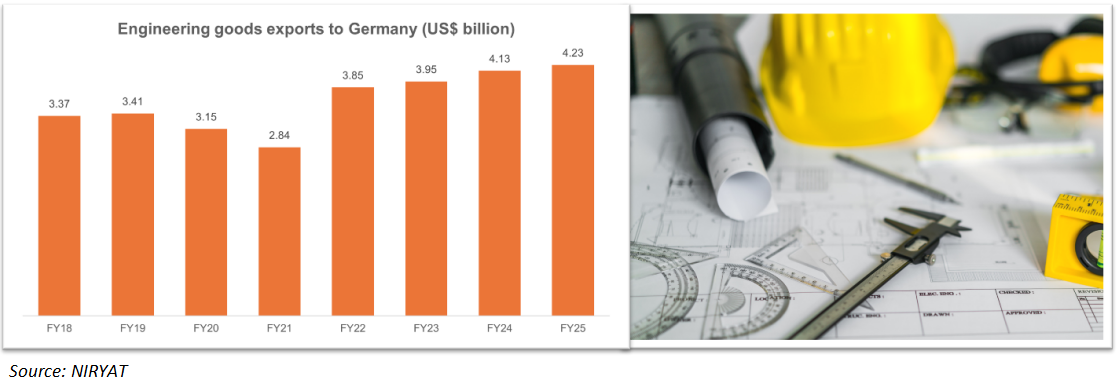
Engineering goods are a key pillar of India’s merchandise exports. In FY25, India’s global engineering exports stood at around US$ 116.70 billion, accounting for ~26.67% of total merchandise exports. Germany, Europe’s largest economy, is an important destination, with India exporting engineering goods worth about US$ 4.23 billion in FY25. This placed Germany among the top five markets for Indian engineering exports, accounting for around 3.63% of India’s total engineering shipments. Engineering goods also form a significant part of India’s export basket to Germany, contributing close to 40% of total exports to the country in FY25. Germany’s strong manufacturing base, spanning automotive, machinery and chemicals, along with its push towards green technologies and energy transition, has sustained steady demand for Indian engineering products, including machinery, electrical equipment and auto components.
On the supply side, India’s growing manufacturing capacity and supportive policy environment have strengthened its competitiveness. The engineering sector contributes about 3.50% to India’s Gross Domestic Product (GDP) and has benefited from sustained infrastructure spending, Production Linked Incentive (PLI) schemes, and export promotion measures such as the Export Promotion Capital Goods and Market Access Initiative schemes. These initiatives have helped Indian firms scale up production, improve quality and reduce costs. Exports to Germany are well diversified, with electrical machinery, industrial machinery and automotive components forming the largest segments, reducing dependence on any single product category. Combined with closer India-Germany industrial partnerships and ongoing India-European Union free trade agreement discussions, this strong demand-supply alignment is expected to keep India’s engineering exports to Germany on a steady growth path.
Organic and Inorganic Chemicals
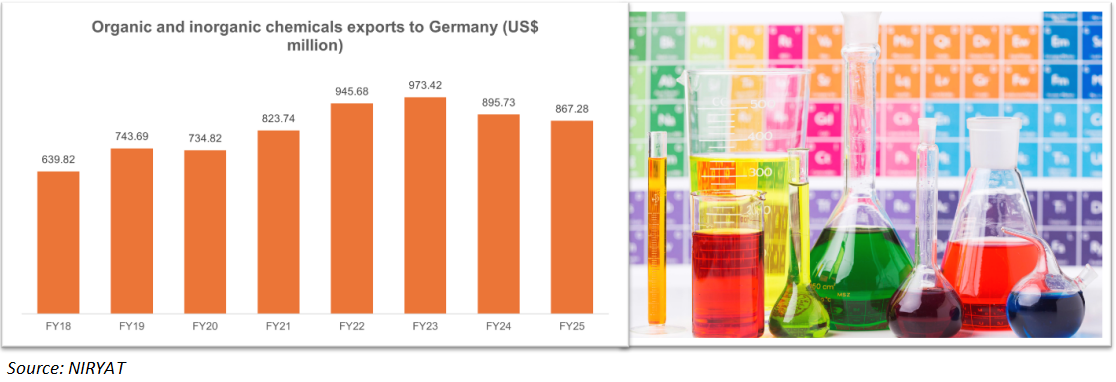
Germany is Europe’s largest economy with a strong industrial base that relies heavily on chemical inputs. India has emerged as a steady supplier of organic and inorganic chemicals to Germany, with exports in the range of US$ 730-900 million annually in recent years, including about US$ 867 million in FY25. This trade is driven mainly by India’s cost competitive manufacturing, supported by lower labour and energy costs, large chemical clusters, and government support such as the Production Linked Incentive (PLI) scheme. Indian chemical exporters have also invested significantly in quality control and compliance, meeting European Union requirements such as Registration, Evaluation, Authorisation and Restriction of Chemicals (REACH) registration, safety data standards, and environmental norms. As a result, German buyers view Indian suppliers as reliable partners capable of delivering consistent quality at competitive prices.
Structural changes in Germany and Europe have further strengthened this relationship. High energy costs and strict environmental regulations have reduced domestic chemical production in Germany, increasing the need for imported intermediates. At the same time, German companies are diversifying supply chains away from concentrated sources, making India an attractive alternative due to its scale, regulatory stability, and transparent business environment. India is among the world’s largest chemical producers and supplies a wide range of intermediates used across automotive, pharmaceuticals, textiles, machinery, and green technology sectors. Compared with other suppliers, Indian chemicals offer a balance of cost efficiency, supply security, and compliance, helping India emerge as one of the leading chemical exporters to the European Union and a key source for Germany’s industrial demand.
India-Canada
India-Canada trade relations have strengthened steadily over the years, supported by expanding economic engagement and complementary sectoral interests. Canada represents an important market for Indian exporters, particularly in value added and knowledge driven segments, while ongoing policy dialogue and business linkages continue to improve trade access and commercial integration. Trade has emerged as a key pillar of the bilateral relationship, reflecting growing depth and diversification in economic ties.
Over the period of eight years, exports from India to Canada have increased exponentially from US$ 2.51 billion in FY18 to US$ 4.22 billion in FY25 at a CAGR of 7.7% per year. Engineering goods, drugs and pharmaceuticals, organic and inorganic chemicals, textiles, etc are few of the major items exported from India to Canada. Among these, engineering goods is one of the highest commodities exported.
Engineering Goods:
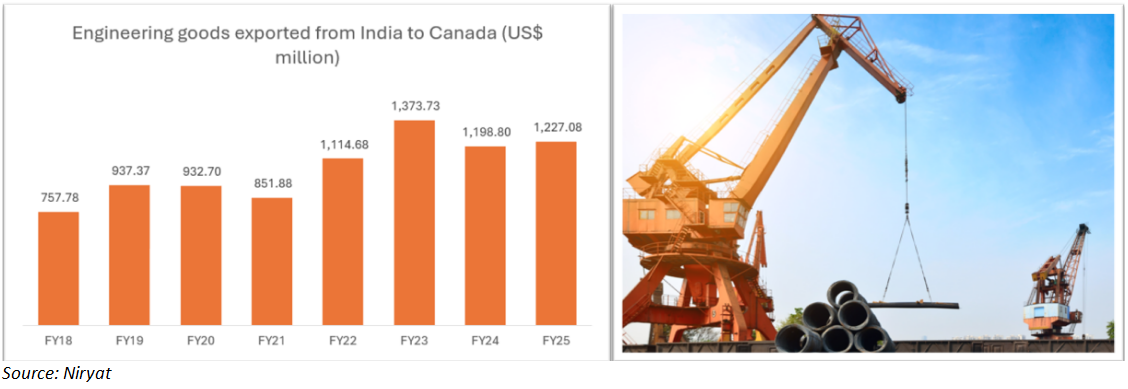
India’s merchandise exports are strongly supported by engineering goods, which reached ~US$ 116.70 billion in FY25 and contributed 26.67% to overall merchandise exports. Engineering goods exports to Canada were valued at US$ 1.22 billion in FY25, recording a marginal 2.36% increase over the previous year and accounting for 29.06% of India’s total exports to the country.
India’s merchandise export performance continues to be anchored by engineering goods, which has emerged as a significant contributor to the export basket. In FY25, engineering goods exports reached ~US$ 116.54 billion, accounting for 26.88% of total merchandise exports, highlighting the sector’s scale and global competitiveness. This performance has been supported by sustained infrastructure spending, Production Linked Incentive (PLI) schemes and export promotion measures such as the Export Promotion Capital Goods and Market Access Initiative schemes, which have enabled Indian firms to scale up production, enhance quality and reduce costs.
Drugs and Pharmaceuticals
India’s pharmaceutical industry is a global giant ranking 3rd in volume and 14th in value. It’s the largest supplier of generic medicines providing 20% of the world’s supply and a key player in affordable vaccines. India’s pharma sector supplies 55-60% of UNICEF’s vaccines, meeting 99% of WHO’s Diphtheria, Whooping cough and Tetanus (DPT) vaccine demand, 52% for Bacillus Calmette-Guérin (BCG) and 45% for measles.
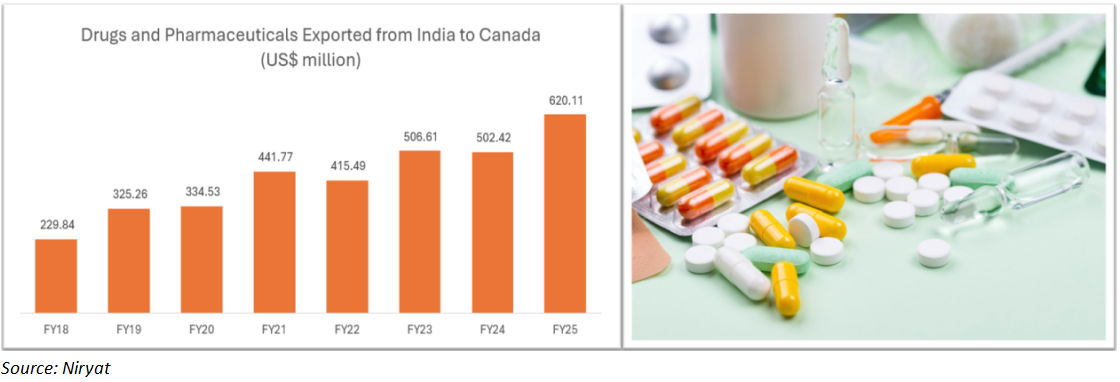
Canada is also a big export destination for Indian drugs and pharmaceuticals with the country being the sixth largest importer globally. In FY25, exports reached US$ 620.11 million, a 23.42% growth rate as compared to previous year. In the same year, drugs and pharma exports accounted for 14.69% of total exports from India to Canada.
Government support has been key to India’s drastic growth in pharmaceutical exports. The PLI Scheme for Pharmaceuticals supports the domestic production of complex drugs, while a separate PLI scheme strengthens the supply of critical raw materials such as Penicillin G. The Promotion of Bulk Drug Parks (PBDP) scheme is building integrated manufacturing hubs in Gujarat, Himachal Pradesh and Andhra Pradesh, and the Strengthening of Pharmaceuticals Industry (SPI) Scheme is enhancing research and infrastructure. Together, these initiatives support cost efficient, high quality pharmaceutical production for global markets.
Looking ahead, efforts by both governments to advance discussions on an India-Canada Comprehensive Economic Partnership Agreement (CEPA) signal clear intent to deepen bilateral economic engagement. For India, this creates strong prospects for scaling exports in new and high value segments such as automobiles, life sciences and advanced manufacturing, where domestic capabilities and cost competitiveness are steadily improving. For Canada, close integration with India offers opportunities to diversify sourcing, secure affordable and quality products, and enhance collaboration in innovation driven industries. As negotiations progress, a structured trade framework could be a catalyst for high trade volumes, increased investment flows and deep industry partnerships, paving the way for more resilient and future oriented India-Canada economic ties.
Disclaimer: This information has been collected through secondary research. The views expressed by the spokespersons are their own and do not necessarily reflect those of IBEF. IBEF is not responsible for any errors in the same.
Get In Touch
Your input is valuable in shaping the future of the IBEF Export Newsletter! Take a moment to share your thoughts and help us bring you more relevant insights, success stories, and export branding strategies.
Contact & Subscriptions: Contact Us
Email us at: info.brandindia@ibef.org
Call: +91 11 43845501
Partners