Introduction
India’s tea production landscape, as outlined by the Tea Board, reflects a strong global standing, high domestic absorption, and regionally concentrated production. India is the second-largest tea producer globally and the largest producer of black tea, underscoring its significance in the global tea industry. A defining feature of the sector is its robust domestic demand. Nearly 80% of the tea produced in India is consumed within the country, making it one of the world’s largest tea-consuming nations. This strong internal market provides stability for industry and reduces dependence on exports compared to other producing countries.
India is the second-largest producer of tea globally. Indian tea is one of the finest in the world owing to strong geographical indications, heavy investment in tea processing units, continuous innovation, augmented product mix, and strategic market expansion.
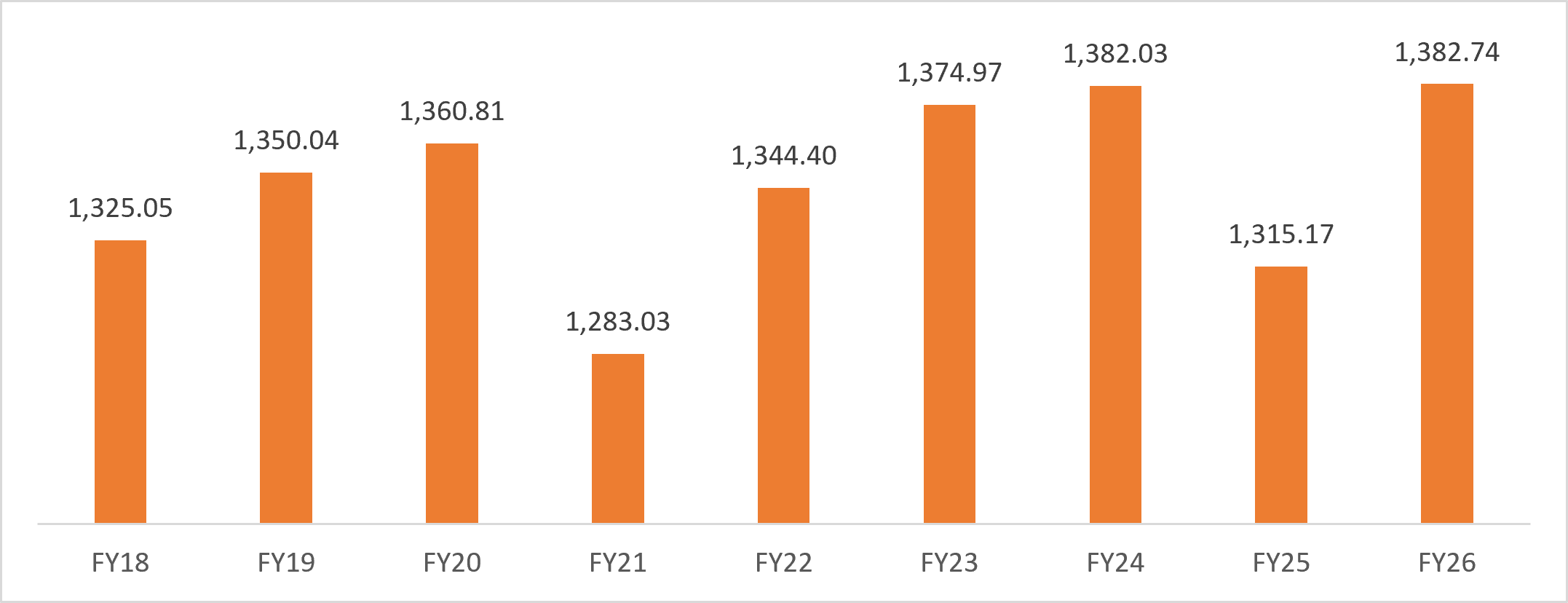
Tea production in India (million kg)
Source: Tea Board of India
As of 2022, a total of 6.19 lakh hectares of area was cultivated in India for tea production. India is also among the world's top tea-consuming countries, with 80% of the tea produced in the country consumed by the domestic population. In FY26, India’s tea production stood at 1382.74 million kgs.
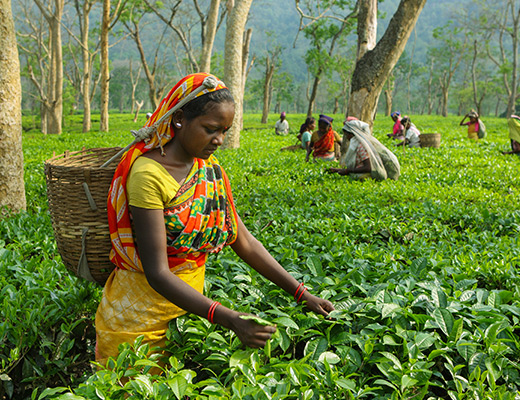
Assam Valley and Cachar are the two tea-producing regions in Assam. In West Bengal, Dooars, Terai and Darjeeling are the three major tea producer regions. The southern part of India produces about 17% of the country's total production with the major producing states being Tamil Nadu, Kerala, and Karnataka.
Export Trend
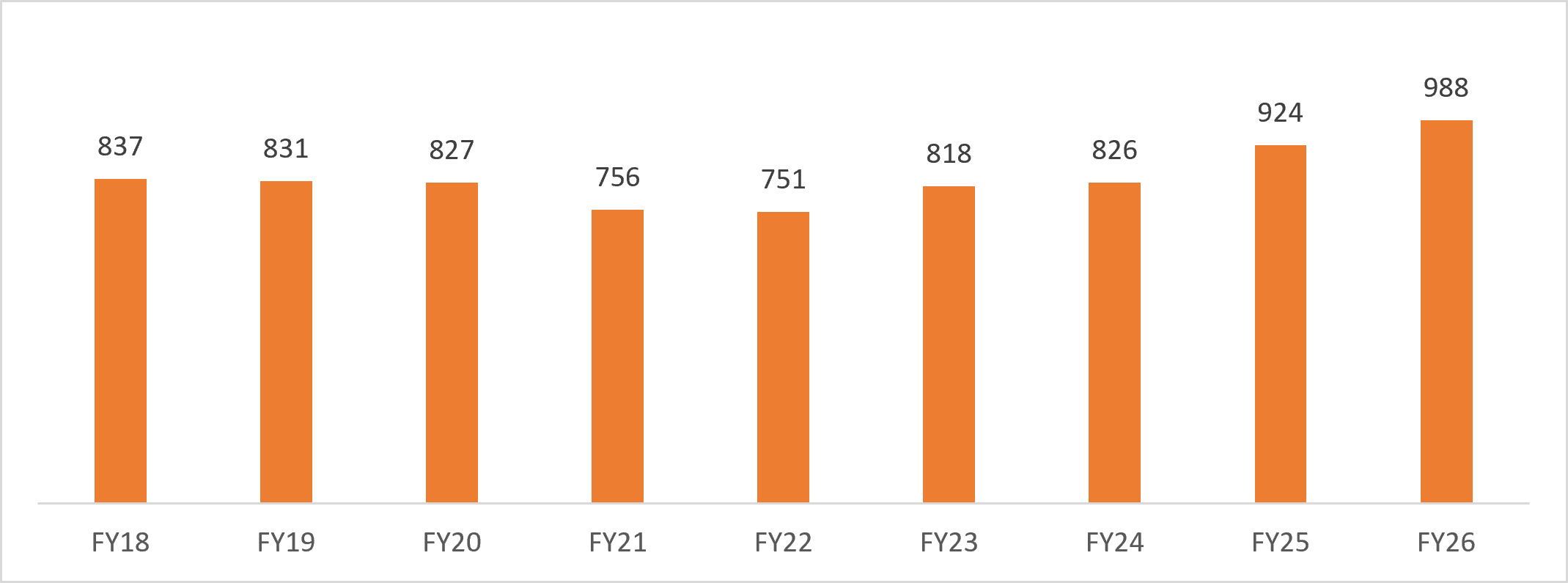
India Tea exports (US$ million)
Source: Tea Board of India, Ministry of Commerce, and Industry
India[TP2.1] is among the top 5 tea exporters in the world, accounting for about 10% of global tea exports. During April 2025- March 2026, the total value of tea exports from India stood at US$ 988.13 million. Indian Assam, Darjeeling, and Nilgiri teas are considered among the finest globally, with black tea continuing to dominate exports.
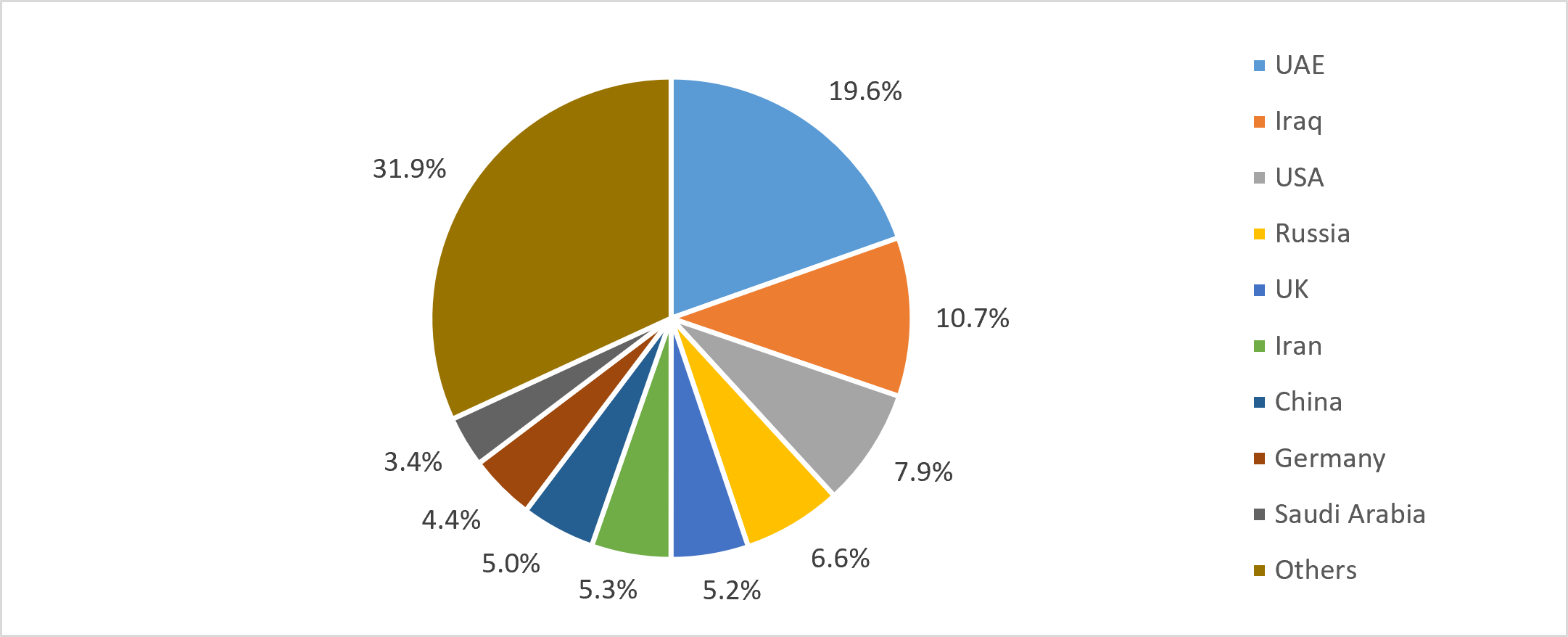
Based on the data shown in the table (Apr 2025–Mar 2026), India exported tea to 151 countries worldwide. The UAE (19.60%) emerged as the largest importer during this period, followed by Iraq (10.68%) and the USA (7.93%). Other major destinations included Russia (6.64%), the UK (5.22%), Iran (5.28%), China (4.95%), and Germany (4.42%), while Saudi Arabia (3.42%) and Turkey (2.78%) also accounted for notable shares. The export pattern highlights a strong concentration in West Asian markets, alongside sustained demand from developed economies and key Asian markets.
Export by Country
India’s tea exports during FY26 reflected strong demand across West Asia, developed markets and traditional tea-consuming economies. The United Arab Emirates emerged as the leading destination, with export volumes of 51.50 million kgs, followed by Iraq (43.34 million kgs) and Russia (31.32million kgs). The strong offtake from West Asian markets highlights India’s continued strength in bulk tea exports, supported by established trade relationships and robust consumer demand in the region.
Other key destinations included the United States (17.02 million kgs), China (18.38 million kgs), Iran (15.25 million kgs), the United Kingdom (10.96 million kgs) and Germany (8.52 million kgs). Demand from European markets, along with sustained imports by Saudi Arabia (8.48 million kgs) and Turkey (7.53 million kgs), underscores the diversified geographical footprint of India’s tea exports. With total tea exports valued at US$ 988.13 million during the period, the sector continues to benefit from India’s strong position in black tea, Crush, Tear, Curl (CTC) tea and speciality orthodox tea segments across global markets.
India's country-wise revenue share from tea exports (FY26)
Source: Tea Board of India, Niryat,
Government Initiatives
India’s tea sector continued to witness growth during FY26, supported by strong export performance and proactive government initiatives. Tea exports reached approximately 239.51 million kg during April 2025-March 2026, valued at US$ 988.13 million, reflecting robust global demand for Indian tea across key markets such as the UAE, Iraq, Russia, the US and the UK. Continued government support through production enhancement, quality improvement and export promotion measures has further strengthened the sector’s competitiveness in international markets.
Under the finalized India-UK Free Trade Agreement (CETA) signed in July 2025, tea was retained as a sensitive item and excluded from tariff reduction on the Indian side. India has kept its existing 110% import duty on tea intact, so no duty relief applies to UK tea imports into India under the new pact.
To help the Indian exporters to market tea of Indian origin in overseas markets on a sustained basis, the Tea Board of India started a scheme: Promotion for packaged tea of Indian origin. The scheme assists in promotional campaigns - up to 25% of the cost reimbursement, display in international departmental stores, product literature and website development, and inspection charges reimbursement of up to 25% of the charges. The Tea Board also provides subsidies to domestic exporters to participate in international fairs and exhibitions. The aim is to provide a platform for exporters to showcase their products at international events for promotion.
Tea Development and Promotion Scheme
This scheme was launched in November 2021 by the Tea Board of India for the period of 2021-26. The objective of this scheme is to enhance the productivity and quality of tea production in India. There are seven important components to this scheme,
- Plantation development of small tea farmers
- Creation of sector-specific action plan for North-East India
- Supporting the tea producers and traders in market promotion activities
- Worker's welfare
- Research and development activities
- Regulatory reforms
- Establishment expenses
Governing Body - Tea Board of India
The Tea Board of India was set up in 1953 for the development of the tea industry in India. It started functioning in 1954. The board is in Kolkata and has 17 offices across India. Being the regulatory body, the board exerts control over the producers, manufacturers, exporters, tea brokers, auction organizers, and warehouse keepers through various control orders notified under the Tea Act. The responsibilities of the board are increasing production and productivity, improving the quality of tea, market promotion, and welfare measures for plantation workers, and supporting research and development.
Besides the development and regulatory framework, the Tea Board of India also undertakes direct promotional activities, including organizing joint participation in international fairs and exhibitions, arranging buyer and seller meets, and sending & hosting trade delegations. It also conducts market surveys, analyses, identifies, and tracks consumer behavior, and provides relevant and accurate information to importers and exporters.
RELATED SITES

1 - 14, B.T.M. Sarani
(Brabourne Road)
Kolkata - 700001
West Bengal
India
Tel.:+91-33-22351411 (11 Lines)
Fax: +91-33-22215715
Email: tboardcp@cal3.vsnl.net.in
Website: www.teaboard.gov.in
Partners




