Introduction
India is the third largest coconut-producing country in the world and accounted for about 30.37% of the world’s total production during FY25, with a production of 21,373.62 million nuts. The coconut palm provides food security and livelihood opportunities to about 30 million people in India. It is also a fibre-yielding crop for more than 15,000 coir-based industries, employing nearly six lakh people. The productivity of coconuts at a national level for FY26 was at 9,871 nuts per hectare, one of the highest in the world. Copra processing, coconut oil extraction and coir manufacturing are the traditional coconut-based activities in the country. India’s coconut production is largely concentrated in Karnataka, Tamil Nadu, Kerala, and Andhra Pradesh, which together account for around 91.11% of total coconut production in the country during FY25.
India’s Production (million nuts)
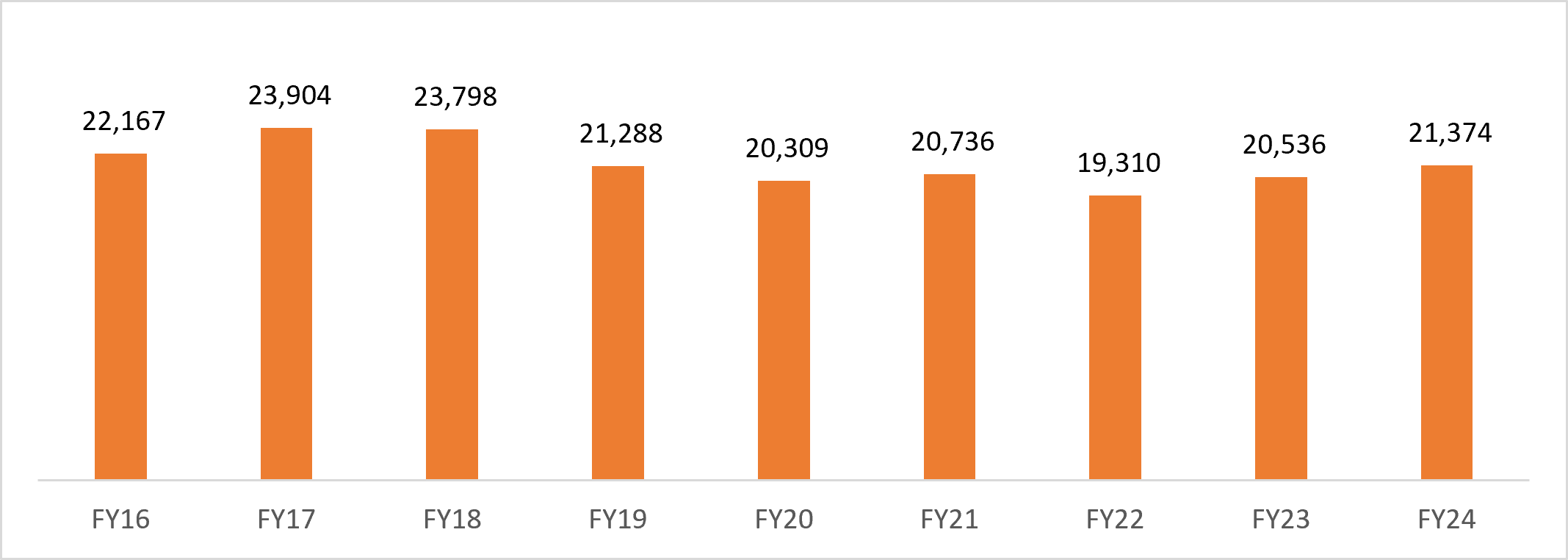
Source: Coconut Development Board
Other coconut-producing states include West Bengal, Odisha, Maharashtra, Gujarat, Assam, and Bihar, which contribute a relatively smaller share to overall production. The Union Budget 2026 emphasizes the development of high-value crops such as coconut, cashew, and cocoa to enhance farm incomes, promote diversification, and strengthen India’s agri-value chains. Initiatives like the Coconut Promotion Scheme aim to improve productivity through better planting materials and replanting of low-yield trees, supporting millions of livelihoods. Targeted programmes for cashew and cocoa are expected to boost domestic production, reduce import dependence, and enhance export competitiveness. Overall, the policy push is set to strengthen supply chains, encourage agro-processing, and position India as a key global supplier of value-added agricultural products.
Export Trend
India’s coconut exports trend (US$ million)
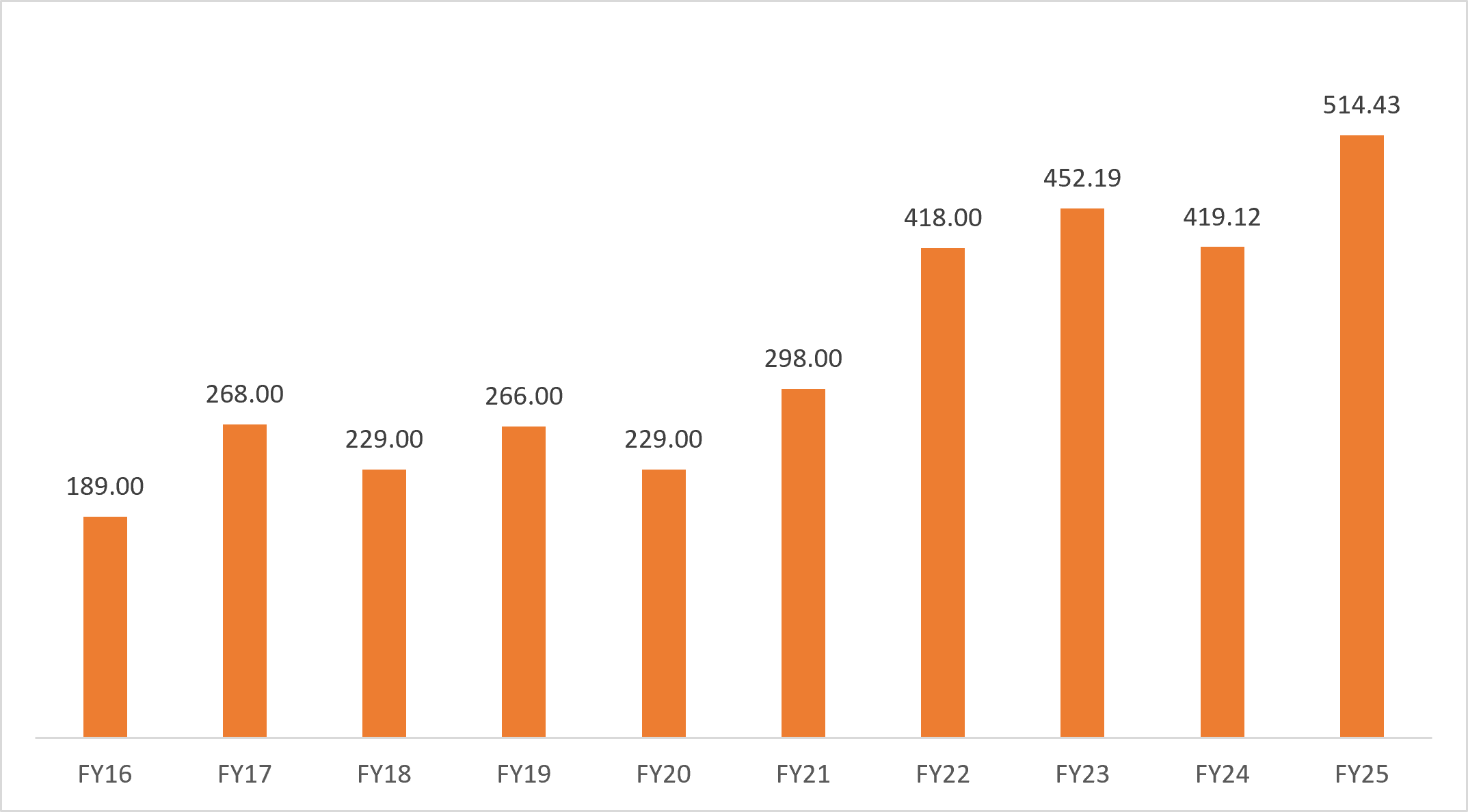
Source: Coconut Board of India, Money Control
The exports of coconut and coconut-based products from India have exhibited a fluctuating yet overall upward trend over the past decade, driven by rising global demand for natural, sustainable, and value-added products. Export value increased from Rs. 1,450.24 crore (US$ 216.71 million) in FY16 to Rs. 3,469.44 crore (US$ 419.2 million) in FY24, reflecting strong growth in key product categories such as activated carbon, coconut oil, and copra. While the export trajectory witnessed periodic fluctuations, including declines in FY18, FY20, and FY24, the overall trend remained positive, supported by increasing industrial applications and demand for eco-friendly alternatives in global markets.
For FY25, exports of coconut products (excluding coir) reached Rs. 4,349.03 crore (US$ 514.4 million), marking a strong year-on-year growth compared to Rs. 3,469.44 crore (US$ 419.2 million) in FY24. This growth underscores improving export momentum and recovery in global demand. Based on FY24 product composition, activated carbon remained the dominant export category at Rs. 2,108.41 crore (US$ 254.7 million),
accounting for a significant share of total exports, followed by coconut oil (refined) at Rs. 334.23 crore (US$ 40.4 million) and copra at Rs. 173.88 crore (US$ 21.0 million). Other notable contributors included fresh coconut (Rs. 187.48 crore; US$ 22.6 million) and shell charcoal (Rs. 68.96 crore; US$ 8.3 million). Overall, the export trend highlights India’s strong positioning in high-value coconut derivatives, with value-added products continuing to drive export growth and diversification.
Export Destinations
India exports coconut to more than 140 countries around the world. The major importers of coconut from India are Vietnam, the UAE, Bangladesh, Malaysia and the USA.
For FY21, the amount of coconut exports to the top five countries are valued at Vietnam (US$ 29.6 million), UAE (US$ 16.61 million), Bangladesh (US$ 14.63 million), Malaysia (US$ 11.27 million), and USA (US$ 5.84 million), accounting for 66% of the exports from India. Vietnam is the major importer with a share of 25%, followed by UAE and Bangladesh, making for 14% and 12% of India’s coconut exports, respectively.
In 2016, India started exporting coconut oil to countries like Malaysia, Indonesia, and Sri Lanka, the countries from where it had been imported earlier. In the same year, India commenced exporting desiccated coconut to the USA and Europe in large quantities under the initiative of the government along with the Coconut Development Board (CDB) to assist the coconut farmers in the production, processing, marketing and export of value-added coconut products. The main destinations for coconut oil exports from India are the UAE, Saudi Arabia, the US, and Vietnam. During FY20, the fastest growth in coconut oil exports was witnessed in countries like Saudi Arabia, the US and Vietnam.
Government Initiatives
India’s coconut sector is set to gain from the Union Budget 2026–27, which introduced a dedicated Coconut Promotion Scheme to enhance productivity, replant ageing trees with high-yield varieties, and strengthen processing and value chains. Backed by increased government support for high-value agriculture, the initiative aims to boost farmer incomes and expand export potential of coconut-based products. Additionally, state-level efforts such as Andhra Pradesh seeking central assistance for large-scale coconut projects further support infrastructure development and cultivation expansion, reinforcing India’s position in the global coconut market.
Under the aegis of the Ministry of Agriculture and Farmers Welfare, the Coconut Board of India had implemented many programs to develop the coconut industry in the country. Some of the schemes include the production and distribution of quality planting material, expansion of area under cultivation, technology demonstration and improvement, replanting and rejuvenation, support exporters for participating in international events, training for market promotion of export-specific products, developing market for coconut products globally by creating opportunities, etc. Other schemes such as Coconut Palm Insurance Mission and Kera Suraksha Insurance Scheme help protect the farmers from natural calamities and losses.
The Government has increased Minimum Support Price (MSP) for milling copra and ball copra from Rs. 5,250 (US$ 60.92) per quintal and Rs. 5,500 (US$ 63.83) per quintal for the marketing season 2014 to Rs. 11,582 (US$ 134.41) per quintal and Rs. 12,100 (US$ 140.37) per quintal for the marketing season 2025, registering growth of 121% and 120%, respectively.
Technology Mission on Coconut (TMoC)
The mission is initiated to converge and synergise all the efforts through vertical and horizontal integration of existing programs, address the problems and bridge the gaps through appropriate schemes in mission mode to ensure adequate, appropriate, timely and concurrent action to make coconut farming competitive and ensure reasonable returns for the farmers.
The key components of this mission are to develop and adopt technologies for managing insect pests and disease-affected coconut gardens, processing and product diversification, market research and promotion. It also entails financial assistance to entrepreneurs/farmers for setting up coconut-based industries (other than coir-based industries), increasing focus on research and development, post-harvest processing, product diversification, value addition and management of pests and diseases.
Recent Development
The Board is actively implementing schemes such as replanting and rejuvenation of old and diseased coconut palms, expansion of area under cultivation with quality planting material, and demonstration of integrated farming practices to enhance farmer income. In addition, initiatives like the Coconut Palm Insurance Scheme and Kera Suraksha Insurance provide risk coverage and financial security to farmers and workers. The Board is also promoting product diversification, technology adoption, and market development through support for processing, value-added products, and producer organizations, thereby strengthening the overall growth and sustainability of the coconut industry in India.
On World Coconut Day 2025, the Coconut Development Board (CDB) launched revised financial assistance schemes and presented Export Excellence Awards at Angamaly, Kerala. Subsidy under the Area Expansion Programme has been sharply raised from US$ 73.63 per hectare to US$ 634 per hectare, while support for seedling production increased from US$ 0.091 to US$ 0.51. MP and CDB Board member, Mr. M. K. Raghavan, called for greater focus on processing and product diversification. The Board also released updated guidelines, booklets, and technology publications to boost production, processing, marketing, and exports, aiming for sustainable growth of India’s coconut sector.
According to news articles, overall coconut prices hit a seven‐year high in January 2025, rising 38.7% YoY compared to a 33.8% increase observed in December 2024. Additionally, green coconut prices surged by 14.4% in January 2025, following a 12.3% rise in December 2024, with inflation in green coconut prices remaining in double digits since April 2024.
Governing Body
Coconut Development Board (CDB)
The Coconut Development Board (CDB), a statutory body under the Ministry of Agriculture and Farmers Welfare, is the nodal agency responsible for the integrated development of the coconut sector in India. It focuses on enhancing productivity, promoting value-added products, supporting farmers with technical guidance, and strengthening the marketing and export of coconut products. The Board also provides financial assistance, implements development schemes, collects statistics, and undertakes publicity activities to support the growth of the sector. Through these initiatives, it aims to ensure sustainable development, improved livelihoods, and efficient utilisation of coconut resources across the value chain.
RELATED SITES

Coconut Development Board
Government of India, Ministry of Agriculture & Farmers Welfare,
P.B. No.1021, Kera Bhavan,
SRV Road (Near SRV High School), Kochi - 682 011
Ernakulam District, Kerala
India
Tel.:+91-484-2375216
Fax: +91-484-2377902
Email: kochi.cbd@gov.in
Website: http://www.coconutboard.gov.in
Partners