Introduction
The handloom sector in India is a culturally rich and traditional industry that reflects the country’s heritage through generations of skilled craftsmanship. It is highly labour-intensive and eco-friendly, relying on minimal mechanisation and sustainable practices. Predominantly based in rural areas, the sector provides significant employment opportunities, especially to women, thereby playing a crucial role in supporting rural livelihoods and promoting inclusive economic development.
The handloom sector of India is one of the biggest unorganized sectors. The handloom industry in India has a long tradition of outstanding artisanship that represents and preserves vibrant Indian culture. India's handloom artists are globally known for their unique hand-spinning, weaving, and printing style.
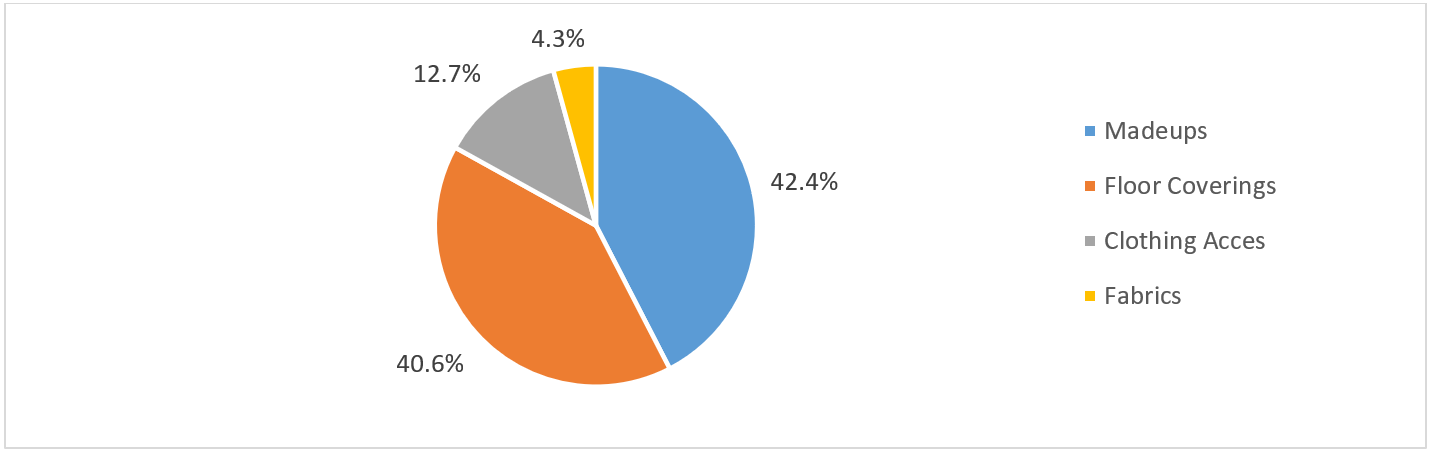
Category-wise share of handlooms export revenue (FY25)
Source: The Handloom Export Promotion Council (HEPC)
They are based out of small towns and villages of the country which transfer skills from one generation to the next. The handloom industry is the country's largest cottage industry, with 2.8 million looms. It is also the rural region's second-largest employment provider, employing around 3.52 million people in direct and allied activities. India produces several traditional products such as sarees, kurtas, shawls, ghagra cholis, lungies, fashion accessories, bedspreads, etc. In the contemporary product category, the country produces fashion fabrics, western dresses, bed linens, drapes, kitchen linen, decorative furnishings, rug durries, etc. The handloom sector of India has the advantage of being less capital intensive, eco-friendly, having less power consumption and having the ability to adapt to market conditions.
According to the Handloom Census 2019-20, about 35.22 lakh handloom workers were employed across the country, out of which 25.46 lakh were women with a share of 72.29%. The sector employs 26.73 lakh weavers directly and indirectly throughout the country with 72% of them being women.
Export Trend
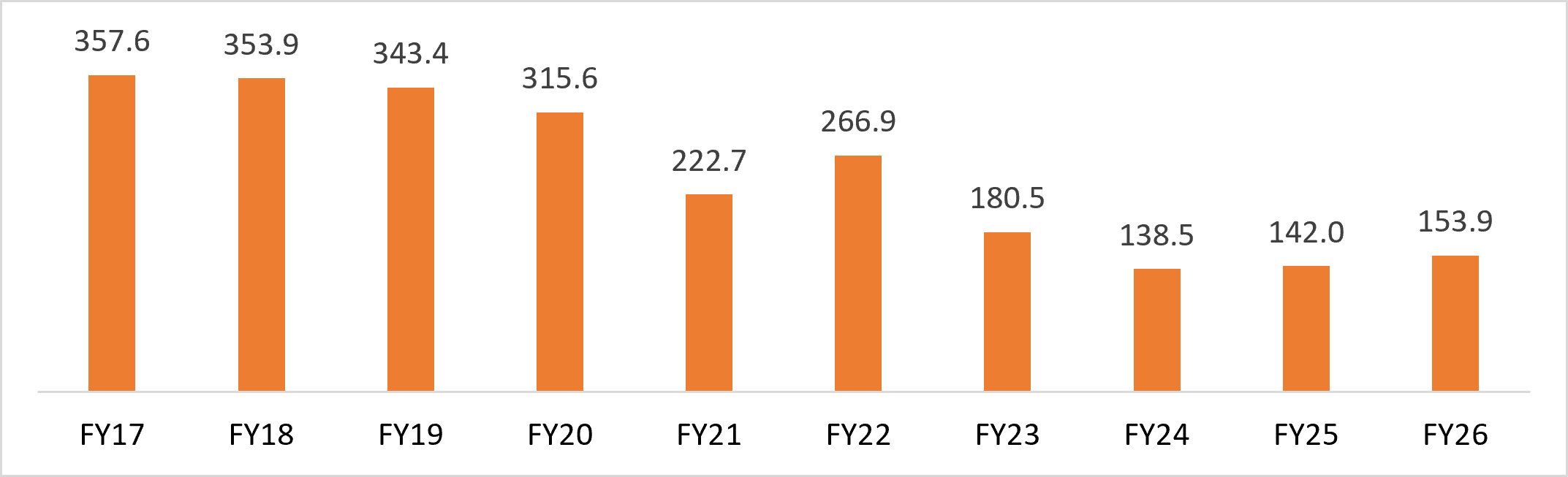
India's handloom export trend (US$ million)
Source: The Handloom Export Promotion Council (HEPC)
India’s handloom product exports have shown a mixed trend over the past six years, reflecting shifts in global demand, discretionary spending patterns and evolving destination dynamics. Exports to the United States, traditionally the largest market, declined from US$ 100.47 million in FY20 to US$ 39.18 million in FY25, indicating moderation in demand from a key mature market. Likewise, exports to the United Kingdom and France softened over the same period, with FY25 exports standing at US$ 7.76 million and US$ 7.82 million, respectively.
In contrast, exports to the United Arab Emirates have strengthened steadily, increasing from US$ 11.16 million in FY20 to US$ 21.33 million in FY25, highlighting growing demand from West Asia.
During April 2025–February 2026, India’s total handloom exports stood at US$ 142.23 million, with demand continuing to be supported by rising global preference for sustainable, handcrafted and heritage textile products. The major handloom export centers are Karur, Panipat, Varanasi & Kannur where handloom products like Bed linen, Table linen, Kitchen linen, Toilet linen, Floor coverings, embroidered textile materials, curtains etc. are produced for export markets. In FY25, India exported cotton yarn/ fabrics /made-ups, handloom products etc. worth US$ 10.56 billion.
Export Destinations
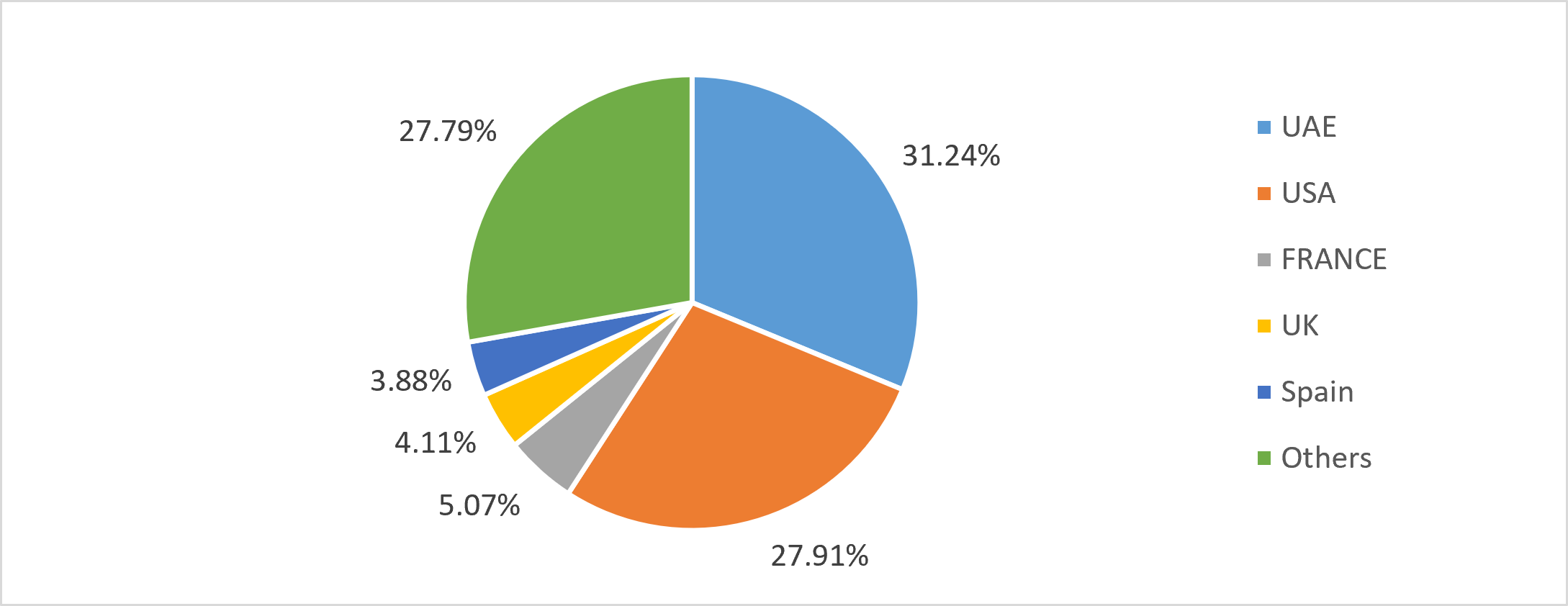
During April 2025–March 2026, the United Arab Emirates emerged as the largest destination for India’s handloom product exports, with shipments valued at US$ 44.80 million, accounting for 31.24% of total exports. The United States followed with US$ 40.02 million, contributing 27.91%. Together, these two markets accounted for 59.15% of India’s total handloom exports during the period, underlining their strategic importance.
Other notable destinations included France (5.07%), the United Kingdom (4.11%) and Spain (3.88%), while the top five destinations together accounted for 72.21% of total exports. The strong concentration in key global markets reflects sustained demand for India’s artisanal weaving products across home décor, furnishing and lifestyle segments.
Country-wise exports share (FY26)
Source: The Handloom Export Promotion Council (HEPC)
Government Initiatives
India’s handloom sector is witnessing strong positive growth supported by rising exports and sustained government initiatives. The government has set an ambitious target to achieve US$ 10 billion in handloom exports by 2031, while promoting the sector as a global movement under the leadership of Prime Minister Narendra Modi and encouraging indigenous production through initiatives like ‘Vocal for Local’. At the same time, the sector is benefiting from targeted policy interventions, including skill development programmes, design support, and marketing assistance, along with participation in international fairs and buyer-seller meets to boost exports and global visibility. Government efforts to strengthen the entire value chain—from raw materials to technology and market linkages are improving income opportunities for weavers and expanding India’s presence in global markets. Additionally, recent statements highlight that focused interventions and innovation-driven growth have strengthened the handloom ecosystem, positioning it as a symbol of sustainability, cultural heritage, and economic empowerment in India.
The Handloom Export Promotion Council (HEPC) provides export assistance through various government-supported schemes aimed at boosting India’s handloom exports. Financial support is offered under initiatives like the Market Access Initiative (MAI) for activities such as international marketing, participation in trade fairs, capacity building, and compliance with global standards. Additionally, support is extended through handloom development programmes to strengthen clusters, improve product quality, upgrade technology, and enhance the skills of weavers and exporters, thereby increasing the global competitiveness of the Indian handloom sector.
National Handloom Development Programme (NHDP)
The NHDP program has several components that focus on various stages of the handloom business. The Cluster Development Programme (CDP) provides financial benefits to clusters and during FY22, assisted 66 clusters. In addition to this, the government provides Handloom Marketing Assistance (HMA), the Urban Haats scheme and handloom awards to develop the industry and encourage businesses in India. For the development of mega handloom clusters, the Government of India plans to provide financial assistance of Rs. 30 crore (US$ 3.9 million) to at least 10,000 handlooms.
Market Access Initiative (MAI)
The MAI launched in 2018, revised in 2021, and will be in effect till March 2026. This scheme will function as a catalyst to promote India's exports on a sustained basis. MAI is based on a product-specific approach with market studies and research on evolving the specific markets. The main activities of this initiative are marketing the products internationally, building capacity, supporting statuary compliances, conducting studies, developing projects, providing portals for foreign trade facilitation, and supporting the smaller and traditional industries. Through the MAI, various components (Trade fairs, exhibitions, market research, buyer-seller meets, etc.) of industry development will have specific ceiling budgets.
Raw Material Supply Scheme (RMSS)
The Raw Material Supply Scheme (RMSS) was approved for implementation from 2021-22 to 2025-26, with objectives of providing quality yarn at subsidized rates to eligible handloom weavers, setting benchmark prices in the market, overcoming poor dyeing facilities, and facilitating weavers' engagement in the sector. Components of the scheme include a freight reimbursement for transportation of yarn and a price subsidy of 15% on certain types of yarn with quantity restrictions, distributed through Direct Benefit Transfer (DBT) to linked bank accounts.
Governing Body
The Handloom Export Promotion Council (HEPC)
The Handloom Export Promotion Council (HEPC) is a nodal organization under the Ministry of Textiles, Government of India, established to promote exports of Indian handloom products such as fabrics, home furnishings, carpets, and floor coverings. It provides support and guidance to exporters and international buyers by facilitating trade promotion, market development, and global marketing initiatives. The Council plays a key role in boosting the handloom sector through activities like organizing international trade fairs, buyer-seller meets, and disseminating market intelligence, while also advising the government on policy matters and promoting innovation, quality improvement, and product diversification in the industry.
RELATED SITES

No. 29A, Rajasekaran Street
Mylapore,
Chennai - 600034,
Tamil Nadu,
India
Tel.:+91-44-28476124
Fax: +91-44-28476126
Email: hepc@hepcindia.com
Website: www.hepcindia.com
Partners