EXECUTIVE SUMMARY
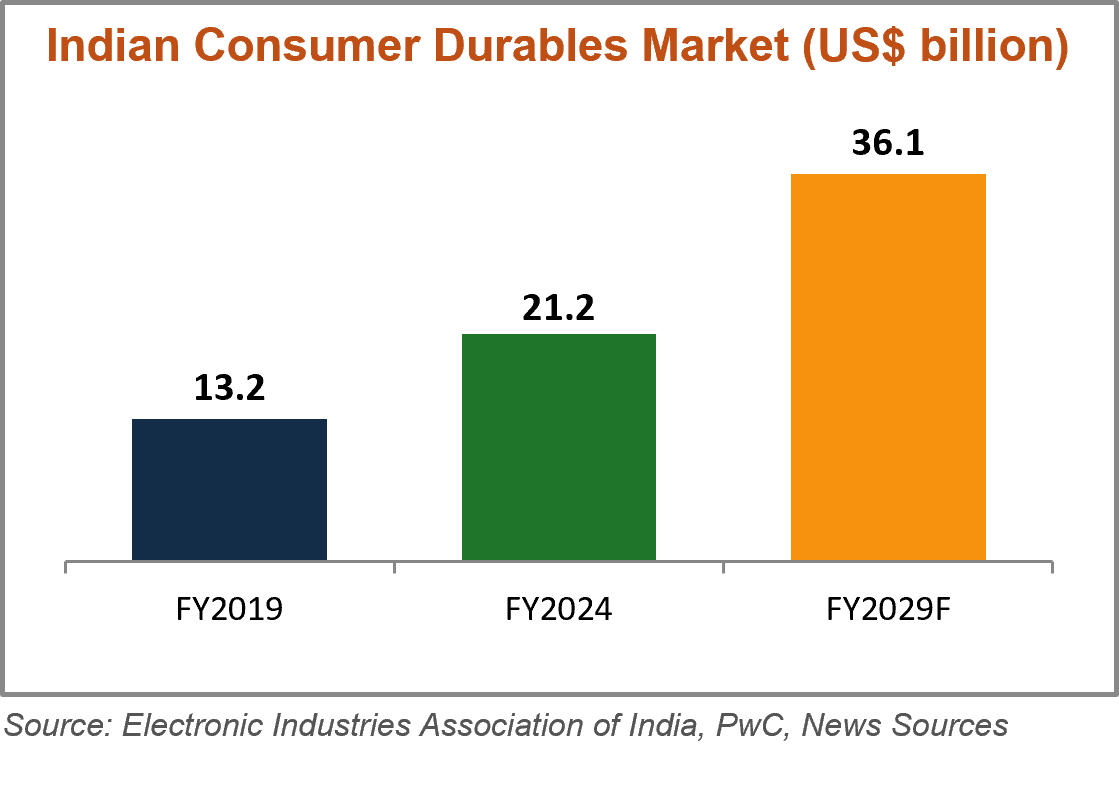
India's consumer durables market, valued at US$ 21.20 billion in FY24, is projected to grow at a CAGR of 11% to reach US$ 36.10 billion by FY29, and India is expected to become the fourth-largest market for consumer durables by FY27. Electronic goods exports reached US$ 47.96 billion in FY26.

Market Size (FY24)
US$ 21.20 billion

Projected Market Size (FY29F)
US$ 36.10 billion

Growth (FY24-FY29F)
11% CAGR

Global Rank by FY27
4th
Introduction
India is the fastest growing market for consumer durables in the world. The need for consumer durables has been rising consistently on the strength of high disposable income levels, advancements in technology, and changed lifestyles, thus increasing competition among both Indian and foreign brands, making India one of the key markets for multinationals.
There are two major segments of the industry: the first is consumer electronics, also called 'brown goods', while the second is consumer appliances or 'white goods'. The sector has come a long way since its closed-market nature in the 1980s and early 1990s. The 1990s saw the liberalisation of the market and the entry of multinational companies like LG and Samsung. This was followed by the introduction of GST with most electronic goods taxed at 18% in July 2017 and the National Policy of Electronics 2019 (NPE 2019).
In FY25, the consumer durables industry contributed to the GDP with a share of 0.60% and aims to increase its contribution by 1.50 times and become the leader of the global industry by 2030. The number of mobile production units in India has raised from just two units in 2014 to more than 300, and the domestically manufactured devices occupy 99.20% of the total domestic mobile market.
MARKET SIZE AND GROWTH
- The consumer durables market has risen from US$ 13.20 billion in FY19 to US$ 21.20 billion in FY24 and is forecasted to grow to US$ 36.10 billion by FY29 with CAGR 11%. India will become the fourth-largest market for consumer durables by FY27.
- India's consumer electronics market accounted for US$ 89.48 billion in 2025 and is forecasted to be US$ 158.40 billion by 2034, which represents a CAGR 6.56%.
- Electronics hardware production has amounted to US$ 133.64 billion in 2025, while exports of electronic goods have grown 24.30% to US$ 47.96 billion in FY26 from US$ 38.58 billion in FY25.
KEY SEGMENTS
Consumer electronics include televisions, audio-video gadgets, personal computers, laptop computers, digital cameras, and camcorders, while consumer appliances include ACs, refrigerators, washing machines, microwave ovens, electric fans, sewing machines, and cleaning equipment.
INVESTMENTS AND FDI
- The inflow of FDI into electronic goods amounted to Rs. 59,953.71 crore (US$ 8,030.05 million) between April 2000 and March 2026, and FDI up to 100% is permissible in the manufacture of electronic hardware.
- The foundation stone for the project of HCL-Foxconn consortium venture India Chip Pvt. Ltd. was laid in Jewar, Uttar Pradesh, in February 2026 and is estimated to be worth more than Rs. 3,700 crore (US$ 433 million), creating over 3,500 direct and indirect employment opportunities.
- Haier Appliances India is making an investment of Rs. 1,000 crore (US$ 114.10 million) from 2024 to 2028 in its plant in Greater Noida, whereas Rs. 417 crore (US$ 47.60 million) worth of EMC 2.0 is being built in Gautam Buddha Nagar, Uttar Pradesh.
- The government of Andhra Pradesh approved an incentive package in May 2026 to support EPACK Durable's proposed investment of Rs. 1,084.31 crore (US$ 122.69 million).
GOVERNMENT INITIATIVES
- Production-Linked Incentive (PLI) Scheme for White Goods: The scheme now covers 85 companies after five more were provisionally selected in January 2026 and is expected to attract investments of Rs. 11,198 crore (US$ 1.27 billion) and generate cumulative production of Rs. 1,90,050 crore (US$ 21.50 billion).
- PLI outlay for ACs and LED lights: Rs. 6,238 crore (US$ 699.50 million), with Daikin, Voltas, Dixon and Signify expanding manufacturing.
- Electronics Components Manufacturing Scheme (ECMS): The outlay was raised to Rs. 40,000 crore (US$ 4.53 billion) in February 2026, and investment commitments of Rs. 1.15 lakh crore (US$ 13.01 billion) were received by April 2026 against an initial target of Rs. 59,350 crore (US$ 6.72 billion). • Quality control: The Transition Facilitation (Quality Control) Order, 2026, notified in June 2026, introduces a risk-based compliance mechanism to facilitate implementation of Quality Control Orders (QCOs).
- GST: The GST Council reduced the rate on televisions above 32 inches from 28% to 18% in September 2025, and some manufacturers reported 30-35% sales growth on the first day.
- Digital India and Skill India : Digital India is set to drive e-commerce adoption in remote areas, while Skill India will create more technicians for after-sales service.
- PLI Scheme for electronic and technology products : An outlay of Rs. 5,000 crore (US$ 674.92 million) over five years under the Ministry of Electronics and Information Technology (MeitY), covering 16 electronics firms including 10 mobile handset manufacturers.
DRIVERS AND OPPORTUNITIES
- Income Growth and Macroeconomic Indicators - Private final consumption expenditure (PFCE) is expected to be around Rs 2,19,63,865 crore (US$ 2,485.30 billion) in FY26, accounting for 61.50% of GDP. At the same time, GDP per capita is expected to be US$ 2,812 in 2026, whereas in 2025, it was US$ 2,675, and in 2031, it is expected to be US$ 4,420.
- Expenditure and Financing - Expenditure on durable goods increased by 72% in FY25 due to high ownership. In May 2026, non-banking financial companies have started playing an increasing role in financing consumer durables like television, washing machine, and air conditioner.
- Rural and Semi-Urban Markets - It is expected that the demand from rural and semi-urban markets will exceed that of the urban market, and non-metro cities including Visakhapatnam, Bhopal, Vadodara, and Chandigarh will become major target markets.
- Cooling and Smart Home Solutions - Installation of air conditioning systems is expected to go up almost nine times in 2050, whereas the penetration of smart television is expected to go up from 30 million units in 2024 to 76 million by 2030.
- Emerging Market Segments - The smart homes segment is expected to grow from Rs 8,000 crore (US$ 912.90 million) in 2023 to Rs 36,000 crore (US$ 4.11 billion) by 2028. Also, the Indian dishwasher market is expected to touch 185,000 units per annum in 2030.
STRATEGIES
- Localisation - The import dependence of Voltas in its AC division came down from close to 65% to about 30-35%, and is expected to be less than 10% in two to three years.
- Diversification - Crompton ventured into the residential wires category in February 2026 and the mobile accessories category in January 2026 through the Energion brand of chargers and power banks.
- Distribution and marketing - More firms have now opted for uniform pricing and targeting of tier-II and tier-III towns. Bajaj Electricals and Crompton have started using demand feedback in real time to cut turnaround time, while festivals are being used for promotions.
- Partnerships and sustainability - Resojet has entered into an MoU with TCL for a joint venture of Rs. 225 crore (US$ 27.10 million) to set up an electronics plant, as firms seek to employ more eco-friendly parts in their products and encourage recycling.
M&A
- In December 2025, Bharti Enterprises and Warburg Pincus announced a strategic investment in Haier India, acquiring a 49% stake in the company.
- TCL Electronics, in May 2026, entered discussions to sell 51% equity in its display manufacturing unit in India, with a target price of Rs. 5,708-7,611 crore (US$ 600-800 million) in collaboration with some Indian firms.
- In May 2026, Vivo India said its proposed joint venture with Dixon Technologies, in which Dixon would hold 51% and Vivo India 49%, remained subject to regulatory approvals.
- In May 2026, there was a joint venture agreement made between China's Skyworth Group and India's Jaina Group for producing and marketing Panasonic-branded televisions.
TRENDS
- Sharing economy - Home appliance rentals have increased in urban environments due to the availability of free complimentary services such as shifting and servicing, offered by companies like Rentomojo, Furlenco and Rentickle.
- AI-based premium products - The growth is fuelled by premiumisation and increased demand for advanced and artificial intelligence (AI)-based products, and Voltas introduced its AI-based ACs in February 2026.
- It is expected that the consumer digital economy in India will be US$ 800 billion by 2030, with 280-300 million consumers shopping online in 2025 and quick commerce delivery orders worth Rs. 64,000 crore (US$ 7.30 billion) during FY25, more than double the previous year.
- Manufacturing base shift - Mobile phones manufacturing increased from Rs. 18,900 crore (US$ 2.14 billion) during 2013-14 to over Rs. 5.50 lakh crore (US$ 62.23 billion) during 2024-25, and in 2025-26, India accounted for an estimated 28% of global iPhone production.
- Energy efficiency - The revised Bureau of Energy Efficiency (BEE) norms have become operational since January 1, 2026, and the Indian government has made it compulsory for manufacturers to regulate emissions from refrigerants that damage the climate.
RECENT DEVELOPMENTS
- July 2026 : Crompton Greaves Consumer Electricals secured an order worth about Rs. 29.77 crore (US$ 3.37 million) for 1,397 off-grid solar water pumping systems under the MTSKPY/PM-KUSUM-B scheme.
- June 2026 : Voltas crossed the milestone of selling over one million air conditioners in Q1 FY27, achieving the landmark in record time.
- May 2026 : LG Electronics expanded its washing machine portfolio in India with new AI DD 2.0 front-load, top-load and semi-automatic models.
- May 2026 : Nothing's CMF launched the CMF Watch 3 Pro, featuring AI-powered health coaching and up to 13 days of battery life.
- April 2026 : Godrej Appliances unveiled over 100 AC models for 2026 and announced Rs. 100 crore (US$ 11.32 million) to expand domestic AC manufacturing capacity.
- March 2026 : Blue Star launched 125 room AC models for Summer 2026, complying with the revised BEE norms.
FAQs
The market size of consumer durables in India was recorded at US$ 21.20 billion for FY24 and is forecasted to be US$ 36.10 billion by FY29, marking a CAGR of 11% during FY24-FY29. India will be the fourth-largest consumer durables market by FY27.
Growth results from increasing incomes, urbanisation, emergence of a middle class, easy access to financing for consumers, changes in lifestyle, technology, and premiumisation.
The uptake of digital technology has increased the spread of online shopping and e-commerce to distant places. The use of smartphones and fast commerce makes shopping easy for consumers, and the digital economy is expected to add up to 20% of GDP in 2030.
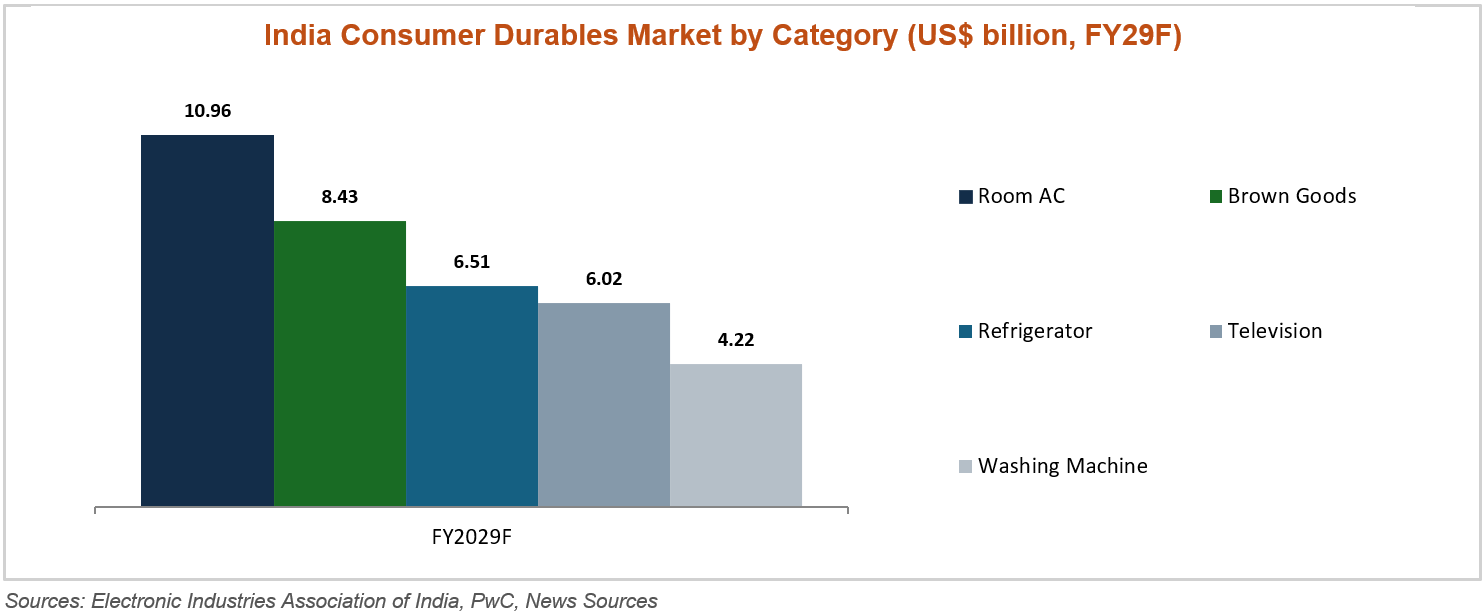
Room air-conditioners and brown goods will be the largest segments, while refrigerators, TVs, and washing machines will follow.
Demand from rural and semi-urban markets is likely to outpace urban demand, and improved rural incomes after a healthy harvest supported strong summer sales of refrigerators, washing machines and ACs.
Support mechanisms involve PLI Schemes, ECMS, improvements in quality control measures, reduced GST on televisions, relaxed FDI policies, and programmes like Make in India, Digital India, and Skill India.
The industry will continue to grow due to increased incomes, premiumisation and local production, as India plans to be the leader of the global industry by 2030.
Related News
MORE

IBEF Campaigns
MORE

Case Studies
MOREContainerisation: Transforming India's Maritime Trade

Despite other modes of transportation, the maritime shipping mode is the backbone of international trade. The concept of containerisation has revoluti...
India’s Growing Senior Care Needs: New Businesses and Services

The current state of India is characterised by the process of demographic transition with gradual growth of the proportion of senior citizens within t...
The Rise of India's Pathology Laboratories: Strengthening Quality and Safety in Healthcare

India has seen its healthcare system witness an impressive evolution in the last two decades because of the growth in healthcare infrastructure, incre...
IBEF BLOG
MORE
India's Blue Economy: Untapped Potential in Ports, Fisheries and Ocean Resources
The maritime space of India, which comprises the coastline, island areas, a...
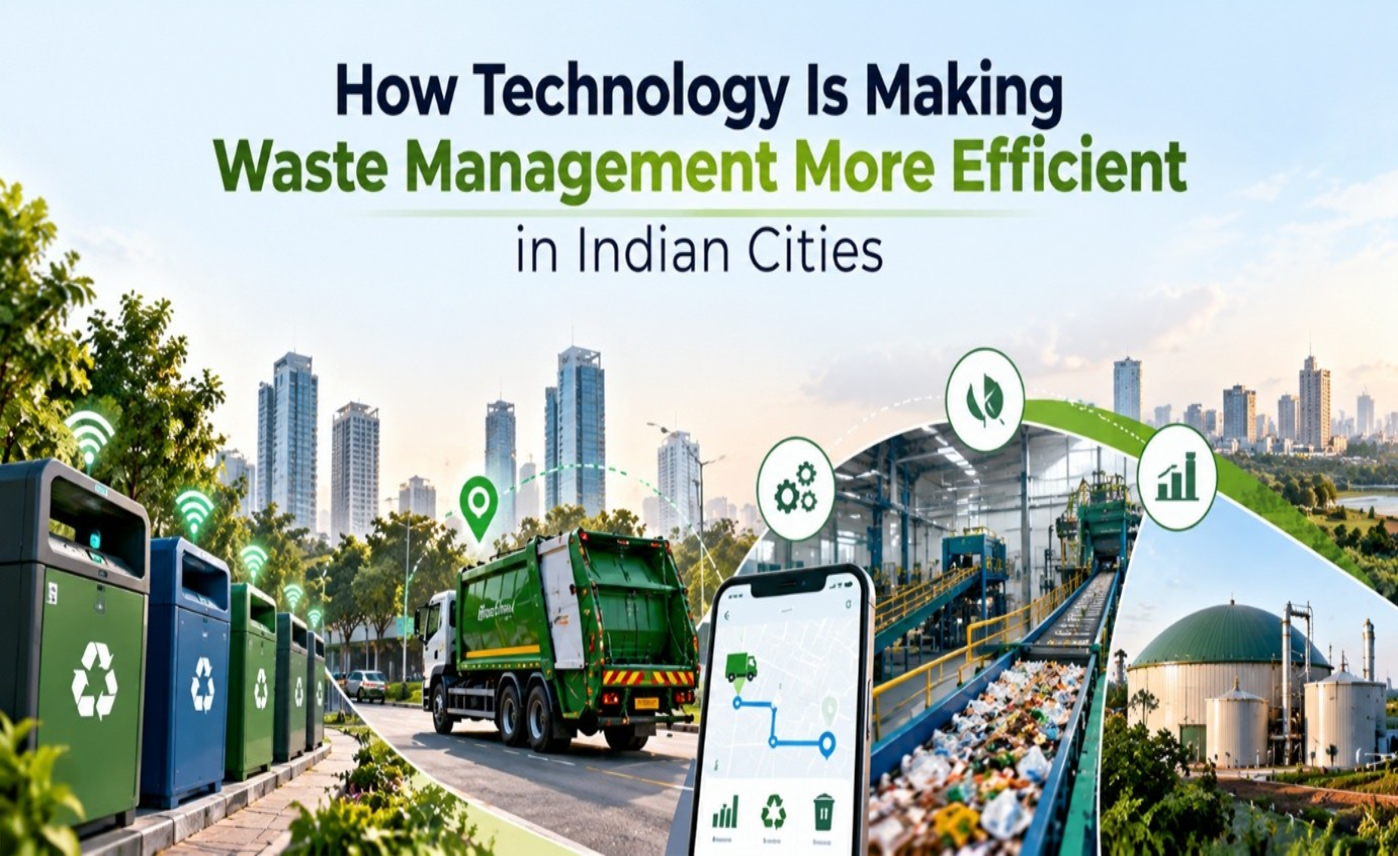
How Technology Is Making Waste Management More Efficient in Indian Cities
Indian cities are adopting digital monitoring, sensors, and automated waste...

India's Cold Chain Logistics: The Backbone of Perishable Trade
India's cold chain network allows the transfer of perishables from farm...
Partners