Advantage India
Growing
Demand
* Rise in demand from end-user industries such as food processing, personal care and home care is driving the development of different segments in India’s specialty chemicals market.
* India is the sixth largest producer of chemicals in the world and third in Asia, contributing 7% to India’s GDP.
* According to a McKinsey report, Chemicals and petrochemicals demand in India is expected to nearly triple and reach US$ 1 trillion by 2040.
* Exports of Chemicals and allied Products reached Rs.181,568.25 crore (US$ 20.54 billion) during FY26. In FY27 (April-May) the exports of chemicals stood at around Rs. 36,336.30 crore (US$ 3.85 billion).

Opportunities
* India’s specialty chemicals companies are expanding their capacities to cater to rising demand from domestic and overseas.
* With global companies seeking to de-risk their supply chains, which are dependent on China, the chemical sector in India has the opportunity for a significant growth.
* In the specialty chemicals sector, manufacturers are focusing on green solvents, biodegradable surfactants, and bio-based polymers, with India’s green chemicals market expected to grow at a CAGR of over 10% and exceed US$ 15 billion by 2027.

Policy
Support
* As part of the Union Budget 2026-27 the government allocated Rs. 185.72 crore (US$ 21.0 billion) to the Ministry of Chemicals and Fertilizers. •
* In November, 2025, Government of India launched a scheme for Rare Earth Permanent Magnets (REPM) with a financial outlay of Rs. 7,280 crore (US$ 824 million) to develop domestic manufacturing capacity of around 6,000 MTPA.
* The Bulk Drug Parks Scheme, with an outlay of Rs. 3,000 crore (US$ 349.6 million). Three Bulk Drug Parks have been approved in Andhra Pradesh, Gujarat and Himachal Pradesh, with the scheme extended until FY27
* The Petroleum, Chemicals and Petrochemicals Investment Region (PCPIR) in Odisha has attracted cumulative investments of approximately Rs. 1.44 lakh crore (US$ 17.3 billion), generated employment for around 40,000 people, and currently comprises 13 chemical units

Increasing
Investments
and spending
* FDI inflows in the chemicals sector (other than fertilizers) reached Rs. 1,50,339.64 crore (US$ 24.1 billion) between April 2000-March 2026.
* In February 2026, Union Minister for Finance and Corporate Affairs Smt. Nirmala Sitharaman launched the National Monetisation Pipeline 2.0 (NMP 2.0) with an estimated monetisation potential of Rs. 16.72 lakh crore (US$ 189.16 billion) for FY26–FY30. The pipeline includes private sector investment of Rs. 5.80 lakh crore (US$ 65.63 billion) and aims to support infrastructure development by unlocking value from public assets across key sectors.
* The Dahej PCPIR in Gujarat has attracted cumulative investments of approximately Rs. 1,28,509 crore (US$ 15.42 billion), generated employment for over 2.45 lakh people, and currently comprises 2,079 chemical units, making it India's largest operational PCPIR.

Introduction
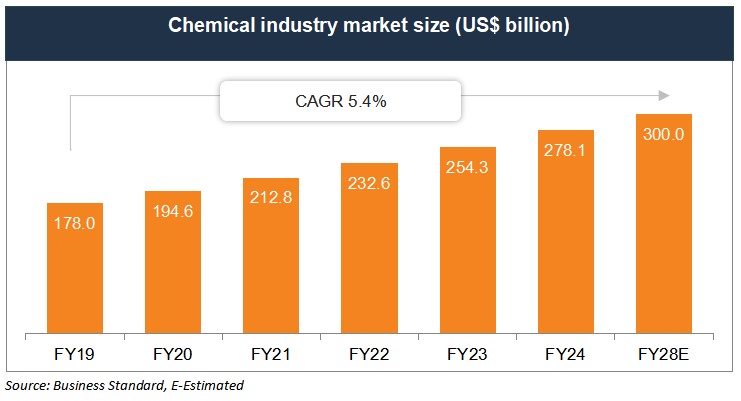
Covering more than 80,000 commercial products, India’s chemical industry is extremely diversified and can be broadly classified into bulk chemicals, specialty chemicals, agrochemicals, petrochemicals, polymers, and fertilisers. India is the sixth largest producer of chemicals in the world and third in Asia, contributing 7% to India’s GDP. India's chemical sector, which was estimated to be worth around Rs. 21,50,750 crore (US$ 250 billion) in 2024, is anticipated to grow to US$ 300 billion by 2028 and Rs. 86,03,000 (US$ 1 trillion) by 2040. This industry remains an active hub of opportunities, even in an environment of global uncertainty.
Globally, India is the third-largest producer of agrochemicals after the United States and China. India accounts for 16-18% of the world's production of dyestuffs and dye intermediates. Indian colourants industry has emerged as a key player with a global market share of ~15%. The country’s chemicals industry is de-licensed, except for a few hazardous chemicals. India has traditionally been a world leader in generics and biosimilars and a major Indian vaccine manufacturer, contributing more than 50% of the global vaccine supply.
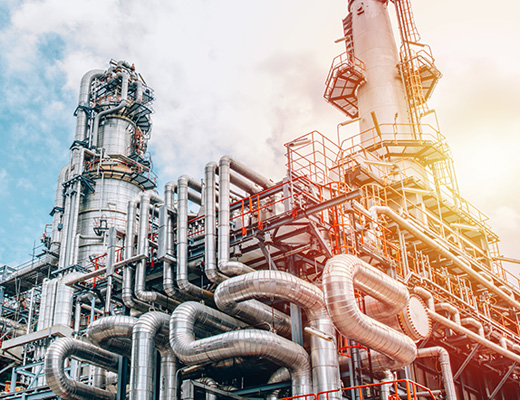
India holds a strong position in exports and imports of chemicals at a global level and ranks 14th in exports and eighth in imports at the global level (excluding pharmaceuticals). In FY26, India's dye exports (Dyes and Dye Intermediates) totalled Rs. 20,992.29 crore (US$ 2,375.50 million). In FY27 (April-May) India's dye exports (Dyes and Dye Intermediates) reached around Rs. 4,373.05 crore (US$ 463.3 million).
Major chemical production reached 979.2 thousand metric tonnes in April 2026, while petrochemical production reached 1,565.6 thousand metric tonnes.
In January 2026, production levels of various chemicals were as follows:
- Soda Ash: 278.92 (‘000 MT)
- Caustic Soda: 313.52 (‘000 MT)
- Liquid Chlorine: 230.32 (‘000 MT)
- Formaldehyde: 27.81 (‘000 MT)
- Pesticides and Insecticides: 18.21 (‘000 MT)
India’s proximity to the Middle East, the world’s source of petrochemicals feedstock, enables it to benefit on economies of scale.
Markets Size
India has traditionally been a world leader in generics and biosimilars and major Indian vaccine manufacturers, contributing more than 50% of the global vaccine supply. Chemicals and petrochemicals demand in India is expected to nearly triple and reach US$ 1 trillion by 2040.
The India specialty chemicals market reached Rs. 5,83,972 crore (US$ 67.0 billion) in 2025 and is projected to reach Rs. 8,65,444 crore (US$ 93.4 billion) by 2034, growing at a CAGR of 3.65% during 2026-2034. Growth is driven by rising demand from agriculture, construction, automotive, electronics, and pharmaceutical sectors, supported by increasing industrialization, urbanization, product innovation, favorable government policies, and growing investments in sustainable chemical solutions.The Department of Chemicals & Petrochemicals intends to bring PLI in the chemical & petrochemical sector and will redraft the Petroleum, Chemicals and Petrochemicals Investment Region (PCPIR) guidelines.
India achieved its highest-ever urea production of over 314 lakh metric tonnes (LMT) in 2023-24, reflecting a significant increase in domestic production capacity. Further, in 2024-25 urea production stood at 306.67 lakh metric tonnes (LMT).
India recorded a record urea production of 71.55 lakh metric tonnes (LMT) during April-June 2026, exceeding the target of 67.86 LMT by 3.69 LMT, supported by the restoration of 100% natural gas supply to domestic urea plants.
Investments and Recent Developments
A few recent developments/investments in the Indian chemical sector are as follows:
- In March 2026, Tata Chemicals' Mithapur facility achieved a production milestone by manufacturing 1 million tonnes of soda ash during FY26, reflecting the company's focus on operational excellence, asset productivity, and manufacturing efficiency.
- In FY26, exports of organic chemicals stood at Rs. 67,871.34 crore (US$ 7,680.36 million) & inorganic stood at Rs. 21,285.68 crore (US$ 2,408.70 million). During April-May 2026, exports of organic and inorganic chemicals were Rs. 14,424.47 crore (US$ 1,528.34 million) and Rs. 4,628.21 crore (US$ 490.38 million), respectively.
- Imports of organic chemicals were Rs. 1,33,254.10 crore (US$ 15,079.11 million) and inorganic chemicals Rs. 64,339.10 crore (US$ 7,280.65 million) in FY26. During April-May 2026, imports of organic and inorganic chemicals stood at Rs. 27,790.85 crore (US$ 2,944.57 million) and Rs. 12,239.67 crore (US$ 1,296.85 million), respectively.
- In FY26, imports of castor oil, essential oils, and cosmetics & toiletries were valued at Rs. 19.09 crore (US$ 2.16 million), Rs. 2,596.84 crore (US$ 293.86 million), and Rs. 21,745.56 crore (US$ 2,460.74 million), respectively. During April-May 2026, imports of these products stood at Rs. 2.08 crore (US$ 0.22 million), Rs. 370.82 crore (US$ 39.29 million), and Rs. 4,198.59 crore (US$ 444.86 million), respectively.
- In FY26, exports of castor oil, essential oils, and cosmetics & toiletries stood at Rs. 1,018.38 crore (US$ 115.24 million), Rs. 2,965.79 crore (US$ 335.61 million), and Rs. 2,412.06 crore (US$ 272.95 million). During April-May 2026, exports of these products reached Rs. 2,789.21 crore (US$ 295.53 million), Rs. 596.10 crore (US$ 63.16 million), and Rs. 4,587.43 crore (US$ 486.06 million), respectively.
- In FY26, exports of agrochemicals, dyes, and dye intermediates reached Rs. 34,210.59 crore (US$ 3,871.29 million), Rs. 19,351.70 crore (US$ 2,189.85 million), and Rs. 1,640.59 crore (US$ 185.65 million). During April-May 2026, exports of these categories stood at Rs. 4,940.32 crore (US$ 523.45 million), Rs. 3,995.95 crore (US$ 423.39 million), and Rs. 376.67 crore (US$ 39.91 million), respectively.
- In FY26, Imports of agrochemicals, dyes, and dye intermediates amounted to Rs. 13,556.05 crore (US$ 1,534.01 million), Rs. 2,670.01 crore (US$ 302.14 million), and Rs. 13,471.39 crore (US$ 1,524.43 million). During April-May 2026, imports of these products stood at Rs. 3,770.29 crore (US$ 399.48 million), Rs. 550.33 crore (US$ 58.31 million), and Rs. 2,137.71 crore (US$ 226.50 million), respectively.
- On March 16, 2026, RIL signed a 15-year green ammonia supply agreement with Samsung C&T Corporation valued at around Rs. 26,512 crore (US$ 3 billion). The supply is expected to commence from the second half of FY29.
- In February 2026, Tata Chemicals Limited announced an investment of Rs. 515.00 crore (US$ 58.28 million) to set up a greenfield Iodised Vacuum Salt Dried (IVSD) manufacturing facility in Tamil Nadu with a capacity of 210 Kilo Tonnes Per Annum (KTPA).
- On October 28, 2025, Bharat Petroleum Corporation Ltd (BPCL) signed agreements with Oil India Ltd, Numaligarh Refinery Ltd and Fertilisers & Chemicals Travancore Ltd to expand refining, petrochemical and downstream operations, including a proposed Rs. 1,00,000 crore (US$ 11.43 billion) greenfield refinery and petrochemical complex in Andhra Pradesh.
- In September 2025, India’s bioeconomy gained momentum with the launch of the Tata Chemicals–TERI Centre of Excellence on Biochemicals to develop sustainable, bio-based chemicals using renewable feedstocks. The initiative initially focuses on 2,3-Butanediol.
- On August 29, 2025, RIL announced it will invest Rs. 75,000 crore (US$ 8.57 billion) in its Oil-to-Chemicals (O2C) business while simultaneously accelerating its clean energy push to establish 20 GW of solar module manufacturing capacity by 2026 at its integrated green energy complex in Jamnagar, Gujarat.
- In FY26 (April-July 2025), exports of organic chemicals stood at US$ 2,750.32 million & inorganic stood at US$ 726.25 million.
- Imports of organic chemicals were US$ 5,301.48 million and inorganic chemicals US$ 2,225.51 million from FY26 (April-July 2025).
- In FY26 (April-July 2025), imports of castor oil, essential oil, and cosmetics and toiletries stood at US$ 987.94 million.
- Exports of castor oil, essential oil, cosmetics and toiletries are US$ 1,446.15 million during FY26 (April-July 2025).
- In FY26 (April-July), the export of agrochemicals was US$ 1,433.89 million, dyes were US$ 765.26 million and the other dye intermediates were US$ 59.51 million.
- The import of agrochemicals was US$ 798.16 million; dyes were US$ 108.86 million and the other dye intermediates were US$ 536.02 million during FY26 (April-July).
- In 2024, Alkali chemicals stood at 71% of the total chemical production.
- After three years of discussions, the UK and India have finalized a landmark Free Trade Agreement (FTA). The agreement removes tariffs on 99% of Indian exports and reduces duties on 90% of UK exports to India, with the chemical industry standing out as one of the major winners.
- Kanoria Chemicals commissioned a new Ankleshwar plant on September 6, 2024, at a total cost of Rs. 90 crore (US$ 10.22 million) financed to add 345 TPD of formaldehyde and 18 TPD of hexamine, thereby supporting the automotive, construction, agriculture, cosmetics, and chemical industries with efficient, sustainable production facilities.
- Tata Chemicals intended to invest about Rs. 8,000 crore (US$ 967.45 million) by 2027 as capex on an expansion spree that includes scaling businesses sustainably.
- New manufacturing plants are being planned to be launched in 2026 to increase capacity, for example, Shivtek Spechemi Industries has opened a new chemical plant near Hazira, Gujarat, covering over 1 million sq ft. aiming to boost production capacity to 2,50,000 MTPA by 2027-28.
- Sudarshan Chemical announced the acquisition of Germany’s Heubach Group on October 11, 2024, and completed the deal in March 2025. This acquisition created a global pigment leader with operations across 19 sites worldwide, strengthening Sudarshan’s portfolio and global presence across Europe, the Americas, and Asia.
- In June 2025, Aditya Birla Group acquired Cargill’s specialty chemicals manufacturing facility in Dalton, Georgia, USA. This strategic move marked Aditya Birla’s entry into the US chemicals market and highlighted the growing ambitions of Indian chemical companies to expand internationally through acquisitions.
Government Initiatives
The government has started various initiatives such as mandating BIS-like certification for imported chemicals to prevent dumping of cheap and substandard chemicals into the country.
In April 2026, the Union Cabinet approved the revised project cost of HPCL Rajasthan Refinery Limited (HRRL) at Pachpadra, Rajasthan, from Rs. 43,129 crore (US$ 4.88 billion) to Rs. 79,459 crore (US$ 8.42 billion), along with an additional equity investment of Rs. 8,962 crore (US$ 0.95 billion) by HPCL to strengthen India's refining and petrochemical capacity.
On March 3, 2026, the Government of India announced a provision of Rs. 13,000.00 crore (US$ 147.08 billion) for the BioPharma SHAKTI initiative and Rs. 3,300.00 crore (US$ 37.34 billion) for setting up three world-class chemical parks to strengthen manufacturing infrastructure.
As of February 2026, the Scheme for Promotion of Bulk Drug Parks, with a budgetary outlay of Rs. 3,000 crore (US$ 339.48 million), is supporting the development of three Bulk Drug Parks in Andhra Pradesh, Gujarat and Himachal Pradesh. The Central Government has approved grant-in-aid of Rs. 1,000 crore (US$ 113.16 million) for each park, while the total project investments amount to Rs. 2,507.02 crore (US$ 283.70 million) for Gujarat, Rs. 1,923.00 crore (US$ 217.60 million) for Himachal Pradesh, and Rs. 1,876.66 crore (US$ 212.36 million) for Andhra Pradesh to develop world-class common infrastructure and strengthen domestic bulk drug manufacturing.
As of February 2026, the Production Linked Incentive (PLI) Scheme for Advanced Chemistry Cell (ACC) Battery Storage has attracted cumulative investments of Rs. 3,237 crore (US$ 366.31 million) generated 1,118 direct jobs and commissioned 1 GWh of domestic ACC manufacturing capacity till December 2025. The scheme has awarded 40 GWh of battery manufacturing capacity to four beneficiary companies, strengthening India's domestic battery manufacturing ecosystem.
- Under the Union Budget 2026-27 the government allocated Rs. 185.72 crore (US$ 21.0 million) to the Ministry of Chemicals and Fertilizers.
- On February 23, 2026, Union Minister for Finance and Corporate Affairs Smt. Nirmala Sitharaman launched the National Monetisation Pipeline 2.0 (NMP 2.0) with an estimated monetisation potential of Rs. 16.72 lakh crore (US$ 189.16 billion) for FY26–FY30. The pipeline includes private sector investment of Rs. 5.80 lakh crore (US$ 65.63 billion) and aims to support infrastructure development by unlocking value from public assets across key sectors.
- The Union Budget 2026–27 has introduced a new scheme to support states in setting up three dedicated Chemical Parks, with an allocation of Rs. 600 crore (US$ 6.6 million). These parks will function as cluster-based, plug-and-play manufacturing hubs with shared infrastructure and facilities. The initiative aims to strengthen domestic manufacturing, improve supply chain integration, and reduce import dependence in the chemicals sector.
- The Government of India launched a scheme for Rare Earth Permanent Magnets (REPM) with a financial outlay of Rs. 7,280 crore (US$ 824 million) to develop domestic manufacturing capacity of around 6,000 MTPA. In addition, the Union Budget 2026–27 proposed the development of dedicated rare earth corridors in Odisha, Kerala, Andhra Pradesh, and Tamil Nadu to support mining, processing, research, and manufacturing. The initiative aims to strengthen domestic capabilities, reduce import dependence, and support key sectors such as electric vehicles, renewable energy, electronics, and defence.
- India’s industrial activity is strengthening, with real industry GVA growing by 7% year-on-year in the first half of FY26. This momentum continued with industrial production rising 7.8% in December 2025, the highest growth in over two years, following a strong 7.2% Renewable Energy (RE) expansion in November 2025.
- In April 2025, Union Minister of Finance Ms. Nirmala Sitharaman said India plans to raise manufacturing’s GDP share from 14% to 23% over the next two decades to boost jobs and economic growth.
- Under the Union Budget 2025-26 the government allocated Rs. 194.05 crore (US$ 18.7 billion) to the Ministry of Chemicals and Fertilizers.
- India is prioritizing 14 sunrise sectors such as semiconductors, renewable energy products, medical devices, batteries, and labor-intensive industries like leather and textiles to boost manufacturing's contribution to GDP.
- In February 2025, the government has implemented enhanced quality compliance requirements via Quality Control Orders (QCOs) for more than 150 products across various sectors, including household appliances and industrial materials. This initiative, overseen by the Bureau of Indian Standards (BIS), aims to enforce stricter safety and performance standards.
- The Union Budget 2025 launched the second Asset Monetization Plan targeting Rs. 10 lakh crore (US$ 113.60 billion) from FY25 to FY30. This plan includes public sector undertakings in the chemical industry like Gujarat Narmada Valley Fertilizers & Chemicals, Gujarat State Fertilizers and Chemicals, and Rashtriya Chemicals & Fertilizers. The initiative aims to attract private investments, fostering public-private partnerships to drive modernization, innovation, and competitiveness in the chemical sector.
- In 2024-25, significant emphasis was placed on skill development for the chemical sector workforce. Institutions like the Central Institute of Petrochemicals Engineering & Technology (CIPET) are offering specialized courses for professionals and technicians to enhance skills tailored to industry needs. This includes training on advanced technologies for modernization of the industry.
- The Rajasthan Refinery Limited (RRL) is expected to be commercially operational by March 31, 2026. The project has seen significant capital investment exceeding Rs. 52,877 crore (US$ 6.01 billion, generating direct employment for over 35,000 people. The government continues to focus on attracting investors to the PCPIR as part of its broader strategy to develop the petrochemical sector with modern infrastructure and sustainable growth.
- The government approved the five new Centers of Excellence for chemicals and petrochemicals in the month of October 2024. Further plans to establish three more centers are ongoing, supported by a dedicated digital portal connecting about 1,000 industries with 50 research institutions to enhance collaboration and innovation.
- PLI schemes have been introduced to promote Bulk Drug Parks, with a budget of Rs. 1,629 crore (US$ 213.81 million).
- The Government of India is considering launching a production-linked incentive (PLI) scheme in the chemical sector to boost domestic manufacturing and exports.
- A 2034 vision for the chemicals and petrochemicals sector has been set up by the government to explore opportunities to improve domestic production, reduce imports and attract investments in the sector. The government plans to implement a production-link incentive system with 10-20% output incentives for the agrochemical sector; to create an end-to-end manufacturing ecosystem through the growth of clusters.
- The government has proposed several incentives for setting up a sourcing or manufacturing platform within an Indian SEZ:
- Single window clearance for central and state-level approvals.
- Duty-free import/domestic procurement of goods for development, operation and maintenance of SEZ units.
Road Ahead
The Indian chemical industry is poised for significant growth, driven by global supply chain shifts and rising demand for environmentally compliant production. Opportunities are emerging as companies diversify away from traditional manufacturing hubs and focus on sustainable, high-value chemical segments. Strategic fiscal support, including tax incentives and benefits under PCPIRs and SEZs, will further enhance production capabilities and encourage downstream development.
The government’s focus on dedicated integrated manufacturing hubs under the Petroleum, Chemicals, and Petrochemicals Investment Regions (PCPIR) policy is expected to attract investments of up to Rs. 20 lakh crore (US$ 276.46 billion) by 2035. Future investments are increasingly emphasizing advanced crude-to-chemicals complexes and specialized refineries designed to produce high-value chemical products, enabling India to move up the global chemical value chain while strengthening domestic capabilities.

FAQs
The chemical industry in India is one of the world's largest and most diversified manufacturing sectors, covering bulk chemicals, specialty chemicals, petrochemicals, agrochemicals, polymers, and fertilisers. It contributes around 7% to India's GDP and supports multiple downstream industries.
The chemical industry is a key contributor to manufacturing, exports, employment, and industrial growth. It supplies critical raw materials to sectors such as pharmaceuticals, agriculture, automotive, construction, textiles, and electronics, strengthening India's overall industrial ecosystem.
The chemical industry in India comprises bulk chemicals, specialty chemicals, petrochemicals, agrochemicals, polymers, fertilisers, dyes and dye intermediates, and industrial chemicals. These segments cater to both domestic demand and international export markets.
The chemical industry in India is expanding due to rising domestic demand, the China+1 strategy, increasing exports, rapid industrialisation, higher demand from end-user industries, and growing investments in specialty chemicals and sustainable manufacturing.
The chemical industry is witnessing strong growth in specialty chemicals, driven by demand from agriculture, construction, automotive, electronics, and pharmaceuticals. India's specialty chemicals market is projected to reach US$ 93.4 billion by 2034, supported by product innovation and industrial expansion.
The Government is supporting the chemical industry in India through PCPIR, proposed PLI schemes, Chemical Parks, Bulk Drug Parks, Advanced Chemistry Cell (ACC) PLI, Quality Control Orders (QCOs), and incentives under SEZs to strengthen domestic manufacturing.
The chemical industry in India offers investment opportunities across specialty chemicals, petrochemicals, agrochemicals, green chemicals, battery materials, bulk drugs, refinery-linked chemicals, and sustainable manufacturing. Strong policy support and global supply chain diversification continue to attract investors.
Sustainability is reshaping the chemical industry in India through bio-based chemicals, green ammonia, cleaner production technologies, circular manufacturing, and environmentally compliant processes. Companies are increasingly investing in low-carbon solutions to strengthen global competitiveness.
The chemical industry in India is expected to witness robust long-term growth, supported by specialty chemicals, petrochemical investments, export opportunities, and favourable government policies. The sector is projected to reach US$ 1 trillion by 2040, reinforcing India's position as a global chemicals manufacturing hub.
Related News
MOREChemical Clusters
- Gujarat
- Maharashtra
- Odisha
- Tamil Nadu
- Andhra Pradesh
- Uttar Pradesh

Industry Contacts
Posters
MORE
INDIA IS THE SIXTH-LARGEST PRODUCER OF CHEMICALS
Covering more than 70,000 commercial products, India’s chemical industry is extremely diversified and can be broadly industrial sector.
IBEF Campaigns
MORE

Aatmanirbhar Bharat Utsav 2024
Union Minister of External Affairs, Dr. S. Jaishankar and Union Commerce an...
Case Studies
MORESUV Dominance and the Future of Passenger Vehicles

India's passenger vehicle industry over the past two decades have been gone under significant changes. In particular, the market has been transfor...
Expressway Infrastructure Development Outlook in India

India's vision of becoming a Viksit Bharat by 2047 has positioned transport infrastructure as a cornerstone of its long-term economic growth strat...
The Rise of Contract Manufacturing in India's Electronics Sector

India's rise to become a large center for electronics manufacturing services is one of the most significant manufacturing changes in India's r...
IBEF BLOG
MORE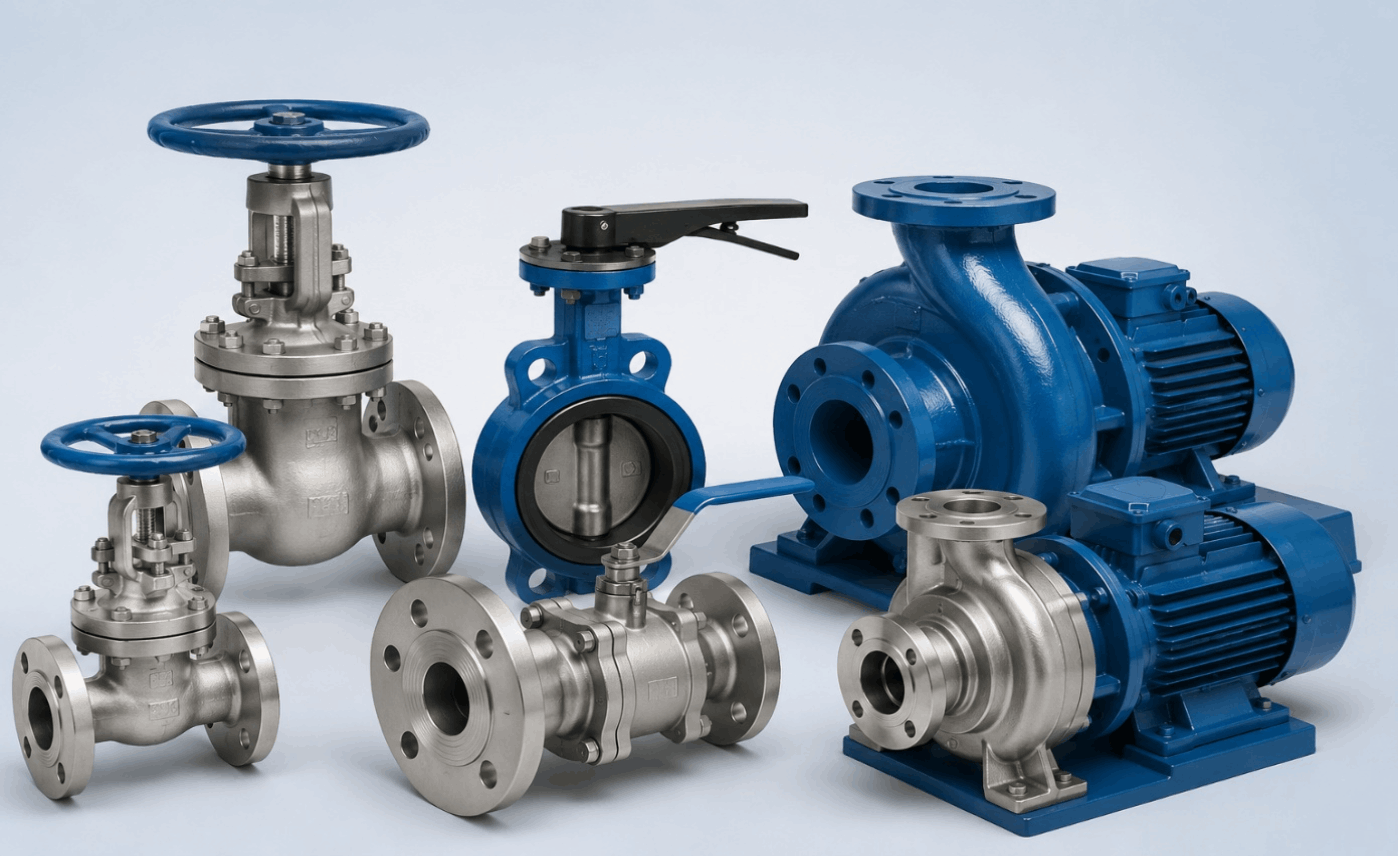
How India's Industrial Valve and Pump Industry Supports Infrastructure and Manufacturing
Pumps and industrial valves represent the basic building blocks of today&rs...

India's Premium Fresh Produce Exports: Creating New Opportunities for Farmers
India has emerged as a major exporter of horticulture crops owing to the pr...

India's Content Economy: Building Global Audiences Through Digital Entertainment
The digital entertainment ecosystem in India is currently experiencing a fu...
Partners




