Introduction
Uttar Pradesh is the most populous state in India with a population of more than 200 million people. Uttar Pradesh shares its borders with Nepal on the north, the Indian states of Uttarakhand and Himachal Pradesh on the northwest, Haryana, Delhi and Rajasthan on the west, Madhya Pradesh on the south, Chhattisgarh and Jharkhand on the southeast, and Bihar on the east.
As of the latest available data, Uttar Pradesh continues to lead India in food grain production. Uttar Pradesh has significantly strengthened its agricultural output over the past four decades, with total foodgrain production increasing from 24.95 million tonnes in 1980-81 to 73.74 million tonnes in 2024-25. During the same period, wheat production more than tripled to 42.25 million tonnes, while rice production rose nearly four-fold to 21.84 million tonnes, reinforcing the state's position as India's leading foodgrain-producing state. Uttar Pradesh recorded sugarcane production of 245.35 million tonnes in 2024-25, maintaining its position as India's largest sugarcane-producing state. The state also reported strong growth in oilseed production, which increased from 2.30 million tonnes in 2023-24 to 3.63 million tonnes in 2024-25, reflecting increasing crop diversification and higher agricultural output.
The state offers a wide range of subsidies, policy and fiscal incentives as well as assistance for businesses under the Industrial and Service Sector Investment Policy, 2004 and Infrastructure and Industrial Investment Policy, 2012. The state has well-drafted, sector-specific policies for IT and biotechnology. The new Uttar Pradesh Civil Aviation Promotion Policy 2017 was brought to promote investment and trade in Uttar Pradesh and to promote tourism while increased road connectivity along with air connectivity will create more employment avenues.
Uttar Pradesh Tourism
On February 10, 2026, the Ministry of Tourism announced the completion of all tourism infrastructure projects sanctioned under the Ramayana and Buddhist Circuits of the Swadesh Darshan Scheme in Uttar Pradesh.
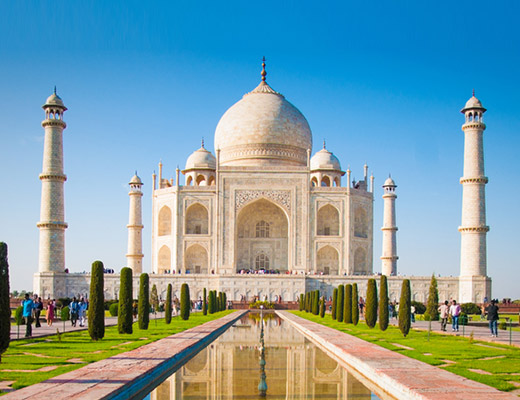
Uttar Pradesh is a favoured tourist destination in India with Taj Mahal, one of the eight wonders of the world, located in Agra. The state witnessed rise in tourist arrivals, with 320 million tourists arriving in 2023, and is expected to grow further. The opening of the Ram temple in Jan 2024 significantly increases religious tourism in Uttar Pradesh. According to Jefferies, the Ram temple is projected to attract at least 100 million visitors annually. Additionally, Uttar Pradesh government is also established the UP-Ecotourism Development board. The key objective of the initiative is to promote the state's rich legacy of forests and wetlands to increase tourist footfall while creating jobs for those living around the natural heritage. In November 2025, Uttar Pradesh Tourism announced a new initiative inviting entrepreneurs and institutions to set up wellness centres and resorts, emphasizing AYUSH therapies and aiming to transform the state into a hub for health and rejuvenation tourism. In CY24, Uttar Pradesh has experienced a significant surge in tourist arrivals, with an increase of approximately 17 crore visitors compared to the previous year. According to the latest data released by the Uttar Pradesh Tourism Department, the state welcomed a total of 64.9 crore tourists in CY24, a notable rise from 48.01 crore in CY23. The Uttar Pradesh tourism sector received Rs. 2,026.06 crore (US$ 228.55 million), with Rs. 400 crore (US$ 45.12 million) allocated to the Chief Minister’s Tourism Sites Development Scheme to enhance accessibility and infrastructure at tourist destinations including Ayodhya, Mathura, and Naimisharanya. In August 2025, Uttar Pradesh declared its ambition to become India's "Rural Tourism Capital," identifying 234 villages as tourism hubs with homestay pipelines and financial support, aiming to reconnect urban youth with rural culture.
Economy of Uttar Pradesh
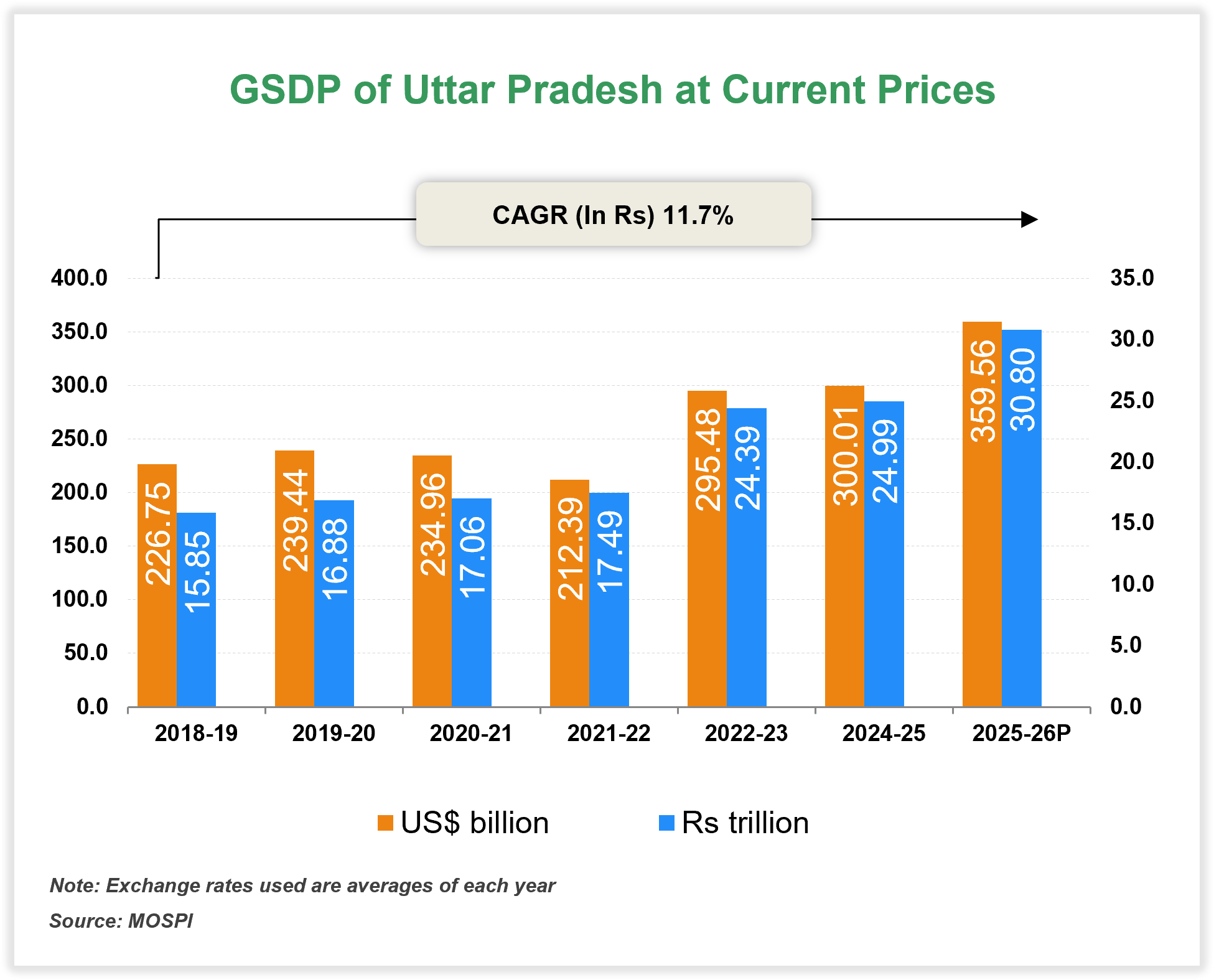
At current prices, the gross state domestic product (GSDP) of Uttar Pradesh is estimated to be Rs. 30.80 trillion (US$ 359.56 billion) in FY26. The GSDP is expected to increase at a CAGR of 11.71% from FY19 to FY26.
The state’s per capita GSDP in FY25 was Rs. 1,26,304 (US$ 1,493.62). Per capita GSDP increased at a CAGR of 9.49% between FY17 and FY25.
As of April 2026, Uttar Pradesh had an installed power generation capacity of 37,170 MW. Of this, 9,860.23 MW was from state utilities, 15633.47 MW (private utilities) and 11,676.32 MW (central utilities).
According to Department for Promotion of Industry and Internal Trade (DPIIT), cumulative FDI inflow in Uttar Pradesh stood at Rs. 24,708 crore (US$ 3,020 million) between October 2019-March 2026.
By June 2025, Uttar Pradesh's proposed capacity for data centres reached 644 MW with investments worth Rs. 21,343 crore (US$ 2.41 billion). This indicates strong investor confidence and the state's focus on developing modern industrial infrastructure.
In August 2025, Uttar Pradesh government reported to link 13.45 lakh youth to private jobs via 10,830 Rozgar Melas since 2017, with overseas demand from Japan, Germany, Croatia and the UAE offering salaries up to Rs. 1.5 lakh (US$ 1,692), strengthening the state’s economy.
Industries in Uttar Pradesh
Uttar Pradesh plans to invest approximately Rs. 33,500 crore (US$ 3.78 billion) over the next five years to boost IT and ITeS sectors aiming for tenfold growth, focusing on technology hubs in Noida, Lucknow, Kanpur, Varanasi, and Prayagraj. Uttar Pradesh is the largest producer of food grains in India and accounted for about 17.83% share in the country’s total food grain output in 2016-17. Prime Minister, Mr. Narendra Modi laid the foundation stone and dedicated to the nation multiple development projects worth over Rs. 19,150 crores (US$ 2.30 billion) in Varanasi, Uttar Pradesh. According to the state government, as many as 1,500 projects worth more than Rs. 70,000 crore (US$ 9.03 billion) were planned to be launched in Uttar Pradesh’s third groundbreaking ceremony that was to be held in June 2022. Some of these major projects are:
- Adani Group’s project worth around Rs. 4,900 crore (US$ 631.86 million).
- Hiranandani Group’s two data centres in Noida with an investment of Rs. 9,100 crore (US$ 1.17 billion).
- Microsoft’s Rs. 2,100 crore (US$ 270.85 million) software development centre.
- Dalmia Group’s Rs. 600 crore (US$ 77.38 million) cement manufacturing plant in Mirzapur, Hamirpur.
Recent Developments in Key Sectors
- On March 2026, the Uttar Pradesh Cabinet approved the establishment of a new dairy plant in Banda district under the Bundelkhand package with a processing capacity of 20,000 litres per day. The cabinet also approved the expansion of the existing dairy plant in Jalaun from 10,000 litres per day to 30,000 litres per day, aimed at strengthening dairy infrastructure and supporting milk producers in the region.
- On February 25, 2026, Uttar Pradesh Chief Minister Mr. Yogi Adityanath signed investment agreements worth approximately Rs. 11,000 crore (US$ 1.20 billion) with Japanese companies during his visit to Japan.
- On February 22, 2026, Prime Minister Mr. Narendra Modi inaugurated the Meerut Metro and dedicated the entire 82-km Delhi-Meerut Namo Bharat Corridor to the nation.
- On January 9, 2026, Ashok Leyland inaugurated a new greenfield commercial vehicle manufacturing facility in Lucknow, Uttar Pradesh. Spread across 70 acres in the Sarojini Nagar Industrial Area near Lucknow Airport, the facility is the company's most advanced and sustainable manufacturing plant and will primarily focus on the production of electric vehicles as part of its clean mobility strategy.
- Kushinagar district in Uttar Pradesh has been identified as a Banana Cluster under the Operation Greens component of Pradhan Mantri Kisan SAMPADA Yojana (PMKSY) and as a One District One Product (ODOP) region for bananas under Pradhan Mantri Formalisation of Micro Food Processing Enterprises (PMFME). A total of 261 projects have been approved in the district under PMFME.
- Uttar Pradesh has developed several new agro and food-processing parks in Bareilly, Barabanki, Gorakhpur, and Varanasi, boosting the state’s role as an emerging leader in food processing. This rapid growth, driven by strategic policy support and investment, is strengthening the agricultural value chain and increasing export opportunities for processed foods.
- Uttar Pradesh currently has more than 65,000 operational food processing units employing 2.5 lakh people. The new Food Processing Industry Policy 2023 has approved 19 new projects and incentivizes solar energy, cold-chain infrastructure, and cluster models for robust value chains. The government aims to set up 1,000 new units in every district to increase local processing and job creation.
- The National Dairy Development Board (NDDB) signed an MoU with the Uttar Pradesh government to operate three major dairy plants (Kanpur, Gorakhpur, Kannauj) and an animal feed production plant to increase farmer profitability and modernize dairy infrastructure.
- Uttar Pradesh has significantly enhanced healthcare infrastructure including disease control, maternal health, medical education, and traditional medicine integration. The state issued 5.34 crore Ayushman Cards providing cashless treatment to 70.36 lakh people. The emergency healthcare system is strengthened with 2,200 '108' ambulances and 375 Advanced Life Support ambulances. Dialysis is free in all districts, and 74 CT scan centers are operational. Over 1,153 medical units achieved National Quality Assurance certification.
- Chief Minister of Uttar Pradesh Mr. Yogi Adityanath inaugurated new buildings and additional dormitories in 139 upgraded Kasturba Gandhi Balika Vidyalayas, emphasizing girl child education. He also laid foundation stones for 43 Chief Minister Model Composite Schools and 66 Chief Minister Abhyudaya Composite Schools, expanding modern education access. The state installed smart classrooms in 7,409 government schools and Resource Centres for Technology labs in 5,228 schools. Over 51,667 teachers received tablets to enhance digital teaching, and digital libraries were developed in 503 PM Shri Schools to democratize quality education.
- The UP government adopted the Smart City framework with key initiatives including smart roads, traffic management, smart classrooms, e-health kiosks, smart parking, and expansion of smart city programs to tier-II and tier-III cities, promoting sustainable urban growth and improved public services.
- Chief Minister of Uttar Pradesh Mr. Yogi Adityanath outlined a new Urban Redevelopment Policy focusing on rejuvenating cities by transforming old structures, enhancing public amenities, promoting private investment, and ensuring environmental balance. The policy also includes establishing a single-window approval system and a state-level redevelopment authority.
- The draft National Telecom Policy 2025 (NTP 2025) puts forward a mission-driven roadmap targeting 100% 4G and 90% 5G population coverage, fiber connectivity for 80% of telecom towers, and broadband for 100 million homes by 2030. The policy seeks to stimulate Rs. 1 trillion (US$ 11.28 billion) in annual telecom investment and create one million new jobs. It also focuses on artificial intelligence, 6G, satellite communications, and enhancing network trust.
- In the State Budget FY27:
- In the State Budget FY27, Uttar Pradesh allocated Rs. 1,06,380 crore (US$ 11.56 billion) towards education, including basic, secondary and higher education.
- As per the State Budget FY27, Rs. 65,926 crore (US$ 7.17 billion) has been allocated to the energy sector. The allocation will support expansion of power generation, transmission and distribution infrastructure, while continuing initiatives such as free electricity for agricultural tube wells and strengthening power supply across rural and urban areas.
- In the State Budget FY27, Uttar Pradesh allocated Rs. 26,514 crore (US$ 2.88 billion) for Urban Development. The allocation is aimed at supporting urban infrastructure projects, municipal services, smart city initiatives and planned urbanisation across the state's rapidly growing urban centres.
- In the State Budget FY27, Rs. 37,956 crore (US$ 4.13 billion) has been allocated for Medical, Health and Family Welfare.
- In the State Budget FY27, Uttar Pradesh allocated Rs. 34,468 crore (US$ 3.75 billion) for roads and bridges. The budget includes substantial investments in bridge construction, state highways, district roads, industrial and logistics park connectivity, rail overbridges, bypasses and flyovers to enhance transportation infrastructure and regional connectivity.
- The Uttar Pradesh government cleared food processing proposals worth more than Rs. 10,000 crore (US$ 1.13 billion) to boost the rural economy. Policies are aimed at augmenting farm income and creating new rural employment, with a 98% bank loan approval rate under the PMFME scheme.
- With the help of the state government's Food Processing Industries Policy 2017 (revised), the government has planned to set up 375 large food processing units in 2022.
- In May 2022, Amity University in Noida, Uttar Pradesh, signed an MoU with the Tourism & Hospitality Skill Council (THSC), with the aim to train the students in the field of tourism, travel, hospitality and aviation by different campuses of Amity University, through the implementation programmes under this MoU.
Uttar Pradesh continues to consolidate its position as one of India’s most dynamic growth engines, driven by strong agricultural output, rising industrial investment, and a rapidly expanding tourism ecosystem. The state’s focused push on infrastructure, renewable energy, digital growth, education, and healthcare is creating a more competitive and investor-friendly environment. With major developments across food processing, dairy, IT, data centres, urban development, and connectivity, Uttar Pradesh is steadily strengthening its economic base. Backed by proactive policy reforms, large-scale budget allocations, and a growing skilled workforce, the state is well placed to attract fresh investments, generate employment, and sustain long-term, broad-based growth.
FACTFILE
Capital
LucknowGeographical Area (sq km)
240,928State Language
Hindi, English and UrduLiteracy Rate
67.68 per centKey Industries:
Information technology
Agro processing
Mineral-based industries
Textiles
Food processing
Handloom and handicrafts
Sports goods
Tourism
Related News
MOREPartners




