Introduction
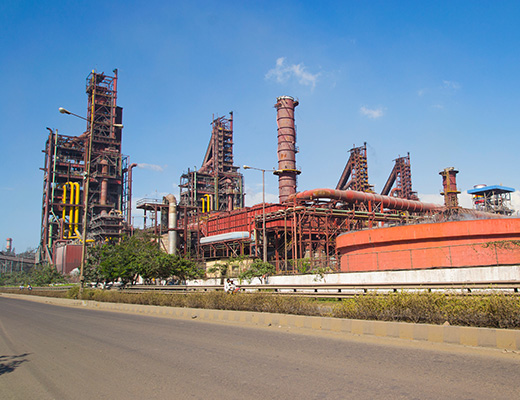
Gujarat is located on the western coast of India and has the longest coastline of 1,600 kms among all the states in the country. The state shares its borders with Rajasthan, Madhya Pradesh, Maharashtra, and the Union Territories of Daman and Diu and Dadra and Nagar Haveli. The Arabian Sea borders the state on the west and the southwest. Gujarat is one of the leading industrialized states in India. Gujarat is considered the petroleum capital of India due to presence of large refining capacity set up by private and public sector companies.
The state is the world’s largest producer of processed diamonds, accounting for 72% of the world’s processed diamond share and 80% of India’s diamond exports. With a contribution of 65 to 70% to India’s denim production, Gujarat is the largest manufacturer of denim in the country and the third largest in the world. There are 42 ports, 17 domestic airports and 3 international airports. There are 106 product clusters and 60 notified special economic zones (SEZs). Large scale investment is expected in Gujarat as part of the US$ 90 billion Delhi-Mumbai Industrial Corridor (DMIC).
Ahmedabad is India's first UNESCO World Heritage City of Gujarat which has been included in the list of the "World's 50 Greatest Places of 2022" by Time Magazine.
The first IFSC (International Financial Services Centre) in India has been set up at the Gujarat International Finance Tec-City (GIFT City) in Gandhinagar.
In 2025-26, the secondary sector contributed 42.87% to the state’s GSDP (at current prices), followed by tertiary (39.16%) and primary (17.97%) sectors.
Gujarat Tourism
On February 1, 2026, the Union Budget 2026-27 announced the inclusion of Lothal and Dholavira in the country's archaeological heritage cluster tourism development programme. The initiative is expected to strengthen heritage tourism infrastructure, enhance visitor experiences and promote Gujarat’s archaeological destinations. Additionally, the proposal to train 10,000 tourist guides across 20 iconic tourist destinations is expected to create employment opportunities and improve tourism services at key destinations across the state.
The Government of Gujarat is strengthening its tourism ecosystem through strategic initiatives such as the state’s first Cinematic Tourism Policy (2022-27) to attract film production and create local jobs. On February 21, 2025, it announced new tourism circuits supported by a 31% rise in funding to Rs. 6,505 crore (US$ 736 million), including 150 new roads, 200 air-conditioned buses, 10 caravans, and Rs. 15 crore (US$ 1.7 million) for infrastructure and circuit development. The state is also developing convention centres in Surat and Vadodara and enhancing air connectivity between key tourist destinations.
Gujarat Economy
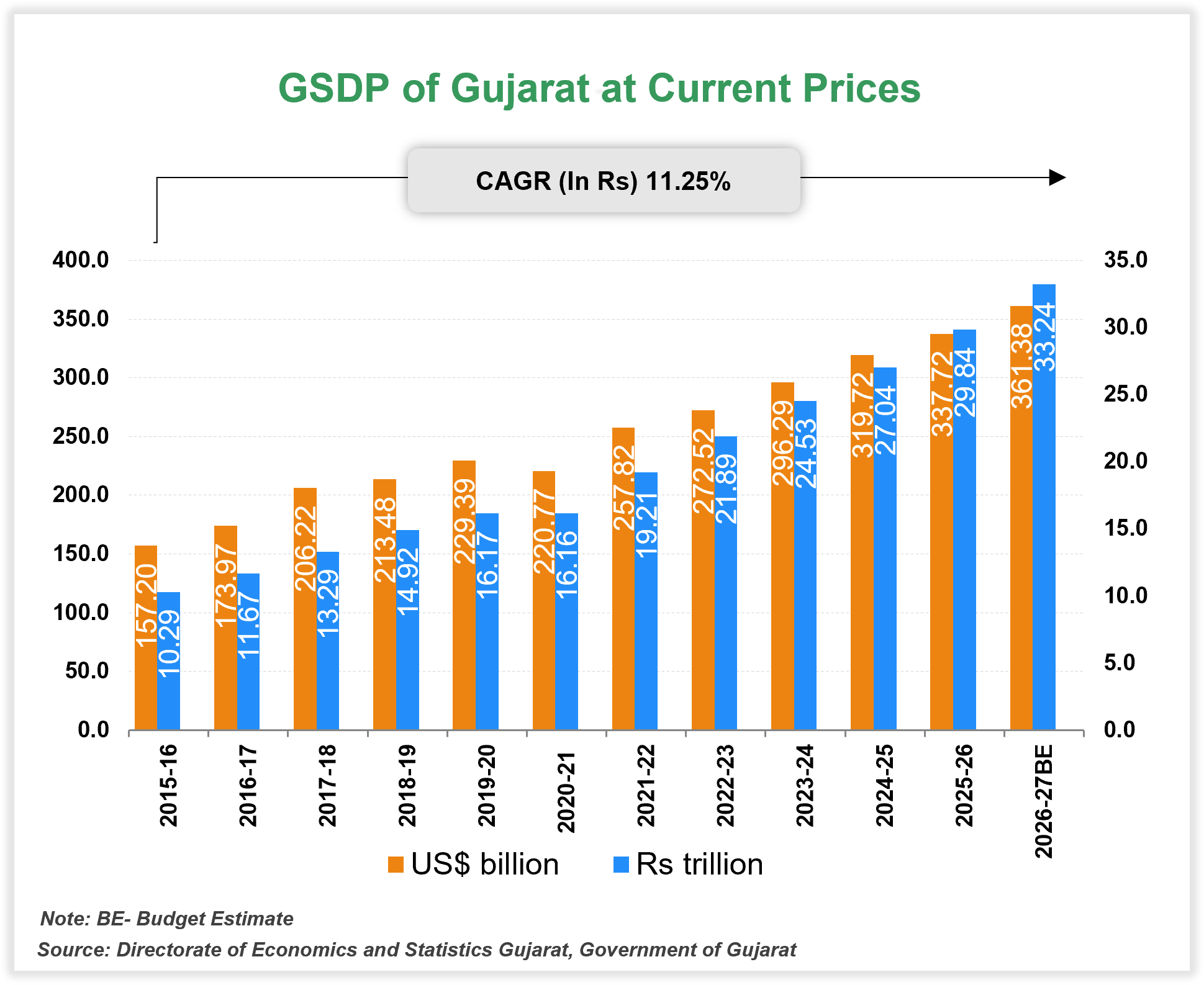
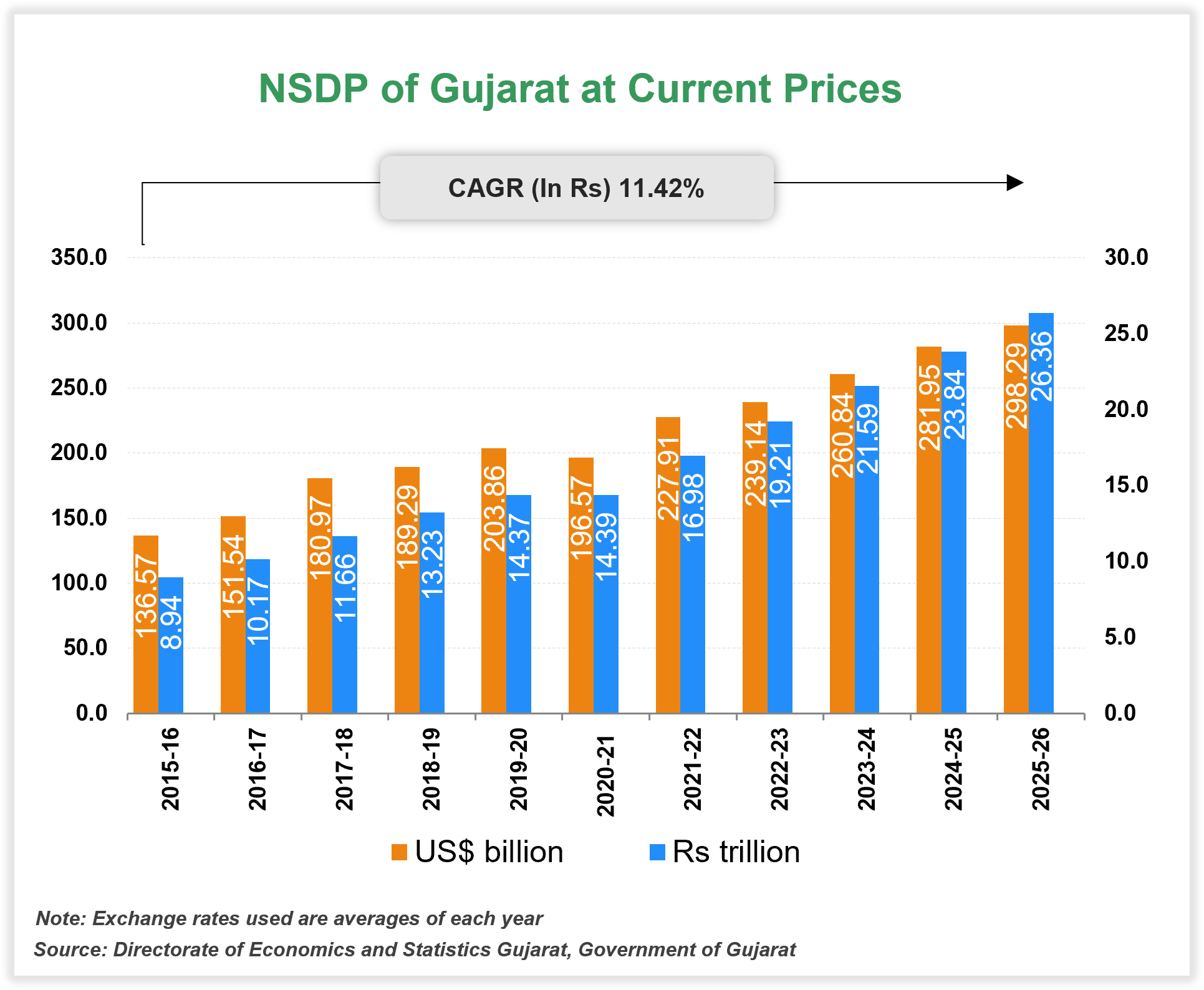
- The Gross State Domestic Product (GSDP) of Gujarat for FY27 (at current prices) is Rs. 33.24 trillion (US$ 361.38 billion). Gujarat’s GSDP increased at a CAGR of 11.25% between FY16 and FY27BE. Gujarat’s NSDP was Rs. 19.46 trillion (US$ 247.63 billion) in 2022-23. The state’s NSDP expanded at a CAGR of 10.21% between 2015-16 and 2022-23. Gujarat’s per capita NSDP was Rs. 273,558 (US$ 3,480) in 2022-23. According to the DPIIT, FDI inflows in Gujarat stood at Rs. 3,98,236 crore (US$ 50.62 billion) from October 2019-March 2026.
In FY26, the State of Gujarat contributed a dominant 46.16% of India’s total chemical exports amounting to Rs. 1,08,259 crore (US$ 12.24 billion) of the country’s Rs. 2,50,567 crore (US$ 28.33 billion) reinforcing its position as the nation’s chemical and petro-chemical hub.
Industries in Gujarat
Gujarat accounts for the largest share of the total investments in the food processing sector of India. As per the Government of Gujarat’s survey report, technical textiles are a key emerging area, with over 860 units in Gujarat. The state accounts for around 72% of the world’s share of processed diamonds and more than 80% of diamonds processed in India. Gujarat consists of 47% of total domestic gas connections in the country
Recent development in Key sectors
- On March 31, 2026, Prime Minister Mr. Narendra Modi inaugurated Kaynes Technology’s semiconductor manufacturing facility in Sanand, Gujarat, marking the commencement of production at the plant. The facility will manufacture Intelligent Power Modules used in electric vehicles and industrial applications, with a significant share of production expected to be exported.
- On February 28, 2026, Prime Minister Mr. Narendra Modi inaugurated Micron Technology’s Semiconductor Assembly, Test and Packaging (ATMP) facility in Sanand, Gujarat. Developed with an investment of over Rs. 22,500 crore (US$ 2.45 billion), the facility marks a major milestone in India’s semiconductor manufacturing journey.
- On February 20, 2026, the Gujarat government signed a memorandum of understanding (MoU) with Larsen & Toubro VYOMA for the development of a 250 MW green AI-ready data centre campus at Dholera Special Investment Region (SIR).
- On January 19, 2026, Maruti Suzuki India Limited signed an investment agreement with the Government of Gujarat for establishing a new automobile manufacturing facility at Khoraj. The company committed an investment of Rs. 35,000 crore (US$ 3.80 billion) for the project, which is expected to further strengthen Gujarat’s position as a major automotive manufacturing hub in India.
- On January 13, 2026, Union Home Minister Mr. Amit Shah laid the foundation stone of the BSL-4 Bio-Containment Facility at the Gujarat Biotechnology Research Centre (GBRC) in Gandhinagar. Being developed with an investment of Rs. 362 crore (US$ 39.3 million), the facility will be India’s second BSL-4 laboratory and the first such high-containment laboratory being established by a state government.
- On July 17, 2025, Oil and Natural Gas Corporation (ONGC) announced it is conducting a pre-feasibility study for a prospective 2,00,000-2,40,000 barrels-per-day refinery in Jamnagar, Gujarat, as India ramps up efforts to become a global refining hub.
- Under GST 2.0, the GST rate on select key inputs used in the gems & jewellery sector in Gujarat, including zari borders and certain high-value craft components, has been cut from 12% to 5%, in a measure aimed at improving competitiveness for units operating in the Surat-Rajkot-Bhavnagar manufacturing belt.
- Gujarat’s textile sector has received a major boost through recent GST 2.0 reforms, with the rate on zari borders and traditional handicrafts such as Kutchi embroidery, Bandhani tie-dye, and Sankheda lacquerware reduced from 12% to 5% to enhance affordability and market competitiveness. Surat, which contributes around 40% of India’s man-made fabric production and nearly 18% of textile exports, stands to benefit significantly from the move, supporting employment and export growth across the State’s textile hubs.
- Gujarat has achieved an annual milk production of 17.28 million metric tons in 2024, securing the fourth position nationwide, with output contributing 7.49% of India’s total; the state’s per-capita milk availability rose from 291 g/day in 2000-01 to 670 g/day by 2022-23.
- On April 24, 2025, Indian Oil Corporation (IOC) announced a Rs. 24,000 crore (US$ 2.72 billion) investment to establish two new petrochemical units in Gujarat, targeting production of polypropylene and butyl acrylate at its Vadodara refinery as part of its diversification into higher-value chemicals.
- In FY25, the State of Gujarat contributed a dominant 46.16% of India’s total chemical exports amounting to Rs. 1,13,011 crore (US$ 12.8 billion) of the country’s Rs. 2,52,509 crore (US$ 28.6 billion) reinforcing its position as the nation’s chemical and petro-chemical hub.
- In FY25, the Gujarat state government approved 183 new allopathic drug-manufacturing units with a total estimated investment of approximately Rs. 12,000 crore (US$ 1.36 billion), averaging around Rs. 50 crore (US$ 5.7 million) per plant.
- On February 21, 2025, the Gujarat government announced the roll-out of new tourism circuits, supported by a 31% increase in tourism sector funding to Rs. 6,505 crore (US$ 736 million), which includes construction of 150 new roads, deployment of 200 air-conditioned buses and 10 caravans with a budget of Rs. 360 crore (US$ 40.8 million) to connect 25 tourist and pilgrimage destinations, and an initial Rs. 15 crore (US$ 1.7 million) earmarked for basic facilities and new circuit development.
- State budget FY27 developments:
- Gujarat allocated Rs. 29,709 crore (US$ 3.23 billion) to the Roads and Buildings Department in FY27. The budget includes Rs. 10,008 crore (US$ 1.09 billion) for roads and bridges, Rs. 5,600 crore (US$ 608.7 million) under Mukhyamantri Gram Sadak Yojana and Rs. 800 crore (US$ 87.0 million) for the Garvi Gujarat High-Speed Corridor.
- The Urban Development and Urban Housing Department received an allocation of Rs. 33,504 crore (US$ 3.64 billion) in FY27, including Rs. 16,116 crore (US$ 1.75 billion) under Swarnim Jayanti Mukhyamantri Shaheri Vikas Yojana, Rs. 2,217 crore (US$ 241.0 million) for Ahmedabad and Surat Metro projects and Rs. 1,420 crore (US$ 154.3 million) under Pradhan Mantri Awas Yojana (Urban).
- The Education Department received an allocation of Rs. 63,184 crore (US$ 6.87 billion) in FY27. The budget includes Rs. 3,055 crore (US$ 332.1 million) under Mission Schools of Excellence and provisions for expansion of PM SHRI Schools and higher education infrastructure.
- The Health and Family Welfare Department received Rs. 25,403 crore (US$ 2.76 billion) in FY27, including Rs. 3,472 crore (US$ 377.4 million) under Pradhan Mantri Jan Arogya Yojana (MA) and Rs. 1,851 crore (US$ 201.2 million) for GMERS hospitals.
- The Agriculture, Farmers Welfare and Cooperation Department was allocated Rs. 24,022 crore (US$ 2.61 billion) in FY27, including Rs. 11,000 crore (US$ 1.20 billion) under the Agriculture Relief Package, Rs. 9,324 crore (US$ 1.01 billion) for electricity assistance to farmers and Rs. 1,565 crore (US$ 170.1 million) for farm mechanisation.
- The Energy and Petrochemicals Department received Rs. 4,842 crore (US$ 526.3 million) in FY27. Major allocations include Rs. 1,166 crore (US$ 126.7 million) for agricultural electricity connections, Rs. 500 crore (US$ 54.3 million) under Kisan Suryoday Yojana and Rs. 200 crore (US$ 21.7 million) under PM-KUSUM.
- Gujarat allocated Rs. 2,634 crore (US$ 286.3 million) to the Science and Technology Department in FY27, including Rs. 1,100 crore (US$ 119.6 million) under the Gujarat Semiconductor Policy and Rs. 150 crore (US$ 16.3 million) under the Gujarat Electronics Policy.
- The state allocated Rs. 6,737 crore (US$ 732.3 million) for tourism development in FY27 and declared 2026 as the ‘Gujarat Tourism Year’, with investments focused on destinations such as the Statue of Unity, Somnath, Ambaji, Dholavira and Lothal.
- In September 2024, Hindalco’s copper division is set to invest US$ 293.8 million (Rs. 2,450 crore) in 2 copper projects in Gujarat, including an e-waste recycling facility at Dahej in South Gujarat, which will have an annual production capacity of 200 kilotons of copper.
- In March 2024, Prime Minister Mr. Narendra Modi virtually inaugurated three semiconductor projects worth US$ 15.1 billion (Rs. 1.25 trillion). These include a US$ 10.99 billion (Rs. 91,000 crore) facility in Dholera, Gujarat, set to start chip production by 2026, as well as facilities in Morigaon, Assam, and Sanand, Gujarat.
- In January 2024, Car market leader Maruti Suzuki India will invest US$ 4.59 billion (Rs. 38,200 crore) in Gujarat to double its output in India to 4 million units by FY31.
- In January 2024, Reliance Industries Ltd will launch a new energy giga complex in Jamnagar, Gujarat, in the second half of 2024, according to an earnings statement and investor call. The complex spans 5,000 acres.
- In January 2024, Gujarat to host India's largest mall. The Lulu Mall project, valued at US$ 361.9 million (Rs. 3,000 crore), will start construction this year.
- In November 2023, the Gem & Jewellery Export Council (GJEPC) the apex body to promote exports of gems and jewellery in India, partnered with the American multinational, FedEx Corporation.
- In November 2023, the Chief Minister inaugurated the state-wide ‘Ravi Krishi Mahotsav 2023, which aims to offer guidance to the state’s farmers on modern agricultural technology concerning seasonal crops and provide insights into various farmer-oriented support schemes.
- In November 2023, Chief Minister Mr. Bhupendra Patel approved the Full Dealer Owned Dealer Operated-(FDODO) CNG scheme which would be implemented by Gujarat Gas Limited and Sabarmati Gas Limited.
- In October 2023, IT SEZ with an investment of Rs. 8,000 crore (US$ 960.37 million) might come up in the city.
- In October 2023, a MoU was signed between the Indian National Space Promotion and Authorization Center (IN-SPACe) and the Government of Gujarat, for the development of a space manufacturing cluster in the city near Ahmedabad.
- In October 2023, the Gujarat government set up a development authority for the Becharaji region. The Mehsana district collector has been appointed chairperson of the authority.
- As of October 2023, Gujarat had a total installed power generation capacity of 48,507.65 MW, comprising 33,084.08 MW under private utilities, 8454.86 MW (state utilities), and 6,968.71 MW (central utilities).
- In October 2023, the Petronet LNG board approved the setting up of a petrochemical plant in Dahej, Gujarat with an estimated cost of Rs. 20,685 crore (US$ 2.48 billion).
- In September 2023, the Gujarat Maritime Board (GMB) revived plans to build ‘Port City,’ an ambitious project conceptualized on the lines of established global maritime hubs like Dubai and Singapore.
- In August 2023, 36 railway projects worth Rs. 30,789 crore (US$ 3.69 billion) were underway in Gujarat.
- In July 2023, 15 companies signed MoUs worth Rs. 2,000 crore (US$ 240.09 million), for investments in the biotech sector.
- In July 2023, an MoU has been signed between the State and Central government at Surat for the construction of PM MITRA Park on 1,141 acres at Vansi Borsi in Navsari, Gujarat.
- According to the Telecom Regulatory Authority of India (TRAI), Gujarat had 71.43 million wireless connections and 2.66 million wireline subscribers as of March 2026.
- In June 2023, Google to set up Global FinTech Operations Centre in Gujarat's Gift City.
- In June 2023, Union Minister of Road Transport & Highways, Mr. Nitin Gadkari dedicates two National Highway projects worth US$ 5.85 million in Vadodara, Gujarat.
- In June 2023, Union Home Minister and Minister of Cooperation, Mr. Amit Shah inaugurated the National Convention of Modi Samaj in Ahmedabad, Gujarat.
Gujarat continues to reinforce its position as one of India’s most dynamic economic powerhouses, driven by strong industrial capabilities, steady investment flows and a policy environment that encourages innovation and enterprise. The state’s leadership in petrochemicals, textiles, diamonds, engineering, dairy and emerging technologies reflects a diversified and future ready growth model. Large scale infrastructure expansion, strategic sectoral reforms, improved connectivity and consistent focus on tourism and services are strengthening competitiveness across regions. With major global companies investing in new manufacturing and semiconductor facilities, and with sustained government commitment to skill development, urban transformation and industrial corridors, Gujarat is well placed to maintain its momentum and emerge as an even stronger engine of national growth in the years ahead.
FACTFILE
Capital
GandhinagarGeographical Area (sq km)
196,063State Language
Gujarati, Hindi and EnglishLiteracy Rate
78.03 per centKey Industries:
Dairy
Agro and food processing
IT
Chemicals and petrochemicals
Textiles and apparels
Engineering and auto
Gems and jewellery
Oil and gas
Pharmaceuticals and biotechnology
Minerals
Ports
Power
Toursim
Related News
MOREPartners