Introduction
India’s textile and apparel industry is a large, diverse, and globally significant sector, playing a vital role in economic growth, employment generation, and export earnings. As one of the world’s leading textile exporters, it contributes substantially to merchandise exports, supported by a strong domestic market and an extensive MSME base. The sector has demonstrated resilience despite global challenges, with exports spanning over 111 countries and steady growth in key segments such as ready-made garments and jute. Government initiatives focused on value addition, market diversification, and global integration—under programmes such as Make in India and Aatmanirbhar Bharat—continue to strengthen its long-term growth potential.
India is also among the top garment-manufacturing countries globally, supported by a well-established and integrated value chain spanning fibre, yarn, fabric, and apparel. The country is a leading producer and consumer of cotton, with the largest acreage under cultivation globally, estimated at around 12.5 million hectares, accounting for nearly 38% of the global cotton area. Alongside this, India has strong capabilities in silk and denim production.
The apparel industry is one of the biggest contributors to the economy with a 2% contribution to the gross domestic product (GDP). It is also the second largest employer after agriculture, providing direct employment to more than 45 million people. Andhra Pradesh, Telangana, Haryana, Jharkhand, and Gujarat are the top textile and clothing manufacturing states in India.
Export Trend
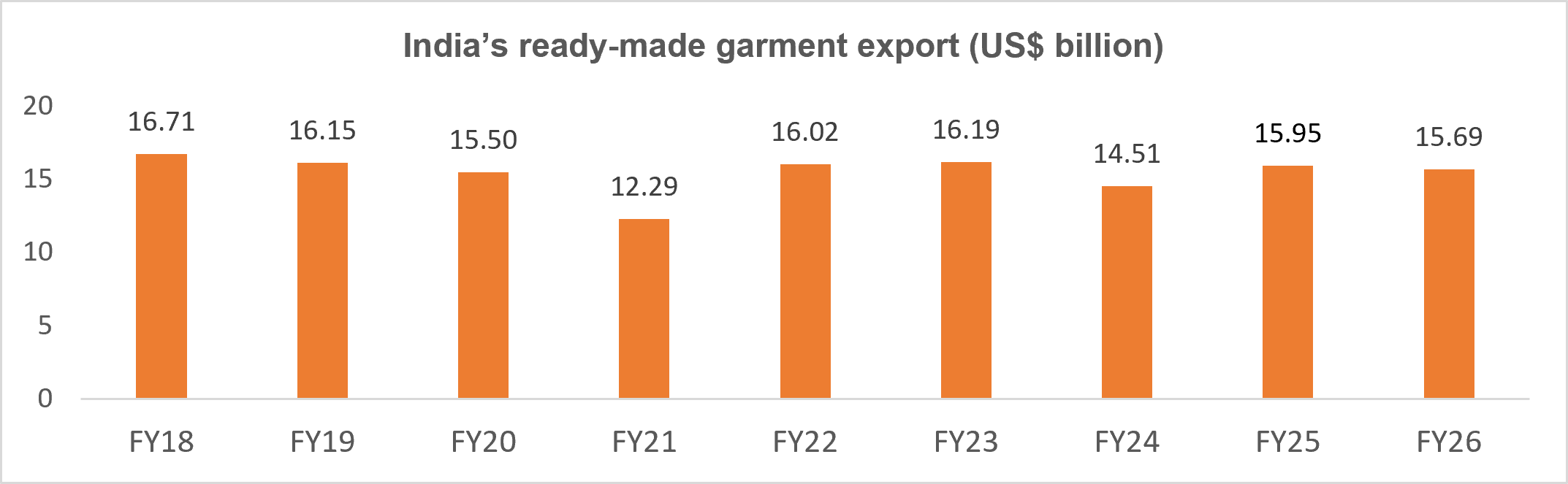
Source: Ministry of Commerce Dashboard, Niryat
India is one of the leading exporters of ready-made garments (RMG) globally, supported by a strong manufacturing base and diversified product offerings. During FY26, India’s RMG exports demonstrated steady performance across key markets despite global demand fluctuations.
India’s RMG exports for the period FY26 stood at US$ 15694.9 million, registering a marginal growth of 1.32% over US$ 15905.31 million in FY25 and a stronger growth of 11.3% compared to US$ 13,059.4 million in the corresponding period of FY24. Monthly trends indicate mixed performance, with notable growth in months such as April (14.4%), May (11.4%), and
November (11.3%) in FY26 over FY25, while some months like September (-10.1%), October (-12.9%), and February (-8.6%) witnessed declines.
In February 2026, RMG exports declined by 8.6% year-on-year to US$ 1,403.0 million compared to February 2025, and also registered a 5.0% decline compared to February 2024, reflecting short-term demand pressures in global markets. Overall, while export momentum remained uneven across months, the cumulative performance indicates stability in India’s RMG sector, supported by resilient demand and continued market diversification efforts.
The government is targeting US$ 100 billion in textile exports by 2030 and US$ 600 billion by 2047. The roadmap for achieving this production and export target was set by Ministry of Textiles in its vision 2047.
Top Export Destinations
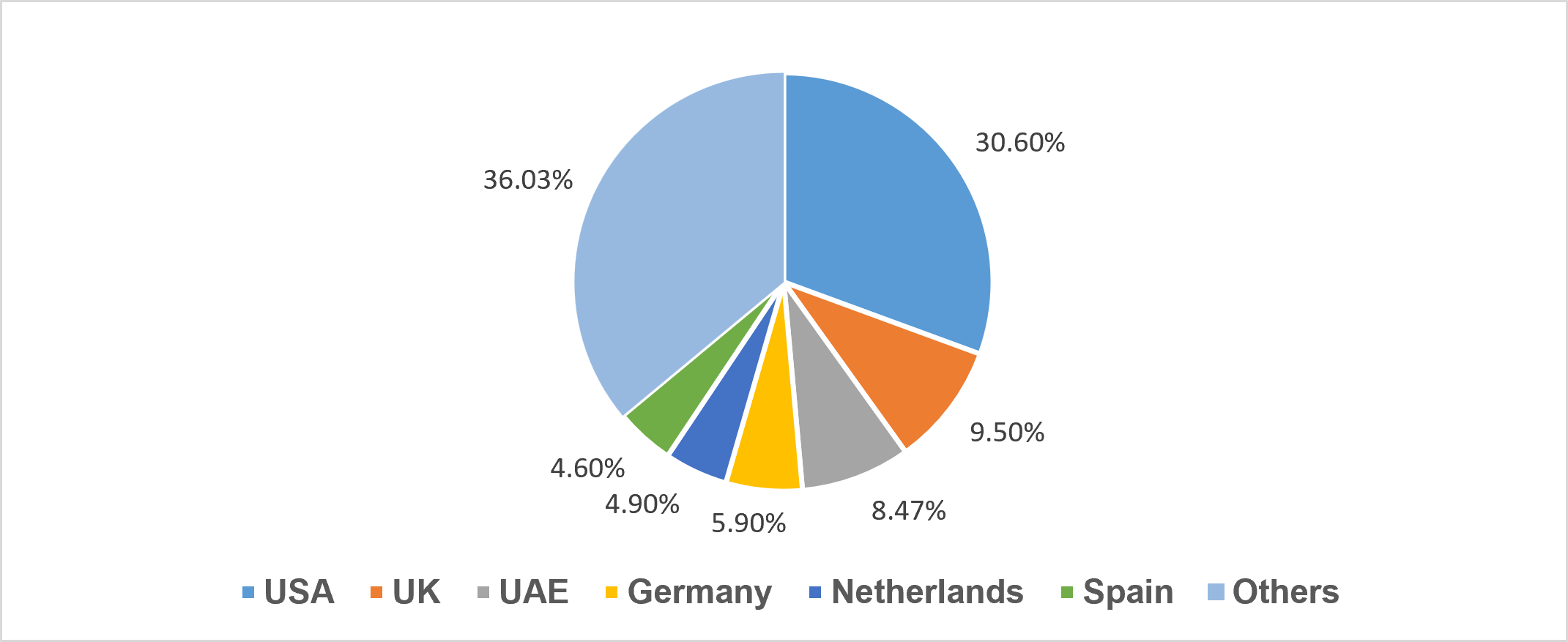
India’s readymade garments (RMG) exports remain concentrated among a few key markets, with the USA continuing to dominate as the largest destination, accounting for 33.37% share at US$ 5,330 million during April–March 2025–26. The USA and UK (FTA) follow as the second and third largest markets, contributing USD 1,183.8 million (9.02%) and USD 1,112.6 million (8.47%), respectively. Among European countries, Germany, the Netherlands, Spain, and France collectively represent a significant share, highlighting the region’s continued importance in India’s RMG export basket.
Mid-sized markets such as Saudi Arabia, Italy, and Australia (FTA) also contribute steadily, though with relatively smaller shares ranging between 2–3%. Overall, the export distribution reflects a balanced mix of developed economies and FTA-supported markets, with strong dependence on the US and growing traction in Europe and the Middle East.
Country-wise RMG export share FY26
Source: Ministry of Commerce and Industry
This diversified geographical presence helps mitigate risks while providing opportunities for sustained export growth. India has entered into 15 Free Trade Agreements (FTAs) with partner nations, whose combined textile import demand amounts to US$ 198.9 billion. The Minister encouraged exporters to focus on the European Union (EU), which imports textiles valued at US$ 268.8 billion, over twice the size of the US market. India is currently in active FTA negotiations with the EU.
Government Initiatives
India’s apparel export sector is witnessing strong positive momentum, supported by a clear policy push and ambitious growth targets. The government is working on a comprehensive roadmap to scale textile and apparel exports from around US$ 40 billion to US$ 100 billion by 2030, with a focus on expanding into FTA markets, boosting high-value segments like handlooms, silk, and GI products, and converting non-exporting districts into export hubs. Complementing this, the Union Budget 2026 outlines an integrated approach to strengthen manufacturing, generate employment, and promote sustainability across the textile value chain, enhancing global competitiveness. Government initiatives such as PM MITRA Parks, Production Linked Incentive (PLI) Scheme, and skill development programs like SAMARTH are creating world-class infrastructure, encouraging large-scale apparel manufacturing, and improving workforce capabilities. Additionally, strategic trade agreements and policy support are opening access to major global markets, positioning India to significantly increase its share in global apparel trade and achieve long-term export growth.
As the textile industry is crucial for India’s growth, the government of India has implemented several schemes for the growth of production and ease of trade. The Amended Technology Upgradation Fund Scheme (ATUFS) and the Advance Authorization (AA) schemes are focused on strengthening and increasing the production of textile and apparel products in the country.
The Union Budget 2026–27 introduces a comprehensive strategy to strengthen India’s textile sector through fibre self-reliance, cluster modernisation, sustainable manufacturing, skilling, Mega Textile Parks and enhanced support for handloom and handicrafts. It also boosts exports and MSME liquidity through extended export obligation timelines, stronger TReDS financing mechanisms and Rs. 10,000 crore (US$ 1.09 billion) SME Growth Fund, aiming to position India as a global textile manufacturing and export hub while generating employment and promoting inclusive growth.
The Mission Steering Group under the chairmanship of Union Minister of Textiles has approved 19 research projects of value approximately US$ 2.52 million across different fields of technical textiles under the National Technical Textiles Mission. The research projects were approved across key strategic areas of composites, geo textiles, smart textiles and machineries etc. in the 9th Mission Steering Group meeting. The approved projects were proposed by eminent research bodies and institutions including Indian Institute of Technology, National Institute of Technology, and Council of Scientific & Industrial Research etc. The Union Minister also reviewed the progress on R&D, promotion and market development, export promotion and education, training and skill development under the Mission. The Union Minister reviewed 27 applications from 16 public and 11 private institutes which were earlier approved for introducing papers on technical textiles, procuring lab infrastructure and training of trainers across different application areas. He also reviewed internship initiatives and skilling initiatives taken by the Ministry under the Mission.
Inspired by the 5F Vision of the Prime Minister Mr. Narendra Modi, Bharat Tex 2024, the largest global textile event in India with a unified Farm to Fashion focus, was held in New Delhi in February 2024. The four-day event witnessed an overwhelming response from Indian and global players including top brands and retailers. The mega event was organised by a consortium of 11 Textile Export Promotion Councils and supported by the Ministry of Textiles. The event focused on trade, investment, and sustainability, attracting over 3,500 exhibitors, 3,000 buyers from 111 countries, and over one lakh trade visitors. Spanning around 2 million sq. ft. across two venues, Bharat Mandapam and Yashobhoomi, the event highlighted the entire textile value chain, featuring highlights like Vastra Katha, an artistically curated textile narrative. Multiple Memorandum of Understandings (MoUs) were signed during the event.
Government Body
Apparel Export Promotion Council (AEPC)
The Apparel Export Promotion Council (AEPC), established in 1978, is the apex body for promoting India’s apparel exports and operates under the Government of India. It serves as a key link between exporters, international buyers, and the government, providing services such as market intelligence, policy support, and export facilitation. The council focuses on the export promotion of ready-made garments and supports the industry through research and inputs on free trade agreements (FTAs), foreign trade policy (FTP), and bilateral agreements. AEPC also organizes trade fairs, buyer–seller meets, and skill development initiatives to enhance the global competitiveness and positioning of India’s apparel industry.
RELATED SITES

Apparel House, Institutional Area
Sector - 44,
Gurgaon - 122003,
Haryana,
India
Tel.: +91-124-2708000/ 03
Fax: +91-124-2708004
Email: chairman@aepcindia.com
Website: www.aepcindia.com
Partners




