Introduction
India is the sixth-largest chemical-producing country in the world and the third-largest producer in Asia, contributing 7% to India’s Gross Domestic Product (GDP). It is also among the top three basic chemical-producing countries globally. The chemicals market in the country is worth around US$ 250 billion in 2024 and is anticipated to grow to US$ 300 billion by 2025 and US$ 1 trillion by 2040. The vision for 2030 is for India to become a global chemical manufacturing powerhouse with a 5-6% share of the global chemical value chain. The country ranks 14th in the global exports of chemicals (excluding pharmaceutical products) with a 2.5% contribution to global chemical sales. The Indian chemical industry employs over two million people and makes up 2.8 to 3% of the global chemical industry. India’s chemicals sector witnessed cumulative foreign direct investment (FDI) equity inflows amounting to US$ 23.21 billion during FY2000–01 to FY2024–25, highlighting the sector’s strong investment attractiveness and
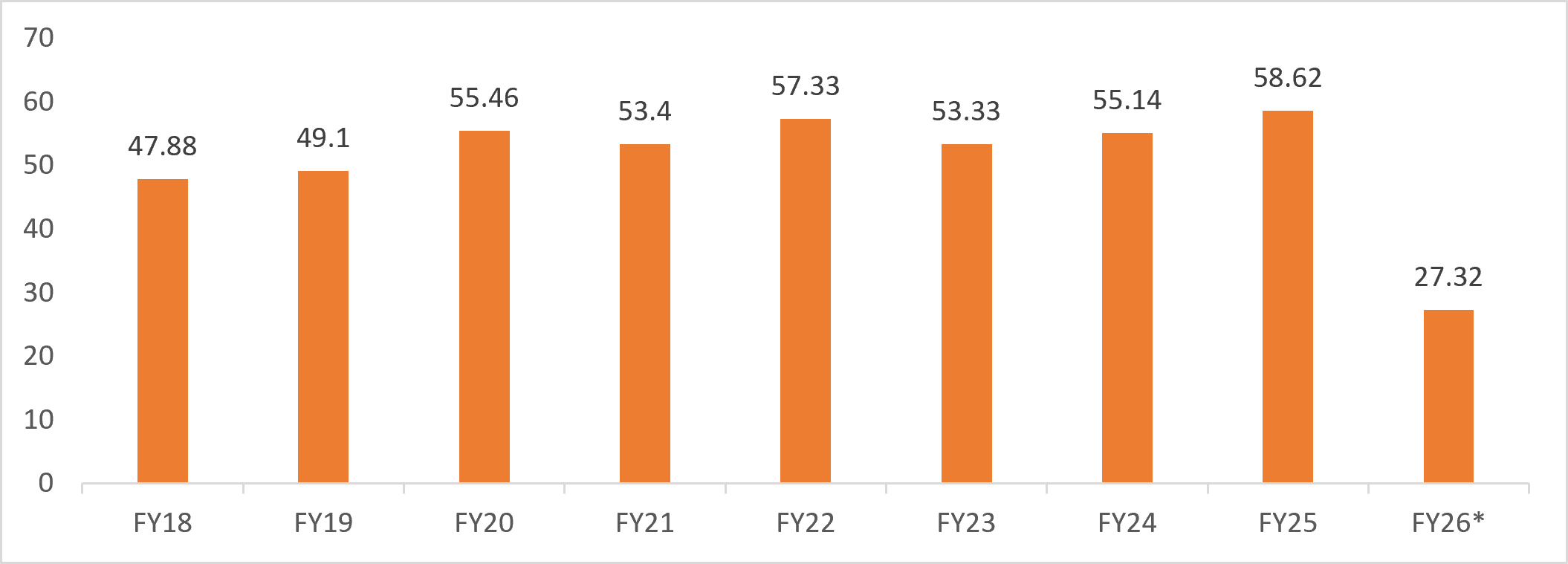
India’s basic major chemicals and petrochemicals production (million metric tons)
Source: Department of Chemicals and Petrochemicals, MoC&F
Note: * - April- September 2025
consistent growth prospects. Chemical manufacturing in India is mainly concentrated in Maharashtra and Gujarat. The other major producing states are West Bengal and Tamil Nadu. The chemicals industry in India is highly diversified, covering over 80,000 commercial products. It is broadly classified into bulk chemicals, agrochemicals, specialty chemicals, polymers, petrochemicals, and fertilizers. India’s chemical industry is the fourth largest producer of agrochemicals and is manufacturing more than 50% of technical-grade pesticides. The industry is the third largest consumer of polymers in the world and is known as a key global dye supplier with exports to over 90 countries, accounting for 16-18% of the global production of dyestuff and dye intermediates. Indian colourants industry has emerged as a key player with a global market share of ~15%.
India has de-licensed the chemicals industry except for a few hazardous chemicals. The Government’s investment plan to set up petroleum, chemicals, and petrochemicals investment regions (PCPIRs) and plastic parks will provide state-of-the-art infrastructure to boost the industry output and grow employment generation from the sector.
Production of basic chemicals and petrochemicals in India strengthened in recent years, rising from 47.88 million metric tons in FY18 to 58.62 million metric tons in FY25. This growth reflects improving domestic demand and increased capacity utilization across the sector. The upward trend in FY25 indicates continued momentum and a stable expansion of India’s chemical manufacturing base.
Export Trend
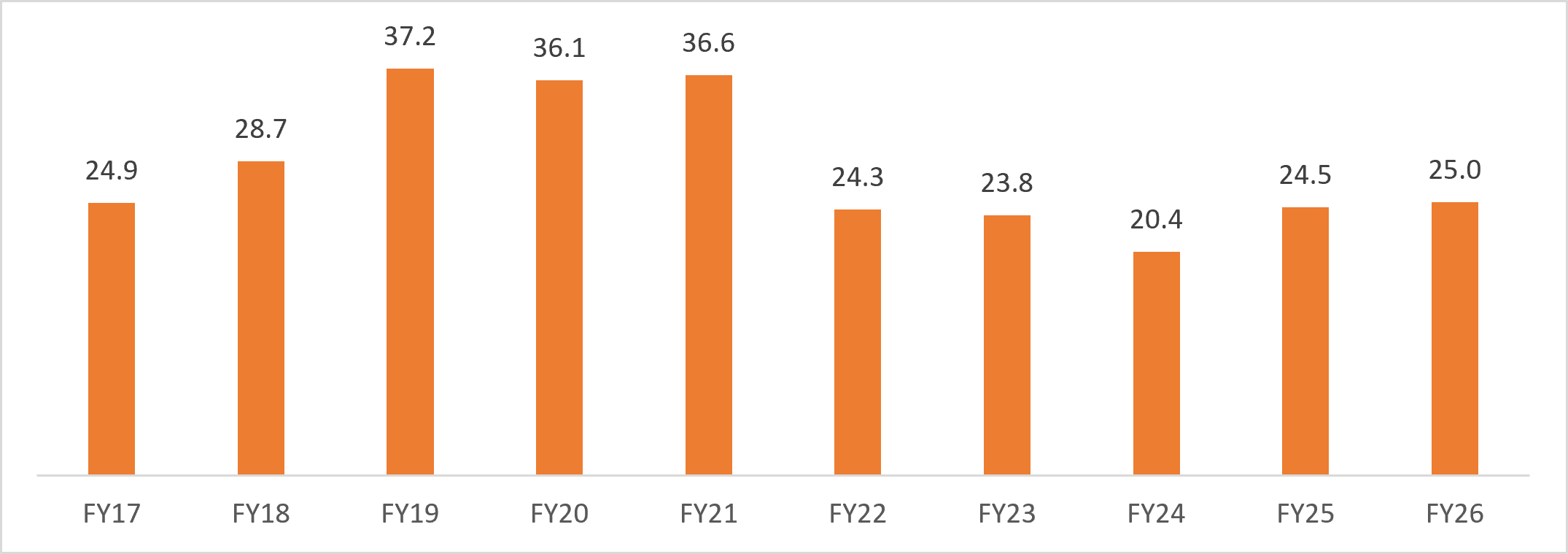
India’s Chemical exports (US$ billion)
Source: DGCI&S, Chemical Export Promotion Council
India is among the top chemical exporting countries in the world. India exports inorganic and organic chemicals, tanning and dyes, agrochemicals, plastics, synthetic rubber, filaments, etc. In FY25, the exports of chemicals stood at US$ 21.1 billion and US$ 16.9 billion in FY26 (till January 2026).
India has established itself as a respected and reliable manufacturer and a key global supplier of dyes, dye intermediates, basic chemicals, agrochemicals, cosmetics, toiletries, castor oils, and other chemical products. The chemicals and petrochemicals industry holds the capacity to elevate India into a prominent global manufacturing center. The surge in chemical exports has been achieved because of sustained efforts on the part of the Department of Commerce & Industry and Indian member exporters.
CHEMEXCIL, India’s chemical exports promotion council, has also made major efforts by using grants in aid under the market access initiative scheme, organizing B2B exhibitions in different countries, exploring new potential markets through product-specific marketing campaigns with the active involvement of Indian embassies, providing financial aid in statutory compliance in overseas product registration, etc. This export growth has been achieved despite issues like high freight rates and container shortages which has benefitted small and medium exporters from key states like Gujarat, Maharashtra, Karnataka, Tamil Nadu, and Andhra Pradesh.
The export growth of chemicals has been achieved because of a surge in shipments of organic, and inorganic chemicals, agrochemicals, dyes and dye intermediates and specialty chemicals.
Export Destinations
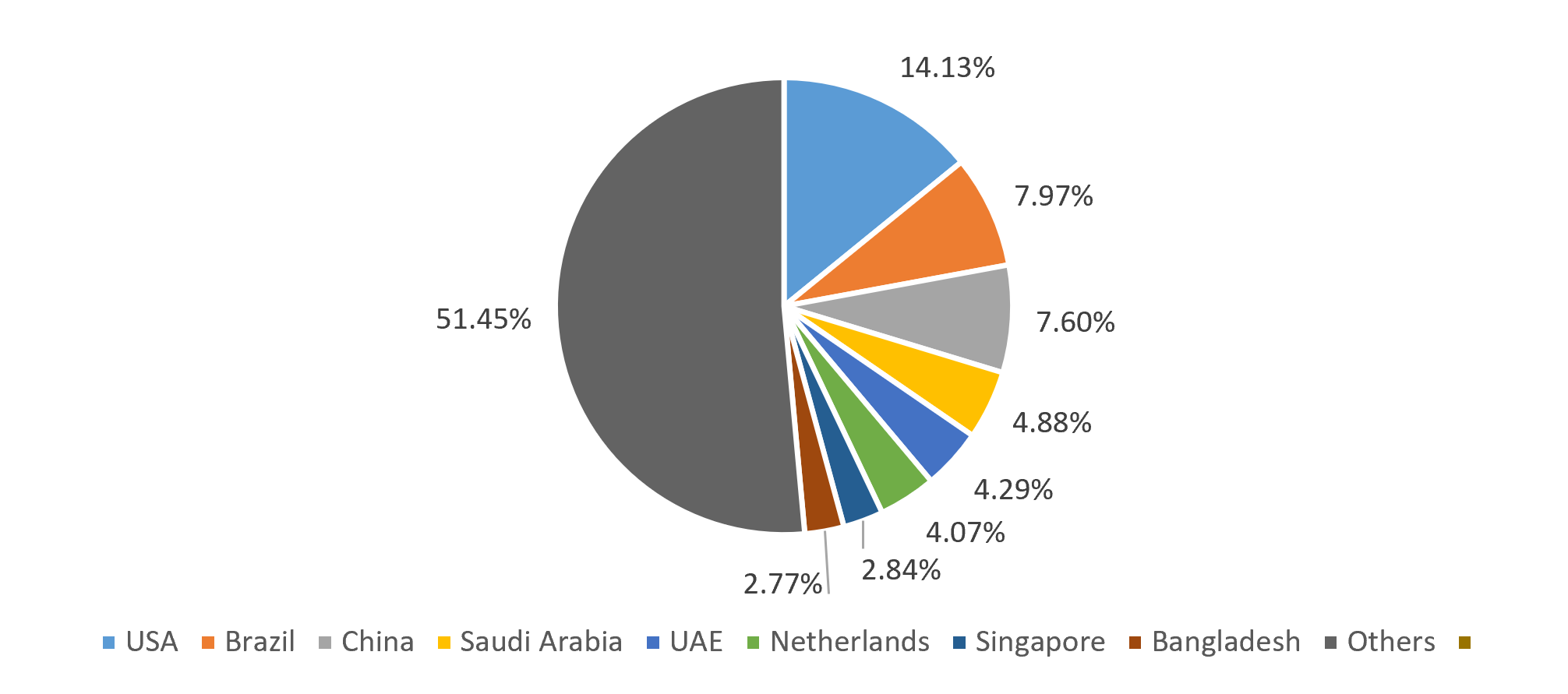
India exports chemicals and chemical products to more than 175 countries with key export destinations like China, USA, Brazil, Netherlands, Saudi Arabia, Indonesia, UAE, Japan, Germany, etc. The industry also started exporting to markets like Turkey, Russia, and Northeast Asian countries namely Hong Kong, Japan, South Korea, Taiwan, Macao, and Mongolia. During FY26 (April 2025–March 2026), the USA was the largest importer of chemicals from India valued at US$ 2.51 billion, followed by Brazil with imports of US$ 1.42 billion and exports to China were valued at US$ 1.29 billion.
China remained a major export destination for India’s castor oil and dye intermediates, importing castor oil worth US$ 411.19 million and dye intermediates valued at US$ 50.87 million in FY26 (April 2025–March 2026), reflecting strong trade linkages and sustained demand across these segments.
Country-wise share of India’s chemical exports (FY26)
Source: DGCI&S, Chemical Export Promotion Council
The USA remained the largest importer from India across multiple segments, including dyes (US$ 158.67 million), inorganic chemicals (US$ 274.48 million), organic chemicals (US$ 1.06 billion), and essential oils (US$ 47.96 million) in FY26 (April 2025–March 2026). Furthermore, Brazil remained the leading importer of agrochemicals, valued at US$ 937.16 million, while the United Arab Emirates was the leading importer of cosmetics and toiletries, valued at US$ 308.10 million in FY26 (April 2025–March 2026).
Government Initiatives
PCPIR Policy 2020-2035
Under the new PCPIR Policy 2020-2035, a combined investment of US$ 142 billion is targeted by 2025, US$ 213 billion by 2030 and US$ 284 billion by 2035 in all PCPIRs across the country. The four PCPIRs are expected to generate employment for ~33.83 lakh people. About 3.50 lakh people were employed in direct and indirect activities related to PCPIRs by the end of 2020.
Chemical Promotion and Development Scheme (CPDS)
The primary objective of the CPDS is to facilitate growth in the chemical and petrochemical industry with knowledge dissemination through studies, surveys, data banks and promotional materials. The three main components of the scheme are knowledge product creation, knowledge dissemination and excellence awards for research and innovation.
Apart from the various schemes mentioned above, the Government of India has introduced several research entities, schemes and councils to develop skilled manpower in the industry aimed at increasing the manufacturing competitiveness of India in the global market. This effort included providing a grant in aid to educational institutes for setting up the Centre of Excellence (CoE) to improve existing petrochemical technology and promote the development of new applications of polymers. The government has also made budgetary allocations towards the Central Institute of Plastic Engineering and Technology (CIPET) to strengthen the research & development capabilities, technical infrastructure and implemented training initiatives.
Government Body
Basic Chemicals, Cosmetics and Dyes Export Promotion Council (CHEMEXCIL)
Found in 1962 by the Government of India, the primary objective of the CHEMEXCIL is to promote chemical product exports abroad. The important roles of the council are to be an interface between industry and government, participate in international exhibitions, advise the government on policies, provide training and knowledge transfer to industries, etc.
RELATED SITES

Jhansi Castle, 4th Floor
7, Cooperage Road,
Mumbai - 400001,
Maharashtra
India
Tel.:+91-22-22021288/22021330
Fax: +91-22-22026684
Email: info@chemexcil.gov.in
Website: www.chemexcil.gov.in
Partners