Introduction
Punjab, one of the northernmost states of India, is bordered by the Pakistani province of Punjab to its west, Jammu & Kashmir in the north, Himachal Pradesh in the northeast, Haryana in the south and southeast, and Rajasthan in the southwest.
As of FY26 (Until March 2026), Punjab has a total installed power generation capacity of 14764.16 MW, with 3965.13 MW under the central sector, 3828.70 MW under state utilities, and 6970.33 MW under the private sector. Of the total installed power generation capacity, 8364.00 MW was contributed by thermal power, 3827.44 MW by hydropower, and 6171.07 MW was generated from renewable energy.
According to the Department for Promotion of Industry and Internal Trade (DPIIT), cumulative FDI inflow in the state stood at Rs. 12,596.25 crore (US$ 1,598.34 million) between October 2019-March 2026.
Tourism in Punjab
Punjab offers a rich culture with Vibrant festivals, historic landmarks like the Golden Temple in Amritsar, and lush agricultural landscapes. Tourists can explore traditional Punjabi cuisine, colourful markets, and heritage sites, making the state a unique and memorable tourist destination.
According to the State Tourism Policy, 2018, the government has he following goals:
- To promote tourism and to double the annual tourist visits in the state from 25 million to 50 million in the next five years by creating new infrastructure and improving the existing one.
- To boost the tourism sector in the state, the Punjab Government unveiled the Punjab Adventure Tourism Policy 2023 and the Punjab Water Tourism Policy 2023.
Economy of Punjab
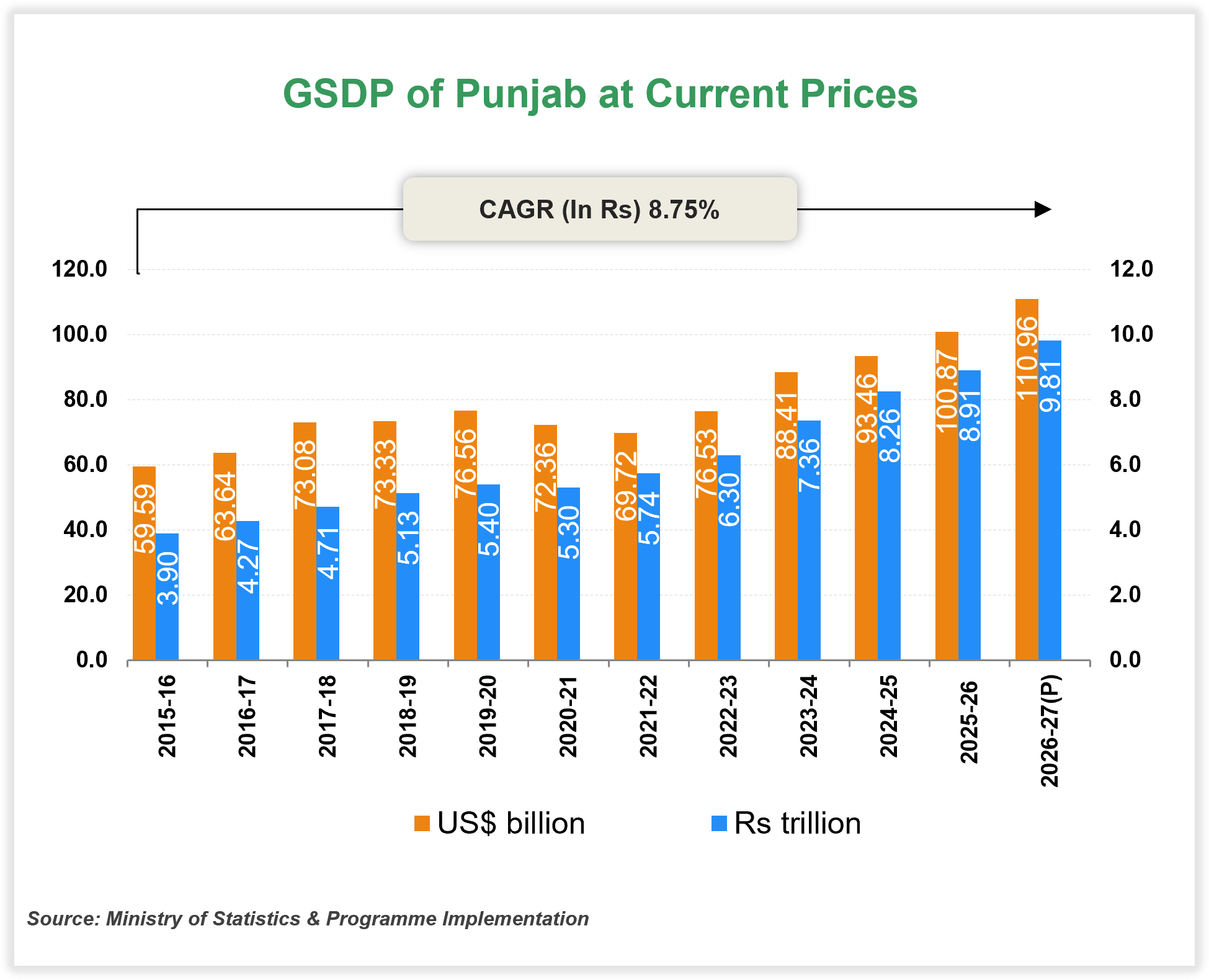
At current prices, Punjab’s gross state domestic product (GSDP) is projected to stand at Rs. 9.81 trillion (US$ 110.96 billion) in 2026-27(P).
The state’s GSDP (in Rs.) increased at a CAGR of 8.75% between 2015-16 and 2026-27(P).
The state’s per capita GSDP in 2024-25 stood at Rs. 249,479 (US$ 2,823.12).
The per capita GSDP (in Rs.) increased at a CAGR of 7.29% between 2015-16 and 2024-25.
Agriculture in Punjab
- Punjab's progressive horticulture model received praise for strengthening fruit and vegetable processing through new cold storages, value-addition centers, and agro-processing units which will support post-harvest management and improve returns for horticulture farmers.
- In FY 2026-27, Punjab launched a pilot crop diversification programme to encourage farmers to shift from paddy to kharif maize in six districts—Pathankot, Gurdaspur, Bathinda, Sangrur, Jalandhar and Kapurthala. The state is providing an incentive of Rs. 17,500 per hectare, with a budget allocation of Rs. 15 crore (US$ 1.70 million) for the initiative.
- In 2024, Punjab successfully exported litchis grown in 3,250 hectares, producing about 13,000 metric tons annually, marking a significant milestone opening international markets for Punjab's horticultural products.
- Under the State Budget 2026-27, Punjab announced a Rs. 1,300 crore (US$ 147.10 million) horticulture transformation programme with assistance from JICA to promote climate-resilient and high-value horticulture over the next 10 years. The initiative aims to increase the area under fruits, vegetables, flowers and medicinal crops from 4.59 lakh hectares to 17.34 lakh hectares by 2035.
- Punjab has allocated 9.2% of its expenditure towards agriculture in 2026-27. This is higher than the average allocation for agriculture by states in 2025-26 (5.7%).
- Under the State Budget 2026-27, the Government of Punjab allocated Rs. 15,281 crore (US$ 1.73 billion) towards Agriculture and Allied Activities. Of the total allocation, Rs. 7,715 crore (US$ 872.98 million) has been earmarked for providing subsidised power to farmers in the state.
- Punjab attracted Rs. 29,480 crore (US$ 3.32 billion) in investments in FY26 across sectors, including agriculture and agro-processing. This wave of investments is projected to generate over 67,000 jobs, signifying a strong policy or regulatory environment for allied industries.
- Punjab has a strong agriculture base with a huge production of principal crops such as rice, maize, sugarcane & barley.
- Top three fruits with the highest production recorded in 2024-25 were Kinnow, Guavaand Mangoes. The highest yield was seen in Bananas (60,573 Kgs/ha), Grapes (30,935 Kgs/ha) and Kinnow (26,950 Kgs/ha). However, the production of banana recorded the highest growth of 11.81% followed by 9.75% growth in the production of pear and 9.53% growth in the production of guava.
- In the Rabi Marketing Season 2021-22, Punjab was the country’s top wheat procurer, with 132 lakh metric tonnes (LMT) of procurement at minimum support price.
Recent Developments in Key Sectors
- Union Minister for Education Mr. Dharmendra Pradhan virtually laid foundation stone for infrastructure projects worth Rs. 201 crore (US$ 22.67 million) at Central University of Punjab, Bathinda, enhancing higher education capacity.
- In March 2026, Punjab Government approved a series of strategic road connectivity projects in Zirakpur and Mohali aimed at reducing traffic congestion and improving regional mobility. Key initiatives include the development of new link roads and bypasses, including a 200-foot-wide road connecting PR-7 Airport Road to the Patiala Highway, which is expected to enhance connectivity to Shaheed Bhagat Singh International Airport and reduce traffic on major corridors by up to 30%.
- Punjab launched six road projects worth Rs. 21.9 million (US$ 246,955) covering various local stretches such as Bhamian Khurd to Shankar Colony, Bhamian Road to Tajpur Road, Jail Road, LC Road to Uchi Mangli, Gobindgarh to Uchi Mangli, etc., as part of ongoing infrastructure expansion efforts.
- Under the State Budget 2026-27, the Government of Punjab has allocated Rs. 21,503 crore (US$ 2.43 billion) towards Education, Sports, Arts, and Culture. Of the total allocation, Rs. 1,435 crore (US$ 162.37 million) has been allocated to the Samagra Shiksha Abhiyan.
- A semiconductor manufacturing project worth Rs. 4,594 crore (US$ 518.04 million) was approved for Mohali, Punjab, expanding the chip-making capacity under the India Semiconductor Mission. This project will produce advanced components like MOSFETs and IGBTs used in EVs, renewable energy, aerospace, and defense, enhancing Punjab's role in India's semiconductor development.
- Punjab boasts 100% electrification of its railway tracks, marking a significant milestone.
- In March 2026, Mansa Railway Station was redeveloped under the Amrit Bharat Station Scheme with modern passenger amenities including lifts, a foot-over-bridge, Wi-Fi connectivity, waiting halls, and improved accessibility infrastructure.
- As of July 2024, there are 12 ongoing projects in Punjab aimed at constructing new tracks across a total of 1,158 km, with an investment of Rs. 19,843 crore (US$ 2.38 billion).
- AIPL Group disclosed a Rs. 2,500 crore (US$ 299.76 million) investment plan for residential and commercial projects in Punjab. Having developed integrated townships in Amritsar, the company sees significant potential in the region.
- Under the State Budget FY27:
- Under the State Budget 2026-27, Rs. 5,153 crore (US$ 583.07 million) has been allocated to the Transport sector, of which Rs. 4,399 crore (US$ 497.75 million) has been earmarked for the development of roads and bridges across the state.
- Punjab has allocated 1% of its expenditure towards urban development. In 2023-24 Rs. 1,215 crore (US$ 137.01 million) was allocated for urban development.
- In March 2026, the Punjab Government launched ‘Punjab Sikhya Kranti 2.0’ in partnership with the World Bank to modernize and strengthen the state's school education system. The programme envisages an investment of Rs. 3,500 crore (US$ 396.04 million) over six years, including Rs. 2,500 crore (US$ 282.89 million) through World Bank assistance and Rs. 1,000 crore (US$ 113.16 million) from the State Government.
- Under the State Budget 2026-27, the Government of Punjab has allocated Rs. 21,503 crore (US$ 2.43 billion) towards Education, Sports, Arts, and Culture. Of the total allocation, Rs. 1,435 crore (US$ 162.37 million) has been allocated to the Samagra Shiksha Abhiyan.
- Under the Union Budget 2026-27, a total allocation of Rs. 3,717 crore (US$ 420.58 million) has been designated for Health and Family Welfare, while the Mukhya Mantri Sehat Yojana (universal health coverage) has been allocated Rs. 2,000 crore (US$ 226.31 million).
- The state has emerged as a key hub for textile-based industries including yarn, readymade garments, and hosiery. With the development of apparel parks, favourable textiles policy and other incentives for the creation of textile infrastructure, the state offers numerous opportunities for investment. Punjab is the source of 95% of India’s woollen knitwear production, 85% of India’s sewing machine production, and 75% of India’s sports goods production.
- Total merchandise exports from Punjab stood at Rs. 63,309.8 crore (US$ 7.16 billion) in FY26.
- Engineering Goods, Rice, Drug and Pharmaceuticals, Cotton Yarn, Organic and inorganic chemicals and Meat, Dairy and Poultry products accounted for a majority share in the overall merchandise exports of the state.
FACTFILE
Capital
ChandigarhGeographical Area (sq km)
50,362State Language
Punjabi, Hindi and EnglishLiteracy Rate
76.7 per centKey Industries:
Tractors and auto components
Agro-based industries
Textiles
Pharmaceuticals
Light engineering goods

Food products
Chemical products
Bicycles and bicycle parts
Related News
MOREPartners