Advantage India
Demand
Growth
*In May 2026 India’s finished steel consumption reached 163.7 MT in 2025–26, driven by infrastructure, urbanisation and manufacturing growth, highlighting strong domestic demand.
*According to a report dated February 6, 2026, domestic copper consumption is expected to grow 10–12% annually over the next two years, driven by urbanisation, infrastructure expansion, and rising demand from renewable energy, electric vehicles, and power infrastructure .
*Similarly, the steel sector is entering a new growth phase, with demand projected to rise by around 9% in 2025–26, supported by broad-based consumption across construction, infrastructure, and industrial sectors

Attractive
Opportunities
*In January 2025, the Ministry of Steel has introduced the PLI Scheme 1.1 for specialty steel, covering five product categories, which aligns with the existing PLI Scheme. This initiative aims to encourage greater participation in response to industry requests for relaxation. The PLI Scheme 1.1 was open for applications from January 6 to January 31, 2025, and will be implemented from FY26 to FY30.
*Under the PLI Scheme for Specialty Steel, 57 MoUs with 27 companies have been signed, attracting investments of US$ 3.55 billion (Rs. 29,500 crores), creating an additional capacity of 25 MT and generating employment for 17,000 people by FY28.
*India’s mining & construction equipment sector is set to grow 19% annually, adding Rs. 8.5 lakh crore (US$ 99 billion) to the economy and 20 million jobs by 2030, backed by policy support and technology upgrades.

Policy
Support
*India launched the seven-year National Critical Mineral Mission in January 2025 with a proposed Rs. 16,300 crore (US$ 1.9 billion) outlay and an expected Rs. 18,000 crore (US$ 2.1 billion) investment by Public Sector Undertakings and other stakeholders to secure key minerals for clean energy and advanced technologies.
*India has strengthened policy support for the metals and mining sector through a series of key reforms. On February 03, 2026, initiatives such as the National Critical Mineral Mission and critical mineral auctions were advanced to enhance resource security. The Union Budget 2026–27 further introduced Rare Earth Corridors and incentives to boost domestic value chains. Earlier, reforms on December 31, 2025, including amendments to the MMDR Act and eased mining regulations, improved ease of doing business and supported higher mineral production.

Competitive
Advantage
*In FY25 (Provisional), the number of reporting mines in India stood at 1,973, down from 2,046 in FY24. Reporting metallic mineral mines decreased from 799 to 772, while non-metallic mineral mines declined from 1,247 to 1,201. Excluding atomic minerals, fuel mineral and minor minerals.
*India is the second largest Aluminium producer, third largest lime producer and fourth largest iron ore producer in the world.
*The FY27 Budget strengthens the metals and mining sector through initiatives such as mineral corridors, duty exemptions, and MSME support, improving efficiency, reinforcing supply chains, and boosting exports, while advancing India’s global competitiveness and self-reliant manufacturing ecosystem.

Introduction
India holds a fair advantage in production and conversion costs in steel and alumina. Its strategic location enables export opportunities to develop as well as fast-developing Asian markets.
The Union Budget FY27 has created strong growth opportunities for India’s metals and mining sector by focusing on boosting domestic production, strengthening supply chains, and enhancing value addition. Key measures such as setting up dedicated mineral corridors in resource-rich states and providing import duty exemptions for capital goods used in processing critical minerals are expected to accelerate mining and processing activities. These initiatives aim to reduce import dependence, support export-oriented manufacturing, and promote capacity expansion across the value chain. Experts note that this push will not only generate large-scale employment but also create downstream opportunities in heavy engineering and allied industries, positioning the sector as a key driver of industrial growth and India’s journey toward self-reliance. Minerals are precious natural resources that serve as essential raw materials for fundamental industries, so the growth of the mining industry is essential for the overall industrial development of a nation.
The vast resources of numerous metallic and non-metallic minerals that India is endowed with serve as a foundation for the expansion and advancement of the nation's mining industry. India is largely self-sufficient in metallic minerals including bauxite, chromite, iron ore, and lignite as well as mineral fuels like coal and lignite. The industry has the potential to significantly impact GDP growth, foreign exchange earnings, and give end-use industries like building, infrastructure, automotive, and electricity, among others, a competitive edge by obtaining essential raw materials at reasonable rates.
Market Size
In FY26, crude steel production in India stood at 168.4 MT, while finished steel production reached 160.90 MT.
In FY27 (April-May 2026) the production of crude steel stood at 28 MT and finished steel stood at 27.4 MT.
In FY26 (April–December 2025), India’s total steel production stood at 5,983 thousand tonnes (provisional), as compared to 6,261 thousand tonnes in FY25, registering a decline.
India is expected to surpass its steel production capacity target of 300 MT by 2030, reaching an estimated 330 MT.
India is the second-largest producer of aluminium globally. The production of primary aluminium reached 7.07 lakh ton (LT) in FY26 (April-May 2025) from 6.98 LT in FY25 (April-May 2024). Iron Ore production for the month of October 2025 is 24.8 million tonnes, as compared to 22.9 million tonnes for October 2024. The cumulative production of Iron Ore for FY26 (April-October 2025) is 156.6 million tonnes as compared to 158.4 million tonnes in FY25 (April-October 2024).
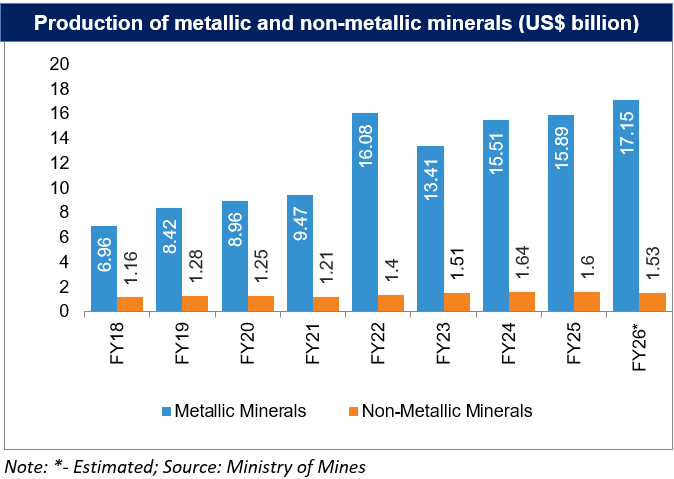
The estimated value of mineral production for FY26 is Rs. 1,71,460 crore (US $18.67 billion), as against Rs. 1,52,431 crore (US$ 17.49 billion) in FY25.
India’s copper demand is expected to grow about 7% annually, led by renewable energy expansion, electric vehicles, and infrastructure projects including industrial corridors, national highways, and the Housing for All programme, with domestic consumption already exceeding 7,50,000 tonnes against production of about 5,55,000 tonnes with demand projected to double by 2030.
GVA at basic prices from mining and quarrying stood at Rs. 5,08,554 crore (US 55.38 billion) in 2025–26 (FAE), as compared to Rs. 5,40,788 crore (US$ 62.05 billion) in 2024-25 (P), as per the Ministry of Statistics.
The construction sector’s Gross Value Added (GVA) at current prices was estimated at Rs. 27,99,847 crore (US$ 316.83 billion) for FY26 (FAE) against Rs. 26,27,009 crore (US$ 310.67 billion) for FY25 (PE).
The combined Index of Eight Core Industries (ICI) in October 2025 has remained unchanged at 162.4 (provisional) as compared to the Index in October 2024.
Investments/ Developments
Some of the investments/ developments in the Metals & Mining sector in the recent past are as follows:
- On February 26, 2026, NMDC’s R&D Centre signed an MoU with IIT Hyderabad to advance indigenous mineral processing, green steelmaking, critical mineral extraction, AI-enabled mining and Mining 4.0 technologies, strengthening India’s metals and mining innovation and sustainable development.
- India is accelerating critical minerals exploration and mining infrastructure under Atmanirbhar Bharat to strengthen supply chains for EVs, renewable energy and defence, while, on May 10, 2026, experts highlighted sustainable CSR initiatives supporting the metals and mining sector.
- Further developments noted on February 18, 2026 indicate that the industry is undergoing structural transformation through policy support such as the Critical Minerals framework, improved regulatory mechanisms, and growing global and domestic investments. The sector is also focusing on digitalisation, ESG practices, and supply chain strengthening, positioning it as a key driver of long-term economic growth and investment expansion.
- India’s metals and mining sector is entering a strong growth phase, supported by government reforms, accelerated mine auctions, and increased domestic exploration, as highlighted on November 6, 2025. The sector is also benefiting from rising demand for critical minerals linked to the global energy transition, alongside a push for mineral self-reliance and higher private sector participation.
- As of October 2025, non-fossil fuel sources now contribute 250.6 GW (49%) of total capacity, including 200.29 GW renewable and 8.78 GW nuclear.
- During the earnings call for Q2 FY26, Tata Steel plans a 7-7.5 million tonne capacity expansion across its Indian operations, with major brownfield projects at Kalinganagar, Neelachal, Meramandali, Ludhiana and Gamharia moving through planning and approval stages.
- India plans to train 5.7 million workers by 2030 in the mining sector under the National Critical Mineral Mission to boost domestic critical mineral production and cut import dependence.
- As of August 2025, JSW Steel and Japan’s JFE Steel are planning to jointly invest Rs. 5,845 crore (US$ 682 million) to expand capacity for cold-rolled grain-oriented electrical steel (CRGO) to 3,50,000 tonnes per annum by FY28 by scaling up the Nashik plant from 50,000 to 2,50,000 TPA and increasing the Vijayanagar unit’s capacity to 1,00,000 TPA.
- On July 7, 2025, Tata Steel signed a Memorandum of Understanding with Australia’s InQuik Group to bring modular bridge construction technology to India, using prefabricated steel formwork filled with concrete on site to enable faster, cost-effective, climate resilient and scalable bridge infrastructure, especially useful in remote regions.
- NALCO produced 37,736 Metric Tonne of Aluminium and sold 30,595 Metric Tonne of Aluminium metal in April, 2026.
- BALCO produced 50,994 Metric Tonne of Aluminium and sold 42,322 Metric Tonne of Aluminium metal in April, 2026.
- Vedanta Limited (Aluminium) produced 1,52,638 Metric Tonne of Aluminium and sold 1,43,666 Metric Tonne of Aluminium metal in April, 2026.
- In June 2025, India and Australia strengthened their Critical Minerals Investment Partnership to co-invest in lithium and cobalt projects and build resilient clean-energy supply chains.
- Between April 2000-March 2026, FDI inflows in the metallurgical industry stood at Rs. 1.20 lakh crore (US$ 19.3 billion), followed by the mining Rs. 21,794.45 crore (US$ 3.54 billion), diamond & gold ornaments Rs. 9,962.78 crore (US$ 1.54 billion), and coal production Rs. 119.19 crore (US$ 27.73 million).
- India’s steel exports in July 2025 saw a higher share from Belgium, Italy, Spain, Taiwan, Bulgaria, the US and Qatar, while the share of the UAE, Nepal and Portugal declined compared to July 2024.
- With the fifth-largest coal reserves and as the second-largest consumer, coal remains crucial for India, contributing 55% to the national energy mix and fuelling over 74% of total power generation as of April 2025.
- On March 28, 2025, AM/NS India has secured 890 hectares of land in Rajayyapeta, Anakapalli district, Andhra Pradesh for a new integrated steel mill with planned capacity of about 7 MTPA of crude steel, expanding beyond its Hazira operations to meet rising domestic demand.
- In January 2025, the Ministry of Steel has introduced the PLI Scheme 1.1 for specialty steel, covering five product categories, which aligns with the existing PLI Scheme. This initiative aims to encourage greater participation in response to industry requests for relaxation. The PLI Scheme 1.1 will be open for applications from January 6 to January 31, 2025, and will be implemented from FY26 to FY30.
- India and Kazakhstan have launched IREUK Titanium Limited, a joint venture to produce Titanium Slag in India, marking India's first venture in Central Asia. The company will convert low-grade Ilmenite into high-grade titanium feedstock, aiming to enhance the titanium value chain in India and create jobs in Odisha.
- Southeastern Coalfields Limited (SECL), a subsidiary of Coal India in Chhattisgarh, has reached a milestone with its Gevra and Kusmunda coal mines ranking 2nd and 4th on WorldAtlas.com’s list of the world's largest coal mines. Located in Korba district, these mines together produce over 100 million tons of coal annually, accounting for about 10% of India’s total coal production.
- India is experiencing a construction boom driven by a growing housing economy and significant government infrastructure investments. The country is projected to become the third-largest construction market in the world, following China and the US, by 2025.
Government Initiatives
The Government of India has adopted few initiatives in the recent past, some of these are as follows:
- On April 9, 2025, the Government launched the National Critical Mineral Mission (NCMM) to strengthen India's critical minerals sector through 1,200 exploration projects, faster approvals, private participation and processing infrastructure, boosting self-reliance and domestic mining capabilities.
- The Union Budget 2026–27, presented on February 1, 2026, outlines several government initiatives to strengthen India’s metals and mining sector as part of a broader push for industrial growth and self-reliance. Key measures include the proposal to develop dedicated mineral corridors in resource-rich states such as Odisha and Tamil Nadu, along with import duty exemptions on capital goods for critical mineral processing, aimed at boosting domestic production and value addition. The budget also emphasises manufacturing expansion, export promotion, and supply chain resilience, with a strong focus on critical minerals and downstream industries. These initiatives are expected to generate large-scale employment, enhance capacity creation, and position the sector as a key driver of economic growth amid evolving global supply chains.
- On November 26, 2025, the Union Cabinet chaired by Prime Minister Mr. Narendra Modi approved a Rs. 7,280 crore (US$ 809.8 million) “Scheme to Promote Manufacturing of Sintered Rare Earth Permanent Magnets (REPM)”, marking a major positive step for India’s metals and mining ecosystem. The initiative aims to establish 6,000 MTPA of integrated REPM manufacturing capacity, creating a complete domestic value chain from rare earth oxides to finished magnets, thereby strengthening self-reliance and positioning India as a key player in the global market. The scheme supports critical sectors such as electric vehicles, renewable energy, aerospace and defence, while also reducing import dependence, generating employment, and reinforcing supply chains in line with the Atmanirbhar Bharat vision and India’s Net Zero 2070 goals.
- In August 2025, the Commerce Ministry, via the DGTR, has recommended a three-year safeguard duty on imports of certain flat steel products, 12% in year one, 11.5% in year two, and 11% in year three, to protect domestic producers from a sharp import surge.
- India launched the seven-year National Critical Mineral Mission in January 2025 with a proposed Rs. 16,300 crore (US$ 1.9 billion) outlay and an expected Rs. 18,000 crore (US$ 2.1 billion) investment by Public Sector Undertakings and other stakeholders to secure key minerals for clean energy and advanced technologies.
- By May 27, 2025, the Centre had successfully auctioned a cumulative 34 critical/strategic mineral blocks across five tranches out of 55 offered, including the first ever potash block; these include both Mining Leases (ML) and Composite Licences (CL) across multiple states.
- In January 2025, the Cabinet approved the National Critical Mineral Mission to fund exploration-to-recycling, with multi year budgetary support and complementary PSU investments.
- In the Union Budget 2025-26, capital investment outlay for infrastructure is being increased by 11.1% to Rs. 11.2 lakh crore (US$ 129.0 billion). To encourage higher private participation, the government has proposed various measures.
- In February 2024, the Union Cabinet approved the amendment to the Mines and Minerals (Development and Regulation) Act,1957 specifying royalty rates for 12 critical minerals, thus completing the rationalization process for all 24 strategic minerals. This move aims to streamline the mining sector and auction processes, aligning with recent amendments to the MMDR Amendment Act, 2023.
- In December 2023, the Ministry of Mines proposed capping performance security and upfront amounts for mining critical minerals to attract more bidders. Currently based on a percentage of the Value of Estimated Resources (VER), the move aims to reduce barriers to participation in auctions and expedite the process for mining leases.
- In October 2023, the Union Cabinet approved the amendment of the Second Schedule of the Mines and Minerals (Development and Regulation) Act, 1957, specifying royalty rates for three critical minerals: Lithium, Niobium, and Rare Earth Elements (REEs) paving the way for the auctioning of blocks for these minerals, as outlined in the MMDR Amendment Act, 2023.
- The government plans to monetize assets worth Rs. 28,727 crore (US$ 3.68 billion) in the mining sector over 2022-25.
- In 2022, PLI Scheme for domestic production of specialty steel has been approved with an outlay of Rs. 6,322 crore (US$ 762.4 million) by the Cabinet.
- Import duty on Anthracite/Pulverized Coal Injection (PCI) coal, Coke, and Semi-coke and Ferronickel were reduced to zero.
- Export duty on Iron ores/ concentrates and iron ore pellets was raised to 50% and 45%, respectively.
- In addition, 15% export duty was imposed on pig iron and several steel products.
- The Ministry of Mines of the Government of India has signed MoUs with different nations.
- The National Steel Policy aims to boost per capita steel consumption to 160 kgs by 2030-31. The government has a fixed objective of increasing rural consumption of steel from the current 19.6 kgs per capita to 38 kgs per capita by 2030-31.
Road Ahead
India’s metals and mining sector is poised for strong growth, supported by favourable policies, abundant mineral resources, and rising demand from infrastructure, automotive, and energy sectors. Government initiatives such as the Union Budget FY27 measures, critical mineral focus, and increased investments are boosting domestic production, reducing import dependence, and strengthening supply chains. The sector contributes significantly to industrial development, GDP growth, and employment, while ongoing reforms, capacity expansions, and global partnerships are further enhancing its long-term growth potential and positioning it as a key driver of India’s self-reliance and economic expansion.
The Government of India has also helped in the development of the metals and mining sector in India by launching key policy initiatives. The National Mineral Policy, which was approved by the government in February 2019, has ensured improved regulation and enforcement, more transparency, balanced social and economic growth, and sustainable mining techniques. The policy grants industry status to the mining activities and boost private sector funding. Additionally, it aims to facilitate the merger and acquisition of mining companies, entice private sector involvement in exploration,
and permit the transfer of mineral corridors created specifically for metals and mining leases. In the future, both increased domestic demand and exports are projected to play significant roles in driving the industry's expansion and its contribution to GDP growth in a post-covid environment.
References: Media Reports, Press Information Bureau (PIB), Union Budget 2026-27, Ministry of Mines, Ministry of Coal, Ministry of Steel, Central Electricity Authority, Ministry of New and Renewable Energy, DPIIT
FAQs
The metals and mining industry in India is expanding steadily, supported by rising mineral production, growing steel and aluminium output, and increasing investments. India is also strengthening domestic mining to meet demand from infrastructure, manufacturing, and clean energy sectors.
India's mining industry produces a wide range of minerals, including iron ore, coal, bauxite, chromite, limestone, copper, lignite, and aluminium. The country is largely self-sufficient in several key metallic minerals that support industrial and infrastructure development.
The Government is strengthening the metals and mining sector in India through the National Critical Mineral Mission, mineral corridor development, PLI schemes for specialty steel, mine auctions, and policy reforms to boost domestic production and value addition.
The Indian mining industry is witnessing rapid transformation through critical mineral exploration, Mining 4.0 technologies, digitalisation, green steelmaking, capacity expansion, and strategic partnerships that improve supply chains and strengthen mineral self-reliance.
Major companies in the metals and mining industry in India include NMDC, Coal India, Tata Steel, Vedanta, NALCO, BALCO, JSW Steel, and AM/NS India. These companies are expanding production capacity while investing in technology, sustainability, and value-added manufacturing.
The Indian mining sector attracted cumulative FDI inflows of Rs. 21,794.45 crore (US$ 3.54 billion) between April 2000 and March 2026. The broader metallurgical industry received Rs. 1.20 lakh crore (US$ 19.3 billion) during the same period.
The metals and mining industry in India is expected to witness strong long-term growth, supported by critical mineral development, infrastructure expansion, rising domestic demand, and government reforms that promote investment, self-reliance, and sustainable mining practices.
Related News
MOREMajor Mining States
- Andhra Pradesh
- Jharkhand
- Odisha
- Rajasthan
- Karnataka
- Madhya Pradesh
- Maharashtra


IBEF Campaigns
MORE

Aatmanirbhar Bharat Utsav 2024
Union Minister of External Affairs, Dr. S. Jaishankar and Union Commerce an...
Case Studies
MORESUV Dominance and the Future of Passenger Vehicles

India's passenger vehicle industry over the past two decades have been gone under significant changes. In particular, the market has been transfor...
Expressway Infrastructure Development Outlook in India
India's vision of becoming a Viksit Bharat by 2047 has positioned transport infrastructure as a cornerstone of its long-term economic growth strat...
The Rise of Contract Manufacturing in India's Electronics Sector
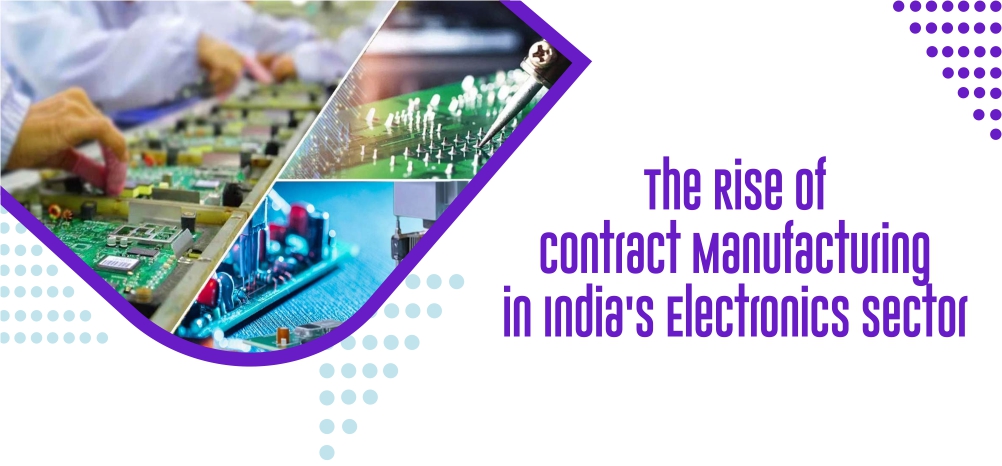
India's rise to become a large center for electronics manufacturing services is one of the most significant manufacturing changes in India's r...
IBEF BLOG
MORE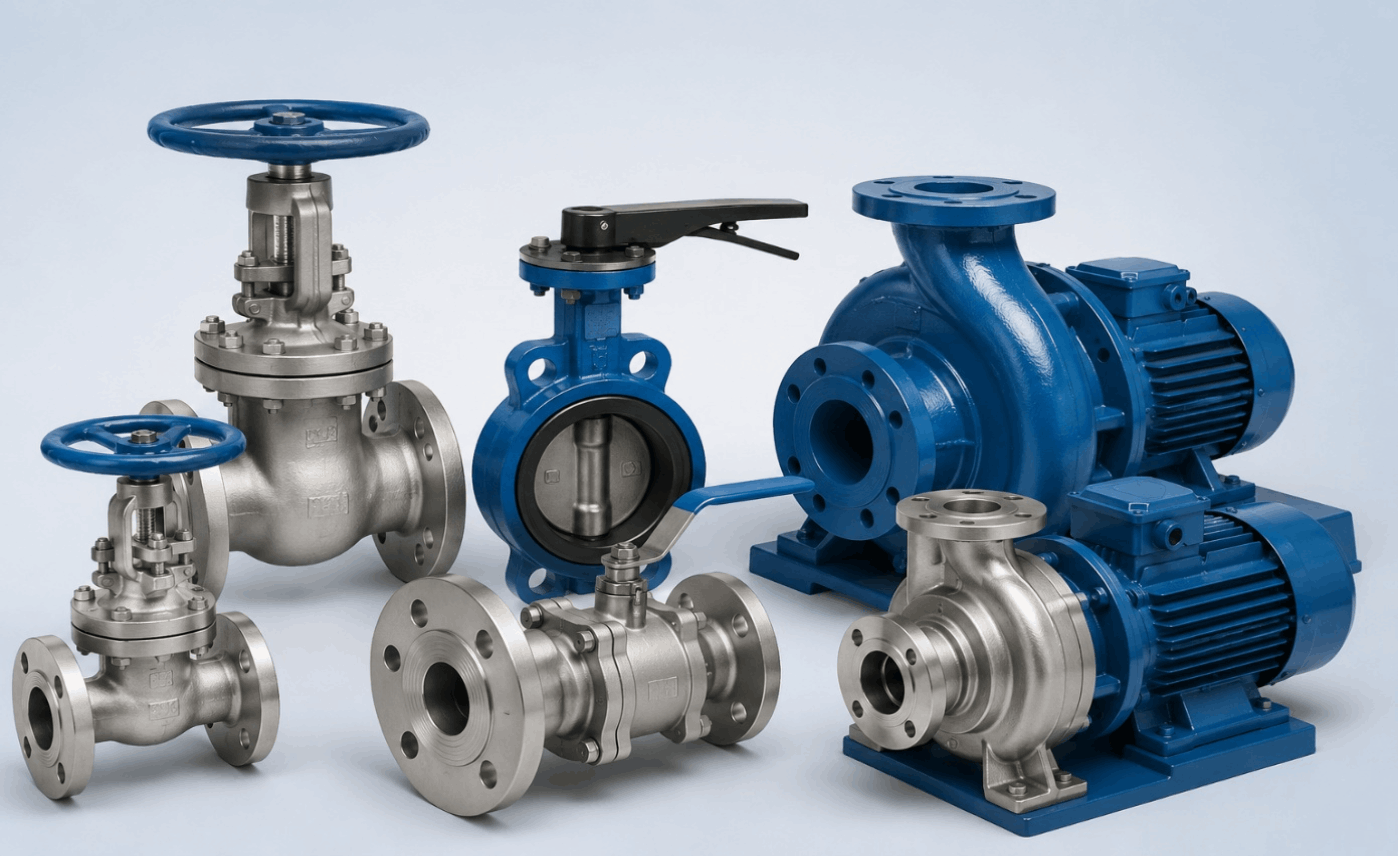
How India's Industrial Valve and Pump Industry Supports Infrastructure and Manufacturing
Pumps and industrial valves represent the basic building blocks of today&rs...

India's Premium Fresh Produce Exports: Creating New Opportunities for Farmers
India has emerged as a major exporter of horticulture crops owing to the pr...

India's Content Economy: Building Global Audiences Through Digital Entertainment
The digital entertainment ecosystem in India is currently experiencing a fu...
Partners