Introduction
The jute industry is among the oldest and most prominent industries in India. The major jute-producing states in India are West Bengal, Assam, Bihar, Orissa, and Andhra Pradesh. However, the Indian jute industry mainly depends on West Bengal due to the higher number of mills. The industry employs about four lakh workers, including workers dependent on the jute industry's forward and backward linkages. The average land area under raw Jute and Mesta cultivation stands at 6,62,000 hectares.
The Jute industry occupies an important place in the national economy of India. Jute, the golden fiber, meets all the standards for ‘safe’ packaging because it is a natural, renewable, biodegradable, and eco-friendly product. The jute industry in India produces different types of jute products such as hessian or burlap (plain-woven fabric), sacking (loosely woven cloth), food-grade jute cloth, yarn, carpet backing cloth, blankets, decorative fabrics,
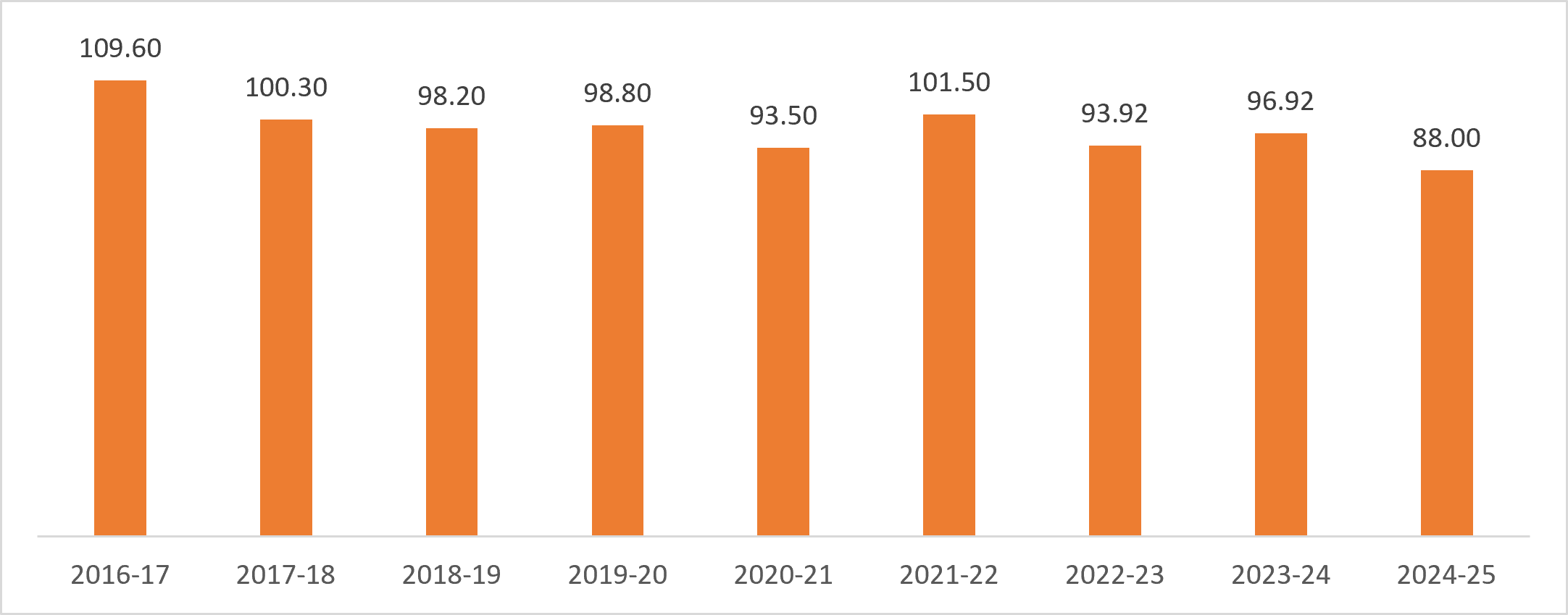
India’s Raw Jute and Mesta production trend (lakh tons)
Source: RBI Handbook of Statistics
floor coverings, and shopping bags. India has an installed capacity of over 50 million spindles and 8,42,000 rotors. India is the leading jute goods-producing country globally, accounting for about 75% of estimated world production. Most of the Jute is consumed domestically due to its vast domestic market demand, with an average domestic consumption of 90% of total production. As per the Ministry of Textiles, India’s raw jute production for 2025–26 (estimated) is placed at 75 lakh bales (of 180 kg each), compared to 73 lakh bales [HK1.1]in 2024–25, indicating a marginal increase in production.
Export Trend
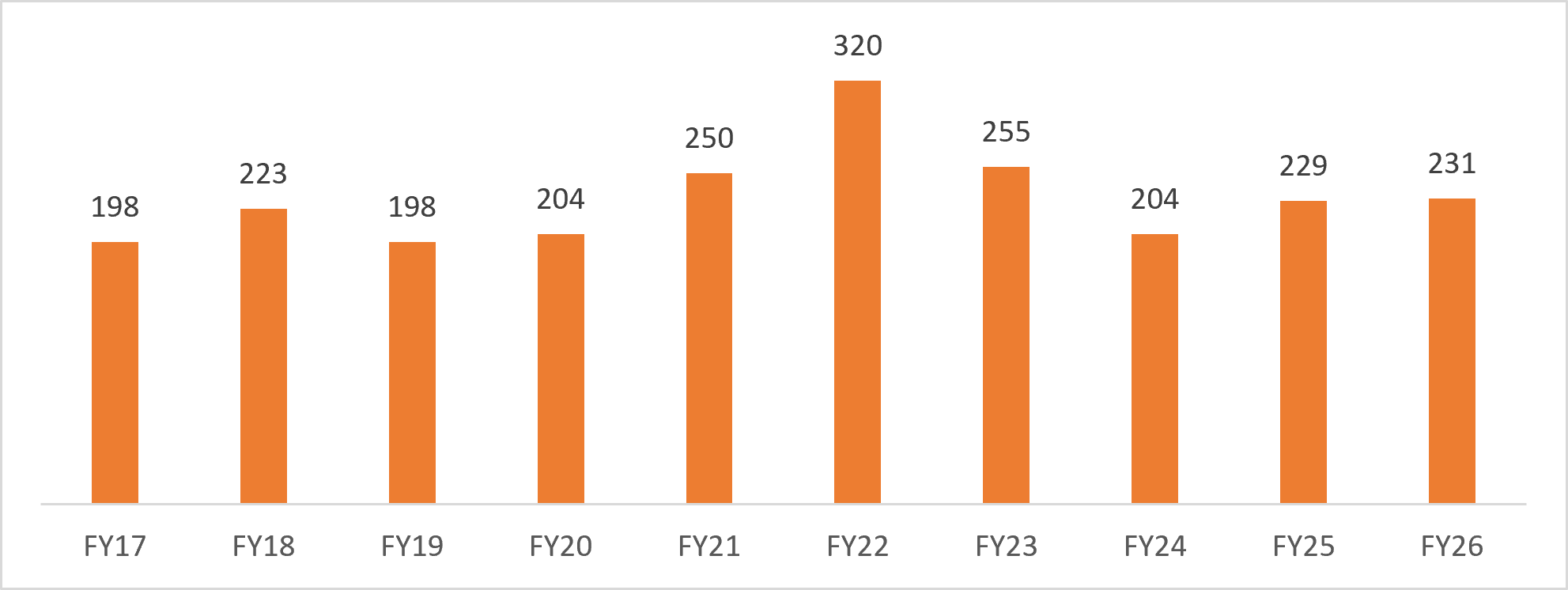
India’s jute exports trend (US$ million)
Source: Department of Commerce, National Jute Board, Indian Jute Mills Association
The exports of Indian jute and jute products have demonstrated a steady performance, supported by consistent global demand for eco-friendly and biodegradable materials. India continues to export a diversified basket of jute products including floor coverings, jute hessian, jute yarn, and raw jute, with value-added products contributing significantly to overall export earnings. The sector remains an important component of India’s agri-based exports, driven by sustainability trends and growing international preference for natural fibres.
During FY 26, India’s total jute exports stood at US$ 231.49 million, compared to US$ 229 million in FY25, indicating a marginal moderation in export value. Among key product categories, jute Hessian emerged as the largest contributor with exports valued at US$ 112.45 million, followed by floor coverings of jute at US$ 76.32 million.
Raw jute exports stood at US$ 25.22 million, while jute yarn accounted for US$ 17.44 million, reflecting a balanced contribution from both traditional and value-added segments. Overall, the export trend indicates stable demand across categories, with slight variations driven by global pricing and demand conditions.
Export Destinations
India exports jute and jute products to a wide range of global markets, with key destinations including the USA, Nepal, the UK, Germany, the Netherlands, the UAE, France, Australia, Spain, and Canada. During FY26, total jute exports stood at US$ 231.49 million, reflecting steady demand across both developed and emerging markets. The export basket comprises floor coverings of jute, jute hessian, jute yarn, and raw jute, catering to diverse industrial and packaging needs globally.
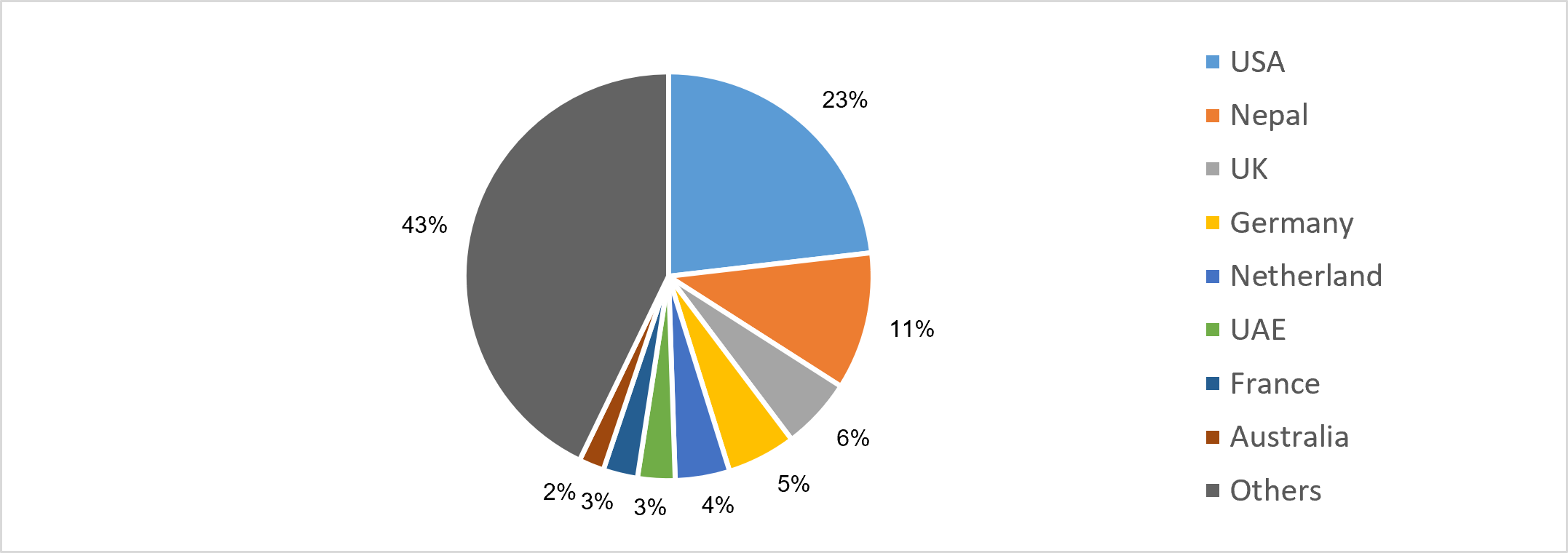
During the same period, the United States emerged as the leading importer, accounting for US$ 48.89 million (22.71%) of total exports. It was followed by Nepal with US$ 24.00 million (11.15%), while the UK accounted for US$ 12.13 million (5.63%) and Germany for US$ 11.63 million (5.40%). Other key markets included the Netherlands (US$ 8.91 million; 4.14%), UAE (US$ 6.70 million; 3.11%), and France (US$ 6.00 million; 2.79%), highlighting a well-diversified export footprint across regions.
Country-wise share of India’s jute exports FY26
Source: NIRYAT, National Jute Board
Government Initiatives
Government initiatives and recent policy support are playing a key role in strengthening india’s jute exports and overall sector growth. The recently announced national fibre scheme aims to promote self-reliance in natural fibres like jute, improve fibre quality and productivity, and strengthen the domestic fibre ecosystem, which is expected to enhance export potential and competitiveness. At the same time, the government is implementing the national jute development program (NJDP), which includes schemes such as market development, diversification, capital subsidy, and production-linked incentives to support exporters and boost value-added jute products. Additionally, measures like mandatory packaging of food grains in jute, minimum support price (msp) for farmers, and support for participation in international trade fairs are helping expand market access and promote jute exports globally.
For the modernization and development of the jute industry in India, the National Jute Board has implemented several schemes and initiatives. Some of the schemes meant for the improvement in production are Improved Cultivations and Retting Exercises (ICARE), Jute Diversifications Scheme, Jute Resource-cum Production Centre (JRCPC), and Jute Retail Outlet scheme for exposure to products and artisans.
The Market Development and promotion, Domestic Market Promotion Activities (DMPA), and other publicity and promotion activities and schemes are meant to increase the sales and exports of jute products in India.
The Union Cabinet on January 22, 2025 approved a minimum support price of Rs. 5,650 (US$ 65.95) per quintal for raw jute for marketing season 2025-26, an increase of 6% or Rs. 315 (US$ 3.68) over the previous MSP. The new MSP ensures return of 66.8% over all-India weighted average cost of production and will benefit growers, Union Minister for Commerce and Industry, Mr. Piyush Goyal said.
The Jute Corporation of India formally raised the MSP to Rs. 5,650 (US$ 64) per quintal for 2025-26, aligning with cabinet approval. This is part of a consistent upward trend in MSP since 2014-15 when it stood at Rs. 2,400 (US$ 27.22) per quintal.
On March 7, 2024, the Cabinet Committee on Economic Affairs chaired by Prime Minister Mr. Narendra Modi, approved the Minimum Support Price (MSP) for raw jute for the 2024-25 season at US$ 63.66 (Rs. 5,335) per quintal, ensuring a 64.8% return over the all-India weighted average cost of production.
Export Market Promotion Activities (EMPA)
Under EMPA, the government implements various activities like international-level fairs in India, international fairs abroad, international mega fairs, business delegations/ road shows/ international conferences and seminars, etc.
Market Development & Promotion Scheme (MDPS)
MDPS scheme aims to develop, promote, and expand markets for Jute and Jute diversified products within India and abroad. It provides selling, marketing, and promoting platforms/avenues to Jute Artisans, entrepreneurs, women self-help groups, Jute MSMEs, Jute exporters, and Jute millers.
Capital Subsidy for Acquisition of Plants and Machinery (CSAPM) Scheme
CSAPM scheme has been approved by the Ministry of Textiles, Govt. of India and is implemented through the National Jute Board (NJB), a statutory body under the Ministry of Textiles, Govt. of India. The objective of the Scheme is to provide financial assistance to the beneficiaries for the purchase of Jute diversified products (JDP) manufacturing machinery. This Scheme is initiated under the National Jute Development Program (NJDP) umbrella scheme of NJB during the 15th Finance Commission (2021-26).
Governing Body
National Jute Board
The National Jute Board (NJB), established under the National Jute Board Act, 2008 and operational since February 2009, functions as a statutory body under the Ministry of Textiles, Government of India, to promote and develop the jute sector. It focuses on enhancing competitiveness through research, innovation, skill development, and support for both traditional and diversified jute products. The Board implements initiatives such as technology upgradation, financial assistance, training, and welfare measures, while also promoting eco-friendly jute products in global markets. Additionally, NJB emphasizes sustainable jute processing and provides structured, timely, and digital support services to stakeholders across the industry.
Jute Product Development & Export Promotion Council (JPDEPC)
The JPDEPC was created in 1958 to advocate the exports of jute and jute products in India. The activities of the council are to arrange fairs and expositions, analyze the buyer-seller market, and act as a registration authority for exporters. The management of the council is supervised by a committee of 12 people, two of whom were nominated by the government of India. Presently, the council has 250 members covering various segments of manufacturing and trading of jute products.
RELATED SITES

DA-149 (Ground Floor), Sector -I
Salt Lake City
Kolkata 700064
West Bengal
India
Tel.:+91-33-40620624
Fax: +91-33-40620624
Email: office@jpdepc.org
Website: http://www.jpdepc.org
Partners




