Advantage India
Skilled human
capital
*With a total population of 1.4 billion, 47% being under the age of 25, India has a large pool of young and skilled workforce.
*India has a large reservoir of scientific human resources including scientists and engineers.
*Biotechnology has emerged as a trending career option among the youth. According to a survey of Class 12th students in Delhi, Biotechnology was ranked as the preferred stream at No.4/5.

Infrastructure
facilities
* India currently has 12 DBT-supported biotechnology parks and 95 BIRAC-supported bio-incubators (75 Bio-NEST and 20 E-Yuva centres) as of 2025.
* Union Minister of Earth Sciences Dr. Jitendra Singh inaugurates the Northeast's first International Biotech Conclave.
* Department for Promotion of Industry and Internal Trade (DPIIT) signed an MoU with Thermo Fisher Scientific to support over 500 biotech startups in the next three years through advisory, technology access, mentorship, and investor connect.

Policy
Support
* The National Biopharma Mission (NBM–i3), led by DBT and implemented by BIRAC with World Bank support, has a Rs. 2,137 crore (US$ 250 million) budget, supports 101 projects with 150+ organisations and 30 MSMEs, set up 11 shared facilities, and created 1,000+ jobs including 304 scientists, alongside the Genome India Programme sequencing 10,000 genomes.
* The government envisions creating biofoundries, Bio AI centres, and thematic hubs focused on bio-based chemicals, smart proteins, and carbon capture as part of policy support to foster biomanufacturing and innovation.
* The Cabinet has approved the merger of two DBT schemes into ‘Biotechnology Research Innovation and Entrepreneurship Development (Bio-RIDE)’, with a new Biomanufacturing and Biofoundry component, allocating Rs. 9,197 crore (US$ 1.1 billion) for 2021-22 to 2025-26 under the 15th Finance Commission.

Epidemiological
factors
* Patient pool expected to increase over 20% in the next 10 years, mainly due to rise in population.
* New diseases & lifestyle changes to boost demand for drugs and devices.

Introduction
India is among the top 12 biotechnology destinations worldwide and the third-largest market in the Asia-Pacific region, commanding around 3% of the global biotech market. The Department of Biotechnology (DBT), under the Ministry of Science and Technology, has been instrumental in building a strong ecosystem for research, innovation, and commercialization across biopharmaceuticals, bio-services, bio-agriculture, bio-industrial, and bio-IT. The sector demonstrated its strength during the Covid-19 pandemic by rapidly developing vaccines, antivirals, diagnostic tools, and medical devices, which also positioned India as a reliable global supplier.
The country hosts 665 FDA-approved plants in the US, accounts for 44% of global abbreviated new drug applications (ANDA) and operates over 1,400 WHO-compliant manufacturing facilities. India is also the world’s third-largest producer of the recombinant Hepatitis B vaccine and the second-largest producer of BT cotton, underscoring its manufacturing depth and global competitiveness. The number of biotech startups has also surged from just 50 in 2014 to nearly 11,000 by 2025, making India one of the fastest-growing global hubs for biotech innovation.
Market Size
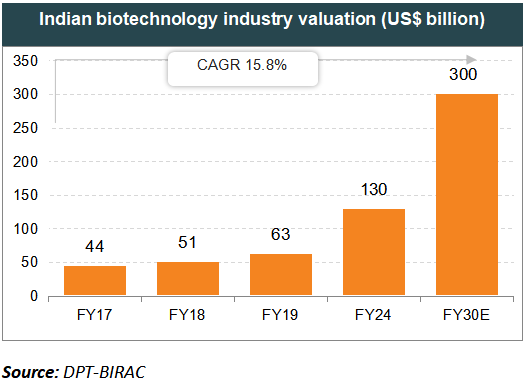
India’s bio-economy has witnessed remarkable growth, expanding from Rs. 86,880 crore (US$ 10 billion) in 2015 to Rs. 11,29,440 crore (US$ 130 billion) in 2024 and is projected to reach Rs. 26,06,400 crore (US$ 300 billion) by 2030. A significant boost came from the Covid-19 vaccination and testing drive, which contributed nearly a fifth of the bioeconomy at Rs. 1,26,497 crore (US$ 14.56 billion). Of this, vaccines accounted for Rs. 75,585 crore (US$ 8.7 billion) and testing Rs. 51,259 crore (US$ 5.9 billion), with 1.45 billion vaccine doses administered in 2021 and 1.3 million tests conducted daily.
India’s biotechnology market size was valued at approximately US$ 37.1 billion in 2025 with an expected compound annual growth rate (CAGR) of 13.09% during 2026-34, potentially reaching US$ 112.2 billion by 2034. Growth drivers include rising demand for personalized medicine, chronic disease treatments, and integration of IT with biotech for precision medicine.
Biopharma continues to dominate the sector, accounting for 49% of the bioeconomy with an estimated economic contribution of US$ 39.4
billion. By 2025, India’s vaccination market is expected to reach Rs. 252 billion (US$ 3.04 billion). A milestone achievement came in July 2022, when India’s first indigenously developed quadrivalent Human Papilloma Virus (qHPV) vaccine against cervical cancer, supported by DBT and BIRAC, received market authorization from DCGI.
Between 2015 and 2020, India’s biotechnology industry doubled in size, growing from US$ 30.2 billion to US$ 70.2 billion. Looking ahead, the sector is projected to reach US$ 150 billion by 2025 and has the potential to scale up to US$ 270-300 billion by 2030, with India’s share in the global biotechnology market expected to climb to 19%. The biologics market alone is forecasted to reach US$ 12 billion by 2025, growing at a CAGR of 22%. Complementing this, India’s stem cell therapy market is expected to expand at over 13% CAGR during 2022-27, driven by strong government support, private sector investment, and robust research infrastructure.
Investments and Recent Developments
India allows 100% FDI under the automatic route (a non-resident or Indian company will not require any approval from the government) for greenfield pharmaceuticals and manufacturing medical devices. Some recent developments/investments in the Indian pharmaceutical sector are as follows:
- As of September 2025, India has around 11,000 biotech startups, up significantly from 8,531 in 2023, indicating thriving innovation across diverse biotech segments including biopharmaceuticals.
- India’s cell and gene therapy market is projected to reach US$ 1.65 billion by 2027, growing robustly. Bharat Biotech, Syngene, Laurus Labs, and Aragen are entering next-gen medicine manufacturing, including approvals for two indigenous CAR-T therapies, expected to make advanced cancer and genetic treatments more accessible and affordable.
- India's pharmaceutical exports reached Rs. 2,60,683 crore (US$ 30.5 billion) in FY25, marking a 9.3% increase from the previous year, according to a new report by Rubix Data Sciences, a leading provider of risk management and monitoring solutions.
- The report projects that the country’s pharma exports could double to Rs. 5,55,555 crore (US$ 65 billion) by 2030.
- Shoolini University highlighted its contribution with infrastructure supporting 104+ advanced laboratories and 11 Centres of Excellence in biotech-related fields, supported by government grants to boost innovation and research facility quality.
- Department for Promotion of Industry and Internal Trade (DPIIT) signed an MoU with Thermo Fisher Scientific to support over 500 biotech startups in the next three years through advisory, technology access, mentorship, and investor connect.
- Kathua is projected to become a frontline leader in North India’s biotech-driven economic growth, supported by startups and new incubation facilities at the biotech park, with government backing.
- Bharat Biotech made a major US$ 75 million investment in its first integrated cell and gene therapy facility in Hyderabad, signaling a shift to advanced personalized medicine with expected launches by 2028.
- The Telangana government has secured a significant investment of Rs. 2,150 crore (US$ 251.55) in the biotech, technology, and fintech sectors, officials said on June 10, 2025, highlighting the state's growing appeal to venture capitalists and entrepreneurs.
- India’s bioeconomy, backed by Bio-E3 and Bio-RIDE policies, has grown 16-fold in the past decade to Rs. 14,16,237 crore (US$ 165.7 billion) in 2024 and is projected to touch Rs. 25,64,100 crore (US$ 300 billion) by 2030, reinforcing its role as a global innovation and growth driver.
- Biofoundries and biotech clusters represent a crucial step in India’s journey towards becoming a global leader in biotech innovation. With continued government support and industry collaboration, the sector is poised to break new ground, empowering startups to turn their ideas into impactful ventures.
- India has become the third-largest destination for conducting clinical trials globally as of 2024, growing at a CAGR of 80% from 2019. Around 18,000 clinical trials were registered in India in 2024 alone, with commitments from global companies for drug development and innovation. The National Biopharma Mission is strengthening clinical trial capacity and enabling hospital-based trials in multiple specialties.
- According to Parexel, India is ready to step in as an alternative site for early-stage clinical trials, the US-based company plans to boost its headcount in India by more than 2,000 over the next three to five years, from about 6,000 currently.
- In March 2024, Union Minister of Science & Technology, Dr. Jitendra Singh, inaugurated the pioneering "National Speed Breeding Crop Facility" at the National Agri-Food Biotechnology Institute (NABI) in Mohali.
- In December 2023, the Gujarat Chief Minister also inaugurated the ‘Start-Up Product Launch’ which included innovative products developed by startups such as Bioscan, SynerSense, Iota, and STRUmed Solutions during the 10th Vibrant Gujarat Global Summit. The Pre-Summit also witnessed the signing of a Memorandum of Understanding (MoU) between Indus Setu Global Foundation and Gujarat State Biotechnology Mission.
- In November 2023, Bharat Biotech signs MoU with University of Sydney Infectious Diseases Institute (Sydney ID) to collaborate on vaccine research initiatives and strengthen academic-industry partnerships.
- In October 2023, the Uttarakhand government signed several MoUs worth Rs. 5,450 crore (US$ 653.97 million) with industrial bodies in Dubai.
- In October 2023, the Uttar Pradesh government is planning to establish a Biotech Park in Pilibhit.
- In August 2023, CSIR- National Institute of Science Communication and Policy Research (NIScPR) published a special issue of the Indian Journal of Biochemistry and Biophysics (IJBB) on Biological Electron Microscopy and Nanobiotechnology.
- In August 2023, the Department of Biotechnology (DBT) and the United States-National Science Foundation (US-NSF) announced to build bilateral collaborations between India and the USA through this Implementation Arrangement.
- In August 2023, Technology Development Board (TDB) and the Department of Science & Technology (DST) partnered with Chemlife Innovations for the Innovative Bio-Trace Minerals Project to enhance livestock productivity, optimize feed, and fodder resources and infuse technology into livestock management.
- In July 2023, 15 companies sign MoUs worth Rs. 2,000 crore (US$ 239.99 million) in a day, for investments in biotech sector.
- In July 2023, Aurigene Pharmaceutical Services to set up a US$ 40 million facility in Hyderabad.
- In July 2023, India and Argentina agreed to a bilateral exchange of young researchers and Startups, particularly in the field of Biotechnology and Agriculture.
- In July 2023, Biocon Biologics launched a biosimilar version of AbbVie's top selling biologic Humira (generically called adalimumab) in the US market under the brand name HULIO.
- In May 2023, India and Israel will strengthen their connection in areas such as innovation and start-ups, ushering in a new period of deeper bilateral cooperation.
- Union Minister Dr. Jitendra Singh inaugurates the Northeast's first International Biotech Conclave.
- In February 2023, Serum Institute of India announces centre of excellence in Hyderabad to tackle future pandemics.
- In February 2023, Bristol-Myers Squibb intends to invest Rs. 800 crore (US$ 96.69 million) in establishing a cutting-edge centre in Telegana to boost its global medical development and IT capabilities.
- In January 2023, Yashoda Super Specialty Hospital will invest about Rs. 500 crore (US$ 60.42 million) in establishing a Biotech Park and 300-bedded hospital in Greater Noida, while Yashoda Medicity will invest Rs. 800 crore (US$ 96.67 million) in Ghaziabad to set up a new hi-tech hospital with a capacity of 1200 beds.
Government Initiatives
The Government of India has taken multiple initiatives to make India competitive internationally in biotechnology research, innovation, entrepreneurship, and industrial growth. Some of these are:
- The government envisions creating biofoundries, Bio AI centres, and thematic hubs focused on bio-based chemicals, smart proteins, and carbon capture as part of policy support to foster biomanufacturing and innovation.
- The Department of Biotechnology (DBT), Government of India, is driving a transformative shift in North-East India (NER) by integrating biotechnology with biodiversity conservation and economic growth. Since 2010, DBT has allocated 10% of its annual budget to specialized programs in NER, fostering research, education, and entrepreneurship.
- The Cabinet has endorsed the consolidation of two Department of Biotechnology schemes into Biotechnology Research Innovation and Entrepreneurship Development (Bio-RIDE) with a new Biomanufacturing and Biofoundry component. The budget allocation for 'Bio-RIDE' is Rs. 9,197 crore (US$ 1.1 billion) for 2021-22 to 2025-26 under the 15th finance commission.
- In March 2024, Union Minister of Science & Technology, Dr. Jitendra Singh, inaugurated the pioneering "National Speed Breeding Crop Facility" at the National Agri-Food Biotechnology Institute (NABI) in Mohali.
- The Department of Biotechnology (DBT) of the Ministry of Science and Technology in India, and UNESCO-TWAS established a fellowship program for foreign scholars from developing countries who wish to pursue research towards PhD/post-doctoral research in biotechnology.
- The National Biotechnology Development Strategy 2020-25 provides the government with a platform to strengthen skill development, resource and innovation converging into one strong ecosystem for knowledge sharing.
- In July 2023, the National Biopharma Mission is supporting 101 projects including more than 150 organizations and 30 MSMEs. It has increased employment opportunities and engaged 1,065 manpower including 304 scientists/ researchers.
- In April 2023, under the Biotech-KISAN scheme, 160,000 farmers received benefits during the last one-year (January-December 2022).
- The Indian government has accepted to announce a new initiative to encourage pharmaceutical research and development (R&D) in the Union Budget for 2023-24.
- In the Interim Budget 2024-25, the Department of Biotechnology (DBT) was allotted Rs. 2,251.52 crore (US$ 271 million).
Department of Biotechnology
- Atal Jai Anusandhan Biotech Mission was implemented by Department of Biotechnology (DBT), Ministry of Science and Technology. The purpose of this mission is to address the challenges of maternal and child health, antimicrobial resistance, vaccines for infectious disease, food and nutrition, and clean technologies.
BIRAC
- Biotechnology Industry Research Assistance Council (BIRAC) established by the Department of Biotechnology (DBT) is aimed at strengthening and empowering emerging biotechnology enterprises to undertake strategic research and innovation.
- In February 2022, BIRAC invited proposals for development, validation, and pre- commercialization of products/ technologies in the areas of healthcare, energy and environment, veterinary sciences and aquaculture, agriculture, and secondary agriculture.
Biotech Parks
- The Department of Biotechnology (DBT) has supported 11 Biotechnology Parks in various States.
- Biotechnology Parks and Incubators are established across the country by the Department of Biotechnology (DBT), under the Ministry of Science and Technology, to translate research into products and services by providing the necessary infrastructure support.
- These biotechnology parks offer facilities to scientists, and SMEs for technology incubation, technology demonstration and pilot plant studies to accelerate the commercial development of biotechnology.
- The government supports nine biotechnology parks in various states with the bulk being in the southern region of the country.
Road Ahead
India’s biotechnology sector is entering a transformative phase, driven by entrepreneurship, innovation, and a thriving start-up ecosystem. The increasing number of biotech incubators and clusters is strengthening collaboration between academia, industry, and government, while also nurturing talent and encouraging indigenous research. This innovation pipeline is helping position India as a global hub for affordable, high-quality biotechnology solutions.
The sector is expected to play a pivotal role in addressing challenges across healthcare, agriculture, energy, and the environment. Rising demand for vaccines, biosimilars, diagnostics, and medical devices is opening new market opportunities, while advancements in stem cell research and bio-manufacturing are creating avenues for high-value growth.
With strong government support, rising private investment, and expanding export potential, India’s bioeconomy is projected to reach US$ 300 billion by 2030, significantly enhancing its contribution to GDP and global biotechnology leadership.
References: Department of Biotechnology, Association of Biotechnology Led Enterprises, BIRAC, Global Bio-India, Union Budget 2023-24, 2024-25

Related News
MOREBIOTECHNOLOGY CLUSTERS
- Haryana
- Bengaluru
- West Bengal
- Maharashtra

Industry Contacts
- Department of Biotechnology, Ministry of Science & Technology
- Department of Science and Technology, Ministry of Science and Technology
- Biotechnology Industry Research Assistance Council (BIRAC)
- Council of Scientific and Industrial Research (CSIR)
- Association of Biotechnology Led Enterprises (ABLE)
- The Biotech Research Society, India
Posters
MORE
CATALYSING GROWTH
The Indian biotechnology industry amounted to US$ 63 billion in 2019 and is forecast to reach US$ 150 billion by 2025.
IBEF Campaigns
MORE

Aatmanirbhar Bharat Utsav 2024
Union Minister of External Affairs, Dr. S. Jaishankar and Union Commerce an...
Case Studies
MOREThe New-Age Logistics Revolution in India: Drone Deliveries, Cold Chains, and Hyperlocal Solutions

India’s logistics sector is undergoing a transformative revolution, driven by digitalization, new delivery models, and proactive policy support....
Inflation Trends and Consumer Price Index Insights for the Economy of India

Over the past decade, India has transformed its inflation landscape, evolving from a high-inflation environment in the early 2010s to one characterize...
The Evolution of Quick Commerce in India: A Sectoral Analysis

Indian retail has undergone a dramatic shift over the past few years. Not too long ago, urban Indians stocked up on groceries and daily essentials wit...
IBEF BLOG
MORE
India Packaged Drinking Water Industry: Demand Trends and Market Outlook
India’s packaged drinking water industry has become an integral part ...
Pharmaceutical Companies in India Advancing Innovation and Global Reach
India’s pharmaceutical sector is transitioning into a phase of capabi...

India Men’s Grooming Industry: Expanding Product Categories and Consumer Base
India’s men’s grooming industry is undergoing a significant tra...
Partners