Advantage India
Growing
Demand
* In 2025, the revenue of the headphones market in India is estimated at Rs. 22,433 crore (US$ 2.56 billion) and is expected to register an annual growth rate of 2.45% (CAGR 2025-2030).
* As of August 2025, India’s dishwasher market is valued between Rs. 596 crore (US$ 68 million) and Rs. 745 crore (US$ 85 million). The market is projected to expand at a CAGR of 3-12% over the next 10 years, with annual sales expected to surpass 1,85,000 units by 2030.
* Average monthly spending on consumer durables soared by 72% in FY25, fuelled by a growing wave of home ownership and the demand for furnishing new homes with appliances, according to the CMS Consumption Report 2025.

Opportunities
* Tech players such as Play (a tech brand) are focusing on tapping the Indian consumer electronics market, developing an electronic components manufacturing base in India, and encouraging export.
* In 2023-24, India’s workforce stood at 590 million, with 13.6% in formal and 86.4% in informal jobs. The formal temporary workforce reached 5.4 million in 2024, growing steadily from 2019-20 to 2023-24, as firms increasingly adopt flexible staffing for demand shifts and compliance needs.
* With robust growth, India aims to achieve electronics manufacturing worth US$ 300 billion in electronics and exports of US$ 120 billion by FY26.

Policy
Support
* 100% FDI allowed in the electronics hardware-manufacturing.
* As of January 20, 2025, under the PLI Scheme for White Goods (Air Conditioners and LED Lights) approved for 2021-22 to 2028-29 with an outlay of Rs. 6,238 crore (US$ 711.85 million), 84 companies have committed investments of Rs. 10,478 crore (US$ 1.20 billion), expected to generate production worth Rs. 1,72,663 crore (US$ 19.70 billion) during the scheme period.

Increasing
Investments
* Between April 2000-March 2025, electronic goods attracted FDI inflows of Rs. 49,715 crore (US$ 6.87 billion).
* The setting up of a Rs. 417 crore (US$ 47.6 million) Electronics Manufacturing Cluster (EMC 2.0) at Gautam Buddha Nagar, Uttar Pradesh. It aims to boost local manufacturing and innovation.

Introduction
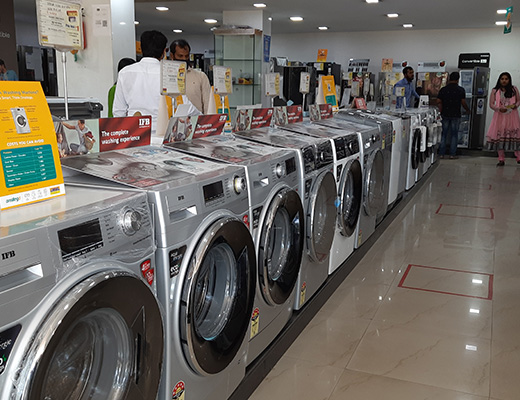
The Indian consumer durables market is one of the fastest-growing segments of the economy, attracting global interest due to its vast consumer base and rising disposable incomes. The sector spans consumer electricals such as fans, lighting devices, and kitchen appliances, as well as white goods including washing machines, televisions, refrigerators, and air conditioners. With its mix of a large middle class, a growing affluent population, and increasing penetration into rural markets, India is viewed as a key driver of global demand in the years ahead.
Market dynamics are shifting from unorganised to organised players, with an estimated 30% of the industry still unorganised. This transition presents significant opportunities for listed Indian companies to capture greater market share. At the same time, emerging trends such as artificial intelligence, manufacturing automation, and Industry 4.0 are reshaping production processes. Investments in R&D and technology infrastructure are expected to enhance manufacturing efficiency, while greater consumer awareness of smart technologies will fuel adoption across categories.

The sector’s strong growth is evident in recent figures. As of August 2025, refrigerator revenues were estimated at Rs. 1,06,208 crore (US$ 12.12 billion), washing machines at Rs. 43,552 crore (US$ 4.97 billion), and air conditioners at Rs. 65,598 crore (US$ 7.52 billion). The Production-Linked Incentive (PLI) scheme for white goods, with an outlay of Rs. 6,238 crore (US$ 711.85 million) has further boosted investments. As of January 2025, 84 companies had committed Rs. 10,478 crore (US$ 1.20 billion), expected to generate production worth Rs. 1,72,663 crore (US$ 19.70 billion) during the scheme period.
Global corporations increasingly regard India as a strategic hub for future growth. The country’s favorable demographics, rapid urbanisation, and rising incomes are expected to propel consumption further. Aligned with this trajectory, India has set ambitious targets to achieve electronics manufacturing worth US$ 300 billion and electronics exports of US$ 120 billion by FY26, reinforcing its position as a global manufacturing and consumption powerhouse.
Market Size
India’s consumer durables market is experiencing rapid expansion, supported by rising disposable incomes, changing lifestyles, and favourable supply- and demand-side conditions. As of 2024, India has emerged as the fastest-growing major market in the world and is projected to become the fourth-largest consumer durables market by FY27.
The white goods segment is showing particularly strong momentum. As of October 2024, the Indian white goods market was valued at US$ 11,788 million and is expected to grow significantly to reach Rs. 15,86,10,300 crore (US$ 18,100 billion) by 2030. Within this, refrigerators, washing machines, and air conditioners alone contributed revenues of Rs. 1,06,208 crore (US$ 12.12 billion), Rs. 43,552 crore (US$ 4.97 billion), and Rs. 65,598 crore (US$ 7.52 billion), respectively, in August 2025.
The air conditioner segment in particular is witnessing record growth, driven by extreme heat waves and rising demand in smaller cities, with players like Blue Star projecting up to 30% growth in summer sales. The dishwasher market, though smaller, is expanding steadily, valued at Rs. 596-745 crore (US$ 68-85 million) as of August 2025 and expected to surpass 1,85,000 units annually by 2030 at a CAGR of 3-12%.

Electronics manufacturing and exports also underscore India’s strong growth trajectory. India’s mobile manufacturing surged from just 2 units in 2014 to over 300 as of FY25. Domestic production rose from 26% in FY15 to 99.2% as of FY25, with output value jumping from Rs. 18,900 crore (US$ 2.14 billion) (FY14) to Rs. 4.22 lakh crore (US$ 47.88 billion) (FY24). Exports have grown 77 times in the last decade, while imports of mobile PCBAs worth Rs. 30,000 crore (US$ 3.48 billion) in FY18 have dropped to nearly zero by FY24. India’s smartphone market shipped 70 million units in H1 2025, with 7.3% YoY growth in Q2 2025 alone, reflecting improved consumer sentiment and government efforts to reduce unemployment.
The country’s smart home market is also on the rise. Valued at Rs. 8,000 crore (US$ 912.9 million) in 2023, it is projected to reach Rs. 36,000 crore (US$ 4.11 billion) by 2028. The overall home category, including smart and non-smart products, stood at Rs. 90,000 crore (US$ 10.27 billion) in 2023 and is expected to grow 1.5 times to Rs. 1,40,000 crore (US$ 15.98 billion) by 2028, according to Redseer Strategy Consultants.
Policy support continues to reinforce this growth trajectory. Under the Production-Linked Incentive (PLI) Scheme for White Goods, with an outlay of Rs. 6,238 crore (US$ 711.85 million) approved for 2021-22 to 2028-29, 84 companies have committed investments of Rs. 10,478 crore (US$ 1.20 billion). These investments are projected to generate production worth Rs. 1,72,663 crore (US$ 19.70 billion) during the scheme period, strengthening India’s position as a global hub for manufacturing and exports in consumer durables and electronics.
Investments
FDI in the Computer Software & Hardware industry has been second highest Rs. 7,84,971 crore (US$ 110.7 billion) between April 2000-March 2025. During the same period, electronic goods attracted FDI inflows of Rs. 49,715 crore (US$ 6.87 billion).
Following are some recent investments and developments in the Indian consumer durables sector.
- On May 14, 2025, India’s Union Cabinet approved a new semiconductor manufacturing facility, a joint venture between HCL and Foxconn, to be set up near Jewar Airport in the Yamuna Expressway Industrial Development Authority (YEIDA) region, Uttar Pradesh.
- Haier is investing Rs. 800 crore (US$ 93.79 million) in India to expand its air-conditioner production and start PCB manufacturing.
- Daikin, the Japanese air-conditioning giant, has invested Rs 500 crore in a new R&D centre in Neemrana, Rajasthan, to develop products for export. This facility, employing over 500 people, will be Daikin's third R&D centre in India. It will focus on tailoring HVACR solutions to meet energy standards and technological advancements, enhancing synergy with the existing manufacturing plant.
- Godrej Enterprises Group is projecting a 50-60% increase in air conditioner (AC) sales this summer, driven by scorching temperatures and an expanded product lineup. The company is also set to close the current financial year (2024-25) with over 100% growth in AC sales, reaching 1.4 million units.
- Foxconn announced Rs. 1,200 crore (US$ 144 million) investment aims to enhance India’s manufacturing capabilities.
- Vivo is set to commence production at its Rs. 3,500 crore (US$ 420 million) facility in Greater Noida.
- Foxconn plans to invest up to Rs. 1200 crore (US$ 144 million) to expand a factory and come up on company- owned land.
- Telangana’s homegrown company Resojet has entered a memorandum of understanding with TCL for forging a joint venture and includes an investment of Rs. 225 crore (US$ 27.1 million). The joint venture will set up a consumer electronics manufacturing facility.
- In March 2023, Tirupati bagged huge investments from TCL Group of Rs. 5,000 crore (US$ 606.44 million) for panel manufacturing.
- In June 2023, Goat Brand Labs acquired 80% in Chumbak at a deal value of US$ 12.12- 14.55 million (Rs. 100-120 crore).
- In FY23, Godrej Appliances announced plans to invest Rs. 200 crore (US$ 25.11 million) in the capacity expansion of its premium range.
Government Initiatives
- India is shifting towards local manufacturing of consumer durables due to government initiatives, rising production capabilities, and changing consumer preferences. This movement aims to reduce dependency on imports, promote economic growth, create jobs, and improve the quality and delivery of products.
- In October 2024, the third round of the PLI Scheme for white goods, specifically air conditioners and LED lights, received 38 submissions, reflecting a net committed investment of Rs. 4,121 crore (US$ 476.2 million).
- The Ministry of Consumer Affairs has asked top consumer durables companies (such as LG, Samsung, Havells, etc.) to share data to create a common repository of information on their service centres and repair policy in an effort to protect customers' rights to repair and maintain home appliances.
- The Indian government has been encouraging consumer durable brands in India to ‘Make in India’, thereby expecting they should be self-reliant for the future; consumers too are showing an affinity towards homegrown products.
- The National Policy on Electronics 2019 is targeting production of one billion mobile handsets valued at US$ 190 billion by 2025, out of which 600 million handsets valued at US$ 100 billion are likely to be exported.
- The Government of India has allowed 100% FDI under the automatic route in electronics systems design and manufacturing sector. FDI into single brand retail has been increased from 51% to 100%; the government is planning to hike FDI limit in multi-brand retail to 51%.
Road Ahead
Rural India is set to drive the next wave of growth in consumer durables, with improved electrification and better power supply expanding demand beyond metros into tier 3 and 4 towns. This widening base, coupled with rising disposable incomes, is creating strong momentum for the industry.
Across categories, India’s TV production is projected to reach US$ 10.22 billion by FY26, while the headset market is expected to touch US$ 77 million by 2027. Dishwashers are gaining traction in metros, with the market poised to cross US$ 90 million by 2025-26. On the electronics front, India could achieve US$ 100 billion in laptop and tablet manufacturing by 2025, and the mobile phone market is expected to generate Rs. 2.4 trillion (US$ 29.38 billion) in revenue by FY26, reinforcing India’s status as a global electronics hub.
References: Media Reports, Press Releases, Press Information Bureau (PIB), Boston Consulting Group, International Data Corporation
Related News
MORE

IBEF Campaigns
MORE

Aatmanirbhar Bharat Utsav 2024
Union Minister of External Affairs, Dr. S. Jaishankar and Union Commerce an...
Case Studies
MOREIndia’s Floriculture Sector: Blooming with Export Potential and Rural Prosperity

India’s floriculture sector is evolving into a globally competitive industry, offering vast potential in rural income generation, export diversi...
India’s Elevators and Escalators Market: Driven by Urban Vertical Growth

India’s elevators and escalators sector has rapidly emerged as a key player in the country’s urbanisation narrative. As of 2024, India has...
The Rise of Public Sector Banks in India’s Economic Revival Post-Pandemic
Public Sector Banks (PSBs) represent one of India’s most remarkable turnaround stories in its recent economic history. These financial instituti...
IBEF BLOG
MORE
How the Chemical Industry is preparing for a Sustainable Future
In India, the chemical industry remains one of the most influential sectors...

India’s Music Industry Today: Streaming High, Growing Fast
The Music industry in India is witnessing unprecedented growth, fuelled by ...

The Impact of Research & Development on Biotech Companies in India
India’s biotechnology sector has been on a remarkable growth trajecto...
Partners