Introduction
India has the largest population in the world in the age bracket of 5-24 years, with nearly 580 million people, offering immense opportunities for the education sector. The country holds a prominent position globally, with one of the largest networks of higher education institutions, comprising over 53,461 colleges and 1,409 universities as of FY26 (as of February 2026). Despite this vast base, there remains considerable scope for expansion and qualitative improvement in the system
In recent years, growing awareness and aspirations have led private players to collaborate with international brands to bring global standards of education to India. Private investments have surged, supporting the rising demand for specialised, industry-focused degrees and online programmes tailored to consumer needs. The Indian edtech market, already valued at US$ 7.5 billion, is projected to grow nearly fourfold by 2030, highlighting the sector’s rapid digital shift
With the adoption of transformative technologies such as AI, ML, IoT, and blockchain, India’s education sector is steadily redefining itself. The Education 4.0 revolution, which emphasises inclusive learning and employability, is already underway.
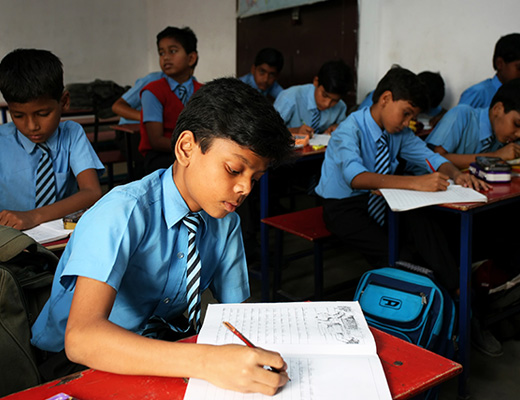
Government initiatives like the National Education Policy (NEP), now in phased implementation since FY22, are set to further reshape the system with a strong focus on high-quality vocational and skills-based education, preparing India’s youth for the demands of a dynamic global economy. As highlighted in the Union Budget 2026–27, in line with the National Education Policy (NEP) 2020, the government aims to achieve universalisation of school education (100% Gross Enrolment Ratio). As per latest data, GER at the secondary and higher secondary levels stood at 79% and 58%, respectively, in 2024–25, indicating continued progress. The National Education Policy (NEP) 2020 aims to provide vocational education to at least 50% of students by 2035, with courses aligned to the National Skills Qualification Framework offered from Grades 9–12. As of December 2025, vocational training is being delivered in 25,000 schools, covering 35 lakh students, with the Economic Survey of India recommending its expansion from Grade 6 onwards.
Market Size
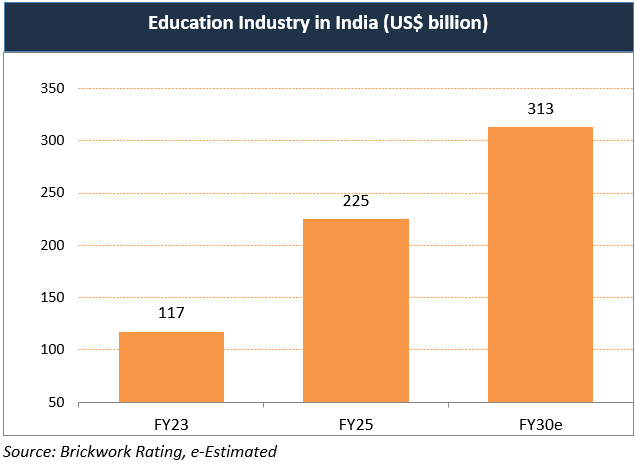
The education market in India is expanding at a rapid pace, projected to reach US$ 313 billion by FY30, up from US$ 117 billion in FY23. Within this, higher education alone was valued at Rs. 5,75,000 crore (US$ 68.06 billion) in 2024 and is expected to nearly double to Rs. 11,60,000 crore (US$ 134.84 billion) by 2033, growing at a CAGR of 8.1%, according to IMARC Group. The K-12 segment, valued at US$ 48.9 billion in 2023, is also on a high-growth trajectory and is estimated to reach US$ 125.8 billion by 2032 at a CAGR of 10.7%.
Edtech has emerged as a critical growth driver within the sector. The Indian edtech market, currently valued at Rs. 64,875 crore (US$ 7.5 billion) is projected to reach Rs. 2,50,850 crore (US$ 29-30 billion) by 2030-31, supported by rising digital adoption and demand for flexible learning models. India has also become the second largest e-learning market after the US, with the online education segment alone expected to grow by US$ 2.28 billion during 2021-2025 at a CAGR of nearly 20%. India’s vast student population underscores the size of this opportunity. With over 250 million school-going children, the country has the largest base of students globally.
The network of institutions continues to expand, with the number of colleges rising from 42,343 in FY20 to 53,461 in FY26 (as of February 2026), and universities increasing from 760 in FY15 to 1,409 in FY26 (as of February 2026). As of FY25, more than half of both universities (51.8%) and colleges (54.3%) are located in rural areas, reflecting deeper penetration of higher education. In FY26 (as of August 2025), India also had 8,439 AICTE-approved institutes, including 3,100 undergraduate, 4,428 postgraduate, and 4,039 diploma institutions.
Despite these achievements, challenges remain in terms of quality and teacher availability. According to UNESCO’s State of the Education Report for India 2021, the pupil-teacher ratio at the senior secondary level was 47:1, much higher than the overall school system average of 26:1. Nonetheless, India is beginning to gain global recognition, with two universities ranking in the top 50 and seven in the top 100 in the QS World University Rankings: Asia 2025, led by IIT Delhi at 44th place.
Investments/ Recent Developments
Cumulative Foreign Direct Investment (FDI) equity inflow in the education sector stood at Rs. 83,605.29 Crore (US$ 11,290.86 million) between January 2000 to March 2026, accounting for 1.42% of total FDI inflows.
The digital education market is a significant growth driver, growing at a 24% CAGR from 2025 to 2030. Key players are Coursera, Udemy, edX, Pluralsight, and Udacity. APAC is expected to grow at the highest rate due to heavy investment in EdTech infrastructure, online learning platforms, and AI-driven education tools.
The education and training sector in India has witnessed some major investments and developments in the recent past. Some of them are:
- The Union Budget 2026–27 allocated Rs. 100 crore (US$ 11.11 million) for a Centre of Excellence in Artificial Intelligence (AI) for Education, aimed at enhancing skills, personalising learning and strengthening AI integration in education.
- In February 2026, Indian Institute of Technology Madras established the IIT Madras Global Research Foundation (IITM Global) and strengthened its global corporate partnerships through collaborations with Technische Universität Dresden, Carl Zeiss and Flexora to advance deep-tech research, innovation, commercialisation and flexible electronics.
- In 2025, the Adani Foundation partnered with GEMS Education to invest Rs. 2,000 crore (US$ 2.12 billion) in establishing 20 schools over three years. The partnership combines GEMS' curriculum and teacher training expertise with Adani's operational capabilities, while reserving 30% of seats for underprivileged students.
- In H1 2025, India’s edtech funding rebounded with a fivefold surge to approximately Rs. 1,071 crore (US$ 120 million) across 11 deals, driven by AI-led startups and renewed investor confidence
- On August 17, 2025, the University of Delhi (DU) partnered with Google Cloud to offer students training in artificial intelligence, cloud computing, cybersecurity and data analytics, along with industry-recognised certifications, hackathons and startup-incubation support.
- On May 17, 2025, the IIT Bombay announced plans to open its first global campus in Japan in collaboration with Tohoku University, opening new avenues for international research and student exchange.
- In May 2025, Oracle, in collaboration with Andhra Pradesh State Skill Development Corporation, began digitally training 400,000 students in emerging technologies including Oracle Cloud, AI, Data Science, DevOps, and Security through over 300 hours of structured learning on Oracle MyLearn. The programme provides certifications and skill badges to enhance employability and prepare youth for future technology roles.
- Coursera is expanding GenAI skills in India through partnerships with 18 leading universities, including IITs, IIMs, and BITS Pilani, along with Fractal Analytics for industry-focused courses, while its AI tool Coach enhances course completion rates, especially among women and learners from weaker academic backgrounds, with Coursera recorded 5.4 million enrolments in generative AI courses globally in 2025, nearly doubling year-on-year, reflecting the rapid adoption of AI-related skills.
- In May 2025, Oracle, in collaboration with Andhra Pradesh State Skill Development Corporation, began digitally training 400,000 students in emerging technologies including Oracle Cloud, AI, Data Science, DevOps, and Security through over 300 hours of structured learning on Oracle MyLearn. The programme provides certifications and skill badges to enhance employability and prepare youth for future technology roles.
- In March 2025, IIT Guwahati is developing “Gyandhara,” India’s first VR-enabled metaverse platform, to teach maths and science in local languages at PM Shri schools, starting with a pilot in 56 schools in Assam later this year.
- The Indian Institute of Foreign Trade (IIFT) opened its first overseas campus in Dubai, advancing India’s higher education globalisation under NEP 2020 and serving global learners and the Indian community abroad.
- In January 2025, CL Educate Limited acquired the Digital Exam Assessment (DEX) business of NSEIT Limited for Rs. 230 crore (US$ 26.6 million) upfront with an additional Rs. 75 crore (US$ 8.7 million) earn-out, entering India’s Rs. 7,000 crore (US$ 809.5 million) assessments market.
- In October 2024, executive education startup Eruditus raised Rs. 1,267 crore (US$ 150 million) led by TPG Rise at Rs. 27,037 crore (US$ 3.2 billion) valuation, with participation from SoftBank and others, plans to shift domicile to India ahead of a likely IPO in two years.
- In September 2024, PhysicsWallah raised 1,774 crore (US$ 210 million) from Hornbill Capital and Lightspeed at a Rs. 23,657 crore (US$ 2.8 billion) valuation to expand operations, with SEBI having approved its IPO in July 2025.
- Imarticus Learning has announced a partnership with PwC Academy in India to provide digital-savvy professionals with expertise in Generative AI (GenAI), as stated in a recent announcement in Feb 2025.
- In August 2025, Going Global Partnerships launched UK-India Industry-Academia TNE Grants 2025-26, offering up to US$ 23,294 for projects starting September 30, 2025, to foster UK-India education and industry collaboration.
- India has 54 universities in the QS World University Rankings 2026, making it the fourth most represented country. The Indian Institute of Technology (IIT) Delhi is the highest ranked at 123, and eight Indian institutions entered the rankings for the first time, the highest number of new entrants from any country this year.
- As highlighted by the Government of India in 2025, the National AI Literacy Programme (‘YUVA AI for All’) aims to create a nationwide movement for AI awareness and is expected to train 10 lakh learners within one year of launch, promoting inclusive and responsible adoption of Artificial Intelligence across the country. The programme is being delivered through digital platforms and in multiple Indian languages to enhance accessibility.
- The Union Budget 2024 introduces a significant financial support program offering loans up to Rs. 10 lakh (US$ 11,943.31) for higher education in Indian institutions. This includes e-vouchers for one lakh students each year and a 3% reduction in interest rates on these loans.
- Edtech startup ConveGenius has raised US$ 7 million, led by UBS Optimus Foundation.
- Digital channels now drive 62% of student enrolments in India, with AI-based insights showing Google as the top paid source, highlighting institutions' growing reliance on online marketing.
- The National Education Policy (NEP) 2020 has been a cornerstone in driving comprehensive reforms in higher education, with the overarching goal of increasing the gross enrolment ratio (GER) to 50% by 2035.
- A total of 105 Indian institutions were included in the list of the Times Higher Education World University Rankings 2025, up from 91 in CY24.
- India along with UK rank third for the most numbers of universities in Times Higher Education University Rankings CY25.
- Under the Interim Budget 2024-25, the Department of School Education & Literacy's budget allocation for FY25 is Rs. 73,498 crores (US$ 8.82 billion), the highest amount ever.
- In February 2025, UpGrad secured an additional Rs. 521.10 crore (US$ 60 million) from Temasek, maintaining its valuation at Rs. 19,541 crore (US$ 2.25 billion). This funding round also included a secondary transaction where Ronnie Screwvala, UpGrad's founder and chairman, bought out Bharti Enterprises' stake for Rs. 173.70 crore (US$ 20 million).
- In 2026, Amazon Web Services (AWS) strengthened its education portfolio by expanding AI-powered cloud solutions for over 17,000 education customers, supporting personalised learning, research and digital transformation across educational institutions.
Government Initiatives
Some of the other major initiatives taken by the Government are:
- As announced under the Union Budget 2026–27, the government is implementing the PM-SETU (Pradhan Mantri Skilling and Employability Transformation through Upgraded ITIs) scheme with an outlay of Rs. 60,000 crore (US$ 6.79 billion) to upgrade 1,000 Industrial Training Institutes (ITIs) through a hub-and-spoke model, focusing on modern infrastructure, industry-aligned courses and Centres of Excellence to enhance employability.In July 2025, the Ministry of Minority Affairs launched the Pradhan Mantri Virasat Ka Samvardhan (PM VIKAS) scheme to empower minority communities through skill development, entrepreneurship, women’s leadership training, education, and cultural heritage promotion.
- As of December 2025, more than 15.78 lakh candidates have benefitted from the ‘FutureSkills PRIME’ programme, aimed at upskilling learners in emerging technologies such as Artificial Intelligence, cybersecurity, cloud computing and data analytics. The programme, implemented by National Association of Software and Service Companies in collaboration with the Government of India, offers industry-aligned certification pathways and digital learning modules, supporting workforce readiness and strengthening India’s digital talent pipeline for emerging technology sectors.
- As announced in December 2025, the Government of India plans to establish 50,000 additional Atal Tinkering Labs (ATLs) in schools across the country over the next five years (2025–2030), under the Atal Innovation Mission to strengthen innovation and STEM education. As of October 2025, over 10,000 ATLs were already operational, engaging more than 1.1 crore students, highlighting the rapid expansion of India’s school-level innovation ecosystem.
- In May 2025, the Union Cabinet has approved a Rs. 11,829 crore (US$ 1.38 billion) expansion of five IITs, adding 6,576 seats, 130 faculty posts, and research parks by FY29 to boost capacity, industry collaboration, and innovation.
- PM SHRI School, a centrally sponsored scheme, aims to develop over 14,500 schools with safe, inclusive environments, quality infrastructure, and diverse learning experiences, seeks to nurture students as engaged, productive citizens aligned with the vision of the National Education Policy (NEP) 2020.
- India marked 10 years of Skill India with Skilling for AI Readiness (SOAR), an AI skilling programme for Classes 6-12 and educators, backed by MoUs with leading institutions to boost future-ready education.
- The Government of India is upgrading 1,000 Industrial Training Institutes (ITIs) under a Rs. 60,000 crore (US$ 6.94 billion) scheme, with hubs, Centres of Excellence, and industry partnerships to train two million youth and boost employability.
- Union Minister for Education, Mr. Dharmendra Pradhan, announced the establishment of three AI Centres of Excellence (CoE) in New Delhi, focusing on Healthcare, Agriculture, and Sustainable Cities. These CoEs, aimed at realizing the vision of "Viksit Bharat," will be led by leading educational institutions in collaboration with industry partners and startups.
- The Union Cabinet, led by Prime Minister Mr. Narendra Modi, has approved the PM Vidyalaxmi scheme, aimed at providing financial support to meritorious students to ensure that financial constraints do not hinder their pursuit of higher education. This initiative aligns with the recommendations of the National Education Policy, 2020.
- According to the Union Budget 2026-27:
- The government allocated Rs. 83,562.26 crore (US$ 9.45 billion) to the Department of School Education and Literacy in FY27, marking an increase of 6.35% over FY26.
- The allocation for the Department of Higher Education stood at Rs. 55,727.22 crore (US$ 6.30 billion) in FY27, reflecting an increase of 11.28% compared to FY26.
- Allocation for school education schemes (including major centrally sponsored programmes) continued to form a significant share, with key schemes such as Samagra Shiksha receiving ~Rs. 42,100 crore, indicating an increase of ~11% over revised estimates of FY26.
- The Union Budget 2026–27 introduced a dedicated allocation of Rs. 100 crore (US$ 11.11 million) for the Centre of Excellence (CoE) in Artificial Intelligence (AI) for Education, aimed at strengthening AI-driven learning, skill development and innovation in the education sector. Additionally, Rs. 250 crore (US$ 27.78 million) has been allocated for establishing three Centres of Excellence in AI, reflecting continued emphasis on AI-led capacity building.
- The Union Cabinet approved the continuation and restructuring of the Skill India Programme till 2026 with an outlay of Rs. 8,800 crore (US$ 1.01 billion) to enhance industry-aligned, tech-driven training nationwide.
- In March 2024, Union Minister of Education and Skill Development & Entrepreneurship launched various initiatives namely, District Institutes of Education and Training (DIETS) of Excellence and National Mission for Mentoring. This program is to strengthen teacher training.
- Financial assistance, totalling to US$ 1.08 billion (Rs 9,000 crores) will be delivered to States/UTs for upgradation of all DIETs to develop them as DIET of Excellence in the country in a phased manner in the next five years.
- In May 2024, Department of Higher Education, Ministry of Education, launched the ‘Capacity Building on Design and Entrepreneurship (CBDE)’ program. This program target to build a problem-solving approach that encourages creative and innovative solutions in students.
- 100% FDI under automatic route is allowed in the Indian education sector.
- To liberalise the sector, the Government has taken initiatives such as the National Accreditation Regulatory Authority Bill for Higher Education and the Foreign Educational Institutions Bill.
- As part of a comprehensive initiative known as PM eVIDYA, the Department of School Education and the Ministry of Education were recognised by UNESCO for their use of information and communication technology (ICT) during the COVID-19 pandemic.
- The Department of School Education and Literacy (DoSE&L), Ministry of Education, has planned to solicit opinions from various stakeholders through an online public consultation survey. This will be helpful in gathering especially useful and important inputs for the formulation of the National Curriculum Framework.
- The government schemes of Revitalising Infrastructure and System in Education (RISE) and Education Quality Upgradation and Inclusion Programme (EQUIP) are helping the government tackle the prominent challenges faced by the education sector.
- Under the Union Budget 2026–27, the Department of School Education and Literacy was allocated Rs. 83,562.26 crore (US$ 9.45 billion), marking the highest-ever allocation, with an 8.27% increase compared to 2025-2026, for the department and reflecting a continued focus on strengthening school education.
- The Cabinet accepted the continuance of the Samagra Shiksha School Education Scheme in 2021 from April 1, 2021-March 31, 2026.
Road Ahead
In 2030, it is estimated that India’s higher education will:
- Combine training methods that involve online learning and games, and it is expected to grow by 38% in the next 2-4 years.
- Adopt transformative and innovative approaches in higher education.
- Have an augmented Gross Enrolment Ratio (GER) of 50%.
- Reduce state-wise, gender-based and social disparity in GER to 5%.
- Emerge as the single largest provider of global talent with one in four graduates in the world being a product of the Indian higher education system.
- Be among the top five countries in the world in terms of research output with an annual R&D spend of US$ 140 billion.
- Have more than 20 universities among the global top 200 universities.
Various government initiatives are being adopted to boost the growth of the distance
education market, besides focusing on new education techniques such as E-learning and M-learning.
The Government of India has taken several steps including opening of IITs and IIMs in new locations, as well as allocating educational grants for research scholars in most government institutions. Furthermore, with the online mode of education increasingly being used by several educational organisations, the higher education sector in India is set for major change and development in the years to come.
References: Media Reports, Press Releases, Press Information Bureau, RNCOS Report, Department for Promotion of Industry, and Internal Trade (DPIIT), Union Budget 2026-27

FAQs
The education sector in India comprises school education, higher education, vocational training, skill development, and edtech. With one of the world's largest student populations and over 1,400 universities, it plays a vital role in developing India's human capital.
The education industry in India is expanding due to rising enrolment, digital learning, growing private investments, increasing demand for skill-based education, and the implementation of the National Education Policy (NEP) 2020.
The Indian education sector includes K-12 education, higher education, vocational training, skill development, online learning, and edtech. These segments collectively support lifelong learning while addressing the country's evolving academic and workforce requirements.
The education sector in India is being transformed by AI, cloud computing, virtual reality, digital learning platforms, and online certifications. These technologies are improving personalised learning, accessibility, employability, and the overall learning experience.
The Government is supporting the education industry in India through NEP 2020, PM-SETU, PM SHRI Schools, Skill India, FutureSkills PRIME, AI Centres of Excellence, Samagra Shiksha, and higher investments in school and higher education.
The Indian education sector offers strong investment opportunities across edtech, digital learning, higher education, vocational training, AI-powered learning platforms, and skill development. Rising private investments, FDI, and technology adoption continue to attract investors.
The education industry in India is being reshaped by the rapid growth of edtech, which enables flexible online learning, AI-driven education, industry-focused courses, and digital skill development. It is expanding access to quality education across the country.
Skill development is strengthening the Indian education sector by improving employability and aligning education with industry needs. Initiatives such as PM-SETU, Skill India, FutureSkills PRIME, and vocational education under NEP 2020 are preparing learners for emerging careers.
The education industry in India is expected to witness strong long-term growth, supported by digital learning, AI integration, higher enrolment, skill development, and policy reforms. The education market is projected to reach US$ 313 billion by FY30.
Related News
MORETop Indian cities for Education
- Bengaluru
- Mumbai
- New Delhi
- Hyderabad
- Chennai
- Manipal
- Kolkata
- Pune
- Kochi
- Ahmedabad


IBEF Campaigns
MORE

Case Studies
MOREContainerisation: Transforming India's Maritime Trade

Despite other modes of transportation, the maritime shipping mode is the backbone of international trade. The concept of containerisation has revoluti...
India’s Growing Senior Care Needs: New Businesses and Services

The current state of India is characterised by the process of demographic transition with gradual growth of the proportion of senior citizens within t...
The Rise of India's Pathology Laboratories: Strengthening Quality and Safety in Healthcare
India has seen its healthcare system witness an impressive evolution in the last two decades because of the growth in healthcare infrastructure, incre...
IBEF BLOG
MORE
India's Blue Economy: Untapped Potential in Ports, Fisheries and Ocean Resources
The maritime space of India, which comprises the coastline, island areas, a...
How Technology Is Making Waste Management More Efficient in Indian Cities
Indian cities are adopting digital monitoring, sensors, and automated waste...

India's Cold Chain Logistics: The Backbone of Perishable Trade
India's cold chain network allows the transfer of perishables from farm...
Partners