Introduction
The expansion of India’s services sector has been closely linked to the economic reforms of the 1990s. While the sector began to grow in the mid-1980s, it gained significant momentum after India initiated a series of structural reforms in response to a severe balance of payments crisis. Today, the services sector is not only the largest contributor to India’s GDP but also a major driver of employment, foreign investment, and exports. It encompasses a wide range of activities, including trade, hotels and restaurants, transport, storage and communication, finance, insurance, real estate, business services, community and personal services, and services associated with construction.
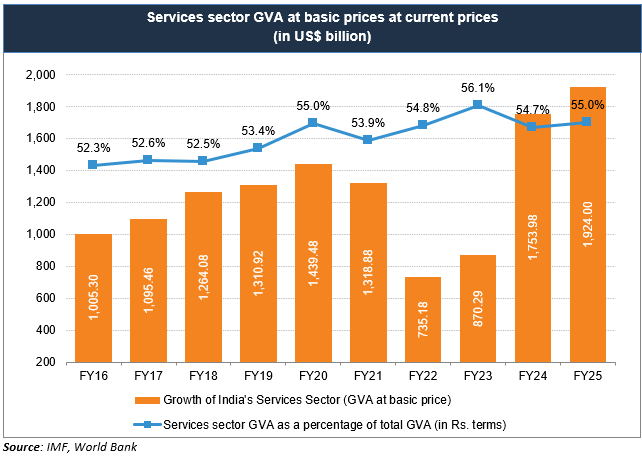
India’s services sector is projected to grow by 9.1% in FY26, up from 7.2% in FY25, indicating an acceleration in services-led economic expansion. In FY2025–26, the sector contributed approximately 56.4% of India’s Gross Value Added (GVA), up from around 51% in FY2013–14, underscoring its increasing role in domestic value creation.
Services exports is estimated to grow by 7.94% during FY 2025-26 (April-March) over FY 2024-25 (April-March). India’s services exports stood at approximately Rs. 36,97,862 crore (US$ 418.31 billion) in FY 2025-26 (April-March), while service imports stood at Rs. 18,06,005 crore (US$ 204.42 billion) in the same period reinforcing India's global standing.
The sector also ranked first in attracting Foreign Direct Investment, according to data from the Department for Promotion of Industry and Internal Trade. India’s unique skills and competitive advantage in knowledge-based services, supported by initiatives such as Smart Cities, Clean India, and Digital India, have created a conducive environment for growth and innovation.
NITI Aayog’s findings on state-level and sector-level dynamics 2025 report says that states like Karnataka, Maharashtra, Tamil Nadu and Telangana together account for nearly 40% of services output, driven by modern, high-productivity services such as IT, finance and professional services, resulting in a concentration of output in highly urbanised states, particularly in southern India.
The gig economy in India, encompassing delivery, ridesharing, and freelancing, has witnessed strong structural growth, transitioning informal jobs into more ecosystem-integrated roles. According to the Survey, the number of gig workers increased from 77 lakh in FY21 to 120 lakhs in FY25, marking a 55% growth, driven by rising smartphone penetration (over 80 crore users) and nearly 15 billion UPI transactions per month. The sector now accounts for over 2% of India’s total workforce, with growth outpacing overall employment. Going forward, non-agricultural gig work is projected to constitute 6.7% of the workforce by 2029–2030, contributing approximately Rs 2.35 lakh crore to GDP.
Global agencies have recognized India’s growth trajectory. The World Bank forecasted India’s GDP between 6.3%-6.5% for FY26, owing to increased government spending on infrastructure and rising household investment in real estate as key drivers. With a growing services trade surplus, rising employment in knowledge and gig-based work, and continued government support, India’s services sector is poised to unlock multi-trillion-dollar opportunities, stimulating sustained economic growth both domestically and globally.
Market Size
The services industry performed strongly in FY26 (April to June 2025), driven by robust export demand and record hiring. In FY25, the sector generated nearly three jobs for every one created in manufacturing, reinforcing its position as the primary driver of employment. It now employs approximately 182 million people, with major contributions from trade, transport, education, finance, and healthcare.
India’s sustainable tourism market is projected to grow significantly over the next decade, reaching Rs. 1,851 crore (US$ 216 million), up from Rs. 317 crore (US$ 37 million) in April 2025, according to the Founder and Chairman of MakeMyTrip, Mr. Deep Kalra. This growth reflects increasing domestic and international interest in eco-friendly travel and experiential tourism. In 2024–2025, the Ministry of Tourism launched the ‘Challenge Based Destination Development’ initiative under the Swadesh Darshan 2.0 scheme to promote holistic and sustainable development of tourist destinations and enhance the overall tourist experience. Under this initiative, 38 projects have been sanctioned across the country with an investment of approximately Rs. 698 crore.
The Union Budget 2026–27 introduced a Scheme to Support States in establishing five Regional Medical Hubs, aimed at promoting India as a global destination for medical and wellness tourism. The hubs will integrate advanced healthcare services, AYUSH centres, and medical value tourism facilitation centres, and infrastructure for diagnostics, post-care and rehabilitation through public-private partnerships, enhancing India’s competitiveness in global healthcare travel.
The Ministry of Health and Family Welfare (MoHFW) is leveraging artificial intelligence (AI) to strengthen public health services across the country. In the healthcare sector, the telemedicine market is also expanding rapidly, reaching Rs. 31,191 crore (US$ 3.64 billion) in 2025 and projected to rise to Rs. 90,660 crore (US$ 10.58 billion) by 2030, driven by growing demand for remote consultation and digital healthcare solutions. The Indian healthcare market was valued at US$ 17 billion in 2000 and is projected to reach US$ 370 billion by 2027. This indicates a massive expansion and continued growth potential
As of October 2025, out of 644,131 villages in India, 634,019 are covered with mobile connectivity, of which 630,676 have 4G services. Broadband subscriptions have increased from 48 crore in September 2018 to 98 crore in June 2025, reflecting significant expansion in digital connectivity, driven by initiatives under the Digital Bharat Nidhi.
Financial inclusion is also being strengthened through the expansion of Digital Banking Units (DBUs). The Government of India plans to nearly double the number of DBUs to 200 by the end of FY26, enabling them to offer a broader range of financial products, including insurance and pension schemes, to underserved populations.
Recent Investments/ developments
Some of the investments/ developments in the services sector in the recent past are as follows:
- On April 21, 2026, Bharti Airtel strengthened its telecom infrastructure by adding 3,400+ new 5G sites across Maharashtra and Goa, enhancing network capacity, expanding coverage across 36 districts, and supporting the region's growing digital economy.
- On March 30, 2026, Nxtra Data, a subsidiary of Bharti Airtel, secured US$ 1.0 billion in funding from Alpha Wave Global, Carlyle, Anchorage Capital, and Airtel to expand its data center network across India and support growing demand for AI, cloud, and hyperscale infrastructure. The investment will accelerate Nxtra's expansion plans as it targets scaling its capacity from ~300 MW to 1 GW over the coming years.
- On March 10, 2026, Bharti Airtel became the first telecom operator to provide mobile connectivity in Marwah, Jammu & Kashmir, a remote region linking Kishtwar and Anantnag. The deployment extends high-speed network coverage across a previously unconnected 150-km corridor, enhancing digital inclusion, supporting tourism development, and improving connectivity for local communities and security forces.
- Sales of non-IT services companies recorded a growth of 10.6% in Q2 FY26 as compared to 7.5% growth in Q1 FY26.
- At the end of April 2026, Reliance Jio Infocomm Ltd. leads the market with 505.92 million in term of wireless (mobile) subscribers, maintaining a substantial lead over competitors. Bharti Airtel Ltd. ranks second with 487.36 million subscribers, followed by Vodafone Idea Ltd. at 201.21 million.
- India has emerged as the world’s third-largest mobile phone exporter with shipments worth Rs. 1,75,665 crore (US$ 20.5 billion) in CY24, driven by the Production-Linked Incentive (PLI) scheme and greater global value-chain integration.
- India’s fintech sector ranked third globally in H1 2025, raising Rs. 7,618 crore (US$ 889 million), with Bengaluru attracting 55% of investments.
- India’s FinTech industry was valued at US$ 44.1 billion in 2025 and is projected to grow at a 16.6% CAGR through 2030. In H1 2025, the sector secured approximately Rs. 7,618 crore (US$ 889 million) in funding, ranking third globally, with Bengaluru accounting for 55% of total investments.
- As of June 2025, India stays in the lead with the fintech adoption rate of 87%, substantially higher than the world average of 67%.
- According to the RBI's Scheduled Banks' Statement of Position in India, total deposits (excluding inter-bank deposits) held by all scheduled banks increased to Rs. 26,188,292.15 crore (US$ 2.96 trillion) as of April 15, 2026.
- The Services sector remained the largest recipient of FDI inflows in India, attracting US$ 128.85 billion in cumulative equity inflows between April 2000 and March 2026.
- As of March 2025, experts forecast that India is poised to attract over Rs. 52,32,600 crore (US$ 610 billion) in alternative investments, primarily private equity and venture capital, from 2025 to 2027, substantially powering the startup ecosystem.
- India’s services exports stood at approximately Rs. 36,97,862 crore (US$ 418.31 billion) in FY 2025-26 (April-March), while service imports stood at Rs. 18,06,005 crore (US$ 204.42 billion) in the same period reinforcing India's global standing.
- On July 2, 2025, IDC reported that India’s domestic IT & Business Services market reached Rs. 1,41,389 crore (US$ 16.5 billion) in 2024, growing by 6.9% YoY, while maintaining a projected CAGR of approximately 8% between 2022 and 2027.
- A large pool of skilled IT manpower has made India into a global outsourcing hub. In 2025 it commands a 55% share in the global sourcing market.
- India ranks third globally in economy-wide digitalisation and 12th among G20 members in individual user digitalisation. The digital economy, having contributed 11.74% of GDP in 2022-23, is expected to account for nearly one-fifth of national income by 2029-30.
- As of 2025, International Workplace Group (IWG) operates just over 100 centres in India, and plans to add 40-50 more by end-2025, aiming to quadruple its footprint over the next three to five years.
- According to experts, India is expected to receive over Rs. 52,32,600 crore (US$ 600 billion) in alternative investments over the next three years, significantly boosting the startup ecosystem.
- The Indian hotel industry experienced a resurgence in 2023, fuelled by domestic leisure travel, MICE events, and business travellers’ return. Premium hotels saw higher occupancy and room rates, with continued domestic travel growth expected in 2024.
Government Initiatives
The Government of India recognises the importance of promoting growth in the services sector and provides several incentives across a wide variety of sectors like health care, tourism, education, engineering, communications, transportation, information technology, banking, finance, and management among others.
- India's digital healthcare transformation continues to accelerate through the Ayushman Bharat ecosystem. As of February 2026, 43.52 crore Ayushman cards have been created under Ayushman Bharat–PMJAY, including 1.14 crore Ayushman Vay Vandana cards for senior citizens aged 70 years and above. The scheme has empanelled 36,229 hospitals nationwide, comprising 19,483 public and 16,746 private hospitals, while providing cashless treatment for 1,961 procedures across 27 medical specialties.
- In Feb 2026, The Government of India announced a scheme to establish five Regional Medical Hubs through public-private partnerships to strengthen medical tourism. The hubs will integrate healthcare, research, diagnostics, rehabilitation, and AYUSH services, positioning India as a global destination for medical value travel.
- In Feb 2026, The Government launched Atal Tinkering Labs (ATL) as a new flagship initiative with an allocation of Rs. 3,200 crore (USD 362 million) in FY2026–27 to establish innovation labs and promote STEM, AI, robotics, and coding education in schools.
- In February 2026, The Digital India BHASHINI Division (DIBD) and the Reserve Bank of India (RBI) signed an MoU to integrate AI-powered language technologies into banking services, enabling multilingual access across 22 scheduled Indian languages and promoting greater financial inclusion by reducing language and literacy barriers.
- The Union Budget 2026–27 introduced a Scheme to Support States in establishing five Regional Medical Hubs, aimed at promoting India as a global destination for medical and wellness tourism. The hubs will integrate advanced healthcare services, AYUSH centres, and medical value tourism facilitation centres, and infrastructure for diagnostics, post-care and rehabilitation through public-private partnerships, enhancing India’s competitiveness in global healthcare travel.
- In Feb 2026, The Government announced a scheme to establish five Regional Medical Hubs under a public-private partnership model to strengthen India's position as a global medical tourism destination.
- The revised GST framework directly impacts the services sector, particularly through rate rationalisation and reclassification of services. Under the latest reforms, many services such as transport, courier, e-commerce delivery, and professional services have been moved to the 18% GST slab (from 12%), increasing the tax burden and potentially affecting pricing and demand. At the same time, selected services like tailoring, beauty, cleaning, and certain job work activities have been reduced to 5%, improving affordability in these segments. Additionally, health and life insurance services have been made GST-exempt, reducing costs for consumers.
- The Union Budget 2025 has significantly increased allocation for the BharatNet project by 238% year-on-year to Rs. 22,000 crore (US$ 2.6 billion) in FY2025–26, aimed at expanding broadband connectivity in rural government-run secondary schools and primary healthcare centres (PHCs). The initiative targets a large opportunity base of around 1 million government-run schools, building on earlier phases where Rs. 420 billion was allocated to connect 214,323 Gram Panchayats.
- India’s draft National Telecom Policy 2025 (NTP-25) aspires to achieve 100% 4G coverage and 90% 5G population coverage by 2030 underscoring a bold vision to elevate digital inclusion and infrastructure.
- The National Education Policy (NEP) 2020 is in the implementation phase, with gradual rollout across school and higher education. The 5+3+3+4 structure is being adopted, alongside a focus on foundational literacy by 2026–2027, skill-based learning, and digital integration. In higher education, four-year undergraduate programmes with multiple entry-exit options and multidisciplinary learning are being introduced, with a target to achieve a 50% Gross Enrolment Ratio (GER) by 2035. While progress is visible in enrolment, digital adoption, and curriculum reforms, implementation remains uneven across states and institutions.
- As of June 2025, an impressive 42,093 out of 45,934 villages in India’s Northeastern Region now have mobile connectivity, including 40,663 with 4G access, supported by 2,485 towers commissioned through the Digital Bharat Nidhi to extend services in remote and border areas.
- Under the Pradhan Mantri Jan Dhan Yojana (PMJDY), the number of bank accounts increased to 58.16 crore as of April 29, 2026, from 14.72 crore in 2015, with cumulative deposits reaching Rs. 3.02 lakh crore (USD 34.17 billion), bringing the unbanked into the formal economy. i need this in USD dollar as well.
- According to the RBI's Scheduled Banks' Statement of Position in India, total deposits (excluding inter-bank deposits) held by all scheduled banks increased to Rs. 26,188,292.15 crore (US$ 2.96 trillion) as of April 15, 2026.
- As of June 2025, India has 23 Indian Institutes of Technology (IITs), 21 Indian Institutes of Management (IIMs), and 20 All India Institutes of Medical Sciences (AIIMS), reflecting significant growth in premier higher education and research institutions.
- The India–EU Free Trade Agreement (FTA), concluded in January 2026, marks a significant milestone in strengthening economic ties and deepening market integration between the two economies. As a modern, rules-based framework, the agreement provides preferential access across 97% of EU tariff lines, covering 99.5% of trade value, while maintaining flexibility for sensitive sectors. In services, the EU has extended commitments across 144 subsectors, including IT/ITeS, professional, education, and business services, providing Indian service providers with a stable and predictable environment to expand exports. These provisions are expected to support innovation, enhance productivity, and strengthen business growth across both economies
- The Ministry of Health and Family Welfare (MoHFW) is leveraging artificial intelligence (AI) to enhance public health services across India focusing on developing and adopting AI-driven healthcare solutions.
- Centre has formulated an ‘Action Plan for Champion Sectors in Services’ to give focused attention to 12 identified Champion Services Sectors.
Road Ahead
The growth of India’s services sector is being shaped by both domestic and global factors. A wide range of service industries has witnessed double-digit expansion in recent years, driven by digital technologies, innovation, and supportive institutional frameworks established by the government. The ease of doing business in India has improved significantly for both domestic and foreign firms, reflecting advancements in regulatory culture and government initiatives.
Ongoing reforms, including the lowering of trade barriers, easing of FDI regulations, and deregulation, have further strengthened the sector’s growth prospects. The implementation of GST 2.0 has created a unified national market and reduced the overall tax burden on goods and services. This reform is expected to lower costs over the long term through the availability of input tax credit, ultimately contributing to more competitive pricing of services.
With these structural reforms, technological adoption, and favourable policy measures, India’s services sector is poised for sustained growth, supporting the country’s broader economic development. The digital economy alone is estimated to reach US$ 1 trillion by 2025, highlighting the transformative potential of the sector in driving employment, exports, and innovation.

References: Media Reports, Press Releases, DPIIT publication, Press Information Bureau, News Articles, TRIA
Note: Services sector includes Financial, Banking, Insurance, Non-Financial / Business, Outsourcing, R&D, Courier, Tech Testing and Analysis, Other
FAQs
The services industry in India is the country's largest economic sector, comprising IT & ITeS, financial services, tourism, healthcare, education, telecommunications, logistics, real estate, and professional services. It is the biggest contributor to India's GDP, employment, and exports.
The services industry contributes 56.4% of India's Gross Value Added (GVA) and is a major source of employment, exports, and foreign investment. It also drives innovation, productivity, and India's competitiveness in the global economy.
The services industry in India includes IT & ITeS, financial services, telecommunications, tourism, healthcare, education, logistics, real estate, business services, and professional services. Together, these segments support domestic demand and international services exports.
The services industry is expanding due to rapid digitalisation, rising services exports, increasing FDI, higher internet penetration, growth in the gig economy, and strong demand for knowledge-based and technology-enabled services.
The services industry in India benefits significantly from the IT and ITeS sector, which drives digital transformation, software exports, outsourcing, and innovation. India's large skilled workforce and leadership in global sourcing continue to strengthen the sector's global competitiveness.
The Government is promoting the services industry in India through Digital India, BharatNet, Ayushman Bharat, the National Telecom Policy, PM Jan Dhan Yojana, and the Action Plan for Champion Sectors in Services to improve connectivity, financial inclusion, and service delivery.
The services industry offers strong investment opportunities across IT & ITeS, fintech, healthcare, tourism, telecommunications, logistics, education, and data centres. Robust FDI inflows and rising digital adoption continue to attract domestic and global investors.
Digital technologies are transforming the services industry through AI, cloud computing, digital payments, broadband expansion, fintech, telemedicine, and online service delivery. These innovations are improving efficiency, customer experience, and access to services across India.
The services industry in India is expected to maintain strong long-term growth, supported by digital transformation, rising exports, expanding FDI, and technology-led innovation. The digital economy alone is projected to reach US$ 1 trillion, reinforcing the sector's growth potential.
Related News
MORE
IBEF Campaigns
MORE

Case Studies
MOREIndia’s Growing Senior Care Needs: New Businesses and Services
The current state of India is characterised by the process of demographic transition with gradual growth of the proportion of senior citizens within t...
The Rise of India's Pathology Laboratories: Strengthening Quality and Safety in Healthcare

India has seen its healthcare system witness an impressive evolution in the last two decades because of the growth in healthcare infrastructure, incre...
SUV Dominance and the Future of Passenger Vehicles

India's passenger vehicle industry over the past two decades have been gone under significant changes. In particular, the market has been transfor...
IBEF BLOG
MORE
How Technology Is Making Waste Management More Efficient in Indian Cities
Indian cities are adopting digital monitoring, sensors, and automated waste...

India's Cold Chain Logistics: The Backbone of Perishable Trade
India's cold chain network allows the transfer of perishables from farm...

From Imports to Innovation: How Indian Businesses Are Building More Local Supply Chains
Indian companies have been able to substitute their imports with locally ma...
Partners