Introduction
India, with its 11,098.81 km coastline, is the sixteenth-largest maritime nation in the world and a critical player in global trade. The country’s maritime infrastructure is anchored by 12 operational major ports and more than 200 notified minor and intermediate ports, with six new mega ports planned under the National Perspective Plan for Sagarmala. There are 14 major ports out of which 12 are operational in the country, 6 on the eastern coast and 6 on the western coast. Around 55% of the total cargo is being handled at 12 major ports in India. Nearly 95% of India’s trade by volume and 70% by value is carried through maritime transport, underscoring the sector’s central role in sustaining economic growth and international commerce. The Government of India has been a strong enabler for the industry, allowing 100% Foreign Direct Investment (FDI) under the automatic route for port and harbour construction and maintenance, while also offering a 10-year tax holiday to enterprises engaged in the development, operation, and maintenance of ports and inland waterways.

Market Size
In FY26, all major ports in India handled 914.73 million tonnes (MT) of cargo traffic compared to 854.86 MMT handled during FY25. During FY26, total Cargo handled by major ports was 914.73 MMT with overseas cargo and coastal cargo accounting for 76.67% and 23.33%, respectively. Merchandise exports reached US$ 441.75 billion during FY26 and US$ 437.70 billion in FY25. The Government has taken several measures to improve operational efficiency through mechanisation, deepening the draft and speedy evacuations. The Energy Information Administration (EIA) estimated that India’s consumption of petroleum and other liquid fuels will reach 5.65 million barrels per day (mbpd) in 2025 and 5.81 mbpd in 2026. India’s crude oil and petroleum products imports stood at 294.13 MMT in FY25 and 291.96 MMT in FY26.

Investments/Developments
Some of the major recent developments are:
- At India Maritime Week 2025, investment pledges worth Rs. 12 lakh crore (US$ 135.5 billion) were signed, with approximately 30% directed toward port development and modernization. This aligns with India's goal to scale its maritime sector significantly.
- India plans to roll out Rs. 4,000 crore (US$ 454 million) in incentives over 10 years from 2026 to boost its shipbreaking industry and reclaim market share from Bangladesh and Pakistan.
- Union Minister for Ports, Shipping and Waterways, Mr. Sarbananda Sonowal, stated India's ports sector is set to attract investments worth Rs. 80 lakh crore (US$ 903.65 billion). During the upcoming Maritime Week, MoUs worth Rs. 10 lakh crore (US$ 112.96 billion) were expected to be signed. New Mangalore Port Authority highlighted its net profit growth and plans to triple capacity over the next 20 years using solar power.
- Ports in India are projected to handle 95% of trade by volume and contribute 2-3% annually to India’s GDP. A government investment of Rs. 8 trillion (US$ 90.36 billion) plus reforms are expected to generate around 15 million jobs by 2047. This scale of investment and job creation provides long-term competitive advantage and economic growth.
- Vadhavan Port, set to be India’s largest with a Rs. 76,220 crore (US$ 9.14 billion) investment plans to raise Rs. 30,000 crore (US$ 3.5 billion) in debt to strengthen maritime trade.
- India will invest Rs. 75,000 crore (US$ 8.72 billion) from July 2025 over five years to establish three shipbuilding clusters along the east and west coasts, strengthening domestic capabilities and attracting global partnerships.
- Inland Water Transport (IWT) recorded 145.5 MMT cargo movement in FY25, with traffic projected to exceed 200 MMT by 2030 through sustained schemes, infrastructure, and policy support.
- The average turnaround time at major ports has fallen from 127 hours in 2010-11 to 49.32 hours as of FY26 (April 2025 to December 2026).
- The Conference on Maritime Decarbonization in India, held in October 2024, reinforced the nation’s goal of net-zero emissions by 2070, showcasing initiatives like Harit Sagar and Harit Nauka guidelines for green ports and cleaner shipping. India and the Netherlands plan to establish a green, digital corridor linking Indian ports with the Port of Rotterdam to export green hydrogen and its carriers, including ammonia and methanol, to Europe, under India’s Maritime Vision 2030.
- Deendayal Port Authority emerged as India’s top major port by cargo volumes, handling 160.11 million tonnes in FY26, accounting for nearly 17.50% of the total. It was followed by Paradip Port in Odisha, which handled 156.45 million tonnes, contributing around 17.10% of the total cargo.
- APSEZ handled a record 500.8 MMT of cargo in FY26, achieving a 11% YoY increase in domestic port operations. The company continued its expansion and now operates 19 ports across India, with Mundra Port surpassing 200 million tonnes in annual cargo volume for the first time.
- India’s Major Ports have achieved significant milestones in FY26, demonstrating notable progress in cargo handling, operational efficiency, and infrastructure development. Major Ports recorded a 7.02% growth in cargo handling, reaching approximately 915 million tonnes, up from 855 million tonnes in FY25.
- In FY25, 962 acres of land were allocated for port-led industrialisation, expected to generate Rs. 7,565 crore (US$ 887.80 million) and attract future investments of Rs. 68,780 crore (US$ 8.07 billion).
- India’s ports sector is set for major expansion between FY23 and FY28, with an estimated annual capacity addition of 500-550 million Tonnes Per Annum (MTPA). This growth is primarily driven by increased handling of Petroleum, Oil, and Lubricants (POL), coal, and containerized cargo.
- India’s Inland Waterways Authority of India (IWAI), under the Ministry of Ports, Shipping and Waterways, has achieved a historic milestone by recording a cargo movement of 145.5 million metric tonnes (MMT) in FY25, reflecting a growth of ~10% from 133 million metric tonnes (MMT) in FY24.
- Adani Ports and Special Economic Zone Ltd. has secured a five-year operation and maintenance contract at Kolkata Port, which will help the company enhance synergies with its transshipment hubs in Colombo and Vizhinjam.
- India plans to establish a new shipping company to expand its fleet by at least 1,000 ships in the next decade, aiming to reduce freight costs and capture more revenue from increasing trade, with joint ownership by state-run oil, gas, and fertilizer companies, along with the state-run Shipping Corporation of India and foreign companies, targeting a reduction of at least one-third in foreign freight outgoings by 2047.
- Adani Group plans Rs. 26,088 crore (US$ 3 billion) investment over three to five years to expand global ports capacity, targeting strategic acquisitions in Europe, Africa, and Southeast Asia to increase revenue from overseas ports to 20-25% and support the India-Middle East-Europe Economic Corridor.
- On March 15, 2024, the Ministry of Ports, Shipping and Waterways approved Rs 645 crore (US$ 77.79 million) for 10 new waterways projects on the Brahmaputra in Assam, enhancing connectivity, boosting river tourism, and facilitating public commute, all under the Sagarmala programme.
- On March 09, 2024, India's trade in container shipments experienced notable growth, totalling nearly 1.9 million TEUs, marking a 5% increase from January. Mundra Port managed 6,35,000 TEUs, Nhava Sheva Port handled 5,65,000 TEUs, and PSA Mumbai processed 1,58,000 TEUs.
- India has plans to invest US$ 82 billion in port projects by 2035.
- The Global Maritime India Summit 2023 to serve as a platform to showcase global best practices, foster investment partnerships and chart a new and bright course for our collective future.
- The cumulative FDI equity inflow in the Port industry is Rs. 6,730.9 crore (US$ 1.6 billion) during the period April 2000-June 2025.
- India plans to cut its maritime carbon footprint by powering 1,000 vessels with renewable energy over five years. Aligning with net zero goals by 2070, the move supports eco-friendly cargo transport, backed by Rs. 50,000 crore (US$ 5.75 billion) infrastructure investment in inland waterways.
- Jawaharlal Nehru Port Trust (JNPT) Special Economic Zone (SEZ) became the first of its kind operational port-based multi-product SEZ in India.
Government Initiatives
Some of the major initiatives taken by the government to promote the ports sector in India are as follows:
- The Union Budget 2026-27 allocated Rs. 5,164.8 crore (US$ 584.45 million) to the Ministry of Ports, Shipping and Waterways which is a significant surge over previous budget allocation.
- Sagarmala Programme envisages 839 projects with a total estimated investment of about Rs. 5.79 lakh crore (US$ 65.52 billion) by 2035. Of these, 277 projects worth approximately Rs. 1.41 lakh crore (US$ 15.95 billion) have been completed, while 209 projects worth around Rs. 1.62 lakh crore (US$ 18.33 billion) are under implementation. Another 353 projects, with an investment worth Rs. 2.75 lakh crore (US$ 31.12 billion) are in planning stage.
- Under the Sagarmala Programme, 65 projects with an estimated investment of approximately Rs. 2.20 lakh crore (US$ 24.89 billion) have been identified for implementation for non-major ports. Of these, 10 projects worth Rs. 12,692 crore (US$ 1.44 billion) have been completed, 21 projects worth about Rs. 48,009 crore (US$ 5.43 billion) are currently under implementation, and the remaining 34 projects, with an estimated cost of approximately Rs. 1.59 lakh crore (US$ 17.99 billion) are at various stages of planning.
- The government encourages private sector participation through PPPs to modernize port terminals and improve logistics. Around 50% of major ports operate under PPPs currently, expected to grow to 85% over the next decade. PPPs have contributed around Rs. 550 billion (US$ 6.2 billion) in investments over 25 years.
- The government targets Rs. 80 lakh crore (US$ 903.65 billion) investments under Sagarmala to boost port handling capacity to 10,000 MMT by 2047, generating millions of jobs.
- The government passed five crucial marine-related bills recently, including the Indian Ports Bill, which signifies a watershed moment for the sector. Financial incentives and schemes have accelerated shipbuilding and maritime infrastructure growth, setting the stage for next growth phases in port demand and operations.
- The Rajya Sabha passed the Indian Ports Bill, 2025 on August 18, 2025, replacing the 1908 colonial law to modernise port operations, enhance transparency, ensure environmental and safety standards, and align with global practices.
- There are 234 port modernization projects worths Rs. 2,91,279 crore (US$ 32.96 billion). Of which, 106 projects worth Rs. 35,423 crore (US$ 4.01 billion) have been completed and 53 projects worth Rs. 71,956 crore (US$ 8.14 billion) are being implemented as of December 2025.
- As of December 2025, the Sagarmala Programme has identified 279 port-connectivity projects worth Rs. 2,06,373 crore (US$ 23.35 billion). Of these, 149 projects worth Rs. 1,22,971 crore (US$ 13.91 billion) comprise of 96 completed projects valued at Rs. 58,628 crore (US$ 6.63 billion) and 52 projects under implementation worth Rs. 67,378 crore (US$ 7.62 billion). 114 rail projects worth Rs. 1,00,599 crore (US$ 11.77 billion) have been taken up, with 49 completed. 152 road projects worth Rs. 98,422 crore (US$ 11.52 billion) have been identified, with 26 completed. 10 Multi-Modal Logistics Parks (MMLP) worth Rs. 2,237 crore (US$ 261 million) are being developed, with five operational and others in advanced stages of implementation. Five parks located in Chennai, Bengaluru, Indore, Nagpur, and Jogighopa.
- The government introduced One Nation One Port Process (ONOP) initiative in February 2025 which aims to unify documentation and processes across all major ports, reducing paperwork by 25% for container and bulk cargo operations and driving substantial savings in logistics costs.
- The Union Budget 2025-26 introduced a Maritime Development Fund (MDF) of Rs. 25,000 crore (US$ 2.9 billion) to support ship acquisition and infrastructure, aiming to raise the share of Indian-flagged ships in global cargo to 20% by 2047.
- The Government of India is advancing Sagarmala 2.0 with Rs. 40,000 crore (US$ 4.6 billion) in support to drive Rs. 12,00,000 crore (US$ 139 billion) in investments from 2025 to 2035, enhancing shipbuilding, port modernisation, coastal growth, and maritime competitiveness.
- India and the Netherlands will establish a green and digital corridor between Indian ports and the Port of Rotterdam to boost clean energy trade. This initiative focuses on exporting green hydrogen and its derivatives to Europe while enhancing port digitalisation, green shipping, and logistics, aligning with India’s Maritime Vision 2030 to modernise port infrastructure.
- To encourage a modal shift to Inland Water Transport (IWT), the Government introduced the “Jalvahak” Cargo Promotion Scheme on December 15, 2024, offering 35% reimbursement on operational costs and launching scheduled cargo services on key NW routes. The Union Budget 2025-26 also extended the tonnage tax regime to inland vessels under the Indian Vessels Act 2021.
- The Union Cabinet has approved the construction of a six-lane access-controlled greenfield high-speed National Highway, connecting Jawaharlal Nehru Port Authority (JNPA) Port (Pagote) to Chowk (29.219 kilometer) in Maharashtra at an investment of Rs. 4,500 crore (US$ 521.50 million).
- India’s 12 major ports handled 915 million tonnes of cargo in FY26. Total cargo reached 855 million tonnes in FY25, reflecting ~7% YoY increase in FY26 from FY25.
- In October 2024, Union Cabinet approved the development of the National Maritime Heritage Complex (NMHC) at Lothal, Gujarat, showcasing India’s 4,500-year-old maritime heritage. This project is expected to enhance employment, tourism, and cultural preservation with phased development supported by public-private partnerships with a completion goal of 2025 for its first phase.
- In July 2024, the Union Minister for Ports, Shipping, and Waterways Mr. Sarbananda Sonowal approved a Rs. 284.19 crore (US$ 34 million) project by the Jawaharlal Nehru Port Authority (JNPA) to establish a comprehensive agricultural commodity processing and storage facility aiming to streamline logistics, reduce handling stages, and extend the shelf life of agricultural products. The projected export capacity includes a frozen store of 1,800 metric tonnes, a cold store of 5,800 metric tonnes, and dry warehouses for 12,000 metric tonnes of grains, cereals, and dry cargo.
- On 19 June 2024, the Government of India approved the establishment of a Major Port at Vadhavan, Maharashtra, with an estimated cost of Rs. 76,220 crore (US$ 9.14 billion), aiming to enhance EXIM trade capacity and accommodate mega vessels, while facilitating public-private partnerships for infrastructure development.
- On 29 July 2024, Secretary Mr. T.K. Ramachandran reviewed the functioning of the Paradip Port Authority (PPA) and inaugurated key projects worth over Rs. 13 crores (US$ 1.56 million), including a Trauma and Burn Care Centre and a Water Treatment Plant with a capacity to filter 16 million litres of water per day, enhancing the port's infrastructure and services.
- On July 26, 2024, the Government of India announced an update to the Shipbuilding Financial Assistance Policy (SBFAP), which has provided financial aid totalling Rs. 337 crores (US$ 40.40 million) to enhance India’s competitiveness against foreign shipyards and revitalize the shipbuilding industry. Since the policy's inception, 313 vessel orders valued at approximately Rs. 10,500 crores (US$ 1.26 billion) have been secured.
- On July 26, 2024, the Government of India announced 29 new proposals from Andhra Pradesh and Visakhapatnam Port Trust under the Sagarmala project, totalling approximately Rs. 3,300 crores (US$ 395 million). These initiatives include port development and fish landing centres.
- The Union Budget 2025-26 extends the Shipbuilding Financial Assistance Policy (SBFAP) 2.0 with Rs. 18,090 crore (US$ 2.08 billion) outlay, offering subsidies to Indian shipyards to offset costs and boost domestic shipbuilding.
- Under the Sagarmala Programme, 45 projects totalling Rs. 47,166 crore (US$ 5.69 billion) have been earmarked for execution at Non-Major Ports. Of these, 4 projects worth Rs. 5,419 crore (US$ 0.65 billion) have been finalized, while 17 projects valued at Rs. 27,673 crore (US$ 3.34 billion) are presently underway. 31 out of the 45 projects are being carried out through Public-Private Partnership (PPP) mode, with a collective investment of Rs. 45,973 crore (US$ 5.54 billion).
- On March 07, 2024, the Union Minister for Ports, Shipping, and Waterways, Mr. Sarbananda Sonowal approved a project exceeding Rs. 800 crore (US$ 96.48 million) to revamp Syama Prasad Mookerjee Port, Kolkata, encompassing berth reconstruction and mechanization to enhance operational efficiency and global competitiveness.
- On February 20, 2024, The Union Minister of Ports, Shipping & Waterways and Ayush, Mr. Sarbananda Sonowal initiated major waterways projects in Northeast India, including inaugurating terminals at Bogibeel and Sonamura, unveiling projects worth Rs. 308 crore (US$ 37.14 million) and announcing initiatives for improved connectivity and economic growth.
- The Ministry of Ports, Shipping and Waterways will invest over Rs. 57,000 crore (US$ 6.55 billion) to boost Kandla Port’s capacity, including a Rs. 30,000 crore (US$ 3.45 billion) mega shipbuilding project and Rs. 27,000 crore (US$ 3.10 billion) cargo terminal.
- On September 19, 2023, the Ministry of Ports, Shipping, and Waterways proposed the Indian Ports Bill with the aim of enhancing transparency in port tariffs and updating penalties. The bill empowers the Maritime States Development Council (MSDC) for integrated planning and introduces a three-tier dispute resolution mechanism for conflicts between state maritime boards.
- On August 24, 2023, the Ministry of Ports, Shipping and Waterways initiated the development of a Next-Gen Container Terminal at Tuna Tekra, Gujarat, through a Rs. 4,243.64 crore (US$ 511.7 million) PPP agreement with DP World, enhancing port infrastructure and trade connectivity.
- On January 27, 2023, the Honourable Minister for Ports, Shipping, and Waterways inaugurated the National Logistics Portal (Marine). This platform connects logistics stakeholders, enhancing efficiency, transparency, and reducing costs and time delays through IT integration. Covering all transport modes, it offers seamless end-to-end logistics service coverage.
- The government aims to increase Inland Water Transport (IWT) share to 5% by 2030 as per Maritime India Vision (MIV)-2030, emphasizing its cost-effectiveness and sustainability for bulk cargo transportation, particularly along National Waterway No. 1 (River Ganga).
- In Union Budget 2023-24, the total allocation for the Ministry of Shipping was US$ 1,813.16 million (Rs. 2,218.74 crore).
- The “Green Port Guidelines” issued by the Ministry of Ports, Shipping and Waterways in May 2023 provides a roadmap for Indian major ports to reduce carbon intensity through green technologies, renewable energy, electrification, waste minimisation, environmental monitoring, and sustainability targets consistent with national de-carbonisation goals.
Road Ahead
The Indian ports and shipping sector is on a transformative growth path, supported by rising investments, expanding cargo volumes, and a strategic policy push. Service providers in areas like O&M, pilotage, harbouring, and marine assets are already benefiting, while the development of domestic waterways promises a cost-effective and environmentally sustainable mode of freight movement. By 2030, the operationalisation of 23 waterways will further diversify India’s logistics network.
The Shipbuilding Financial Assistance Policy (SBFAP), extended until March 2026, is playing a pivotal role in strengthening the shipbuilding industry, with added incentives for green-fuel and hybrid propulsion systems driving technological advancement. Complementing this, the Sagarmala programme’s massive pipeline of 574 projects worth Rs. 6,00,000 crore (US$ 82 billion) is reshaping coastal and port infrastructure. Mega investments at Kandla Port and the establishment of the Rs. 25,000 crore (US$ 2.9 billion) Maritime Development Fund reaffirm the government’s commitment to capacity building and global competitiveness.
As these initiatives converge, India is well-positioned to not only lower logistics costs

but also to evolve as a sustainable, technology-driven maritime hub. The road ahead will be marked by enhanced efficiency, greater self-reliance, and a stronger presence in global shipping and trade networks.
FAQs
The shipping industry enables the movement of goods through India's extensive maritime network of major and non-major ports. It handles nearly 95% of India's trade by volume and plays a vital role in logistics, exports, and economic growth.
Ports in India are the backbone of international trade, handling around 95% of trade by volume and 70% by value. They support exports, industrial growth, supply chains, and improve the country's global trade competitiveness.
Ports in India include 12 operational major ports such as Deendayal, Paradip, Jawaharlal Nehru Port (JNPA), Chennai, Visakhapatnam, and Mumbai. These ports handle over half of the country's total cargo traffic and support international maritime trade.
The shipping industry is expanding due to rising cargo volumes, growing merchandise exports, port modernisation, inland waterways development, private investments, and increasing demand for efficient multimodal logistics infrastructure.
Ports in India are being modernised through mechanisation, capacity expansion, deeper drafts, multimodal logistics parks, inland waterways, and greenfield projects such as Vadhavan Port. These investments are improving efficiency and reducing logistics costs.
The Government is strengthening the shipping industry through Sagarmala, Sagarmala 2.0, the Maritime Development Fund, the Indian Ports Bill 2025, ONOP, Jalvahak, and the Shipbuilding Financial Assistance Policy to enhance port capacity and maritime infrastructure.
The maritime sector in India offers investment opportunities in ports, shipbuilding, inland waterways, logistics parks, green shipping, and maritime infrastructure. Supportive FDI policies and large-scale government investments continue to attract private and global investors.
Ports in India serve as the country's primary gateways for international trade by handling the majority of export and import cargo. Efficient port operations strengthen supply chains, reduce logistics costs, and enhance India's global trade competitiveness.
The shipping industry is expected to witness sustained growth, supported by Sagarmala projects, expanding cargo capacity, green shipping initiatives, inland waterways, and major investments in port modernisation, positioning India as a leading global maritime hub.
Related News
MOREMajor Ports in India
- Kolkata
- Paradip
- Visakhapatnam
- Kamarajar (Ennore)
- Chennai
- V.O Chidambaranar
- Cochin
- New Mangalore
- Mormugao
- Deendayal
- Mumbai
- J.N.P.T


IBEF Campaigns
MORE

Case Studies
MOREContainerisation: Transforming India's Maritime Trade
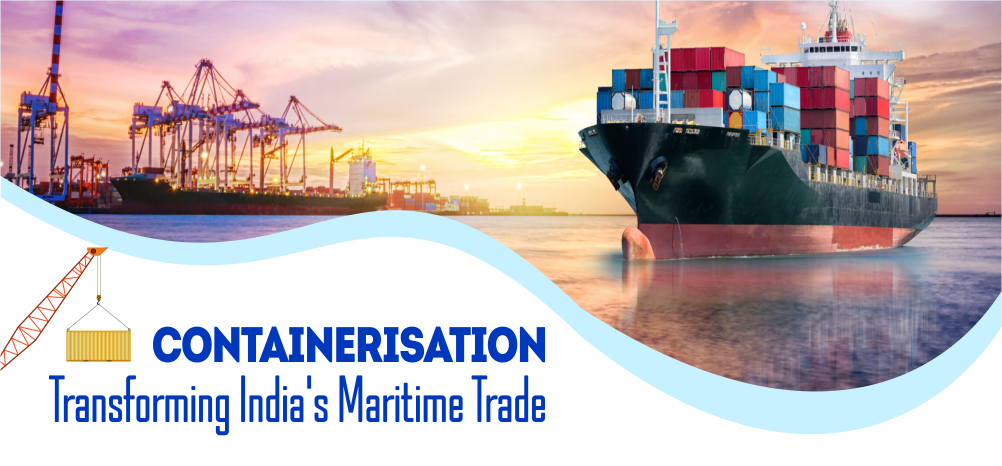
Despite other modes of transportation, the maritime shipping mode is the backbone of international trade. The concept of containerisation has revoluti...
India’s Growing Senior Care Needs: New Businesses and Services

The current state of India is characterised by the process of demographic transition with gradual growth of the proportion of senior citizens within t...
The Rise of India's Pathology Laboratories: Strengthening Quality and Safety in Healthcare

India has seen its healthcare system witness an impressive evolution in the last two decades because of the growth in healthcare infrastructure, incre...
IBEF BLOG
MORE
India's Blue Economy: Untapped Potential in Ports, Fisheries and Ocean Resources
The maritime space of India, which comprises the coastline, island areas, a...
How Technology Is Making Waste Management More Efficient in Indian Cities
Indian cities are adopting digital monitoring, sensors, and automated waste...
India's Cold Chain Logistics: The Backbone of Perishable Trade
India's cold chain network allows the transfer of perishables from farm...
Partners