Advantage India
Robust
Demand
* Rising working group and widening middle-class demography is expected to boost demand.
* Country will become the third-largest aviation market in terms of passengers by 2024.

Opportunities
in MRO
* By 2028, the MRO industry is likely to grow over US$ 2.4 billion from US$ 800 million in 2018.
* Land allotment for entities setting up MRO facilities in India has been revised to a period of 30 years in September 2021, from the current 3-5 years as the government aims to make India a ‘Global MRO Hub.
* In June 2023, the US committed to creating a global hub for MRO for high-end drones in India.

Policy
Support
* Foreign investment up to 49% is allowed under the automatic route.
* Under the Union Budget 2021-22, the government lowered the customs duty from 2.5% to 0% on components or parts, including engines, for manufacturing of aircraft by public sector units of the Ministry of Defence.

Increasing
Investments
* Investment up to Rs. 420-450 billion (US$ 5.99-6.41 billion) was expected in India’s airport infrastructure between FY18-2FY3#.
* Growing private sector participation through the Public-Private Partnership (PPP).
* In May 2023, It was informed that there is a plan to invest Rs. 1 lakh crore (US$ 12 billion) in airports in the coming days.

Introduction
The civil aviation industry in India has emerged as one of the fastest growing industries in the country during the last three years and can be broadly classified into scheduled air transport service which includes domestic and international airlines, non-scheduled air transport service which consists of charter operators and air taxi operators, air cargo service, which includes air transportation of cargo and mail. Domestic traffic contributes around 69% of the total airline traffic in South Asia and India’s airport capacity is expected to handle 1 billion trips annually by 2023. The Indian aviation industry has recovered fully from the covid-19 pandemic shock as indicated by the air traffic movement which stood at 327.28 million in FY23 compared to 188.89 million in FY22.
Indigo is the largest airline company in India with the highest market share. India has become the third-largest domestic aviation market in the world and is expected to overtake the UK to become the third-largest air passenger* market by 2024.
Market Size
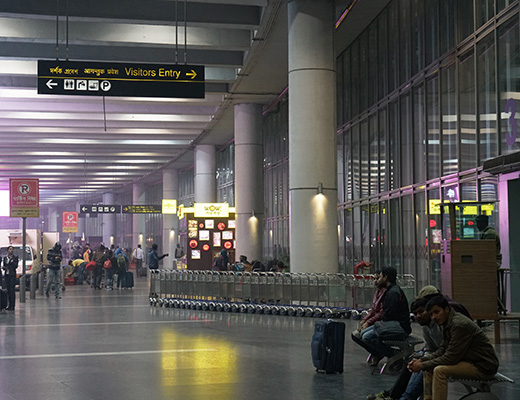
India is expected to overtake China and the United States as the world's third-largest air passenger market in the next ten years, by 2030, according to the International Air Transport Association (IATA). Further, the rising demand in the sector has pushed the number of airplanes operating in the sector. The number of airplanes is expected to reach 1,100 planes by 2027.
During April-January 2024, the domestic passenger traffic stood at 254.44 million, registering a 15.3% increase, and international passenger traffic stood at 57.57 million, a 23.5% increase, as compared to the same period the previous year.
In FY23, airports in India pegged the domestic passenger traffic to reach 270.34 million, a 62.1% YoY increase, and international passenger traffic to reach 56.9 million, a 157% YoY increase, as compared to FY22.
Between FY16 and FY23, freight traffic increased at a CAGR of 2.20% from 2.70 MMT to 3.15 MMT. Freight traffic stood at 3.15 million metric tonnes in FY23. Freight traffic in airports in India has the potential to reach 17 MT by FY40. In FY22, the number of aircraft movements stood at 1,757,112, and aircraft movements reached 2.5 million in FY23. To cater to the rising air traffic, the Government of India has been working towards increasing the number of airports. As of 2023, India has 148 operational airports. India has envisaged increasing the number of operational airports to 220 by 2025.
Key investments and developments
- According to the data released by the Department for Promotion of Industry and Internal Trade (DPIIT), FDI inflow in India’s air transport sector (including air freight) reached US$ 3.83 billion between April 2000-December 2023.
- As per the present FDI Policy, 100% FDI is permitted in scheduled Air Transport Service/Domestic Scheduled Passenger Airline (Automatic upto 49% and Government route beyond 49%). However, for NRIs 100% FDI is permitted under automatic route in Scheduled Air Transport Service/Domestic Scheduled Passenger Airline.
- In 2023, scheduled airline operators added 112 aircraft to their fleet, totaling 771 aircraft by December 31, 2023. New aircraft inductions aim to meet increasing air transport demand.
- Union Civil Aviation Minister Mr. Jyotiraditya Scindia inaugurates Asia's largest aviation expo, Wings India 2024, unveiling the theme "Connecting India to the World in Amrit Kaal: Setting the Stage for India Civil Aviation @2047" and launches UDAN 5.3. The event highlights India's aviation prowess, emphasizing accessibility, availability, and affordability, with significant announcements fostering industry growth and collaboration.
- In May 2023, Union Civil Aviation Minister Mr. Jyotiraditya Scindia said that there is a plan to invest Rs. 1 lakh crore (US$ 12 billion) in airports in the coming days.
- AAI and other Airport Developers have targeted a capital outlay of approximately Rs. 98,000 crore (US$ 12 billion) in the airport sector in the next five years.
- The number of PPP airports is likely to increase from five in 2014 to 24 in 2024.
- India’s aviation industry is expected to witness Rs. 35,000 crore (US$ 4.99 billion) investment in the next four years. The Indian Government is planning to invest US$ 1.83 billion for the development of airport infrastructure along with aviation navigation services by 2026.
- India aims to have 220 new airports by 2025, said, Mr. Jyotiraditya Scindia, Minister of Civil Aviation. Cargo flights for perishable food items will also be increased to 30% with 133 new flights in the coming years.
- In 2022, Mumbai International Airport Ltd (MIAL) raised US$ 750 million in debt in a private placement from a US-based private asset manager, Apollo Global.
- Adani Airport Holdings (AAHL) raised US$ 250 million in May 2022 for capital expenditure and for the development of six airports that it currently manages.
- In February 2022, the Airports Authority of India (AAI) and other airport developers set a capital outlay target of Rs. 91,000 crore (US$ 12.08 billion) for the development of the airport industry.
- AAI was planning to invest Rs. 25,000 crore (US$ 3.58 billion) in next the five years to augment facilities and infrastructure at airports.
- UK group to invest Rs. 950 crore (US$ 135.9 million) in Turbo Aviation's new airline TruStar.
- In October 2021, Tata Sons won the bid to acquire state-run Air India by offering Rs. 18,000 crore (US$ 2.4 billion) to acquire 100% of shares.
- In October 2021, Akasa Air, a start-up airline, received a ‘No Objection’ certificate from the Ministry of Civil Aviation to launch operations. The start-up commenced its operations in mid-2022.
- In September 2021, JetSetGo, a private aviation company, was planning to make its flight operations carbon neutral by 2024 through a carbon management programme.
- In August 2021, Indira Gandhi International Airport was declared the best airport in India and Central Asia at the Skytrax World Airport Awards.
- In June 2021, SpiceJet announced its ambitious target to fly 100 million domestic passengers on a Sustainable Aviation Fuel (SAF) blend by 2030 under the aegis of the World Economic Forum (WEF).
- In March 2021, the government announced a plan to set up two water aerodromes in Assam and four water aerodromes in Andaman & Nicobar Islands this year to boost tourism and connectivity.
- In March 2021, the government submitted a proposal to develop a water aerodrome project at the Ujjani Dam, under the Ministry of Civil Aviation’s UDAN-RCS (regional connectivity scheme).
- On March 25, 2021, Union Minister of Civil Aviation Hardeep Singh Puri inaugurated the Kurnool Airport, Orvakal, Andhra Pradesh, in a virtual ceremony. The flight operations at Kurnool airport will commence on March 28, 2021, under the Regional Connectivity Scheme – Ude Desh Ka Aam Nagrik (RCS-UDAN). UDAN flights carried 34,38,955 passengers till 7th November 2021.
- According to WTTC, India’s travel & tourism total contribution accounts for 4.7% of the GDP in 2021. The contribution was worth US$ 178 billion.
Government Initiatives
Some major initiatives undertaken by the Government are:
- In the Union Budget 2023-24:
- Rs. 3,224.67 crore (US$ 440.36 million) was allocated to the Ministry of Civil Aviation.
- Government to revive 50 aircraft landing sites comprising airports, heliports, water aerodromes, and advanced landing grounds to improve regional air connectivity.
- In the budget 2022-23, the RCS (Regional Connectivity Scheme) UDAN scheme which aims to stimulate regional air connectivity was allocated Rs. 601 crore (US$ 77.52 million).
- For better execution of the PM-Gati Shakti vision, Mr. Jyotiraditya M. Scindia, Minister of Civil Aviation asks for synergy between the Central and State Governments to build 16 new airports in Madhya Pradesh, Chhattisgarh, Uttar Pradesh, Rajasthan, and Maharashtra.
- The Ministry of Civil Aviation disbursed an amount of approximately US$ 3.7 million (Rs. 30 crore) (approximately) to the beneficiaries during FY23 under the PLI Scheme for Drones and Drone Components.
- The Directorate General of Civil Aviation (DGCA) has granted in-principle approval to Air India Ltd. and Interglobe Aviation Ltd (Indigo) for the import of 470 and 500 aircraft respectively. As per the induction plan of the airlines, the aircraft is proposed to be imported during the period 2023-2035.
- Union Civil Aviation Minister Mr. Jyotiraditya Scindia inaugurates Dehradun Airport's new terminal, expanding capacity to serve 3240 passengers during peak hours and 47 Lakh annually. The terminal embodies local heritage, with columns inspired by state flower "Brahmakamal", promoting sustainability and accessibility.
- UDAN scheme fosters regional connectivity with 519 operational routes, encompassing 53 tourism and 48 helicopter routes, benefiting 133.86 lakh passengers. Over 2.56 lakh flights have operated, involving 13 airlines, including startups, shaping a transformative impact on regional growth and air connectivity.
- NABH (NextGen Airports for Bharat) - Nirman is a government initiative to expand airport capacity more than five times to handle billions of trips a year, in the next 10-15 years.
- The Government has informed that India will spend US$ 11.88 billion by 2025 to boost regional connectivity by constructing airports and modernising existing ones.
- In 2023, the government has accorded 'In-Principle' approval for setting up 21 Greenfield Airports across the country. Out of these, 11 Greenfield airports have been operationalised.
- AAI Startup Policy: Delivering a framework & mechanism for the interaction of AAI with internal and external stakeholders that catalyze innovation at airports and leveraging technology for addressing challenges and enhancing the delivery of services to passengers.
- Under four rounds of bidding of RCS-UDAN, as of November 2022, 459 routes have commenced, operationalizing 70 airports including 2 water aerodromes & 9 heliports.
- Union Minister for Civil Aviation Mr. Jyotiraditya Scindia launches Digi Yatra for three airports in the country. Digi Yatra is being implemented across airports in a phased manner. In the first phase, it was launched by Mr. Jyotiraditya M. Scindia, Union Minister of Civil Aviation and Steel on December 1, 2022, at Delhi, Bengaluru, and Varanasi Airports. The implementation of Digi Yatra under phase I is also planned at Kolkata, Pune, Vijayawada, and Hyderabad Airports by March 2023.
- Civil enclave to be built in Jammu at a cost of Rs. 861 crore (US$ 107.9 million).
- In October 2022, Prime Minister Mr. Narendra Modi laid the foundation stone of the C-295 Aircraft Manufacturing Facility in Vadodara, Gujarat.
- The Ministry of Civil Aviation (MoCA) announced that airlines can operate domestic flights without any capacity restriction, effective from October 18, 2021.
- In October 2021, the Union Minister of Civil Aviation, Mr. Jyotiraditya M. Scindia, virtually flagged off the first direct flight along the Shillong–Dibrugarh route, under the RCS-UDAN (Regional Connectivity Scheme - Ude Desh Ka Aam Naagrik) scheme.
- The Ministry of Civil Aviation launched the Krishi UDAN 2.0 scheme in October 2021. The scheme proposes assistance and incentives for the movement of agri-produce by air transportation. The Krishi UDAN 2.0 will be implemented at 53 airports across the country, largely focusing on Northeast and tribal regions, and is expected to benefit farmers, freight forwarders, and airlines.
- On October 20, 2021, Prime Minister Mr. Narendra Modi inaugurated the Kushinagar International Airport in Uttar Pradesh. The international airport is likely to facilitate the air travel requirements of international Buddhist pilgrims in India.
- In August 2021, the government plans to implement a biometric boarding system using facial technology in six airports, including Bengaluru, Hyderabad, and Pune. The project is currently in the testing phase.
- The Ministry of Civil Aviation (MoCA) is hopeful that aspiring commercial pilots will soon be able to get trained in India without having to leave the country. In this regard, the government in July 2021 announced setting up eight new flying academies across the following five airports: Belagavi and Kalaburagi in Karnataka, Jalgaon in Maharashtra, Khajuraho in Madhya Pradesh, and Lilabari in Assam.
- The government is planning to start 14 more water aerodromes across the country, after the successful launch of seaplane service by Prime Minister, Mr. Narendra Modi, between the Statue of Unity near Kevadiya in Gujarat's Narmada district and Sabarmati Riverfront in Ahmedabad in October 2020.
Road Ahead
India’s aviation industry is largely untapped with huge growth opportunities, considering that air transport is still expensive for the majority of the country’s population, of which nearly 40% is the upwardly mobile middle class. The government has been instrumental in developing policies to give a boost to the aviation sector. For this, the UDAN-RCS scheme has been launched by the government which aims to increase air connectivity by providing affordable, economically viable, and profitable travel on regional routes.
The industry stakeholders should engage and collaborate with policymakers to implement efficient and rational decisions that would boost India’s civil aviation industry. With the right policies and relentless focus on quality, cost, and passenger interest, India would be well placed to achieve its vision of becoming the third-largest aviation market by 2020. The expenditure of Indian travellers is expected to grow up to Rs. 9.5 lakh crore (US$ 136 billion) by 2021. In 2022, the contribution of India's travel and tourism sector to India's economy was worth Rs. 15.7 trillion (US$ 190 billion). By the end of this year, it would be worth Rs. 16.5 trillion (US$ 200 billion), as per the data released by the World Travel & Tourism Council (WTTC). The forecast for the next ten years is worth an enormous almost Rs. 37 trillion (US$ 450 billion).
Due to the rise in demand for air travel, India will need 2,380 new commercial airplanes by 2038. According to a report titled ‘Travel market in India’, published by RedCore - a RedSeer unit focusing on early-stage companies - the travel market in India, worth ~US$ 75 billion in FY20, is projected to cross US$ 125 billion by FY27.
References: Media Reports, Press Releases, Press Information Bureau, Directorate General of Civil Aviation (DGCA), Airports Authority of India (AAI), Union Budget 2023-24
Note: Conversion rate used in February 2024, Rs. 1 = US$ 0.012
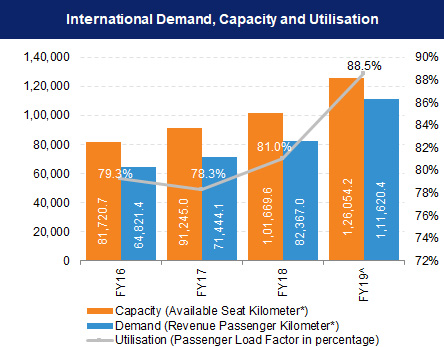
Note: *- International and Domestic, ^ - As per International Air Transport Association (IATA) forecasts
Related News
MOREAviation India / Major Airports
- Delhi
- Mumbai
- Chennai
- Bengaluru
- Kolkata
- Hyderabad


IBEF Campaigns
MORE

India Organic Biofach 2022
Ibef Organic Indian Pavilion BIOFACH2022 July 26th-29th, 2022 | Nuremberg, ...
Case Studies
MOREPromoting Indigenous Start-ups: Case Study of Investor Interest in Small-town Start-ups

As urban markets become saturated, investors are turning their gaze towards the untapped potential of small-town innovation, driven by a desire to fos...
India's White Revolution

The "White Revolution" in India refers to the successful implementation of Operation Flood, a dairy development program launched on January ...
The Growth of Ayurveda in India

Ayurveda, an ancient health system originating from India, has a longstanding history. It revolves around using plants and herbs to maintain health an...
IBEF BLOG
MORE
India's Solar Power Revolution
India is leading the renewable energy revolution, with a strategic emphasis...
Empowering MSMEs: Fintech Solutions for Small Businesses in India
Micro, small, and medium enterprises (MSMEs) are the backbone of the Indian...
Unlocking India's Digital SME Credit Gap and Economic Potential
The Indian economy thrives on the contributions of the Micro, Small, and Me...
Partners