Feature Article
How Indian Exporters Can Improve Global Brand Visibility Through Digital Commerce Platforms
Global commerce is undergoing a paradigm shift. Increasingly, the platforms of digital commerce have come to dominate the ways in which businesses interact, compete, and grow in international markets. While traditional export models, characterised by trade fairs and direct engagement with distributors and buyers, remain relevant, a growing share of supplier discovery and evaluation is now taking place digitally. The digital presence of a company thus has come to play an important part in enhancing business visibility and creating trust for exporters in foreign markets .
This has created immense potential for Indian exporters who are striving to carve out an international niche in global manufacturing and sourcing. Not only have government initiatives like Trade Connect ePlatform, the Districts as Export Hubs (DEH) program, the Export Promotion Mission, and Digital India made it easier for exporters to get more exposure to international markets, but the use of digital commerce platforms, digital marketing and data-driven approaches has facilitated engagement with international customers and helped exporters build stronger, long-term relationships.
However, mere digital visibility is not enough to be successful anymore. As competition increases in global markets, exporters need to establish their credibility by creating their own brands, communicating quality and compliance requirements, gaining insights from digital data, and providing a cohesive experience through multiple digital touchpoints. Increasingly, the focus has shifted from mere discovery of businesses online to establishing oneself as trusted and recognizable brands in international markets. The following insights from industry experts will help Indian exporters understand how they can build their brand visibility through digital commerce and gain an edge in the global marketplace through digital innovations.

Digital Visibility: The New Gateway to Global Markets
Over the course of the last few years, the process of discovering, evaluating, and engaging with suppliers has changed fundamentally. Today, international buyers increasingly tend to begin their sourcing processes online, researching suppliers' profiles on Google, digital commerce platforms, their company websites, and professional networking sites. In the increasingly digital world of business, a company's online presence has stopped being a marketing tool. It has turned into the very first point of contact with international buyers, setting the tone of perceptions about credibility and capability of companies. Thus, digital visibility is becoming an integral part of exporters' strategy helping them overcome geographic barriers and establish trust among their international clients at the very beginning of their relationship. Reflecting this transformation, Ravi Saxena, Founder & CEO, Wonderchef Home Appliances, states, “Twenty years ago, an export deal began with a handshake at a trade fair. A buyer in Dubai or Frankfurt met you, saw your factory, and decided. Today, that gatekeeping does not exist. Today the buyer checks you online long before they ever speak to you. If they can't find you, or what they find looks second-rate, the conversation never starts. So visibility isn't a marketing nicety anymore. It's how trust gets built before a single email is exchanged. For Indian brands, that's actually a gift, as we no longer need a distributor's permission to reach a customer in London or Riyadh. We can put our design and quality in front of them directly and let it speak.”


This change in buyer behaviour is also reshaping competition for Indian exporters across industries. Digital commerce has provided companies of different sizes with an opportunity to showcase their products, certifications, production capabilities and competitive advantages without having to use conventional channels of distribution alone.
At the same time, increased accessibility of markets has increased the level of competition in the world which calls for a higher degree of credibility, discoverability and engagement. As such, the development of a digital platform does not mean having a website but rather projecting trust and professionalism at all levels and enhancing one's brand reputation. Echoing this perspective, Neelima Burra, SVP – Chief Strategy and Marketing Officer, Business Head – Omnichannel Retail and International Business, Luminous Power Technologies, states, “Global trade has become increasingly digital-first, with international buyers now beginning their sourcing journeys online. For Indian exporters, digital visibility is no longer optional it is a fundamental requirement for competitiveness. Whether buyers are located in North America, Europe, the Middle East, or Southeast Asia, their first interaction with a supplier is often through digital channels rather than traditional trade networks. A strong digital presence allows exporters to overcome geographical boundaries, showcase their product capabilities at scale, and establish credibility in competitive international markets. Increasingly, buyers are evaluating suppliers not just on quality and pricing, but also on transparency, responsiveness, and brand trust. In many cases, a company’s digital footprint from its website to marketplace presence and customer reviews becomes its first and most influential introduction. From our experience at Luminous, building a strong digital presence has been central to expanding into newer markets. It allows us to communicate not just product specifications but also reliability, innovation, and service capabilities factors that are increasingly important in high-involvement categories like energy solutions.”
Independent research shows that roughly 90% of B2B buyers now begin their purchasing journey with online research, and complete close to two-thirds of that journey – comparing suppliers, checking certifications, reading reviews before ever making direct contact. Around 71% of B2B buyers start this research with a simple search engine query, with Google alone commanding roughly 85% of that search traffic. The digital-first nature of the B2B buying journey is also reflected in the pace at which supplier decisions are made. 6sense’s 2025 Buyer Experience Report, based on nearly 4,000 B2B buyers across North America, Asia-Pacific and Europe, found that the average buying cycle shortened from 11.3 months in 2024 to 10.1 months in 2025. More significantly, the winning vendor was already on the buyer’s Day One shortlist 95% of the time, underlining the importance of establishing credibility and visibility before direct engagement request.
Digital Commerce Platform: Creating a Globally Recognised Digital Brand
While the availability of digital commerce platform provides an opportunity for Indian exporters to become visible on international markets, mere visibility is not enough in order to gain business. In a highly competitive environment, buyers consider not only the products offered by an exporter but also how credible they appear. An effective combination of a professional website, high-quality images of the products, authentic storytelling, certificates, reviews of past customers and other factors create brand credibility even prior to establishing any business contacts. Therefore, the development of a digital platform goes far beyond mere presence and includes creating a recognizable and credible brand.

Reflecting this shift, Jaquar Group Spokesperson, states, “Digital commerce today is much broader than simply selling products online. The most successful exporters are building an integrated digital ecosystem where multiple platforms work together to enhance discoverability, build credibility and simplify cross-border trade. Although some of the established B2B marketplaces such as Global Sources and IndiaMART have helped manufacturers increase visibility among international buyers, sector-specific digital platforms continue to play a growing role in connecting suppliers with specialised procurement networks. Government-supported initiatives such as the Trade Connect ePlatform have also made it easier for exporters to access market intelligence, regulatory information and overseas business opportunities. That said, the platform itself is rarely the differentiator.
International buyers assess suppliers based on their ability to manufacture, innovate on the product, assure quality, respond quickly and deliver equally across markets. Digital platforms allow one to test out these strengths. In future, successful exporters will increasingly marry digital commerce with branding, technical content, responsive customer engagement and data-driven market insights. As global supply chains continue diversifying, businesses using digital ecosystems to generate trust and not only inquiries will be better positioned to internationalise and strengthen India’s credentials as a reliable and quality manufacturer.”
Digital infrastructure and policy support are accelerating the shift towards e-commerce-led exports. More than 200,000 exporters have generated over US$ 20 billion in cumulative e-commerce exports from India through Amazon Global Selling, highlighting the growing role of digital channels in international trade. The government is also developing E-Commerce Export Hubs to streamline export processes and reduce logistics-related barriers. The Trade Connect ePlatform provides exporters with trade information, regulatory guidance and access to Indian Missions abroad. India Post’s integration with ONDC is also expanding digital access to parcel logistics, while its Logistics Post services provide warehousing and fulfilment support.
For Indian exporters seeking to build a globally recognised brand, credibility needs to be reinforced at every digital touchpoint. Buyers increasingly look beyond product specifications to certifications, manufacturing capabilities, customer testimonials, sustainability credentials and responsiveness. As face-to-face interactions become less frequent, exporters need to maintain consistent standards of professionalism and communication across marketplaces, websites and professional networks.
Leveraging Digital Tools and Data to Strengthen Global Buyer Engagement
The changes in international trade as it is facilitated by digital commerce are leading to exporters not just using digital channels in order to make themselves visible but also engaging customers and gaining competitive advantage through data-driven strategies. The modern digital platforms provide exporters with the means to collect market intelligence which is crucial for them in understanding consumer behaviour and adapting their strategy for international markets. Together with social media and content marketing, digital tools are helping Indian exporters engage their customers in global markets. The role of social media in B2B decision-making is becoming increasingly significant. Gartner’s 2025 research found that 90% of B2B buyers use social media when considering a purchase, indicating that digital platforms are becoming an important part of the supplier discovery and evaluation process
Jaquar Group Spokesperson notes, “For exporters, digital tools have moved well past brand awareness; they are now instruments of real-time buyer intelligence. Social platforms, in particular, have become the primary discovery layer for international buyers. For an exporter, a well-run LinkedIn presence isn't a marketing nicety anymore; it's often the first impression a global buyer forms of the company. Data analytics adds the second layer. Rather than broadcasting the same message everywhere, exporters can now track which markets, buyers and product categories are generating genuine interest, and adjust pricing, positioning and outreach in near real time. This shift from guesswork to evidence-based engagement is what separates exporters who convert inquiries into orders from those who simply generate traffic.”The growing importance of professional digital platforms is particularly relevant for manufacturing exporters, where supplier discovery increasingly extends beyond traditional industry networks. LinkedIn’s 2025 research, based on a survey of 1,767 B2B manufacturing buyers across Europe, Asia-Pacific, the US and Brazil, found that 59% of manufacturing buyers are active on LinkedIn daily, highlighting the platform’s growing role in professional research and vendor engagement.

Sharing a similar perspective, Neelima Burra States “Digital tools have fundamentally transformed how businesses connect with customers and stakeholders across geographies. For exporters, they provide an opportunity to improve visibility, engage buyers more effectively, and make informed business decisions based on real-time insights. Social media platforms allow exporters to showcase products, share customer success stories, and demonstrate expertise to global audiences. Search engine optimisation, content marketing, and digital advertising further enhance discoverability by ensuring that exporters appear when buyers actively search for relevant products or suppliers.” The shift towards digital-first buying is also changing how suppliers engage potential customers. Gartner’s 2025 research found that 61% of B2B buyers prefer an overall rep-free buying experience, while 73% actively avoid suppliers that send irrelevant outreach. This reinforces the importance of relevant digital content, targeted communication and data-led engagement in reaching international buyers.
Standing Out in a Crowded Digital Marketplace
While digital commerce made it easier for firms to reach international markets, it also increased competition because buyers can easily compare different suppliers across the globe within short periods. This means that digital visibility alone is not enough, and exporters have to consistently differentiate their companies through branding, good value proposition, and great customer experience. In the environment where buyers can compare thousands of similar companies selling similar products, success in the long run will depend on building trust rather than competing on prices alone. The scale of online competition is reflected in shopper behaviour: 98% of global shoppers buy from marketplaces, while 59% of online shoppers have purchased from retailers based outside their home country. This gives exporters access to larger markets but also places them alongside suppliers from around the world. It means that exporters have to develop the necessary digital skills, great communication and customer engagement that will improve the credibility of their companies.

Digital trade has expanded market access, but has also intensified competition, particularly for MSMEs. Building sustained visibility requires exporters to strengthen digital capabilities, sharpen product positioning, ensure compliance with international standards and use market intelligence to understand customer requirements. Government initiatives such as the Export Promotion Mission and Trade Connect ePlatform can further support market access and global connectivity. Ultimately, sustainable export growth will depend on building trust, delivering consistent quality and offering differentiated value, rather than visibility alone.
However, creating a sustainable brand in the digital era also involves moving away from short-term marketing to the development of good customer relationships. Companies that rely heavily on discounting, irregular and poor-quality content or advertising alone will get visibility temporarily but fail to create brand equity. Customer experience is increasingly influencing online purchase decisions.
DHL’s 2025 global shopper survey found that 72% of shoppers consider free delivery an important improvement, while 52% cited faster delivery and 46% better product descriptions. More and more exporters start to invest in unique content, good experience after the purchase, delivery options, and the development of brand stories to build good customer relations. The importance of fulfilment extends beyond logistics. Around 31% of global shoppers say delivery by a trusted provider would encourage them to purchase from retailers in other countries, underlining the role of reliable fulfilment in cross-border brand building.
Sharing a similar perspective, Ravi Saxena notes, “Excessive discounting is one big trap. Too many Indian exporters compete only on price, and price is a race you eventually lose. The way out is to stop being a manufacturer who just supplies and become a brand that's chosen in the marketplace, moving from OEM (Original Equipment Manufacturer) to an OBM (Original Brand Manufacturer). Over-dependence on paid advertising is another challenge. If your visibility vanishes the day, you stop spending, you don't have a brand. Organic strengths like search, content, and a genuine community take longer, but they compound. Another important area is logistics. A good website means nothing if the parcel arrives late or the return is a big hassle. The post-purchase experience has to match the premium promise, which is why serious exporters lean on strong fulfilment partners abroad instead of improvising.”
The Road Ahead: From Digital Presence to Global Brand Leadership
With the development of global business and digital commerce, the next phase of exporting competitiveness will depend on how effectively the companies use digital commerce rather than simply participating in the process.
As mentioned above, exporters are required to combine digital visibility with innovations and customer engagement to generate a valuable brand. The focus is changing from getting the traffic online to creating good customer relations, analysing buying patterns and preferences, and providing consistent experience to the clients.
It gives Indian exporters a chance to become global brands rather than being considered only efficient manufacturers. India’s total exports reached a record US$860.09 billion in FY2025–26, up 4.22% from the previous year, increasing the importance of building globally competitive brands alongside manufacturing capabilities.

Reflecting this transformation, Ravi Saxena states, “Over the next three to five years, Indian exporters need to prioritise strategic pillars: Design and IP. The world pays a premium for something thoughtfully made and genuinely original. Indian brands have to lead with design, not apologise for price. Use of AI for the unglamorous work: predicting what to stock where, tailoring a campaign to a local market. Building direct-to-consumer relationships: Marketplaces are great for getting found, but if they have your customer, they control your future.”
The need for an integrated approach is reflected in changing B2B buying behaviour. McKinsey’s 2026 Global B2B Pulse Survey, based on nearly 4,000 decision-makers across 13 countries, found that buyers use an average of 10 channels across the purchasing journey. The survey also found that 71% of B2B companies offer e-commerce and, among these companies, roughly one-third of revenue flows through digital channels, highlighting how digital commerce is becoming part of the core commercial engine.
Echoing this perspective Neelima Burra notes, “Over the next few years, Indian exporters will need to adopt a more integrated digital-first approach to remain competitive in global markets. Building visibility alone will not be sufficient; businesses must focus on creating strong brands that inspire trust and long-term loyalty. The first priority should be strengthening digital infrastructure through professional websites, marketplace optimisation, and customer experience capabilities. Exporters should also invest in content, thought leadership, and brand storytelling to differentiate themselves beyond price and product specifications.”
Jaquar Group Spokesperson further adds, “Over the next few years, Indian exporters should move beyond simply being digitally present to becoming digitally competitive. The priority should be building an integrated digital strategy that combines visibility, credibility and data-driven decision-making. First, exporters should invest in a strong digital foundation through search-optimised websites, multilingual content, virtual product catalogues and seamless digital customer experiences. Second, they should leverage B2B digital marketplaces and professional networks like LinkedIn to expand global reach. Third, adopting AI and data analytics will be critical to understanding buyer behaviour, identifying high-potential markets and personalising engagement.”
For Indian exporters, the opportunity presented by digital commerce extends beyond gaining visibility in international markets. The next phase of export growth will depend on the ability to combine digital capabilities with strong branding, differentiated products, data-driven decision-making and consistent customer experiences. As digital channels increasingly shape how global buyers discover, evaluate and engage with suppliers, exporters that build trust across every stage of the digital journey will be better positioned to move from being recognised as reliable manufacturers to becoming globally recognised brands.
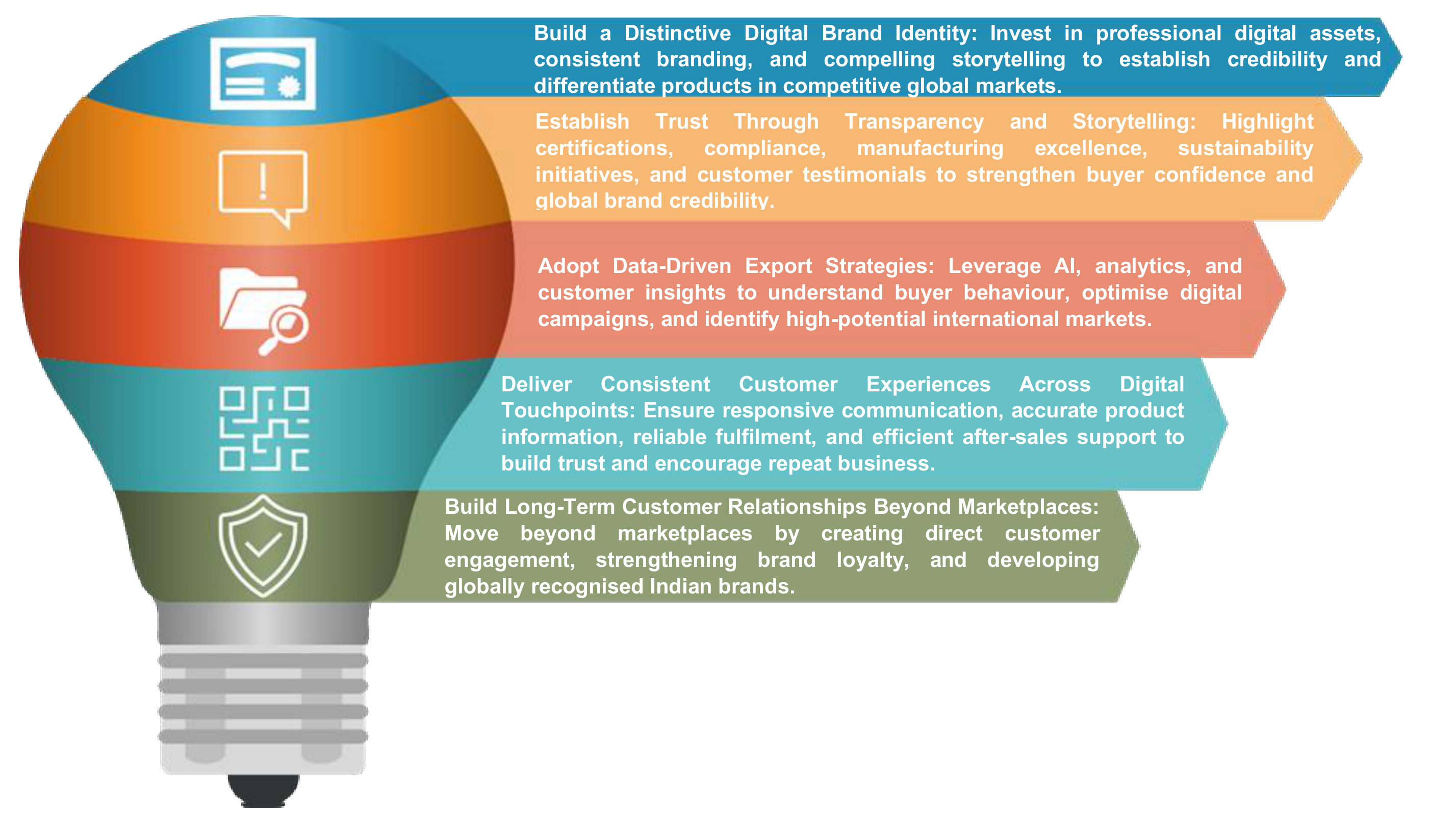
Digital Commerce Success Tips for Indian Exporters
Get In Touch
Your input is valuable in shaping the future of the IBEF Export Newsletter! Take a moment to share your thoughts and help us bring you more relevant insights, success stories, and export branding strategies.
Contact & Subscriptions: Contact Us
Email us at: info.brandindia@ibef.org
Call: +91 11 43845501
Partners