IBEF Export Insights: Tracking India’s Trade Performance and Global Opportunities
India’s export scenario has witnessed a lot of change during the past decade. While traditional industries like agriculture, textiles, and gems & jewellery have remained important contributors to India’s exports, the country has equally become a leading exporter of engineering goods, pharmaceuticals, chemicals, electronics, services, and other value-added products. With increasing India’s participation in global value chains and emergence of new trade deals that create fresh opportunities, exporters need not just trade numbers but reliable market intelligence to discover products, analyse destination markets and comprehend changing trade dynamics.
To meet this demand, India Brand Equity Foundation (IBEF) has created a detailed Exports section that acts as a one-stop place to gain knowledge about India’s export scenario. Targeting exporters, investors, policy makers, researchers, and companies alike, the portal goes beyond simply providing trade data and offers valuable insights about Indian export products, key international markets, industry-wise performance, and bilateral trade relations. By merging product-focused and country-focused analysis in one platform, the Exports section allows users to study the global trade activities of India and take wise business decisions.
A Comprehensive Gateway to India’s Export Scenario
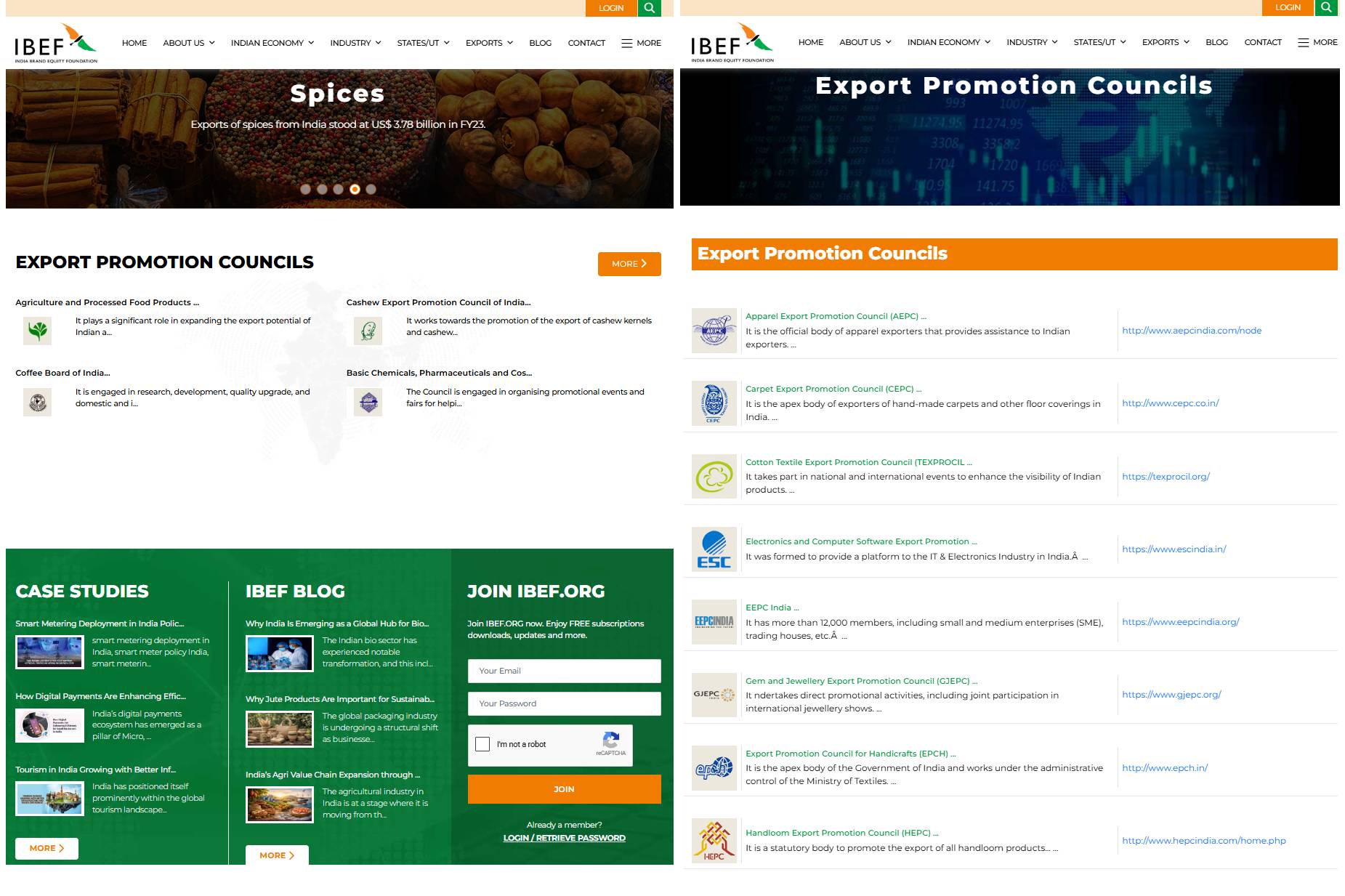
The Exports section in the IBEF website acts as a complete gateway to gaining knowledge about India’s international trade performance. In contrast to conveying information about the country’s export scenario from a single angle, the portal makes data and insights available in a structured format that helps users understand India’s exports from different perspectives.
Irrespective of whether the user wants to learn about the export products of India, opportunities in a specific country, bilateral trade relations or emerging trends in exports, the section allows users to do all of this using a well-structured format. This helps the users to easily move from one aspect to another and thereby form a holistic view of India’s export scenario.
An important feature of the platform is that it facilitates analysis of India’s exports from two different perspectives – what products India exports and to which countries India exports. Overall, these two perspectives together offer a complete picture of India’s changing trade scenario.
Exploring India's Export Basket: Product-wise Insights
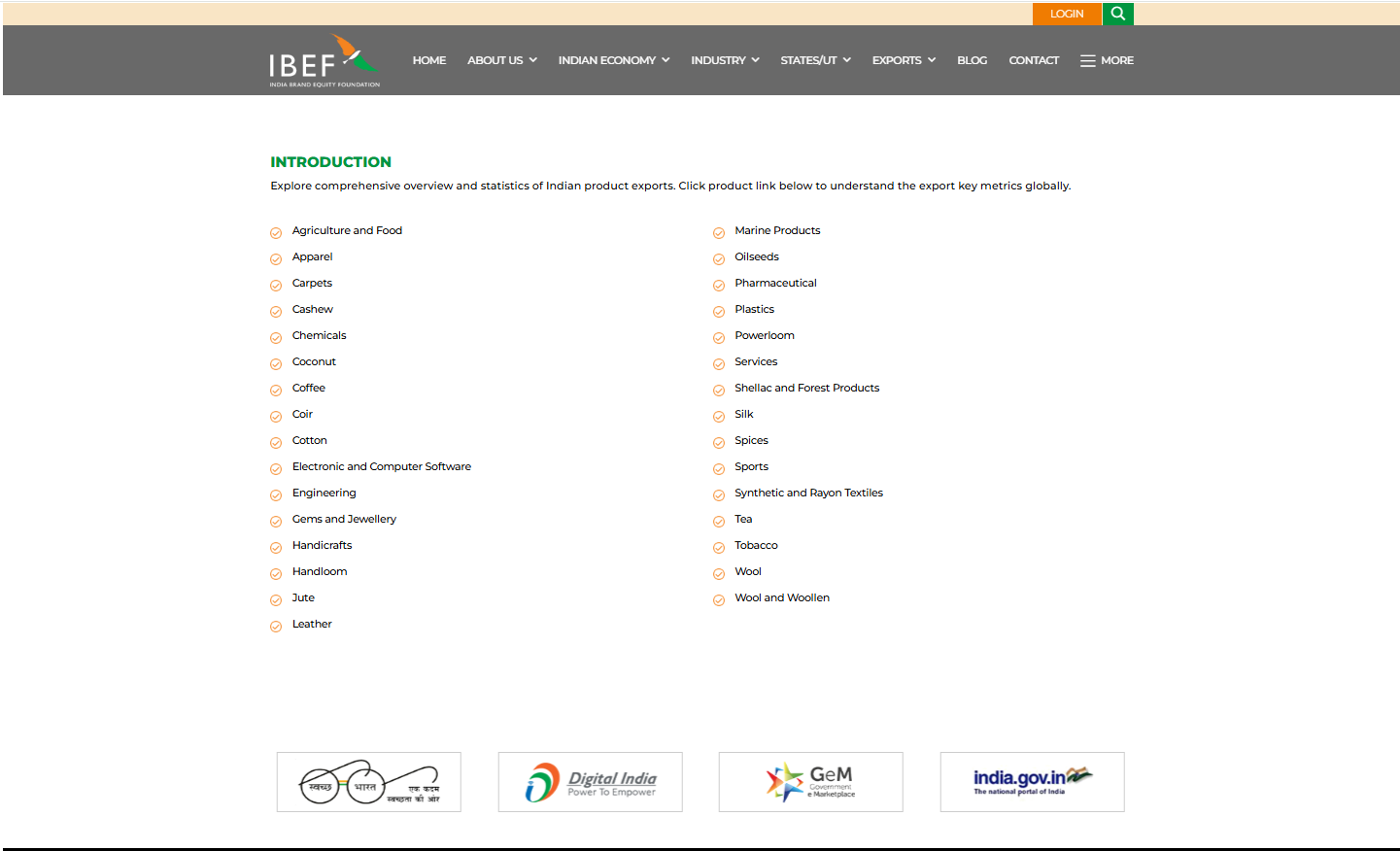
Every export activity begins with an underlying product. It can be about an existing exporter expanding into new markets or a MSME seeking its first overseas exposure, but it is critical to understanding the product ecosystem before crafting a good export strategy. In recognition of this, the IBEF Exports product-wise classification provides insight into the export environment of India, allowing users quick access to information relating to their business sectors.
A wide array of export products is covered by this platform, highlighting the diversity in India’s export profile. A user can look at various sectors like agriculture & food products, textiles, carpets, spices, tea, and handicrafts, as well as high-value export products like engineering goods, pharmaceuticals, chemicals, plastics, electronics, gems & jewellery, marine products, services, and software. This allows firms in diverse sectors to understand where their products fit in the wider export ecosystem of India.
However, the product classification does not provide a simple listing of products for the sake of it. Instead, the product classification is the starting point of getting sector specific information on the product of your choice. It will allow you to get details about the export performance of your product, potential of the market, development in the industry and growth opportunities.
Structuring of exports based on products makes it easier for the business to understand the comparative advantage of India in various industries and sectors that have high global demand and long-term export potential.
Understanding Global Markets: Country-wise Export Insights
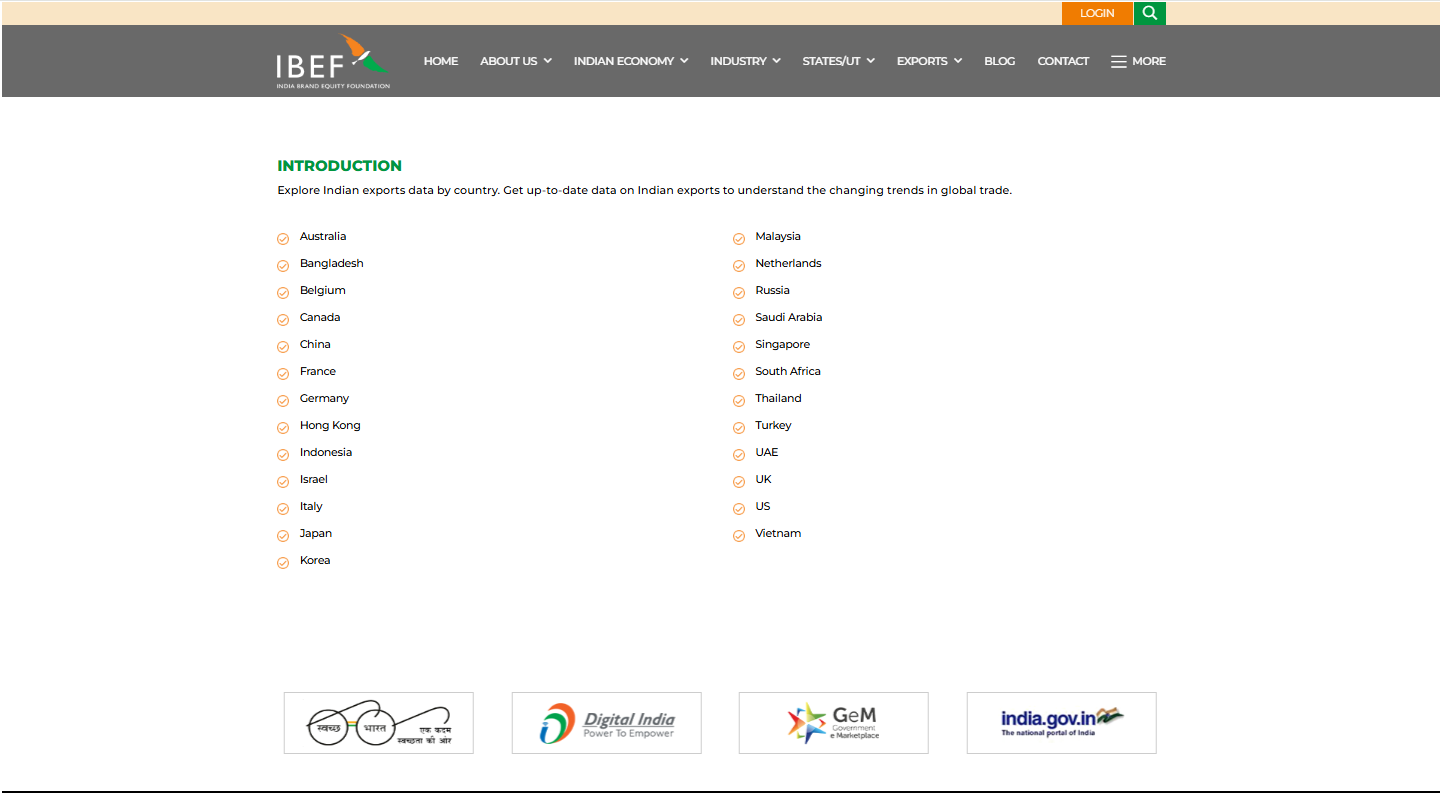
Export orientation of certain companies begins with the identification of certain products for export, while other companies opt for a market-based strategy that includes the evaluation of countries which have the largest potential for business activities. Considering these different perspectives, the IBEF Exports section offers a unique country-based description of India's export situation, which allows analysing India's trade relations with key international markets.
The resource offers a wide variety of key export destinations such as the United States, the United Kingdom, the United Arab Emirates, Germany, Japan, Australia, Vietnam, Singapore, France, Italy, South Africa, and some more important countries. This diversity ensures quick access to information about India's trade relations with each of these countries and shows the differences in exporting tendencies of various regions.
A classification based on destination country helps get a useful market perspective of the situation. Instead of analysing India's exports in terms of certain products, one can look at trade relations between India and a certain country and find out the sectors where India has strong or promising positions. This strategy will be especially helpful for those exporters who need to analyse the diversification of their markets or to learn the demand in various regions.
Product and country-based classifications help users analyse the exports of India from two different perspectives – the supply and demand side. Depending on whether the first step is a product or a destination country, the user can gain an understanding of India's global trade system.
Beyond the Overview: Deep-Dive Export Intelligence
The main advantage of the IBEF Exports section is not only in helping users to find suitable products and countries but also in providing the relevant information that can be used for making decisions. After choosing certain products or countries, users have access to special pages where they can find all kinds of information concerning this particular sphere. Such an approach turns the website from just a database into a guide for businesses that want to export something.
Understanding Sector-Specific Export Opportunities
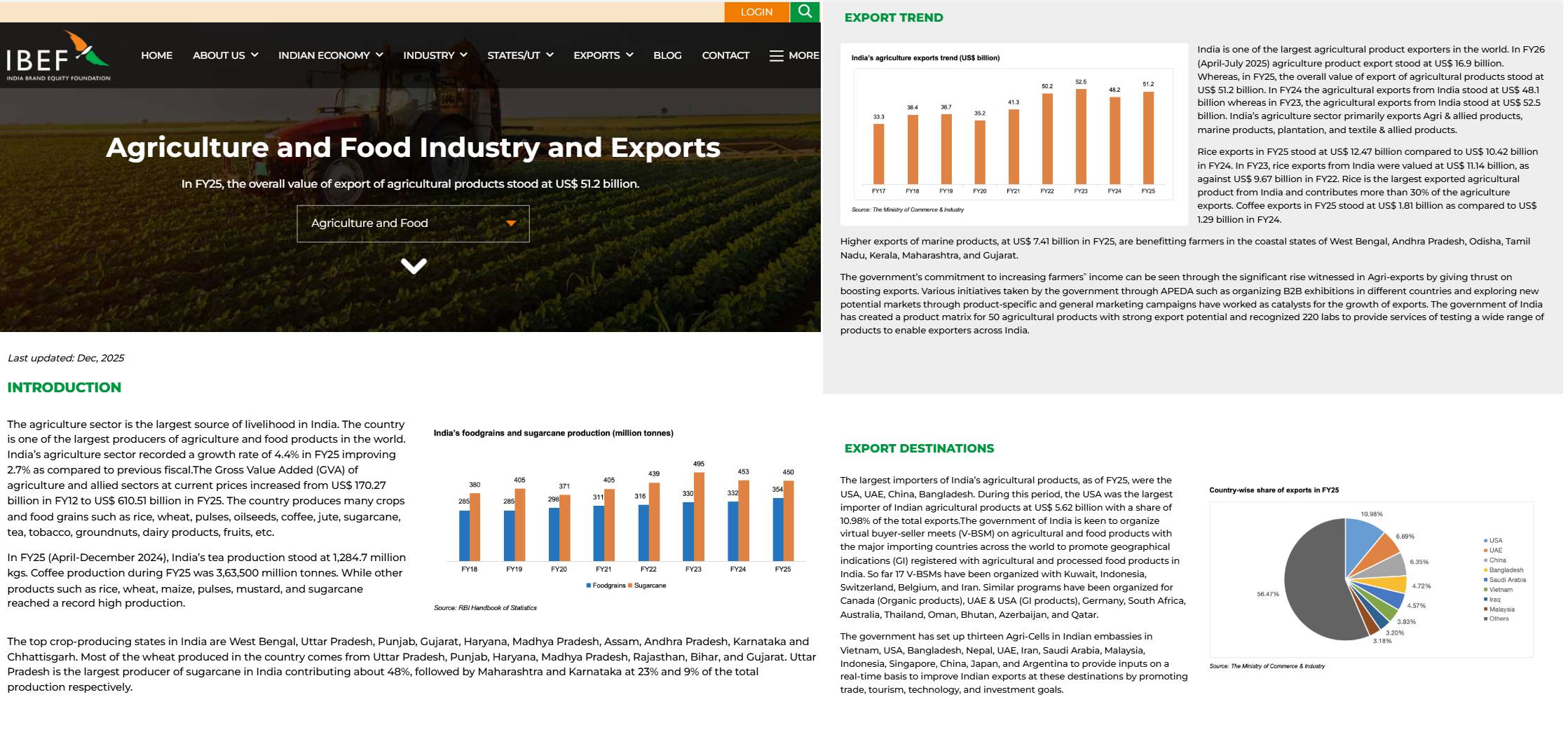
Every commodity page provides an extensive description of a selected export area, helping readers understand not only the country’s strengths but its competitiveness on the international market as well. Contrary to the previous pages focused on export data alone, these pages present a broad picture of the industry in terms of its market size, production environment, export dynamics, government support, latest developments, and future growth prospects.
Thus, for instance, while examining the Agriculture and Food industry page, the reader will be able to learn about India’s status of a world leader in agriculture and food export, the key factors promoting export growth, and the latest initiatives contributing to making the Indian industry more competitive abroad. Integrating the information about the industry and export into one page will help businesses analyse opportunities in their industries.
This is equally useful for exporters looking for new markets, investors assessing the potential of certain industries, researchers analysing trade trends, and government officials monitoring the industry performance.
Analysing Bilateral Trade Relationships
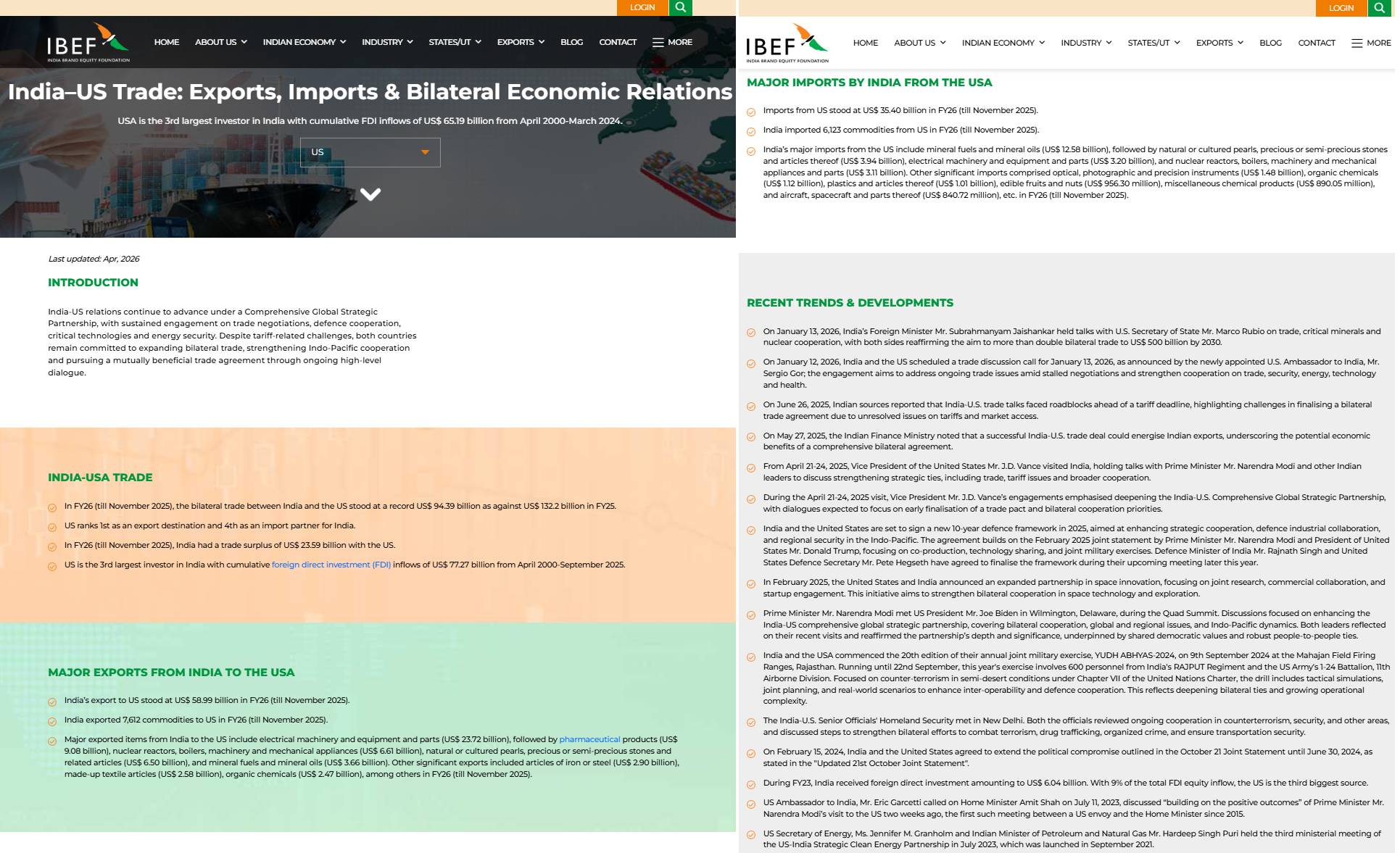
Alongside the product-oriented view, the individual country sections also provide an in-depth look at India’s trade relations on a bilateral basis. These pages go beyond trade statistics to give a more extensive insight into economic interaction.
A typical country page will provide insights into India’s export and import flows with the chosen country, main commodities being traded, trends in trade flows, investment connections, relevant policies, and new business opportunities in the particular country. Thus, a company can assess not only the volume of trade between the two countries, but also which sectors drive this trade activity.
For example, the India-US Trade page explains one of the most important trading partnerships of India, providing details about the main export sectors, changes in trade relations, and areas of cooperation. Information like this is very useful for companies planning to explore an existing market, find product opportunities, or understand the business environment in the particular country.
Combining sector-oriented information with trade-related data by individual countries, the IBEF Exports section allows business to get a thorough insight into India’s export profile and the countries in which Indian products have the best opportunities. Taken together, these perspectives allow making well-informed decisions in relation to international growth plans.
Transforming Information into Export Strategy
One of the distinguishing features of the IBEF Exports section is that it supports users at every stage of the export journey. Rather than presenting information in isolation, the platform enables businesses to connect products, markets, and trade intelligence, helping them make more informed strategic decisions.
In the case of growth exporter of engineering products, the first step would be to consider the relevant product category to determine India’s export performance, the strengths of the industry, and the current trends. The analyst could then move on to analyse the country specific pages to determine trade relations with key countries, major exporting destinations, and emerging opportunities. Along similar lines, an exporter of food products could begin by analysing relevant product information before assessing potential export markets.
This type of system ensures that the process of transition from product information to market information is smooth, providing more insight into export possibilities. Instead of relying on different sources for obtaining information on industry, countries, and trade patterns, all the information can be obtained from one source.
For export businesses, these trends provide a means by which better market selection and planning can be achieved. Investors can identify areas of the economy where there is strong export capacity, and policy makers and researchers gain access to systematic information which helps analyse India’s changing trade profile. Through the combination of product, market, and trade information, the Exports section goes beyond being simply an information bank and serves as a tool for decision-making.
Supporting India's Expanding Export Ecosystem
Export development in India is now dependent on the diversification of products, market expansion, and globalization through value chain. In light of the emerging dynamics of business and exploration of new markets, accurate information will become very important.
IBEF Exports is a part of this ecosystem which integrates intelligence about products, trade details for individual countries, and industry developments in one place. The information presented in an organised manner will enable the user to gain knowledge about the strengths of India as an exporter as well as new opportunities in different industries.
In all cases, whether it is to select a good export sector, analyse the target market, or assess the bilateral relations between trading partners, the platform makes an excellent base for decision-making. Through this process, it aids India in the fulfilment of the country’s broader goal of boosting trade internationally and in letting businesses seek new opportunities abroad.
Conclusion: A Strategic Resource for India's Export Journey
As India's export structure becomes increasingly diversified on account of variety in products, markets, and industries, information has assumed a significant role for companies interested in competing in the international environment. Competing successfully in international trade entails not only production ability but also the need to understand market dynamics, opportunity identification, and strategic decision-making.
The IBEF Exports section serves the purpose of bringing together detailed information on products and countries in one online platform. By considering India's export structure, analysing bilateral trade relations, offering specific industry intelligence and market developments, the platform gives the user the opportunity to see the whole picture of India's international trade.
Thus, by gathering credible information and industry insights into one place, the Exports section represents a useful tool for exporters, investors, policymakers, and scholars. In addition, it is important to note that the use of such a platform corresponds with IBEF's ultimate goal of showing India's export potential and improving its international trade image.
Get In Touch
Your input is valuable in shaping the future of the IBEF Export Newsletter! Take a moment to share your thoughts and help us bring you more relevant insights, success stories, and export branding strategies.
Contact & Subscriptions: Contact Us
Email us at: info.brandindia@ibef.org
Call: +91 11 43845501
Partners




