Industry Trends
Market Insights
The exports segment of India maintained its strength in the FY26 on account of its diverse export basket, improved manufacturing capacity, and higher participation in global value chains. Total exports of India (merchandise and services) in FY26 stood at US$ 860.09 billion which marks a growth of 4.22% over the previous year’s figure of US$ 825.26 billion as per the Ministry of Commerce & Industry. Of the total, merchandise exports were at US$ 441.78 billion registering an increase of 0.93% YoY whereas non-petroleum merchandise exports grew by 3.62% YoY to stand at US$ 387.88 billion.
Out of the various industries which contribute towards shaping the export scenario of India, pharmaceuticals and electronics have become two of the most prominent industries. While the industry of pharmaceuticals helps India establish itself as the 'pharmacy of the world' by producing affordable and quality medicine and vaccines, electronic exports have picked up pace due to the growth in local manufacturing and diversification in global supply chains along with the government initiatives like PLI Scheme and Make in India.
Both these industries help in emphasising the transformation of the cost competitive manufacturing hub into an innovation-oriented exporting nation. While pharmaceuticals showcase the country’s prowess in the field of research, regulations and healthcare manufacturing, the electronics showcase the capabilities of the country in the manufacturing sector driven by technology. The development in both these sectors is going to prove crucial for improving the export scenario of India.
DRUGS & PHARMACEUTICALS
The India's drugs & pharmaceutical sector continues to retain its stronghold on being referred to as the "Pharmacy of the World" owing to effective cost of production, quality of output and scientific approach. This industry, which is the third largest in terms of volume and eleventh in terms of value, comprises more than 3,000 companies along with 10,500 units manufacturing drugs. The domestic pharmaceutical industry size is estimated to be Rs. 5.30 lakh crore (US$ 60.3 billion) in FY26 and is likely to reach Rs. 12.47 lakh crore (US$ 130 billion) by 2030, whereas the total turnover of in FY25 was estimated to be Rs. 4.72 lakh crore (US$ 55.82 billion).
Furthermore, the report highlights the increased global reach of the country with exports of drugs & pharmaceuticals worth US$ 31.12 billion in FY26, more than 16 times in comparison to 2000-01 with exports to 191 nations across the globe. The government policies like PLI schemes, Bulk Drugs Parks and Medical Device Parks, and the proposed Biopharma SHAKTI policy have helped in contributing to the manufacturing progress of the nation by reducing dependence on imports, innovation, and increasing India’s competitiveness on a global scale in healthcare. Further, the trade agreements that the Indian government has signed lately with the EU, UK, and New Zealand will increase pharmaceutical exports and investments.
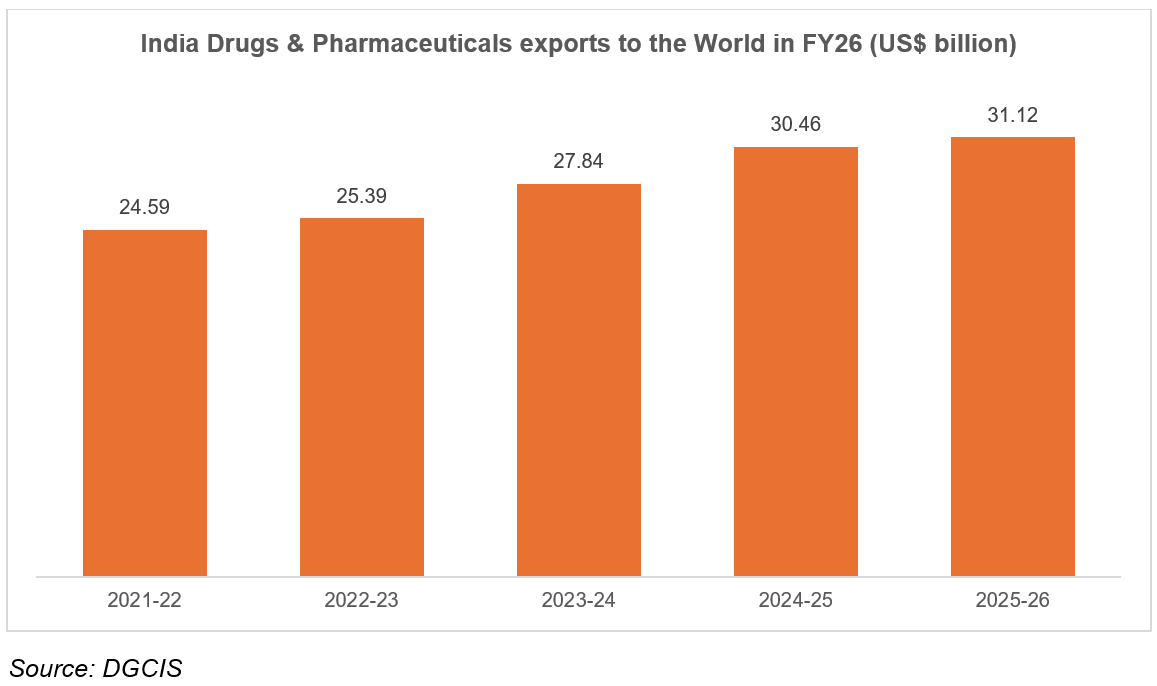
India's drugs & pharmaceutical trade has shown consistent strength in FY26, with exports worth US$ 31.12 billion, registering a 2.16% rise over the previous fiscal year. The growth of exports reveals consistent demand for drugs & pharmaceuticals from India across the world. Overall, this shows that India is playing a crucial role in the global pharmaceutical value chain.
India’s category-wise export share of Drugs & Pharmaceuticals in FY26
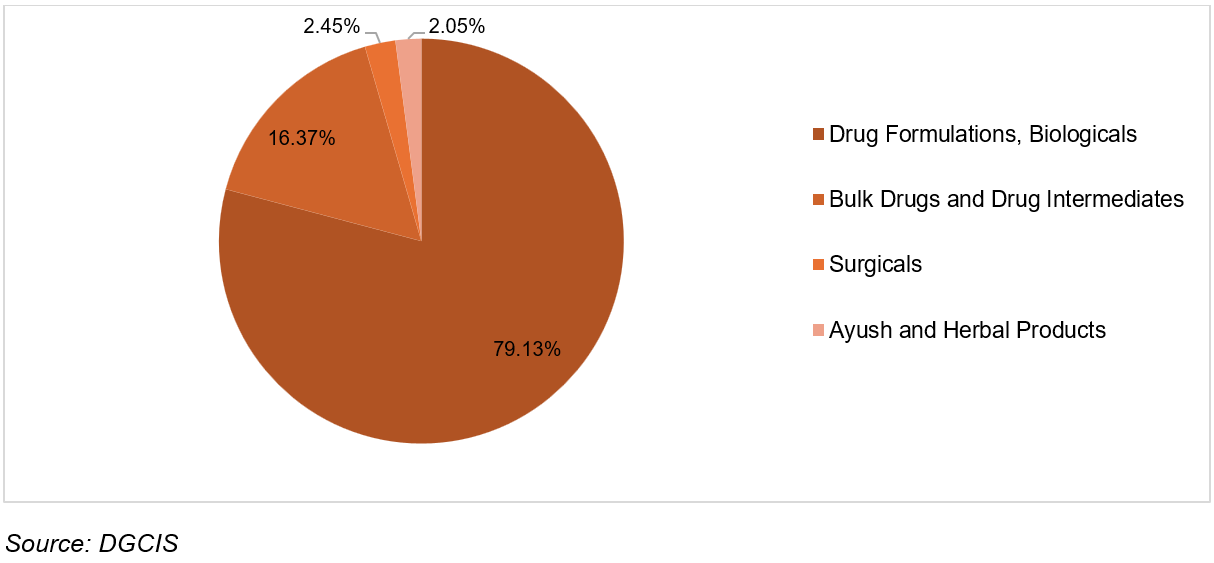
The composition of India’s drugs & pharmaceutical exports for FY26 is characterized by drug formulations and biologicals, accounting for 79.13% of the total pharmaceutical exports from the country. Such a structure highlights India's position as a significant exporter of high-value-added pharmaceutical products to the global marketplace. Bulk drugs and drug intermediates account for 16.37%, thereby revealing the strength of the manufacturing sector in the production of active pharmaceutical ingredients (APIs) and intermediates. The share of surgical products is 2.45%, whereas that of Ayush and herbal products is 2.05%. This shows the increasing interest in traditional Indian health care products and medical devices among other countries.
India’s country-wise share of Drugs & Pharmaceuticals in FY26
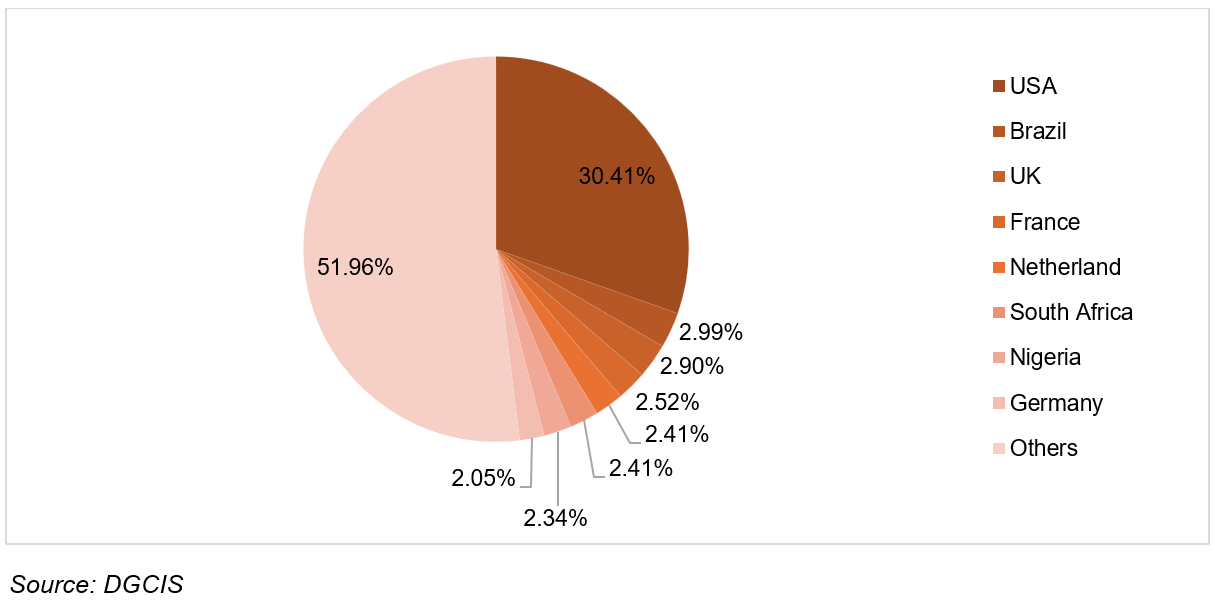
The United States remained India's largest drugs & pharmaceutical export destination, accounting for US$ 9.46 billion in exports and 30.41% of the total. Other significant export markets included Brazil (US$ 929.80 million; 2.99%), the UK (US$ 902.95 million; 2.90%), France (US$ 785.12 million; 2.52%), the Netherlands (US$ 751.25 million; 2.41%), South Africa (US$ 751.17 million; 2.41%), Nigeria (US$ 727.22 million; 2.34%) and Germany (US$ 639.01 million; 2.05%) highlighting the country's diversified global export footprint alongside its strong presence in the US market.
India’s export of drugs & pharmaceuticals to United states of America (USA) in FY26
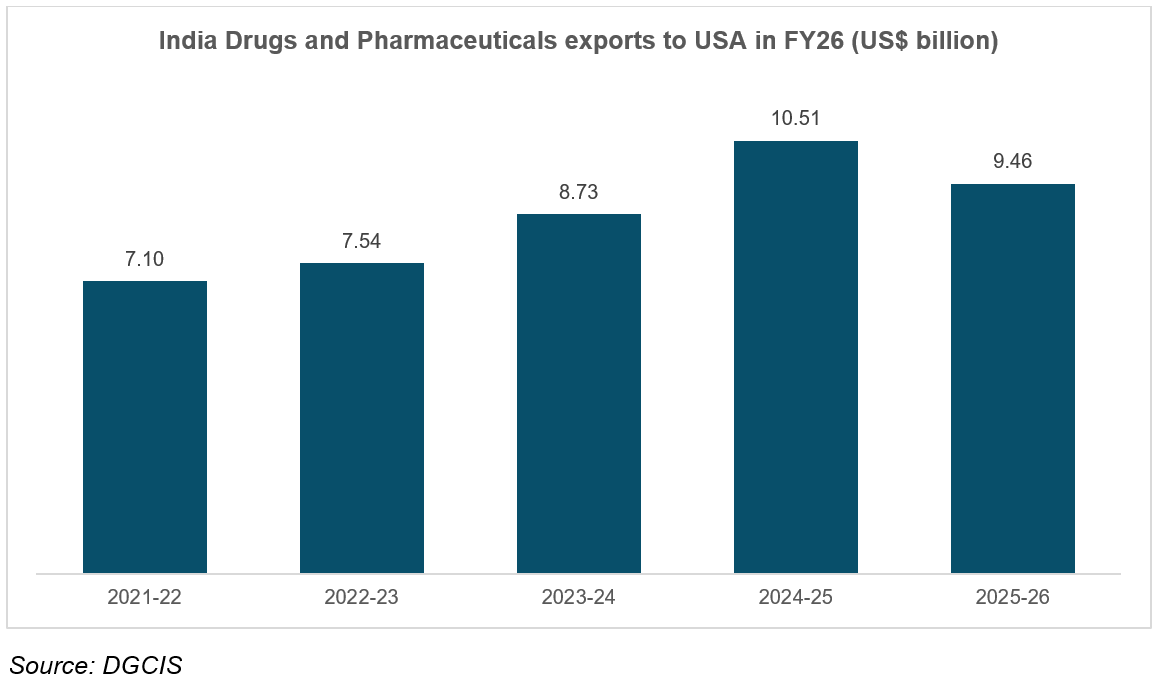
The exports of Indian pharmaceutical products to the US showed an upward trend, starting at US$ 7.10 billion in FY22 and rising to US$ 10.51 billion in FY25, reflecting the strong demand for generic drugs and specialty pharmaceutical products from India. For FY26, the figure stands at US$ 9.46 billion for exports to the US, thereby making it continue as the topmost country in terms of exports of pharmaceuticals from India although lower than the last peak. The United States was responsible for 30.41% of India’s total pharmaceutical exports in FY26.
India’s export of drugs & pharmaceuticals to Brazil in FY26
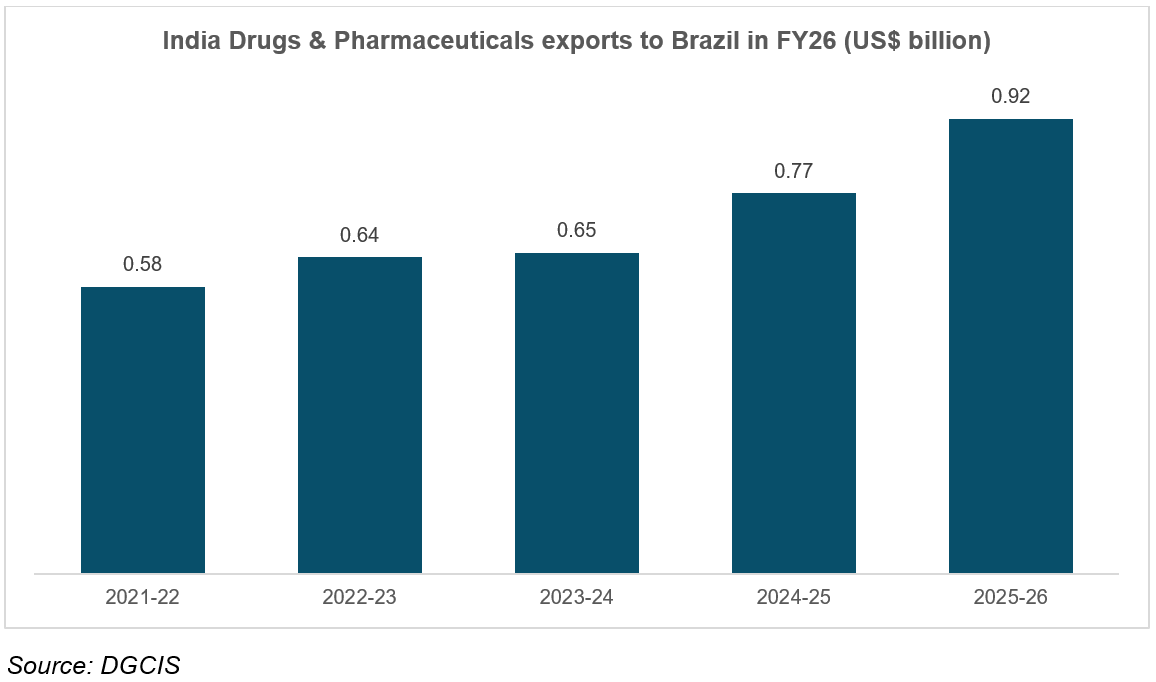
India’s exports of drugs and pharmaceutical products to Brazil have demonstrated consistent growth over the last five years, increasing from US$ 0.58 billion in FY22 to US$ 0.92 billion in FY26, representing an increase of about 59%. The exports increased from US$ 0.64 billion in FY23 to US$ 0.65 billion in FY24 and further to US$ 0.77 billion in FY25 before attaining their peak of US$ 0.92 billion in FY26. Such positive performance underscores the significance of Brazil as one of the important destinations for Indian drugs because of high demand for affordable generic drugs in Brazil.
Emerging opportunities
- The India-EU Free Trade Agreement (FTA) offers preferential access to the market of medicines and MedTech with the value of US$ 572.3 billion. It is expected that FTA will result in greater pharmaceutical exports, create high-quality job opportunities, increase the involvement of MSMEs, and further integrate India into the global health care industry supply chain.
- The India-Brazil Healthcare Business Gateway was held on February 25, 2026, by Pharmexcil. The main objective of the event was the promotion of pharmaceutical business between India and Brazil, where opportunities were seen in specialty pharmaceuticals, biosimilar drugs, oncology, hospitals' technology, government purchases and regulation. The meeting also focused on simplifying the process of complying with the Brazilian regulatory body ANVISA.
- The Ministry of Commerce and Industry, on 21 February 2026, stated that Indian pharmaceutical exports rose by 9.4% to US$ 30.47 billion during FY25, suggesting high competitiveness in the international market. In the recent ‘Scaling up Pharma Exports’ Chintan Shivir, opportunities have been discovered by the industry and government officials with the help of diversifying the market, harmonising regulations, innovating, and increasing export promotion. As medicines are exported to more than 200 countries, the pharmaceutical industry is targeting double-digit export growth till 2026-27 and hopes to become a US$ 130 billion business in 2030.
Road Ahead
India's pharmaceutical industry is set to become a global front-runner in terms of innovations in biopharmaceutical space by 2047, thanks to increased funding in research and development, biologics, personalized medicines, artificial intelligence-based drug discovery, and innovative manufacturing techniques. Better regulation, better management of intellectual property rights, and greater cooperation between industry, academia, and government are set to boost innovation and commercialization efforts. The continued growth in CRDMOs and GCCs along with digitalization, talented human resources, and collaborations with other countries will improve India’s competitiveness in the pharmaceutical sector and position India as a reliable destination in the world of healthcare and life sciences.
ELECTRONIC GOODS
India is currently in the process of evolving from being mainly an assembly platform for electronics into developing a self-reliant manufacturing infrastructure for its electronic components. Electronics Component Manufacturing Scheme (ECMS) of the Indian government acts as one of the important catalysts in this respect, through fostering investments in important components, minimising dependence on imports, and increasing value-addition locally. It can be seen from the analysis that the electronics industry of India is moving towards a new growth cycle, where increased localization of components would make the supply chain more resilient and increase the competitiveness of India in international electronics manufacturing. Through focusing on domestic production of key inputs such as strategically important components like rare earth magnets, India intends to build a full electronics value chain, attract long-term investments, export more, and emerge as a global center for electronics manufacturing. Despite some difficulties in implementation and capacity creation, the future prospects for the Indian electronics industry appear to be very bright indeed.
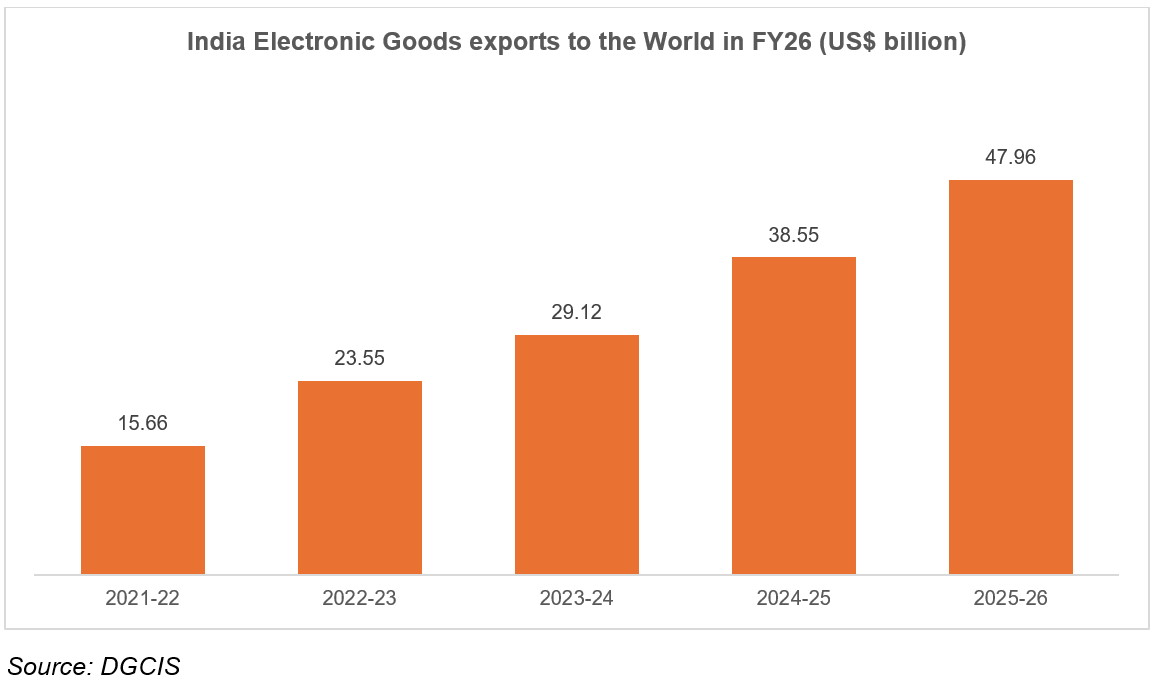
The exports of electronic goods from India have seen remarkable growth during the last five years, starting at US$ 15.66 billion in FY22 and reaching a record high level of US$ 47.96 billion in FY26, indicating an increase of more than three times. The growth rate of exports has been consistent, with levels of US$ 23.55 billion in FY23, US$ 29.12 billion in FY24, US$ 38.55 billion in FY25, and close to US$ 47.96 billion in FY26. The positive trend is attributed to the enhanced competitiveness of the electronics manufacturing industry in India due to increased domestic value addition, production linked incentives, increased manufacturing capacity, and rising demand from across the world. This export growth further strengthens India's position as a major manufacturing and exporting hub for electronics.
India’s category-wise export share of Electronic Goods in FY26
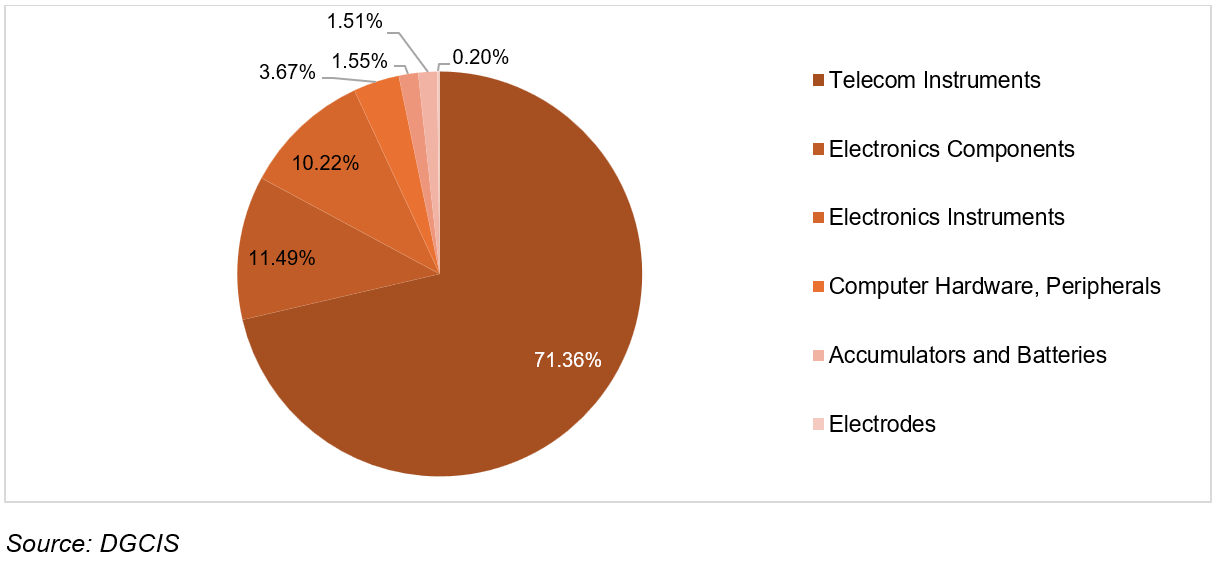
The major export classification of India’s electronics sector in FY26 was led by Telecom Instruments, accounting for 71.36% of total electronics exports, underscoring the country's strong manufacturing capabilities and growing integration into global telecom supply chains. Electronic Components constituted 11.49%, followed by Electronic Instruments at 10.22%, reflecting India's expanding presence in high-value electronic manufacturing. Computer Hardware and Peripherals contributed 3.67%, while Consumer Electronics and Accumulators & Batteries accounted for 1.55% and 1.51%, respectively. Electrodes represented a marginal 0.20% share. The export composition highlights India's increasing focus on value-added electronics manufacturing, with telecom equipment and electronic components remaining the primary drivers of export growth.
India’s country-wise share of Electronic Goods in FY26
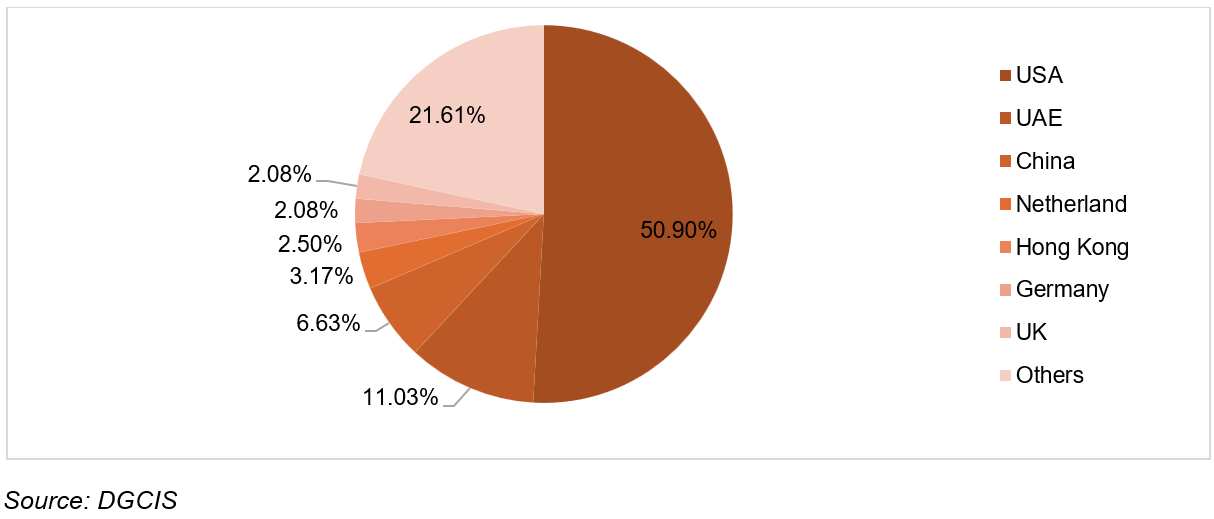
The USA remained the largest destination for India's exports in the given sector, accounting for US$ 24.41 billion, representing 50.9% of total exports. It was followed by the UAE with US$ 5.29 billion (11.03%) and China with US$ 3.18 billion (6.63%). Other major export destinations included the Netherlands with US$ 1.51 billion (3.17%), Hong Kong with US$ 1.20 billion (2.50%), Germany with US$ 997.58 million (2.08%), and the UK with US$ 995.69 million (2.08%), highlighting India's strong presence across key global markets.
India’s export of Electronic Goods to United states of America (USA) in FY26
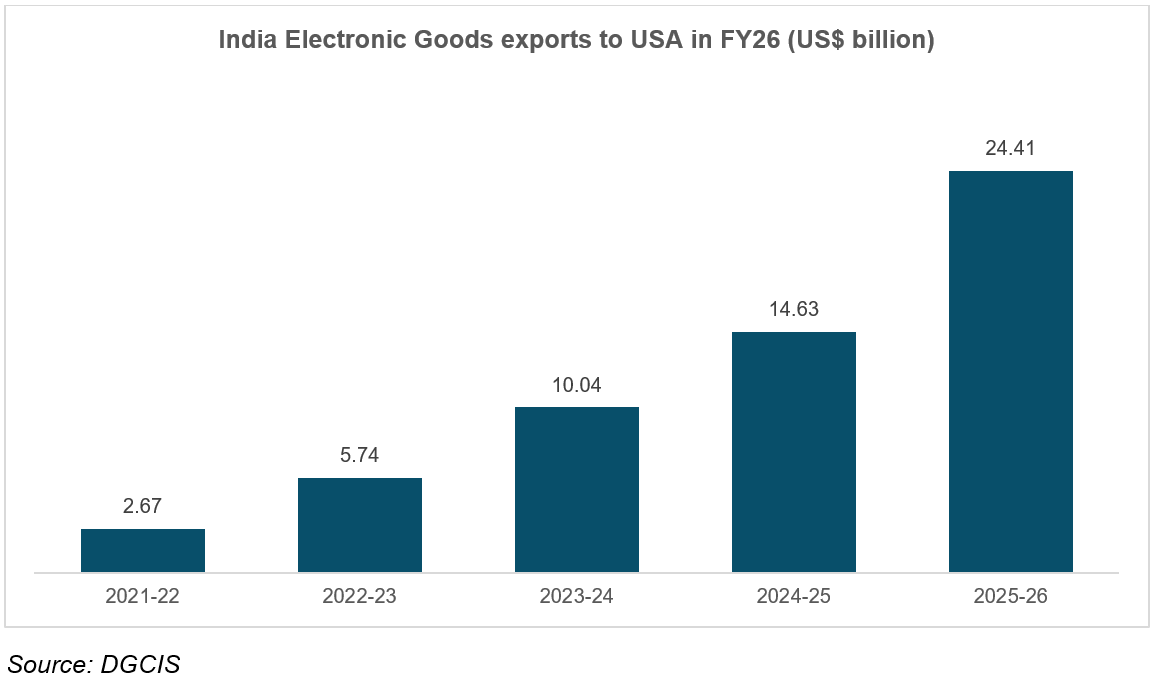
There has been massive growth in India's exports of electronic goods to the US in the past five years, growing from US$ 2.67 billion in FY22 to US$ 24.41 billion in FY26. Exports increased by 66.8% in FY26 from US$ 14.63 billion in FY25. This suggests that there is considerable demand for electronics produced in India, especially smartphones and other valuable electronic goods. The significant increase is an indication of India’s growing competitiveness in electronics manufacturing on a global scale, facilitated by higher production capacity and localization.
India’s export of Electronic Goods to United Arab Emirates (UAE) in FY26
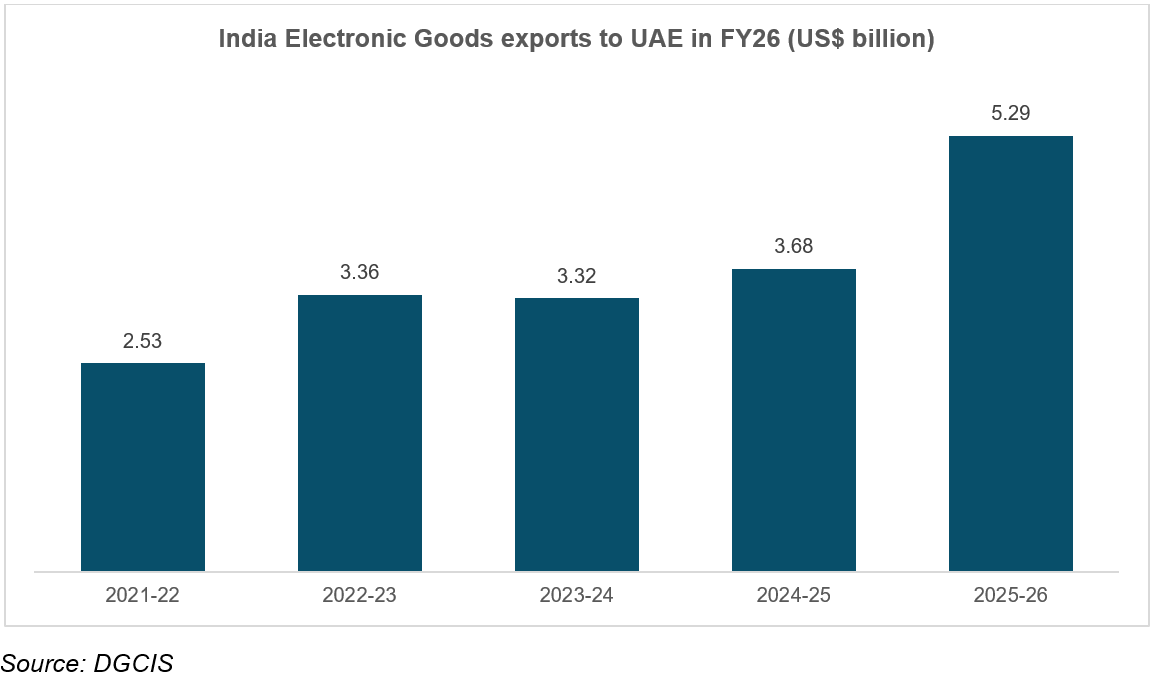
The exports of electronics from India to the UAE stood at US$ 5.29 billion during FY26 and witnessed an impressive jump of 43.8% compared to the amount of US$ 3.68 billion recorded during FY25. The massive growth indicates the growing importance of UAE as one of the major destinations for exports of electronic goods from India. During the past five years, the exports grew more than two times from US$ 2.53 billion during FY22 to US$ 5.29 billion during FY26.
Emerging opportunities
- The recent trade deals concluded by India have opened up many avenues for the development of the country’s electronic contract manufacturing (ECM) industry through increased market access to critical regions, including the US and Europe. The relatively cheaper tariffs compared to other competing manufacturing centers will make the products of Indian electronics exports more competitive internationally. The increasing number of trade deal partnerships, combined with India’s improved manufacturing capacities, will give the country a better position to attract investments and strengthen its position in the global electronics supply chain.
- The Government of India is strengthening India's electronics manufacturing ecosystem through the Electronics Components Manufacturing Scheme (ECMS), notified on April 8, 2025, with an outlay of Rs. 22,919 crore (US$ 2.71 billion). This program seeks to attract foreign as well as domestic investments, add value to the local economy, and connect local producers to international supply chains. As of December 2025, expected investment commitments have reached Rs. 1.15 lakh crore (US$ 13.60 billion), while projected production stands at Rs. 10.35 lakh crore (US$ 122.40 billion) over six years. These developments present significant opportunities for component manufacturing, exports, employment generation, and positioning India as a global electronics manufacturing hub.
- India’s electronics manufacturing industry is experiencing tremendous growth owing to favourable government policies and increasing competitiveness. The budget of India for 2026-27 has enhanced the budget allocated for the Electronics Components Manufacturing Scheme (ECMS) to Rs. 40,000 crore (US$ 4.18 billion). This will promote indigenous manufacturing of components in the country. The last eleven years have seen six times rise in electronics manufacturing, creating 25 lakh job opportunities. With a target of building a Rs. 47.69 lakh crore (US$ 500 billion) electronics manufacturing ecosystem by 2030-31, India is well positioned to become a global hub for advanced electronics manufacturing and exports.
Road Ahead
The aim of India is to move beyond the assembling phase in manufacturing through increasing local production of sophisticated electronic components, semiconductors, and electronics. With continuous policies, infrastructure, supply chains, and R&D efforts, it is expected that value creation will improve and make India an internationally competitive destination for electronics manufacturing industry, thereby ensuring sustainable growth and increased exports.
Get In Touch
Your input is valuable in shaping the future of the IBEF Export Newsletter! Take a moment to share your thoughts and help us bring you more relevant insights, success stories, and export branding strategies.
Contact & Subscriptions: Contact Us
Email us at: info.brandindia@ibef.org
Call: +91 11 43845501
Partners