Market Spotlight: Africa
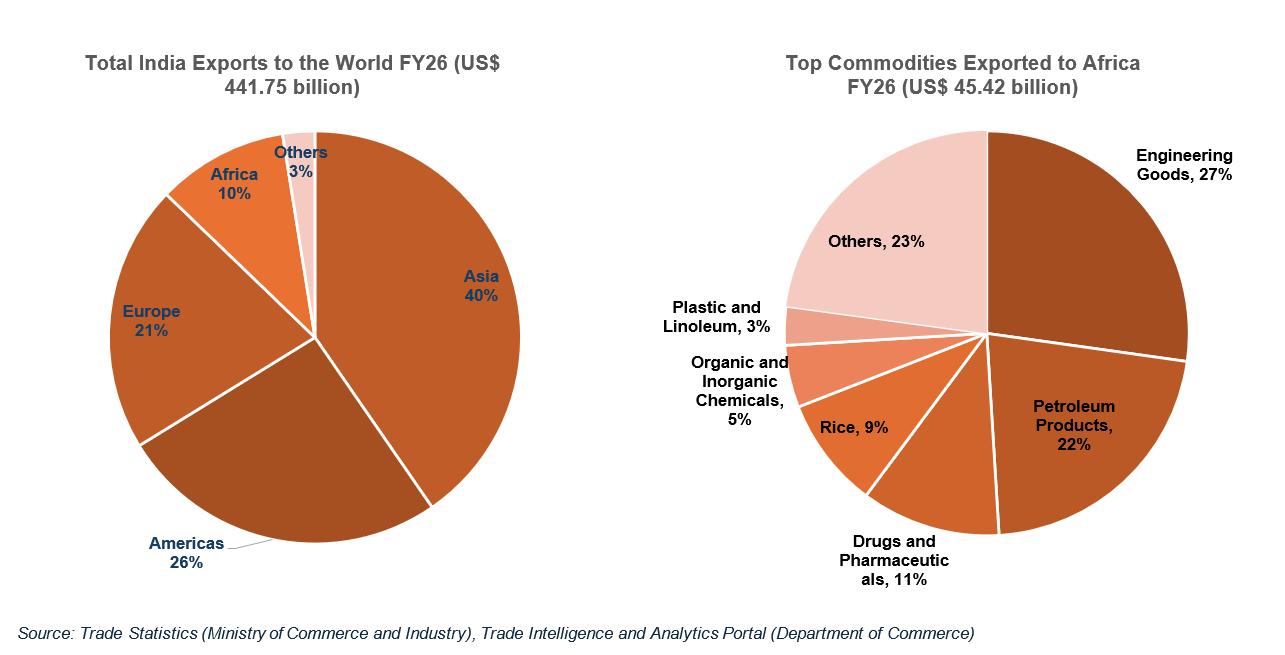
Africa, including SACU countries, West Africa, Central Africa, East Africa, North Africa, and other Southern Africa countries, remains one of the important markets for exporting Indian products. That is made clear through increased business interactions and growing demands for various products in key industries. The exports of India to Africa during FY26 amounted to US$ 45.42 billion, which grew from US$ 42.70 billion in FY25 at the growth rate of 6.36%.
Among African countries, South Africa was the top one among those receiving exports from India (15.43% of all India's exports to Africa), followed by Tanzania (11.93%), Kenya (8.84%), Egypt (8.66%), and Nigeria (6.90%) in FY26. There is immense demand in Africa for certain industrial and basic items that are leading India to export its products. Some of the major product groups include engineering products, petroleum products, pharmaceutical products, rice, and organic and inorganic chemicals.
Competition Analysis:
The import market in Africa is a combination of diverse trading partners globally, where China and the United States together make up to 26.4% of the total imports in Africa in CY25. After these countries come India, UAE, Germany, and South Africa. Each one of them has different competitive strengths related to manufacturing, technology, energy, logistics, and regional integration. By analysing these important players, one can identify the types of exports they have, their market position, and competitive strength as well as the opportunities India can use to enter Africa more successfully via diversified exports and other approaches.
China: China was Africa's biggest merchandise supplier in CY25, with total imports from China being US$ 98.88 billion (19.53%) of Africa's total imports.
This trade relation is based on the country's strong manufacturing industry and competitive prices in popular merchandise such as smartphones, telephones, automobiles and automobile parts, electrical machinery, and consumer electronics.
Ongoing investments of FOCAC and BRI have built transport, logistics, and industries' infrastructure that promotes trade relations between two parties. Chinese manufacturers have increased their presence in Africa by establishing local factories, distributing products, and online business.
In case Africa will continue to develop and become more industrious and connected, then the demand for cheap manufactured goods will help maintain China's supremacy in the import market of Africa.

United States: The United States was able to continue functioning as one of the significant suppliers of the African markets in CY25, with the value of US$ 34.85 billion being imported from there, which constitutes 6.88% of the overall imports of the African countries. US exports consist of quality and technologically advanced manufacturing industries, such as hydrocarbon and petroleum-based industries, airplanes and airplane parts, heavy machinery, medical equipment, and agriculture products. Trade is made possible through the African Growth and Opportunity Act (AGOA), which helps encourage business between the US and Africa, and through programs created within the Partnership for Global Infrastructure and Investment (PGII). High interest in aviation equipment results from the development of airline fleets on the African continent, while energy products help to stimulate industrial development and electricity production.
Despite the fact that China's export numbers are significantly bigger than those of the U.S., the latter manages to compete effectively in the area of specialised and high-value-added industries.
United Arab Emirates: The UAE managed to maintain its position of the significant trading partner for Africa in CY25, with the value of African imports being equal to US$ 20.65 billion, or 4.08% of the overall imports of the continent. Trade relations are formed due to the fact that the UAE functions as a re-export center and logistics hub, offering such products to Africa as petroleum oil, gold, copper wire, polymers, machinery, and consumer goods. World-class ports, like Jebel Ali, and integrated free zones allow the redistribution of the products obtained from Asia, Europe, and the Middle East and delivered efficiently across Africa. The Comprehensive Economic Partnership Agreement (CEPA) strategy combined with the growing involvement of the UAE in ports, logistics, renewable energy, and industrial infrastructure projects has contributed to the development of commercial ties between UAE and Africa. With the increasing demand for industrial raw materials, energy products, and consumer goods, the UAE will maintain its position as the connection point of Africa with the international market.


South Africa: South Africa was one of the top intra-regional exporters of Africa in CY25, with exports to other countries in Africa amounting to US$ 18.95 billion, constituting 3.74% of Africa’s overall imports. The export basket of South Africa is quite diverse, including cars, gold, coal, corn, petroleum products, machinery, and finished industrial goods, indicating the relatively developed nature of its industries and mines.
The well-developed logistics, financial services, and industrial facilities enable the country to be a supply source for neighbouring economies, such as those in SACU and SADC. The implementation of the African Continental Free Trade Area (AfCFTA) will likely increase South Africa’s competitive advantage in the regional exports due to lower trade barriers and increased market access across borders. An increased demand for industrial goods, automobiles, energy goods, and agricultural goods in Africa is expected to facilitate the development of trade between South Africa and Africa.
The assessment of competing countries shows that India is a strong and reliable trade partner for Africa. However, steady growth will require moving beyond traditional export strengths to achieve deeper market integration. Manufacturing capability of China, technological advancements in the US, logistics capability of the UAE, and the regional presence of South Africa are the factors that influence purchases in the African countries. In order to strengthen the competitive advantage of India in the region, it is essential for India to seek more manufacturing collaborations in the region, set up regional distribution centers, provide trade financing facilities, and interact positively with changing African policies and customs. Increased interaction with regional economic communities, investments in rapidly growing areas like health care, renewable energy, agri-processing, and industrial equipment, and increased cooperation between government and private enterprises will further improve market access. With rapid urbanization, industrialization, and regionalization of Africa, India is very much poised to increase its trade with Africa.
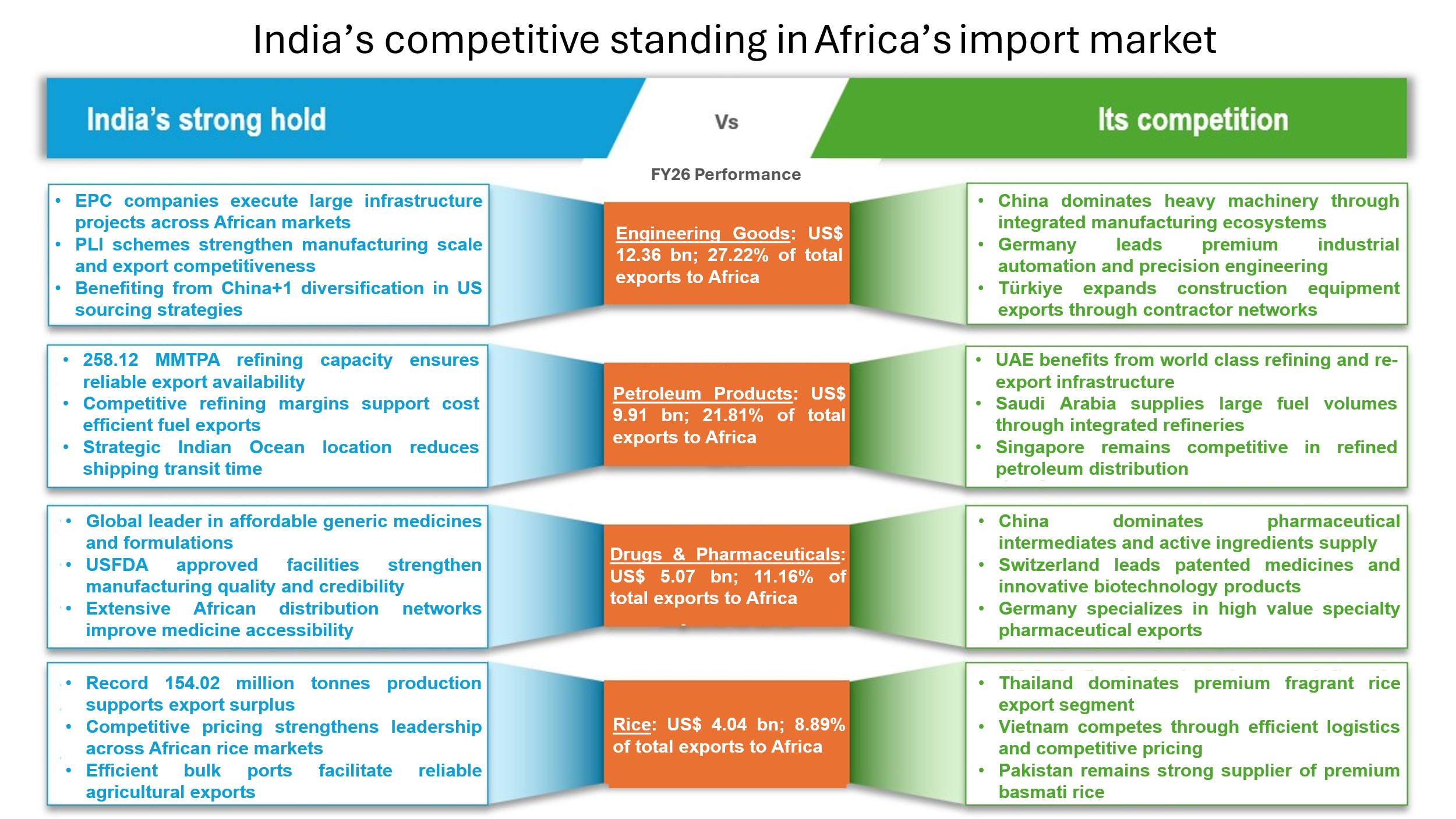
- Engineering Goods: The segment of engineering goods formed the majority share of exports to Africa, accounting for 27.22% share of total exports worth US$ 12.36 billion in FY26. Also, Africa represented 10.10% share of total engineering goods exports of India, indicating increased importance of the region as one of its major export destinations. The factors driving the exports include demand for electrical machinery, industrial machinery, iron & steel, motor vehicles, and construction equipment. In view of increased investments by Africa in infrastructure, manufacturing, mining, and energy projects, it is evident that there is a high potential for engineering goods in Africa. Some of the important destinations for India’s exports, forming 51% of exports to Africa include South Africa, Tanzania, Kenya, Egypt, and Nigeria. India has the advantage of having low-cost manufacturing facilities, diverse range of engineering expertise and strong trade relations with the African economies. On the other hand, competition from China, Türkiye, EU due to extensive manufacturing facilities and supply chain is significant. Going ahead, investments in the African Continental Free Trade Area (AfCFTA) and infrastructure development will create significant opportunities for the Indian exporters.
- Petroleum Products: Petroleum products constituted the topmost exported products from India to Africa in FY26, forming 21.81% of total exports worth US$ 9.91 billion. Africa formed 18.40% of the total exports of petroleum products from India to various countries, highlighting the significance of the region as an important importer of refined petroleum products. The strong refining sector of India, aided by its installed capacity of refining petroleum products amounting to 258.12 MMTPA as of April 2025, helps the country refine the imported crude and export the refined petroleum products. The increasing business ties show that India has strong refining skills along with decent geographic linkages and also because of the increasing need for transport fuels in Africa. But the Indian exporters will have tough competition from large refineries in the Middle East countries such as Saudi Arabia and UAE. With many African nations continuing to develop their energy sector, India has all the opportunities for expanding its exports.
- Drugs & Pharmaceuticals: Drugs and Pharmaceuticals have become one of the topmost categories of goods exported by India to Africa in FY26 with 11.16% of India's exports to Africa comprising this category and valued at US$ 5.07 billion. Africa accounted for 16.28% of India's total Drugs and Pharmaceuticals exports, which reflects the high dependency of African countries on pharmaceutical products supplied by India and highlights India's status as a reliable provider of quality and reasonably priced medicines. The demand for exports is based on a wide array of products ranging from drug formulations, biologicals, surgical products, bulk drugs, drug intermediates, and herbal products, which helps India address a wide range of healthcare requirements of Africa. The increase in the burden of diseases including communicable and non-communicable diseases, the development of healthcare facilities, and availability of medicines in Africa drive pharmaceutical imports from India. With its strong manufacturing base and product variety, India has great potential to further grow its pharmaceutical exports and healthcare trade relations with Africa.
- Rice: Rice continued to be one of the major agricultural exports from India to Africa during FY26, amounting to 8.89% of India’s total exports to the continent, with the export value amounting to US$ 4.04 billion. The continent was the major buyer of India’s rice export, which amounted to 34.98% of India’s total rice exports, making it the biggest market region for India. The dependency of the continent on rice imported from India in order to cope up with growing demands for food was evident from the above figures. The large-scale production of India, which stood at 154.02 million tonnes of rice in FY26, gave it an edge to provide a continuous supply of both basmati and non-basmati varieties to Africa. Growth in population, rapid urbanization, and importance of rice as the staple food in several countries of Africa together ensure import demand.
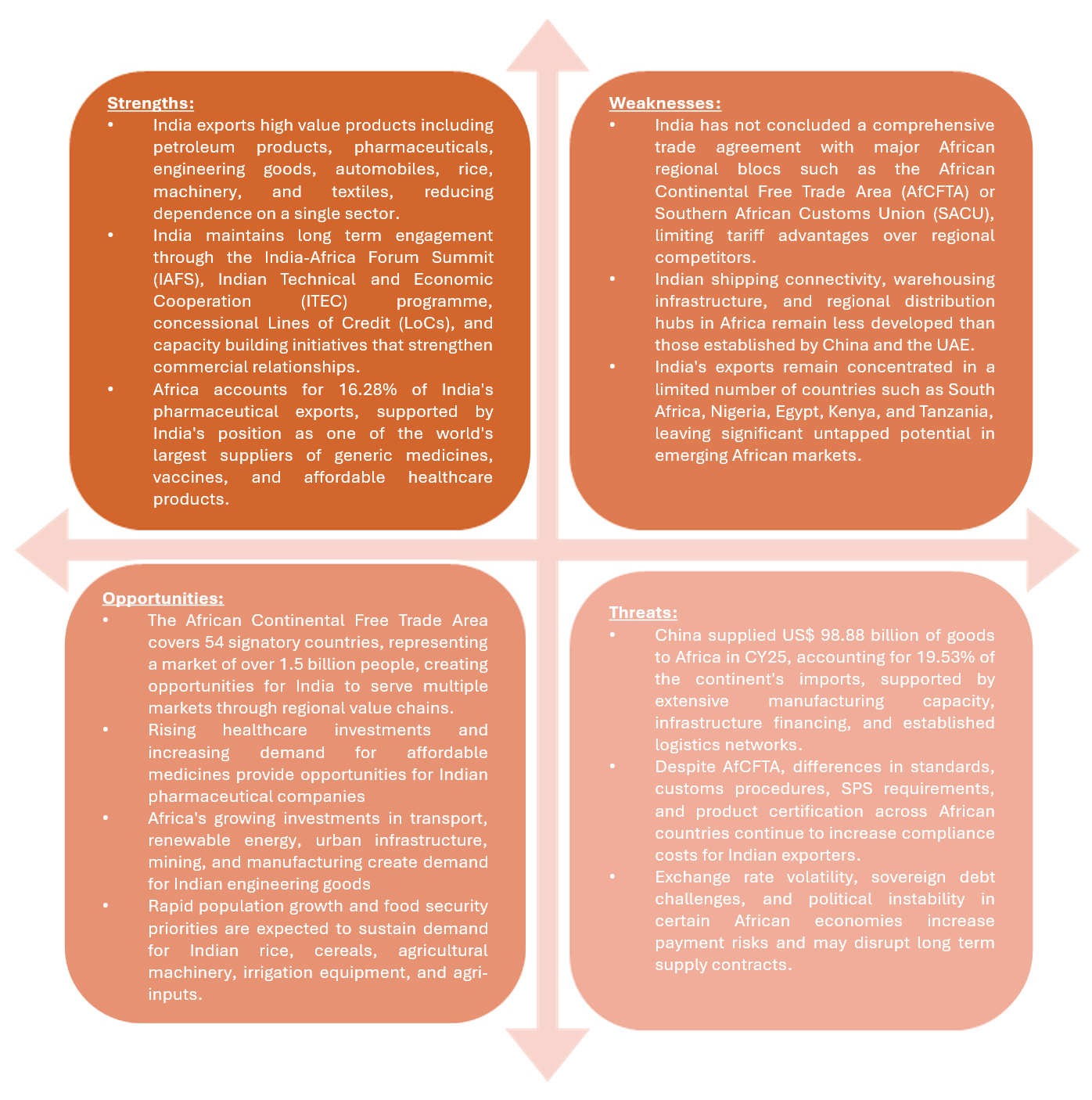
SWOT Analysis
Indian Africa Trade Access, Regulatory Integration and Market Framework
Trade between India and Africa is governed more through market access agreements, regional economic cooperation, and development partnerships than one continental trade pact. India provides tariff concessions on its imports from 33 countries in Africa through its DFTP Scheme, thereby increasing market access for diverse products. In Africa, there is the AfCFTA, which is made up of 54 member states and represents a population of 1.5 billion people. The AfCFTA is increasingly working on aligning tariffs, custom processes, and other aspects of trade. It is expected that this emerging regime will create access for Indian exporters through regional value chains and trade regimes.
Bilateral India-South Africa Trade Framework
India’s Bilateral Relationship with South Africa is being fostered through dialogues, trade facilitation, and strategic cooperation. During the second meeting of the Joint Working Group (JWG) on Trade and Investment in Pretoria on 22nd April 2025, the issues deliberated upon included: Exports, Investments, Market Access for Plant & Animal Products, and Negotiations for India-SACU Preferential Trade Agreement (PTA). This preferential trade agreement seeks to lower tariff rates and provide greater bilateral market access. The relationship is also developed through participation in international platforms such as BRICS and IBSA Dialogue Forum, where cooperation in trade, investments, and technology is sought. Moreover, India and South Africa have upgraded their 31-year-old science and technology partnership from just scientific research cooperation to industrialization.
India-Nigeria Trade Relations
India and Nigeria have continued to improve their bilateral trade ties through well-defined institutional processes meant to improve their commercial relations and investments. The two countries decided to form a Joint Trade Committee (JTC) in 2017 that would involve the Commerce Secretaries from both sides to discuss bilateral trade ties regularly, as well as any problems regarding market access. Further impetus has been provided by the first meeting of Nigeria-India Business Council that was organised on 28th April 2022 in New Delhi. All of these efforts are expected to boost their bilateral trade and business relations.
Trade Opportunities and Market Access Outlook
Changes in trade architecture in Africa offer great chances for Indian companies to export their goods due to improved regulatory convergence and cross-border market access. Under the AfCFTA, countries involved in the initiative are gradually introducing rules of origin, digitalization of customs processes, and tariffs exemptions applicable to 90% of tariff lines of non-sensitive items. It is expected that the changes will help reduce costs for businesses and allow them to create distribution centres in the region.
There are additional policy changes which make it easier for companies to conduct trade operations. According to the UN Economic Commission for Africa (UNECA) published in April 2025, the full-scale implementation of AfCFTA will boost the GDP of Africa by US$ 141 billion and stimulate intra-African trade growth by 45% by 2045. With the development of manufacturing capacity in the region, the need for the import of machines, chemicals, pharmaceutical ingredients, engineering items, and industrial machinery is likely to grow thus making it possible to expand the exports from India.
Apart from trade in merchandise, Africa's focus on digitalization of trade process, logistics integration, and services liberalization makes it easier for foreign companies to invest in the region. Gradual convergence of customs regulation and other aspects of trade facilitation will result in shortened periods of clearance and improved efficiency of supply chains in the regional corridors.
Key Challenges between India and Africa
- Regulatory Fragmentation and Non-Tariff Barriers: India’s exporters continue to be confronted with disparate product standards, SPS regulations, documentation, and conformity testing in different African countries. Even though AfCFTA aims at standardising trade regulations, implementation has not been uniform. Studies have found that non-tariff measures increase the trade cost more than tariffs in 88% of countries, while complying with different national regulations raises export costs especially for drugs, foods, and engineering products.
- High Logistics Costs and Weak Transport Connectivity: Restrictions on direct shipping, port congestion, poor multimodal logistics, and lengthy customs processes contribute to the increased cost of India-Africa trade. UN Economic Commission for Africa argues that for AfCFTA to offer its maximum advantages, there will be a need for considerable investment in infrastructure development since inefficient transport system continues to hamper regional trade. Inefficiency of transport network increases transportation costs slows down deliveries and reduces competitiveness of Indian exports in African markets.
- Slow Progress in Preferential Trade Agreements: Though India has had active diplomatic relations with African nations, it has not succeeded in signing preferential trade agreement with leading African regional blocs like SACU. The delay in the negotiations process results in minimal reduction of tariffs and access to preferential markets compared to other countries having regional trade agreements. This means that Indian exporters still pay import duties in some African markets thereby reducing the competitiveness of their prices especially in automobile, machinery, processed foods, and industrial products.
Actionable Insights for Indian Brands: Africa 2026
The changing nature of the trade environment in Africa offers great potential for the growth of Indian companies. Smart investment decisions, cooperation in the region, setting up local operations, and working in line with emerging trade systems will increase market entry and competitive capacity. Some of the key priorities and strategies are mentioned below.
- Develop Regional Production and Packaging Centers: It is crucial for Indian businesses to look beyond exports alone and develop centers of production and packaging of products in strategically important countries such as Kenya, South Africa, and Nigeria. This localised production strategy will enable Indian businesses to fulfil the provisions of local procurement requirements, minimise transport costs, and build robust supply chains. As per the AfCFTA framework, tariffs on 90% of tariff lines will be slashed to zero.
- Build AfCFTA-Based Multi-Country Distribution Networks: Instead of operating in separate entities within each country, Indian companies must create a centralised system of distribution facilities that operates in harmony with AfCFTA routes of commerce. The accord includes a market that is home to more than 1.5 billion people and allows the firms to maximise their efficiency by streamlining logistics operations, lowering expenses, and increasing sales. Early moves into regional warehousing and distributing will help Indian firms gain from reduced tariffs.
- Prioritise High-Growth Value-Added Export Segments: The Indian exporters must emphasise products such as pharmaceuticals, engineering products, processed foods, renewable energy products, and information technology products rather than just focusing on exporting commodities. UNECA points out that manufacturing, agriculture industries, and industrial value chain businesses will be the key sectors to benefit from the implementation of the AfCFTA. Technical assistance and after-sales service along with local production offerings may help create distinction of the Indian brands from cheap products and also increase customer loyalty.
Get In Touch
Your input is valuable in shaping the future of the IBEF Export Newsletter! Take a moment to share your thoughts and help us bring you more relevant insights, success stories, and export branding strategies.
Contact & Subscriptions: Contact Us
Email us at: info.brandindia@ibef.org
Call: +91 11 43845501
Partners