Market Spotlight: North America Countries
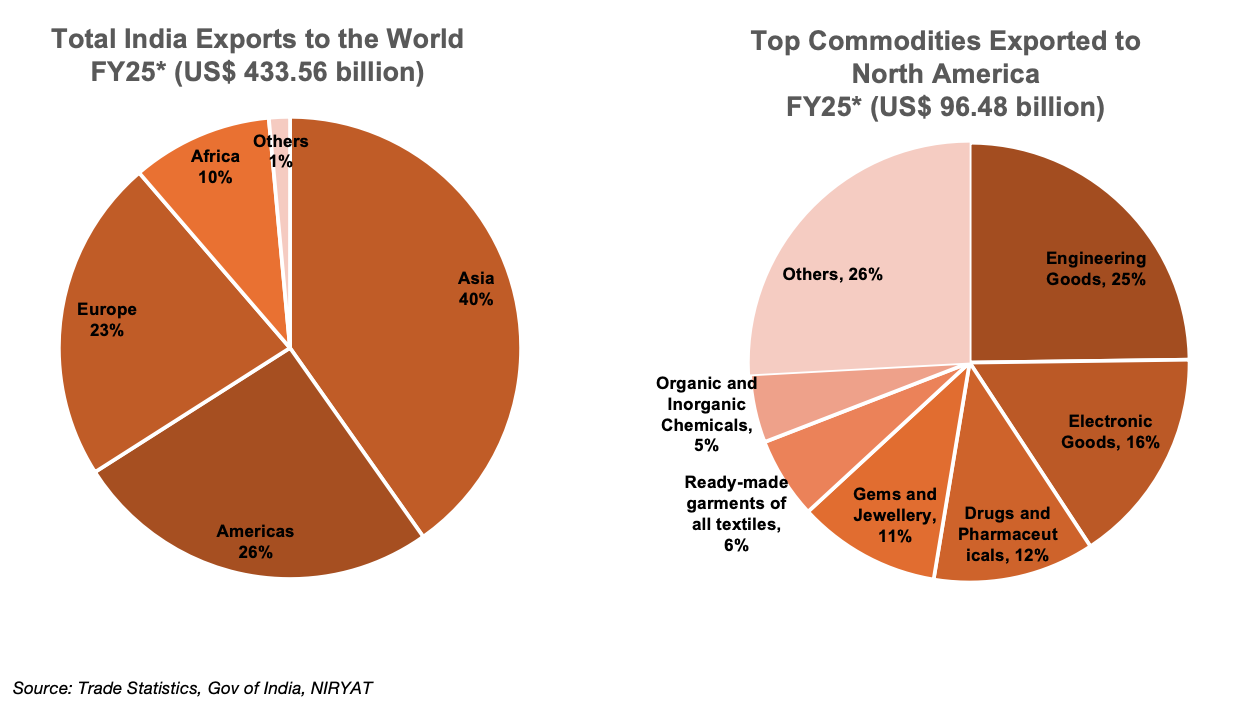
North America, comprising the United States, Canada, and Mexico, continues to strengthen its position in India’s export portfolio as one of the country’s most strategic premium markets. During FY25, India’s exports to North America reached US$ 96,485.57 million, from US$ 86,684.55 million in the corresponding period of the previous year, reflecting a steady growth of 11.31%.
The USA leads the pack with a dominant 89.67% share of India’s exports to North America, followed by Mexico (5.96%) and Canada (4.38%) in FY25. More than half of India’s shipments to North America are concentrated in high-value manufactured and industrial goods, including telecom instruments, drug formulations and biologicals, jewellery products, petroleum products, products of iron and steel, electric machinery and equipment, cotton products and marine products, reflecting the complementarity between India’s manufacturing strengths and North America’s market demand.
Competition Analysis:
The North American retail and design-driven sourcing environment is very competitive, driven by the dominance of Mexico and China, which together account for approximately 26.5% out of total imports into North America in CY24, followed by the USA, Canada, and Germany. Mexico’s edge arises from its strong and well-integrated supply chains and nearshore benefits, while that of China results from its scale of production in electronics and consumer goods. At the same time, Vietnam and India remain important challengers in electrical machinery, pharma products, nuclear reactors, boiler furniture, and differentiated consumer products, creating significant headroom for India in premium, design-driven, and value-added export segments.
China: China remains North America’s largest import supplier with US$ 656.43 billion of exports into North America, contributing around 14.5% of total imports into the region, which was around US$ 4.54 trillion in CY24, supported by its large-scale manufacturing ecosystems, deep supplier networks and strong category leadership in machinery and electronics. Its position is especially reinforced by dominance in consumer electronics, electrical machinery, lighting equipment, small appliances, telecom-linked devices, nuclear reactors, boilers, machinery and packaged consumer goods, where scale efficiencies and broad product depth remain unmatched.
The continued success of China as a leader relies on its capacity to provide an ecosystem of component parts, speedy manufacturing processes, price competitiveness, and linkage in intermediate goods that make it a vital
supplier of not only manufactured goods but also industrial components in North America. Despite efforts geared toward tariffing and diversification, its deep-seated involvement in machinery, electronics, and consumer goods manufacturing ensures its status as the largest importer in the region.

Mexico: Mexico remains North America’s second largest import supplier with 12% import into NA, supported by USMCA-led tariff advantages, geographical proximity and deeply integrated supply chains.
With strong leadership in automobiles, auto components, appliances, consumer electronics, furniture and fast-turn retail supply chains. Its proximity-driven model gives it a major edge in speed-sensitive and replenishment-heavy categories.For India, the key opportunity lies in design-led home décor, sustainable textiles, premium private-label products and specialised engineering goods, where value addition and product differentiation matter more than delivery speed.
United States: The United States ranks as North America’s third-largest exporter within the region, accounting for approximately US$ 526 billion in exports into North America. The export composition of the United States is very diversified, covering vehicles and vehicle parts, machinery, mineral fuels, electrical machinery, plastic material, and other commodities.
This position of the United States can be attributed to its advanced manufacturing capabilities and technological leadership, resulting in the production of high-value industrial products in sectors such as aerospace, automotive, energy and capital goods. The country's strong integration with neighbouring countries such as Canada and Mexico through its manufacturing supply chains helps in increasing its presence in regional trade.

Policies such as the United States-Mexico-Canada Agreement (USMCA) act as a facilitator for trade flows by lowering tariffs, harmonising, and strengthening rules of origin. Moreover, the country enjoys infrastructure, innovation and an abundance of natural resources, making it well-positioned as an energy exporter.

Canada: In 2024, Canada stood out as North America's fourth-largest importer, accounting for approximately 9.67% in exports into North America in CY24, owing to its regional trade integration, connectivity and synchronisation of the industrial ecosystem with its neighbouring countries, the US and Mexico. Canada holds a significant position when it comes to supplying industrial goods related to energy, automotive parts, machinery, aerospace parts, wood, paper, packaging, and agricultural products because of its proximity and established vendor relationships in those industries.This position of Canada becomes even stronger due to cross-border manufacturing linkages, reliability through standards, and stable industrial partnerships.
Canada is a crucial supplier of both industrial goods and consumer goods due to its above-mentioned strength. In terms of industries, Canada holds a competitive position in resource industries, transport equipment, and high-reliability intermediate goods, making it North America's fourth-largest import supplier in CY24.
Despite stiff competition posed by the Mexico nearshore supply chain model, China’s massive-scale production ecosystem, and the USA & Canada’s integrated regional industrial clusters, India is further cementing its niche within a select few value-add and design-intensive export categories in North America. North America’s emerging focus on premiumization, sustainability, compliance-based sourcing, and private label diversification strategies is generating better demand clarity for niche suppliers, thereby offering significant room for India in categories where innovation, customisation, packaging security, and brand narratives have started to play an increasingly important role in procurement strategy. The potential for India within North America is particularly notable in electronics, pharmaceuticals, engineering systems, luxury gift items, specialised automotive parts, and premium consumer lifestyle products, as these sectors align well with India’s comparative advantages in innovation at cost, compliance, and manufacturing flexibility. With retailers and industry buyers seeking greater diversity within their supplier base for resilience and business value generation, India stands well-placed to capitalise on this trend in its higher-value export categories.
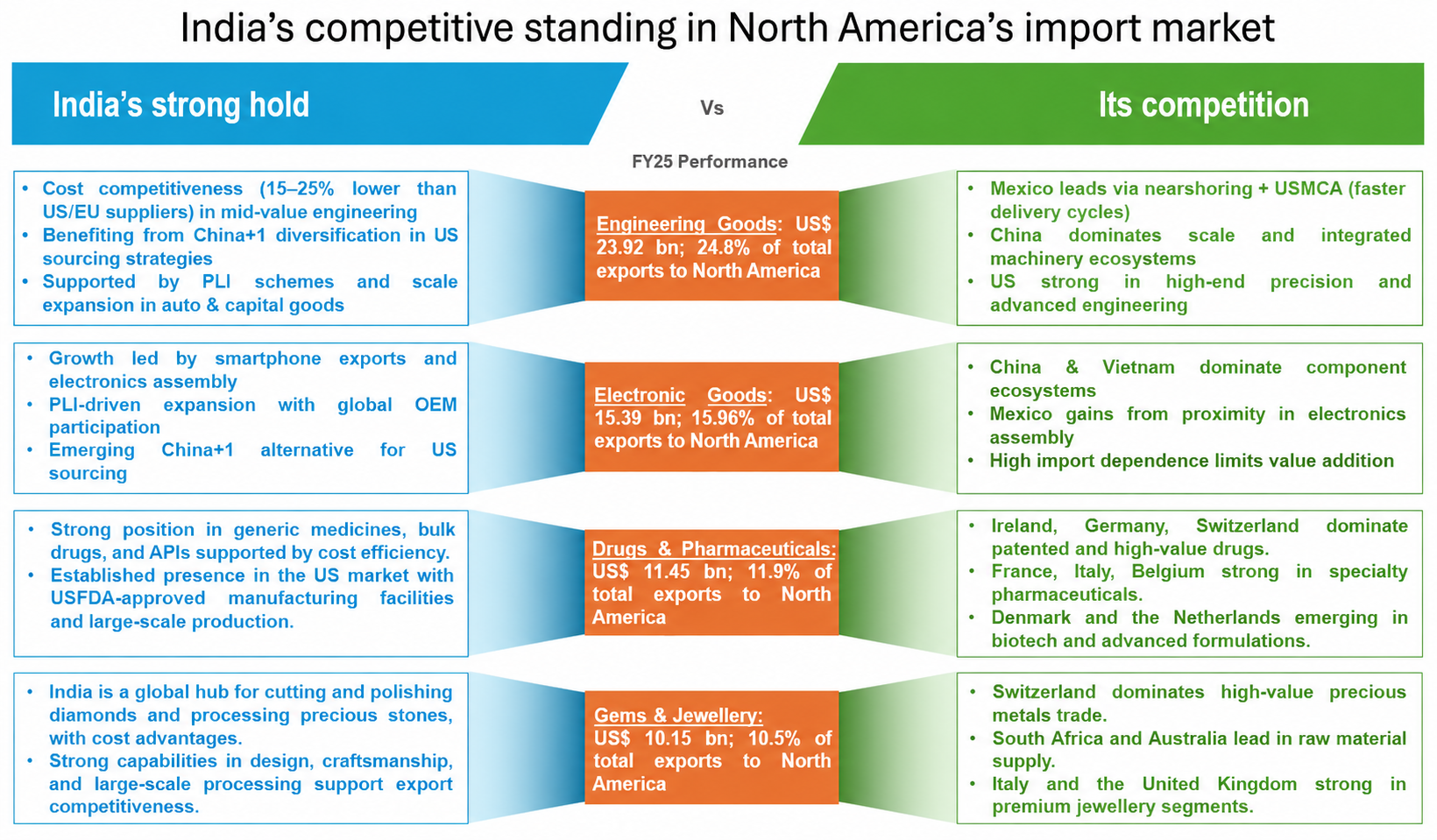
- Engineering Goods : The engineering goods segment constitutes the highest proportion of India's exports to North America, with FY25 exports worth US$ 23.9 billion or 24.8%. This segment is led by exports related to auto components, industrial machinery, castings, and capital goods, leveraging the cost advantage of 15-25% and PLI-induced capacity expansion in the mid-value range of engineering products. The United States is the largest consumer of engineering goods, with demand driven by auto parts, construction equipment, and machinery. However, India faces stiff competition from Mexico's nearshoring capabilities under USMCA and China's economies of scale and ecosystem of engineering products. Despite this, India is making inroads with US companies under the China+1 strategy, especially through forgings, castings, and standardised machinery exports. For future growth, India needs to tap into the export potential of EV components, precision engineering, and niche industrial machinery to compete with China and Mexico.
- Electronic Goods : Electronic goods constituted 15.96% (US$ 15.39 billion) of India's exports to North America during FY25. Exports of electronics have seen exponential growth in FY25 because of smartphone shipments and electronics assembly exports under the government PLI program, with growing participation of leading electronics Original Equipment Manufacturers (OEMs). India's strength in exporting electronic goods lies in its electronics assembly capabilities. The United States emerges as the main importer due to the realignment of supply chains to reduce dependency on China. However, 70-80% imports of components limit India's ability to increase the domestic value addition of electronics exports. China, Vietnam, and Mexico are the major competitors to India for electronic goods exports. India needs to focus on building up its component base, semiconductors, and efficient supply chains to sustain growth going forward.
- Drugs & Pharmaceuticals : The drugs and pharmaceuticals segment constitutes 11.9% (US$ 11.45 billion) of India's exports to North America in FY25. India's pharmaceutical exports are among the largest in the world because of its reputation for supplying generic drugs, Active Pharmaceutical Ingredients (API), and finished formulations. The United States is India's biggest customer in pharmaceutical exports, with Indian companies supplying around 40% of the generics by volume in the country. The exports benefit from India's strong USFDA approvals for its manufacturing processes. The sector sees high pricing pressure in generics and regulatory scrutiny from the FDA. Indian companies face competition from their US counterparts when it comes to exporting proprietary drugs, which requires extensive R&D. Future growth in the segment will require investments in R&D and producing complex generics and speciality drugs.
- Gems and Jewellery : Gems and jewellery exports constitute 10.5% (US$ 10.15 billion) of India's exports to North America during FY25. The United States emerges as India's largest buyer of jewellery. India enjoys a monopoly position in the global value chain, being responsible for cutting and polishing almost 90% of the total volume of the world's diamonds. The sector offers opportunities in the export of polished diamonds and studded jewellery. It is known for excellent craftsmanship, scale economics, and well-established connections with US-based retailers. The segment is highly sensitive to North American demand, influenced by disposable income levels. India faces stiff competition from global trading centres like Belgium and the UAE, besides the growing shift towards laboratory-grown diamonds (LGD).
SWOT Analysis
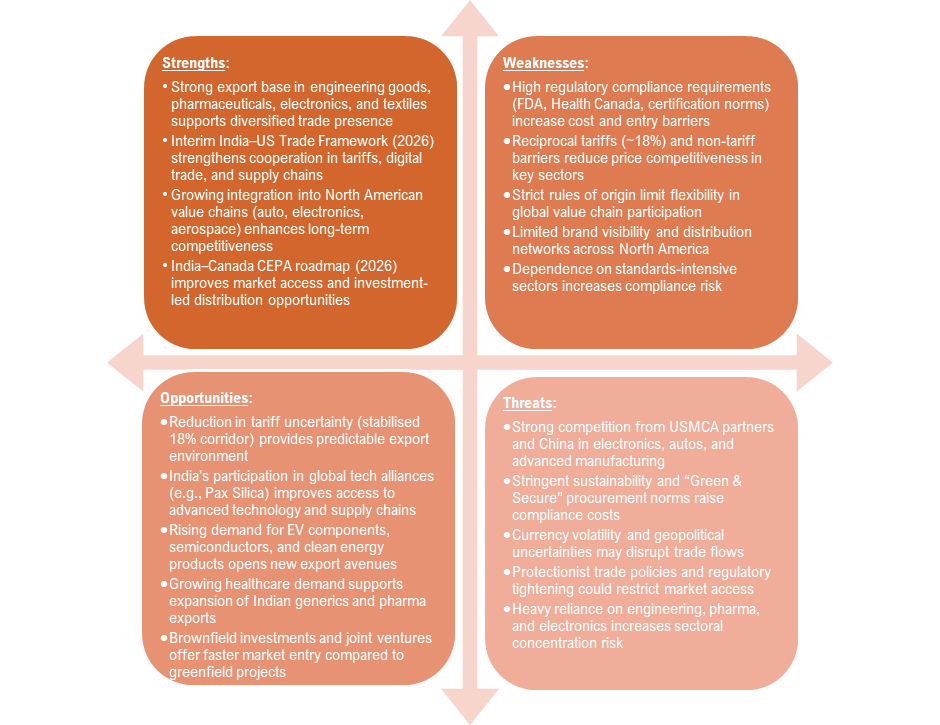
Indian North America Trade Access, Regulatory Integration and Market Framework
Indo-North American trade is increasingly being shaped through bilateral and targeted agreements rather than a regional framework. With the USA, Canada, and Mexico being signatories to the USMCA, Mexico emerges as an important gateway in global value chain-driven trade flows, especially in automotive systems, electronics assembly, and nearshoring-linked supplier networks within the USMCA structure. On the other hand, India’s approach is focused on developing separate bilateral relations with the US and Canada while making use of market-based approaches for gaining access to Mexico through value chains and partnerships.
Bilateral India-United States Trade Framework
The US emerges as the most important market in North America, and the trade ties between the two countries have taken a turn towards more institutional developments with the signing of the Interim India-US Trade Framework in February 2026. The framework would function as the precursor to a Bilateral Trade Agreement (BTA). Some key areas that it addresses include tariff rationalisation, rules of origin, digital trade, non-tariff barriers, and supply chain resilience. Cooperation in specific sectors, including medical devices, technology products, aircraft parts, and advanced manufacturing, would be deepened in the new phase of trade. The ongoing framework is crucial for India's exports, especially design-driven exports from electronics, pharmaceuticals, home decoration, gems, and automotive components.
India-Canada Comprehensive Economic Partnership Agreement (CEPA)
There emerged an important development concerning Indian trade with North America in March 2026, wherein India signed Terms of Reference (ToR) for initiating comprehensive economic partnership agreement (CEPA) negotiations with Canada. The new CEPA is likely to cover trade in goods and services, digital trade, critical minerals, investment cooperation, and technology partnerships with the goal of bilateral trade reaching US$ 50 billion by 2030. It would be crucial for India’s export competitiveness and market access to Canada in pharmaceuticals, engineering goods, clean-tech equipment, and education-linked services.
Trade Opportunities and Market Access Outlook
North America continues to remain an attractive but standards-heavy market where compliance with regulations, packaging standards of retailers and certification continue to impact India’s export performance. In terms of its trade relationship with the region, India has focused on bilateral and market-driven strategies to gain better access to Canada and the US, as well as Mexico, through value chains.
The signing of the India-US Interim Trade Framework in February 2026 marked a major development as it would pave the way for a Bilateral Trade Agreement (BTA), covering tariff rationalisation, rules of origin, digital trade, non-tariff barriers, and supply chain resilience. It has been crucial for India's electronics, pharmaceuticals, home decoration, gems, and automotive component exports in particular due to certifications and packaging.
In yet another development in March 2026, India signed ToRs for starting CEPA negotiations with Canada, with the goal of reaching US$ 50 billion bilateral trade by 2030. It is expected to enhance India's market access in pharmaceuticals, engineering goods, clean-tech equipment, and sustainable lifestyles.
Key Challenges between India and North America
- Lack of comprehensive trade agreements and tariffs : While countries like Mexico and Canada have the advantage of duty-free imports under the USMCA agreement, India is at a disadvantage as far as high tariffs and strict rules of origin are concerned, affecting price competitiveness in industries like engineering products, textile goods, and certain consumer products.
- Distance factor and logistic disadvantage : Due to long distances, logistics costs and longer transit time (25-35 days compared to Mexico) pose a challenge in making Indian exports competitive in terms of fast-moving or replenishment-based supply chains, especially in the retail and automotive sectors.
- Compliance challenges due to stringent regulations : North America, especially the United States, has rigorous compliance processes and regulations (like USFDA, environment, labour regulations, product regulations).
Actionable Insights for Indian Brands: North America 2026
There are ample opportunities available for Indian exporters in North America because of the premiumization trends, supply chain diversification efforts, and stringent requirements for product quality and certification among buyers in the US, Canada, and Mexico markets. Some of the key priorities and strategies are mentioned below.
- Compliance, Quality, and Reliability: Being competitive in North America requires compliance with regulations (USFDA, UL, EPA, and others), as well as quality standards. Certifications, packaging, and traceability systems need to be put in place, with an emphasis on after-sales service and warranties. The ability to prove consistency and reliability will allow building relationships with large buyers and major retailers, resulting in longer-term procurement orders.
- Integration into Supply Chains and Local Presence: Given logistical inefficiencies, it makes sense for Indian companies to pursue hybrid approaches that combine local manufacturing with logistics networks that involve local warehousing and shipping. Collaboration with local distributors, OEMs, and private label companies can greatly increase market access.
- Niche Markets and High-Value Products: In the context of the North American market, India's strengths lie in its niche product areas, where innovation and customisation are valued more than fast delivery. These include electric vehicle components, speciality drugs, complex generics, precision engineering, lab-grown diamonds, and luxury consumer goods. Pursuing such markets and products enables Indian suppliers to compete less against near-shore competitors.
Disclaimer: This information has been collected through secondary research. The views expressed by the spokespersons are their own and do not necessarily reflect those of IBEF. IBEF is not responsible for any errors in the same.
Get In Touch
Your input is valuable in shaping the future of the IBEF Export Newsletter! Take a moment to share your thoughts and help us bring you more relevant insights, success stories, and export branding strategies.
Contact & Subscriptions: Contact Us
Email us at: info.brandindia@ibef.org
Call: +91 11 43845501
Partners




