Case Study
Success Story: Carraro India’s Export Journey
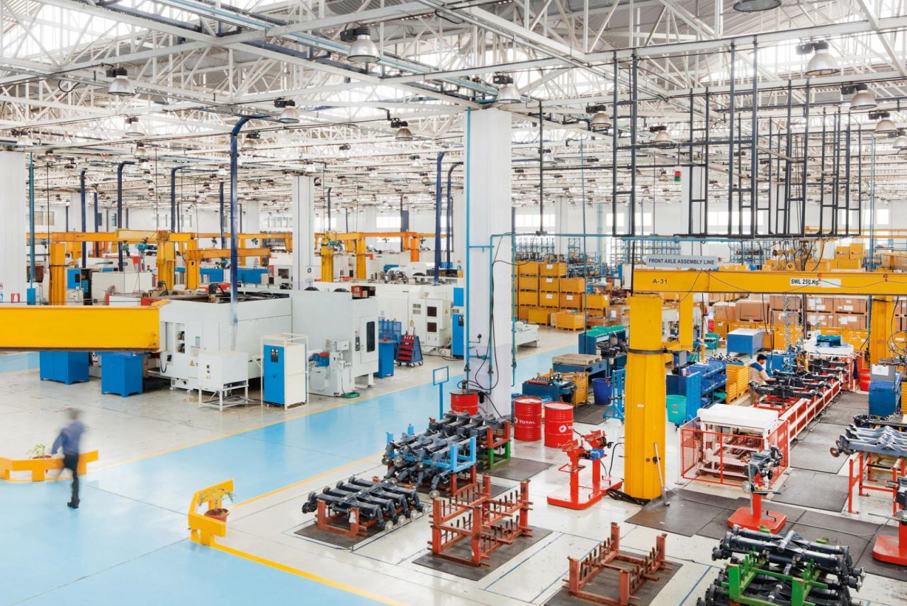
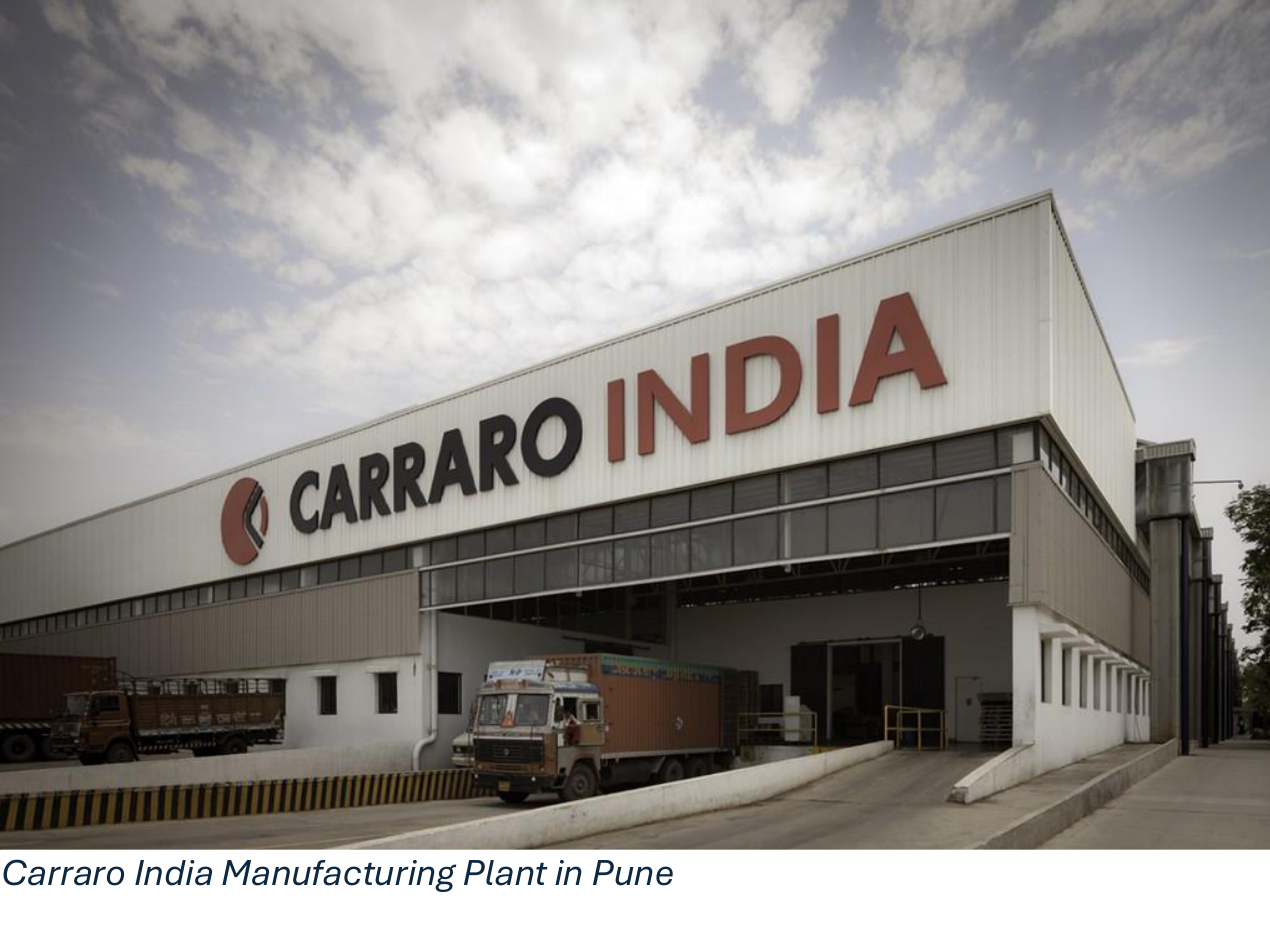
Carraro India Limited, established in 1997, is a technology-driven integrated supplier of drivetrain solutions for agricultural, construction, and off-highway equipment. Part of the global Carraro Group, the company develops and manufactures axles, transmission systems, gears, shafts, and related components for OEM customers worldwide. With two manufacturing facilities in Pune and strong in-house R&D capabilities, Carraro India provides end-to-end capabilities across product design, manufacturing, prototyping, testing, assembly, and engineering support. Its products are mission-critical components used in agricultural tractors, backhoe loaders, telehandlers, cranes, forklifts, aerial work platforms, and other specialised equipment. The company is supported by an extensive supplier network in India and overseas, enabling it to serve both domestic and international customers.
Carraro India’s journey is unique because exports were not a later strategic initiative but an integral part of its business from inception. When the company established operations in India during the late 1990s, it was part of the Carraro Group’s broader global industrialisation strategy. At the time, the Indian market for advanced drivetrain technologies was still developing, particularly in the agricultural equipment segment. As a result, the company initially focused on supporting OEMs that were exporting equipment to markets across Africa, Asia, Europe and South America, making exports a natural part of its operating model.
Over the years, the company concentrated on building manufacturing capabilities, engineering expertise, and backward integration. Significant investments were made in developing in-house capabilities for critical components and strengthening the supplier ecosystem around its operations. Rather than competing solely on cost, the focus remained on delivering technology-driven solutions that met global standards for quality, reliability, and performance.
As the Indian market evolved and demand for advanced technologies increased, particularly in agricultural and construction equipment, Carraro India expanded its domestic presence while continuing to play an important role within global OEM supply chains. The company’s growth has been supported by long-term customer relationships, engineering collaboration, localisation efforts, and continuous capability building.
Today, Carraro India serves as an integrated drivetrain solutions provider with expertise spanning axles, transmissions, gears, and related systems for agricultural and construction equipment. Through its manufacturing, engineering, and technology capabilities, the company continues to support OEM customers across domestic and international markets while remaining closely integrated into global supply chains.
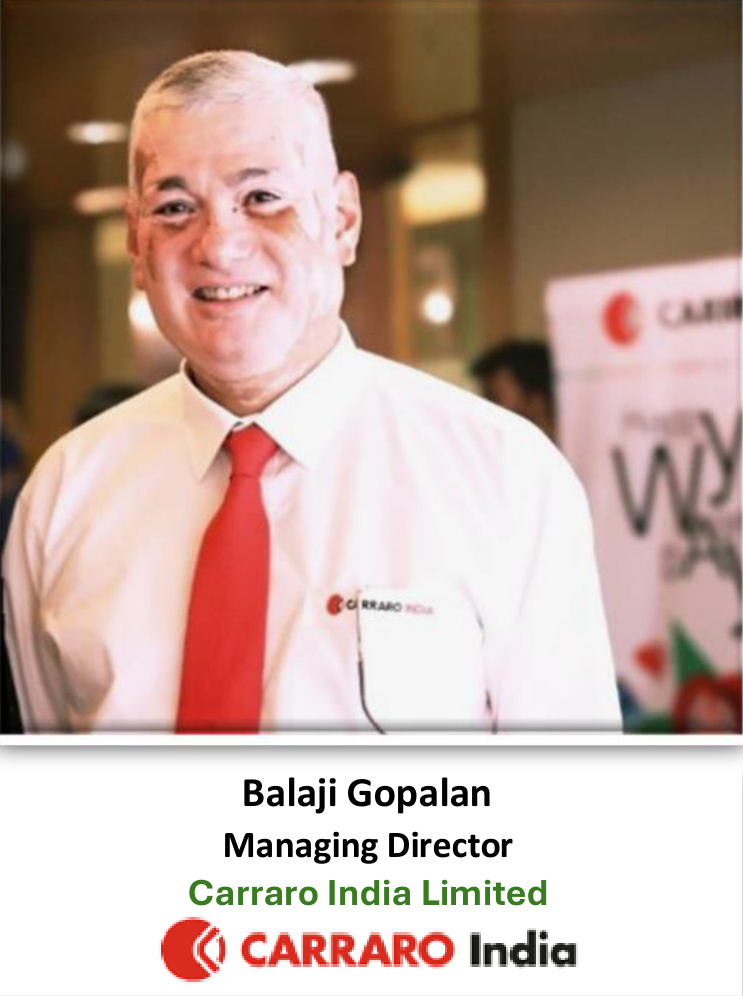
We interviewed Balaji Gopalan, Managing Director at Carraro India Limited to understand the company’s evolution from an export-oriented manufacturing base to a technology-driven drivetrain solutions provider serving global OEMs. The discussion covered Carraro India’s journey in building manufacturing and engineering capabilities, its approach towards localisation, customer collaboration, and its role within global supply chains. In the following sections, we share key insights from our discussion and excerpts from the interview.
Carraro India operates in the drivetrain segment for agricultural and construction equipment. What factors guided you to export into international markets, and how did your global business evolve over time?
For Carraro India, exports were closely linked to the requirements of the OEMs we served. In the early years, a significant portion of our business involved supporting customers that were exporting agricultural and construction equipment to markets across Africa, Asia, and South America and Europe. This created a natural opportunity for Carraro India to become part of those global supply chains.
Over time, the business evolved beyond simply supplying products for export. As we strengthened our manufacturing capabilities and built credibility with customers, our role expanded within global programmes and platforms. Today, our exports are a combination of direct exports and indirect exports through OEMs, with our products ultimately reaching multiple international market.
Another important aspect is that we do not look at exports strictly from a country perspective. Many of our customers operate globally, and products supplied by Carraro India may eventually be used across different regions through their worldwide manufacturing and distribution networks. As a result, our global presence is closely linked to the strength of our OEM relationships and our ability to support their requirements consistently.
In the auto component sector, exports are often driven by OEM relationships. How has Carraro India built and strengthened its partnerships with global OEMs?
A key aspect of Carraro India’s approach has been building long-term engagement with OEMs rather than focusing purely on transactional supplier relationships. In our business, products such as transmissions and axles are highly integrated into the customer’s platform, which makes early collaboration and continuous engagement extremely important.
One of the ways we have strengthened these relationships is through close engineering collaboration. Our teams work with OEMs during the product development stage itself, helping define and develop solutions that are aligned with specific application requirements. This creates a deeper level of integration and allows us to support customers throughout their product lifecycle.
Another important factor has been what we describe as “customer intimacy.” The focus is not only on supplying products but also on understanding customer requirements, technology roadmaps, and future needs. This helps create long-term partnerships where both organisations work together towards common objectives.
Over the years, investments in manufacturing capability, engineering expertise, and quality systems have also helped strengthen customer confidence. As customers see consistent performance, reliability, and responsiveness, relationships naturally deepen and expand into additional programmes and platforms. Overall, our OEM partnerships have been built through sustained engagement, collaborative product development, and a long-term commitment to supporting customer success, which has helped us become an integral part of their global supply chains.
Global customers place strong emphasis on quality and reliability. What key practices during exports have helped Carraro India build trust and long-term relationships with international clients?
For Carraro India, trust is built through consistent performance over time. Since transmissions and axles are mission-critical systems, customers place significant importance on quality, reliability, and long-term product performance.
One of the key practices has been institutionalising quality through robust manufacturing processes and in-built control systems. The focus has always been on preventing defects rather than correcting them later, ensuring consistency across production volumes and customer programmes.
Another important aspect has been maintaining close engagement with customers throughout the product lifecycle. Rather than limiting interactions to commercial discussions, our engineering and technical teams work closely with customers to support product development, validation, and ongoing improvements.
Reliability during challenging situations has also been important in strengthening customer confidence. The ability to support customers consistently and maintain continuity of supply has helped reinforce long-term relationships.
Over time, these factors have enabled Carraro India to move beyond a supplier relationship and become a trusted technology partner within the global supply chains of its customers.
What specific efforts has your company undertaken for establishing the brand in the international market?
Brand building in our industry is different from consumer-facing sectors. In the drivetrain and off-highway equipment segment, reputation is largely built through technology, performance, and customer experience rather than conventional marketing activities.
The approach was direct engagement with OEMs through technical interactions and technology-focused discussions. These engagements provide an opportunity to showcase engineering capabilities and collaborate on future product requirements.
The company also focuses on building visibility through strong customer relationships and successful product performance in the field. As products become part of established OEM platforms, they create credibility and confidence among existing and prospective customers.
Overall, Carraro India's brand in international markets has been built primarily through engineering expertise, technology engagement, and a track record of reliable execution rather than through traditional promotional efforts
Carraro India offers a range of axles and transmission systems across different applications. Could you briefly outline your key product segments you export in international markets, and whether your export approach varies across these segments?
Carraro India’s core focus is on driveline systems for off-highway vehicles. Our product portfolio includes transmissions, axles, gear systems, and complete drivetrain solutions that transmit power from the engine to the wheels.
We primarily serve two key segments agricultural equipment and construction equipment. In agriculture, our solutions are widely used in tractors, particularly in the four-wheel-drive segment and high horsepower agriculture tractor. In construction equipment, we supply driveline systems for applications such as backhoe loaders and other off-highway machinery.
Across these segments, our focus remains on providing technology-driven solutions that are aligned with customer requirements. Since our products are typically developed in close collaboration with OEMs, the approach is largely driven by the specific application, vehicle platform, and performance requirements of the customer.
Rather than offering standard products across markets, we work closely with customers to deliver solutions that fit their operational and technical needs while maintaining the same standards of quality, reliability, and performance.
Different markets and OEMs have varying technical requirements. What have been your key learnings in adapting products or engineering solutions for global customers for exports?
One of our key learnings has been that there is no one-size-fits-all approach when it comes to global OEMs. Different customers have different operating conditions, performance expectations, and technology roadmaps, which means engineering solutions must be tailored to specific applications rather than standardised across markets.
Our approach has therefore been centred on close collaboration with customers right from the product development stage. We work closely with OEM engineering and R&D teams to understand their requirements and co-develop solutions that are aligned with their vehicle platforms and end-use applications.
Another important learning has been that technology adoption happens in stages. Customers move through different levels of technology maturity over time, and suppliers need to be prepared to support that journey. This requires strong engineering capabilities and the ability to continuously adapt products to evolving requirements.
We have also learned that successful adaptation is not limited to product design alone. It requires a combination of engineering expertise, manufacturing capability, testing, validation, and process discipline to ensure that products perform consistently under different operating conditions.
Ultimately, our focus has been on developing application-specific solutions while maintaining the same standards of quality, reliability, and performance that global OEMs expect. This approach has helped us become a long-term technology partner rather than simply a component supplier.
As part of global supply chains, localisation often plays an important role. How has Carraro India approached localisation, both in terms of manufacturing and global customer requirements?
Localisation has been a gradual and important part of Carraro India’s journey. When operations began, the local supplier ecosystem for advanced drivetrain technologies was still developing, which meant a higher dependence on imported components and global sourcing.
Over time, our focus has been on building stronger manufacturing capabilities within India and increasing the level of localisation wherever it made technical and commercial sense. A key part of this effort has been backward integration, particularly for critical components such as gears, which are central to drivetrain performance. By developing these capabilities in-house, we have been able to achieve better control over quality, delivery, and manufacturing consistency.
At the same time, localisation has also involved working closely with the Indian supplier ecosystem. As suppliers have improved their capabilities in terms of quality standards, manufacturing processes, and reliability, it has enabled greater local sourcing while continuing to meet global customer expectations.
For global OEMs, localisation is not only about cost competitiveness but also about ensuring dependable supply chains and consistent product quality. Our approach has therefore been to build local capabilities that can match global standards rather than viewing localisation purely as a cost-reduction exercise.
Today, localisation forms an important part of our manufacturing strategy, helping us support both domestic and export requirements while remaining aligned with the expectations of global customers.
What were some of the key challenges faced while expanding into international markets, particularly in terms of technical standards, customer expectations, or competition?
One of the key challenges was that the markets and applications we operate in require highly specialised technology, with very little room for error. Customers expect products to meet stringent performance, durability, and reliability standards, which means that quality and engineering excellence cannot be compromised.
Another challenge was establishing credibility over time. Global OEMs typically look for suppliers who can consistently deliver quality, reliability, and long-term support. Building that confidence required sustained investment in manufacturing capabilities, processes, and customer relationships over many years.
Competition was also unique in our case. Rather than positioning ourselves as a low-cost manufacturing source, the objective was to compete against global benchmarks and demonstrate that products manufactured in India could match the standards available anywhere in the world. This required continuous investments in technology, infrastructure, and manufacturing excellence.
In addition, the company operated for many years ahead of market demand. While advanced drivetrain technologies had strong potential, adoption in India was relatively slow, which meant that capabilities had to be built well before the market was ready. Maintaining this long-term commitment required patience and a clear strategic vision.
Overall, the ability to consistently meet global standards, invest ahead of demand, and build long-term credibility with OEMs has been critical in overcoming the challenges associated with international business.
How has Carraro India’s R&D and engineering expertise supported its export growth?
R&D and engineering capabilities have been central to Carraro India’s growth, particularly because our business is driven by technology rather than standard products. Our focus has always been on providing complete drivetrain solutions that address specific customer requirements and applications.
A key strength has been our ability to work closely with OEMs during the product development stage. Rather than supplying off-the-shelf products, we collaborate with customers to develop solutions that fit their vehicle platforms and performance requirements. This close engineering engagement helps create long-term partnerships and deeper integration into customer programmes.
Another important aspect has been the ability to design and manufacture not only complete transmission and axle systems but also critical sub-components. For example, we have invested significantly in gear manufacturing capabilities, enabling us to maintain control over technology, quality, and production processes. This level of integration strengthens our ability to deliver reliable products consistently across markets.
Our engineering expertise has also enabled us to support customers as technology requirements evolve. As demand has shifted towards more advanced drivetrain solutions, particularly in agricultural and construction equipment, we have been able to align our products and capabilities with these changing requirements.
Overall, our export growth has been supported by a combination of technology leadership, engineering collaboration with OEMs, strong manufacturing capabilities, and continuous investments in product and process excellence. These capabilities have helped position Carraro India as a trusted technology partner within global supply chains.
As exports scaled, what were the key considerations in strengthening manufacturing processes and ensuring consistent quality across global deliveries?
From the beginning, the focus was on creating infrastructure and processes that could match the expectations of international OEMs in terms of quality, reliability, and consistency. A major part of this approach was investing in backward integration and developing in-house capabilities for critical components. For example, Carraro India established its own modern gear manufacturing facility, allowing greater control over technology, production quality, and delivery performance. This helped ensure consistency across products supplied to customers in different markets.
The company also invested in advanced manufacturing technologies at an early stage. One example was the installation of a water-based paint shop, which was among the first of its kind in India at the time. Such investments were aimed at aligning manufacturing practices with evolving global standards and customer expectations.
Another important consideration was maintaining reliability over the long term. Building credibility with global OEMs required consistent execution over many years. As a result, the focus remained on process discipline, manufacturing excellence, and the ability to deliver products that were comparable to the best available globally.
Overall, strengthening manufacturing was not viewed as a short-term exercise to support exports. It was a long-term effort centred on technology, quality, backward integration, and continuous capability building, which helped establish Carraro India as a trusted supplier within global supply chains.
For markets where you do not have a direct presence, how does Carraro India manage logistics, customer coordination, and overall execution?
Carraro India operates as part of a larger global organisation, which enables close coordination with customers across different regions. Rather than managing individual markets independently, the company works through established global OEM relationships and supply chain networks.
A significant part of the business is integrated into customers' global platforms, where products manufactured in India are supplied as part of broader international programmes. This allows the company to support customers across multiple geographies while maintaining common standards of quality, delivery, and technical support.
The focus has always been on building reliability and long-term customer relationships. Over the years, investments in manufacturing capabilities, process discipline, and supply chain integration have helped ensure consistent execution for global customers.
Overall, the emphasis is on being a dependable technology and manufacturing partner within global supply chains, allowing customers to serve international markets efficiently.
Cost competitiveness remains important in the auto component sector. How does Carraro India balance cost, quality, and innovation while competing globally?
At Carraro India, cost competitiveness is important, but it has never been the sole basis of our value proposition. From the beginning, the focus has been on competing with global standards rather than positioning ourselves simply as a low-cost manufacturing source.
A key element of this approach has been continuous investment in technology, engineering, and manufacturing capabilities. By developing strong in-house expertise and increasing backward integration in critical areas such as gear manufacturing, we have been able to maintain better control over quality, production efficiency, and delivery performance.
Innovation also plays an important role. As a technology-driven company, our focus is on providing advanced drivetrain solutions that address evolving customer requirements in agricultural and construction equipment. Close collaboration with OEMs allows us to align product development with market needs while maintaining the required performance standards.
On the quality front, the emphasis has always been on building robust manufacturing processes and systems that can consistently meet global expectations. Reliability and consistency remain critical because customers view drivetrain systems as mission-critical components within their equipment.
Overall, our approach is to balance cost, quality, and innovation through capability building, technology leadership, and operational excellence. This enables us to deliver products that are globally competitive while maintaining the standards expected by international OEMs.
Over the years, how has the perception of Indian manufacturing and auto component companies evolved among global customers, based on your experience?
The perception of Indian manufacturing has evolved significantly over the years. When Carraro India started operations, the local supplier ecosystem was still developing, and many of the capabilities required for advanced drivetrain technologies were not readily available. As a result, companies often had to rely on imports or global sourcing for several critical components.
Over time, however, the Indian manufacturing ecosystem has matured considerably. Suppliers have improved their capabilities in terms of quality, technology, delivery performance, and overall professionalism. This has enabled Indian manufacturers to meet increasingly demanding global standards and compete more effectively in international markets.
Another important shift has been the growing confidence of global customers in India's ability to deliver complex and technology-intensive products. Today, India is no longer viewed only as a cost-competitive manufacturing destination. Customers increasingly recognise the country’s engineering talent, manufacturing capabilities, and ability to support long-term industrial growth.
From Carraro India’s perspective, the focus has always been on delivering products that are comparable to the best available globally. Consistent investments in technology, manufacturing excellence, and capability building have helped strengthen customer confidence and demonstrate that products manufactured in India can meet the same standards expected from established global manufacturing locations.
Overall, the perception has moved from viewing India primarily as a sourcing destination to recognising it as a capable and reliable manufacturing and engineering hub within global supply chains.
Based on your journey, what key lessons would you share with Indian auto component manufacturers looking to grow through exports?
There are a few important lessons that have shaped Carraro India’s journey over the years.
First, companies need to take a long-term view of exports. Building a successful global business requires patience and a willingness to invest well before the market opportunity fully materialises. In our experience, capabilities often need to be built years before demand reaches scale.
Second, it is important to focus on technology and capability development rather than competing solely on cost. Global customers look for suppliers who can consistently deliver quality, reliability, and engineering expertise. Developing these capabilities creates a stronger and more sustainable competitive position.
Third, investments in manufacturing excellence and backward integration are critical. Greater control over key processes and components helps improve quality, reliability, and responsiveness, which are essential for serving international customers.
Another important lesson is the value of close customer engagement. Building long-term relationships requires more than supplying products. It involves understanding customer requirements, supporting their technology roadmap, and working together to solve challenges over time.
Finally, companies should focus on creating robust systems and processes that can consistently meet global standards. Credibility is built gradually through consistent execution, and once trust is established, it becomes a strong foundation for long-term growth.
Overall, sustained investment in technology, manufacturing capability, quality, and customer relationships has been central to our journey, and these remain important considerations for any company looking to expand through exports.
Get In Touch
Your input is valuable in shaping the future of the IBEF Export Newsletter! Take a moment to share your thoughts and help us bring you more relevant insights, success stories, and export branding strategies.
Contact & Subscriptions: Contact Us
Email us at: info.brandindia@ibef.org
Call: +91 11 43845501
Partners