Industry Trends
India’s approach to trade fairs and exhibitions is undergoing a significant transformation. New world-class venues are being launched to host major events. The government and industry are introducing flagship expos branded under “Bharat,” and Indian business delegations are increasingly visible at international fairs. This multi-pronged strategy reflects India’s ambition to become a global trade hub and integrate its industries into worldwide markets. Below, we explore how upgraded infrastructure, new mega-events, and proactive outreach are reshaping the trade fair landscape.
Trade fairs: India’s borderless branding
Modernising India’s exhibition infrastructure
A decade ago, India had only a handful of large exhibition venues, but recent investments have added several state-of-the-art facilities. Bharat Mandapam and Yashobhoomi, two massive convention and expo centers in Delhi exemplify this upgrade, alongside major venues in other metros. Key exhibition centres now include:
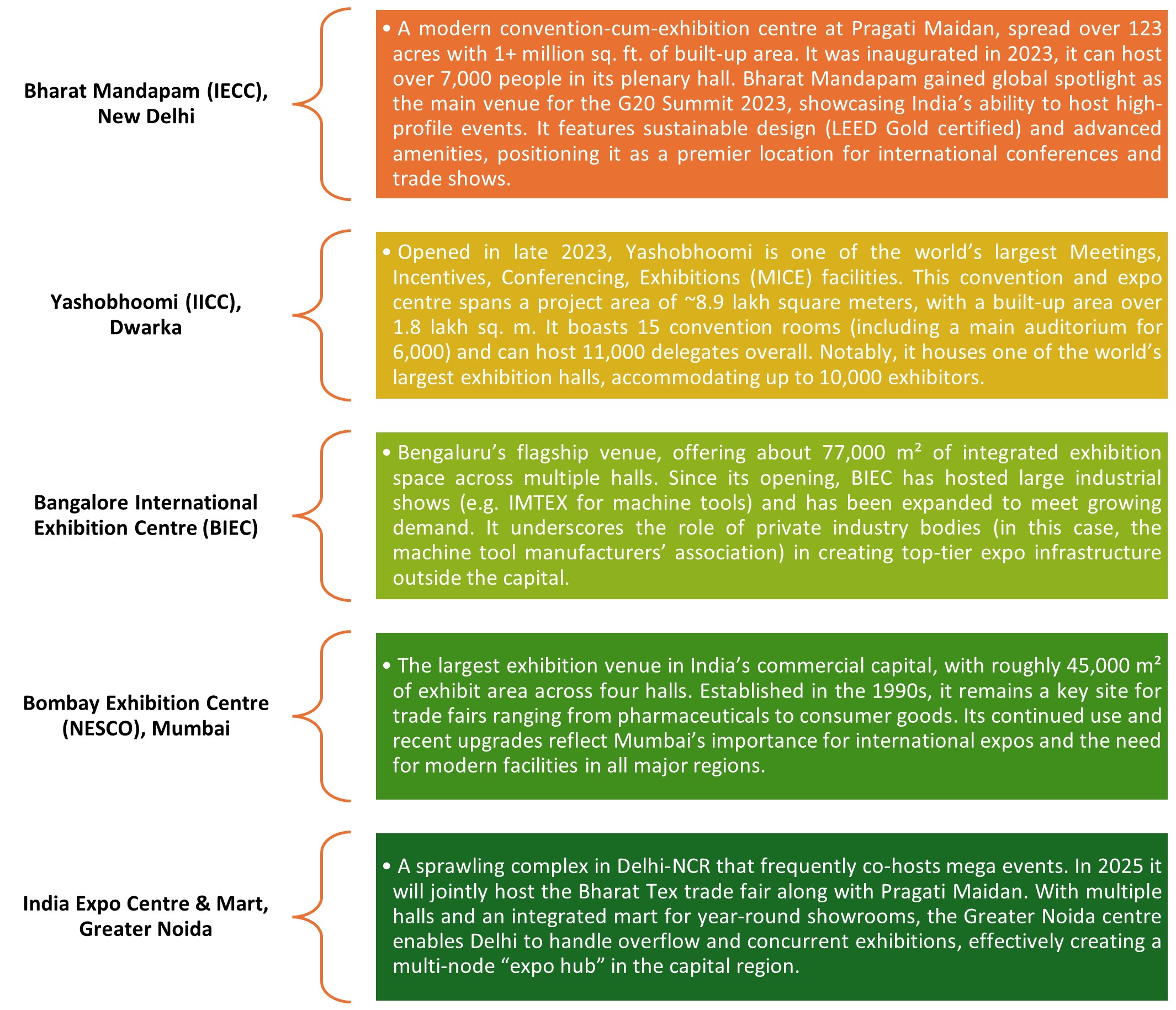
Every venue mentioned here is just as important as the others in the trade fair ecosystem of India. They all together meet the requirements which were long awaited of having large and well-equipped spaces to hold global-level exhibitions. The existence of several large venues in various locations also decentralises the events and makes trade opportunities available to different industrial clusters. Organisers now have options to choose venues based on sector and audience. For example, tech expos in Bengaluru’s BIEC or textile fairs split between Delhi and Noida thereby maximizing reach and impact.
Emergence of ‘Bharat’-branded mega trade events
Alongside infrastructure growth, India is witnessing the rise of “Bharat” branded mega-events. Large trade fairs conceived to put Indian industries on the global map. These sector-specific expos, organised with heavy government and industry collaboration, signal a new era of home-grown international events.
One notable example is the Bharat Mobility Global Expo, which in 2025 replaced the long-running Auto Expo. In 2025, the Bharat Mobility Global Expo drew more than 9.8 lakh visitors. The rebranded show expanded in scope and scale, reflecting the rapid shifts in the automotive sector towards electric and smart mobility. The January 2025 edition of Bharat Mobility spanned three venues across Delhi-NCR: Bharat Mandapam, Yashobhoomi, and the India Expo Centre to accommodate different components of the mobility ecosystem. This multi-venue format allowed showcasing everything from passenger Electric Vehicles (EVs) and concept cars to specialised zones for tyres, batteries, and urban transport technology. The event featured 239 new product launches with a strong spotlight on electric vehicles and sustainable transport solutions, underlining India’s intent to lead in green mobility. After an impressive 2025 turnout, Bharat Mobility is set to adopt a biennial schedule aligned with global auto show trends, a sign that it aims to be on par with international motor shows in influence and frequency.
Similarly, Bharat Tex has emerged as a flagship trade fair for India’s textile and apparel sector. Launched in 2024, Bharat Tex is positioned as “India’s largest and most comprehensive textiles event ever”. The 2025 edition is planned as a dual-venue expo split between Bharat Mandapam in New Delhi and the India Expo Centre in Greater Noida. This setup will cover the entire textile value chain: the main venue in Delhi focusing on fabrics, fashion and the core textile industry, while the parallel venue showcases niche segments like handicrafts, machinery, and traditional apparel.
Bharat Tex 2025 hosted around 5,000 exhibitors and 6,000 international buyers from 110+ countries, with over 1,20,000 visitors in total truly a world-scale expo. It is a consortium effort by multiple Textile Export Promotion Councils supported by the Ministry of Textiles. Organizers emphasize themes of resilient global value chains, sustainability, and innovation, aligning with national initiatives (for example, the event highlights the Prime Minister Mr. Narendra Modi’s 5F vision – “Farm to Fibre to Factory to Fashion to Foreign” for the textile sector). With government incentives like the PLI scheme and new PM MITRA textile parks backing the industry, Bharat Tex serves as both a showcase and a catalyst for investment in India’s textiles. As one official noted, it’s a “unique effort to bring the entire textiles value chain under one roof” and to reaffirm India’s attractiveness as a sustainable sourcing and investment destination.
Beyond mobility and textiles, other “Bharat” expos are on the horizon in areas like defence, food, and technology, as India looks to create its own globally-recognised trade fair brands. The common thread in these events is a blend of government push and industry partnership leveraging India’s large domestic market and production base to draw international participation. By hosting such mega fairs at home, India not only promotes its products to global buyers on its own soil but also spurs local innovation (e.g. EV startups at Bharat Mobility) and knowledge exchange through conferences and seminars. The “Bharat” series of events thus represents a form of trade-show thought leadership: India crafting narrative-setting industry gatherings that can influence global trends while uplifting its own industries.
Global outreach: Indian delegations on the world stage
India’s trade fair strategy isn’t confined to domestic events and infrastructure. There is also a strong outward component. Export Promotion Councils (EPCs) and industry associations are actively leading Indian delegations to major trade fairs worldwide, ensuring India’s presence in key global markets. These delegations typically set up “India Pavilions” at international exhibitions, allowing dozens of Indian companies (often SMEs) to showcase under a national banner and engage with foreign buyers.
To illustrate, the Trade Promotion Council of India (TPCI), along with the government agencies Agricultural and Processed Food Products Export Development Authority (APEDA) and India Trade Promotion Organisation (ITPO), made a presence at the Summer Fancy Food Show 2024 in New York, which is a top-notch food industry event worldwide. The Indian Pavilion was officially opened by the Indian Consul General in New York and included the participation of more than 70 Indian exporters of food and beverages who were marketing their products to U.S. and global buyers. Such a prominent participation has become a signal of quality and variety of Indian F&B offerings (from spices to snacks) and has created opportunities for export deals. Indian entrepreneurs are also given a chance to be enlightened with international market trends and consumer preferences.
In another example, India was the “Guest of Honour” country at Vietnam’s International Trade Expo 2024, reflecting deepening trade ties between the two nations. The India Trade Promotion Organisation (ITPO) coordinated a pavilion of 14 Indian companies across sectors like electronics, auto components, wastewater tech, banking, and food processing at the Hanoi event. Big names such as Adani Ports, Bharat Electronics, Tata Coffee, and others joined this delegation, showcasing India’s capabilities in diverse fields. This concerted presence in Vietnam, one of Southeast Asia’s fastest-growing markets helped bridge information gaps and promote business cooperation between Indian and Vietnamese firms. In practical terms, it meant B2B meetings, networking sessions, and likely MoUs or deals that could bolster bilateral trade beyond the expo.
The overseas engagements of Indian industry groups have become more frequent. Regular sector-specific EPCs (engineering, pharmaceuticals, textiles, gems and jewellery, etc.) promote India Pavilions at the world's foremost fairs, turning Heimtextil in Frankfurt (for home textiles) in January 2025 into a regular stop for Indian delegations, where more than 50,000 trade visitors and over 3,000 exhibitors participated, with India among the top exhibiting countries alongside China, Pakistan, Turkey and Italy. Likewise, SIAL in Paris (for food) in 2024 celebrated its 60th anniversary and hosted 7,500 exhibitors from 127 countries with attendance crossing 2,85,000 professional visitors, of which about 79% were international. Arab Health in Dubai (for medical devices) in 2025 marked its 50th edition with more than 3,800 exhibitors and over 60,000 healthcare professionals from more than 70 countries, including a strong Indian presence.
Exporters are often the ones benefitting from government schemes (such as Market Access Initiative funds) which subsidise small exporters to attend these events. The entire concept is simple. The plan is to give Indian companies access to the international market and connect them to the supply chains of the world. Indian industries by attending international fairs not only learn about the new technologies and standards but also have the opportunity to meet new partners or attract the interest of foreign investors or buyers. Besides that, it is a kind of economic diplomacy that showcases India’s manufacturing and innovation prowess on a global stage.
Disclaimer: This information has been collected through secondary research. The views expressed by the spokespersons are their own and do not necessarily reflect those of IBEF. IBEF is not responsible for any errors in the same.
Get In Touch
Your input is valuable in shaping the future of the IBEF Export Newsletter! Take a moment to share your thoughts and help us bring you more relevant insights, success stories, and export branding strategies.
Contact & Subscriptions: Contact Us
Email us at: info.brandindia@ibef.org
Call: +91 11 43845501
Partners