Introduction
India’s plastic industry has evolved into a dynamic and globally competitive sector, supported by strong institutional frameworks such as the Plastic Export Promotion Council. Over the decades, the industry has transitioned from a nascent manufacturing base to a key contributor to India’s industrial ecosystem, demonstrating resilience and adaptability, including during periods of global disruption. Today, it plays a significant economic role through large-scale manufacturing, extensive MSME participation, and substantial employment generation. The sector is also highly export-oriented, supplying a diverse range of plastic products to over 200 countries, thereby strengthening India’s position in global trade. Its contribution extends beyond exports to include technological advancement, supply chain development, and reinforcing the global presence of ‘Made in India’ products.
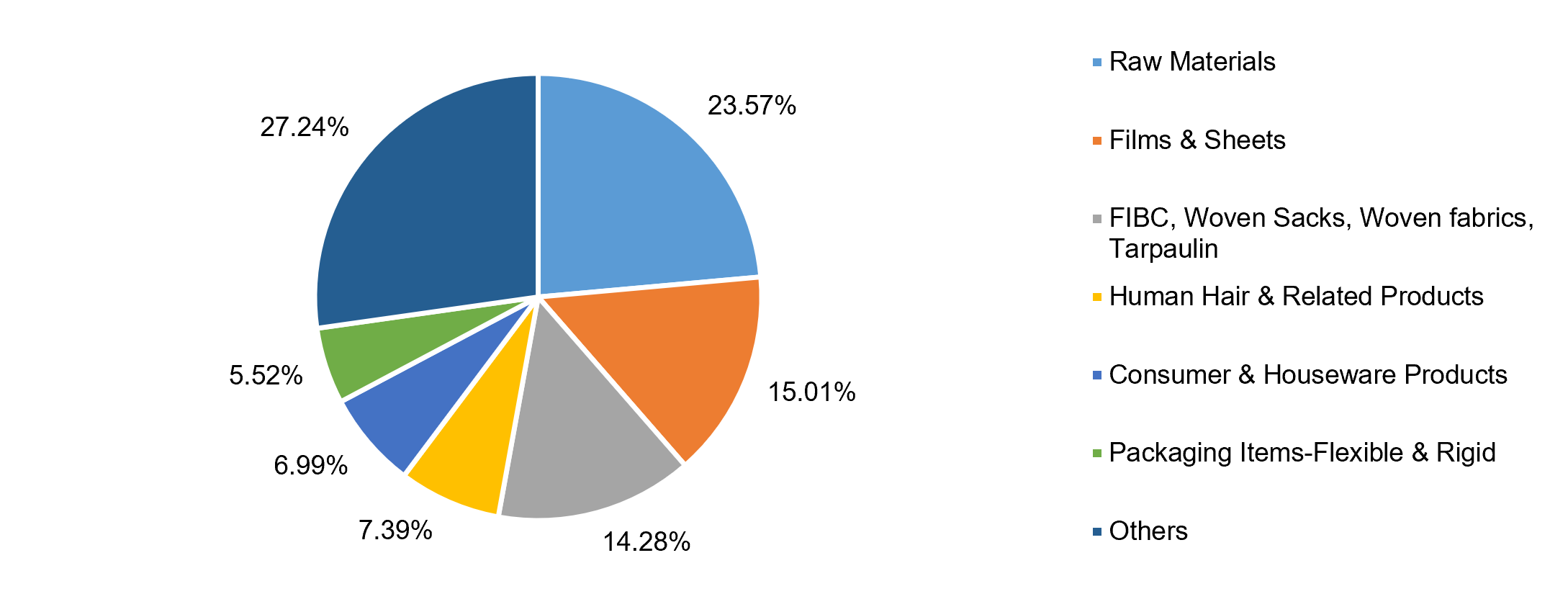
India’s product-wise share of plastics exports FY26 (April-February)
Source: The Plastics Export Promotion Council of India (PLEXCONCIL)
Looking ahead, the industry holds strong growth potential driven by rising domestic demand across packaging, infrastructure, healthcare, and consumer goods, along with expanding export opportunities through trade agreements and shifting global supply chains. Government support remains a key enabler, with initiatives such as export promotion schemes, plastic parks, and industrial clusters aimed at boosting infrastructure and competitiveness. Policy measures under broader programmes like manufacturing and export promotion further enhance investment and capacity building. Additionally, there is an increasing focus on sustainability, innovation, and value-added products, positioning India as a future leader in responsible plastic manufacturing. With continued government-industry collaboration and favourable market dynamics, the sector is expected to witness substantial expansion in the coming years.
Export Trend
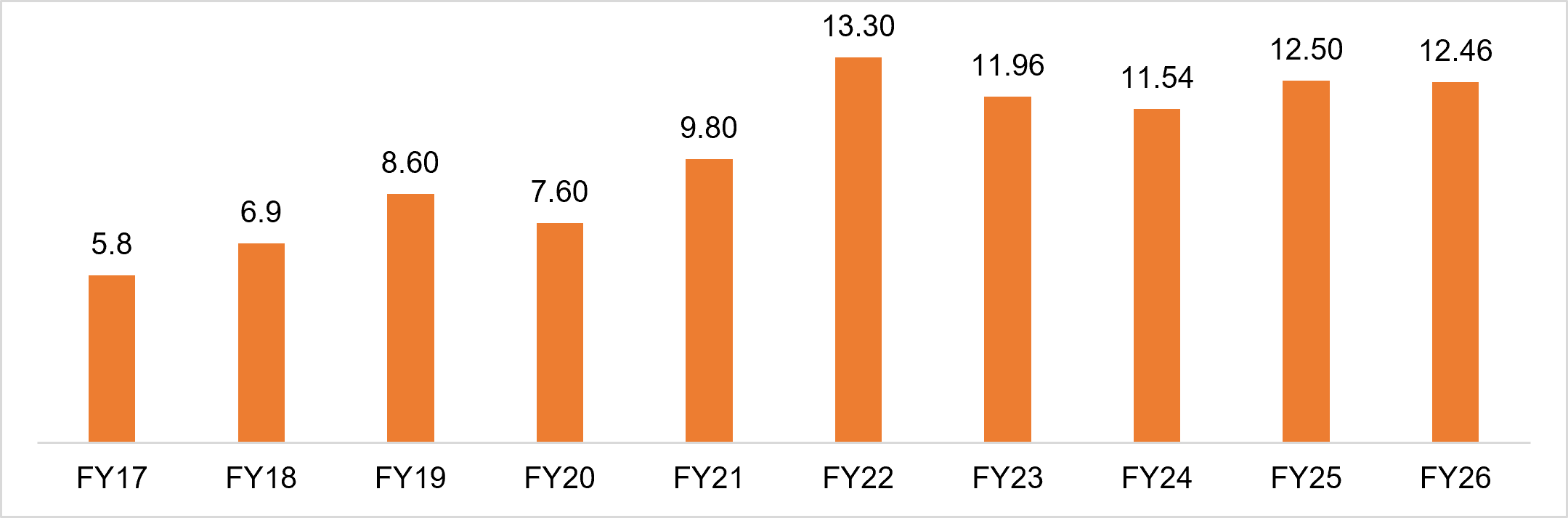
India’s plastics and allied products exports (US$ billion)
Source: DGCI&S, PLEXCONCIL
India’s plastics exports remained broadly stable during FY26, with total exports valued at US$ 12,468.7 million compared to US$ 12,501.0 million in FY25, reflecting a marginal decline of 0.3%. On a monthly basis, plastics exports stood at US$ 992.1 million in March 2026, compared to US$ 1,159.7 million in March 2025. In terms of product composition, plastic raw materials continued to be the largest export segment at US$ 2,894.9 million, followed by plastic films and sheets (US$ 1,888.2 million) and FIBC, woven sacks, woven fabrics and tarpaulin (US$ 1,772.4 million). Other major export categories included human hair and related products (US$ 942.8 million), miscellaneous plastic products (US$ 903.4 million) and consumer and houseware products (US$ 872.6 million), highlighting the diversified nature of India’s plastics export basket.
Category-wise performance was mixed during FY26. Miscellaneous plastic products recorded the highest growth at 31.7%, followed by human hair and related products (19.1%), FIBC, woven sacks, woven fabrics and tarpaulin (12.7%), and consumer and houseware products (10.4%). On the other hand, plastic raw materials declined by 9.8%, floor coverings, leathercloth and laminates by 12.2%, writing instruments and stationery by 11.9%, cordage, fishnets and monofilaments by 9.0%, and plastic films and sheets by 6.9%. Overall, the sector demonstrated resilience despite subdued global demand conditions, supported by strong growth in several value-added product categories.
Export Destinations
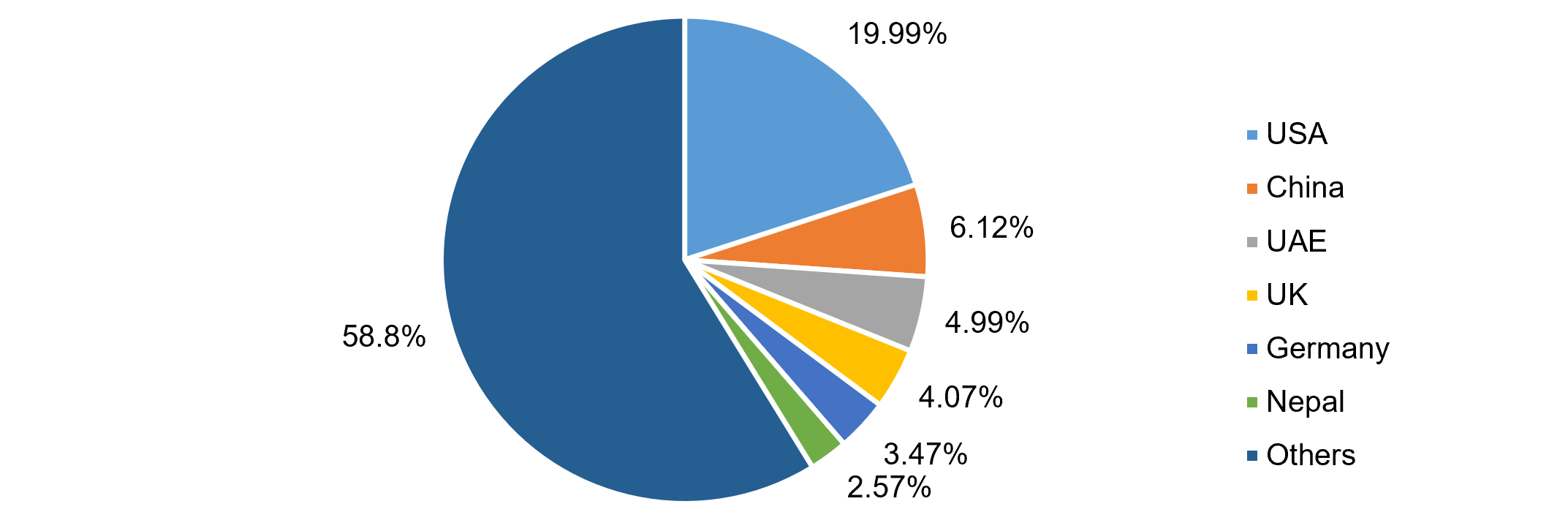
India’s plastics exports are well diversified across global markets, with a strong concentration in a few key destinations. In FY2024–25, total exports stood at US$ 12,500.69 million, with the USA emerging as the largest importer, accounting for US$ 2,499.51 million (20.00%) of total exports. This was followed by China (US$ 764.67 million; 6.12%) and the UAE (US$ 623.45 million; 4.99%), highlighting the importance of both developed and emerging markets in India’s plastics export basket. Other major destinations included the UK (US$ 508.73 million; 4.07%) and Germany (US$ 433.78 million; 3.47%), indicating steady demand from European economies. Additional key markets included Nepal (US$ 321.02 million; 2.57%), Bangladesh (US$ 298.00 million; 2.38%), and Saudi Arabia (US$ 289.82 million; 2.32%), reflecting strong regional trade linkages in Asia and the Middle East.
Country-wise share in exports of plastic products during FY25
Source: PLEXCONCIL, Commerce Dashboard
Countries such as Italy (2.17%), Netherlands (2.06%), Vietnam (1.96%), Spain (1.88%), and France (1.87%) also contributed notable shares, while markets including Belgium, Myanmar, Brazil, Canada, Mexico, South Africa, and Australia each accounted for around 1–1.7% of total exports. The ‘Others’ category accounted for 33.47%, highlighting the wide geographic spread of India’s plastics exports across smaller markets. Overall, the export destination profile reflects a balanced mix of high-volume markets and diversified global reach, supporting resilience in export performance.
Government Initiatives
India’s plastics export sector continues to show strong and growth, supported by government initiatives and industry efforts. Plastics exports have expanded significantly from just US$ 16.5 million at inception to over US$ 12.5 billion, reaching more than 200 countries, reflecting India’s emergence as a reliable global sourcing hub. During April-September 2025, exports rose to US$ 6.4 billion, registering steady growth over the previous year. The government has played a key role by promoting quality manufacturing, expanding Free Trade Agreements (FTAs), and supporting exporters through institutions like PLEXCONCIL, which provides market intelligence, trade facilitation, and capacity-building initiatives. Additionally, policy focus on sustainability such as encouraging recycling, reuse, and circular economy practices along with the ‘Make in India’ push, is further strengthening the sector’s global competitiveness and long-term export potential.
The Plastic Export Promotion Council (PLEXCONCIL) has set a target to increase the plastic exports of the country to US$ 25 billion by 2027. There are multiple plastic parks that are being set up in the country in a phased manner that will help improve the plastic manufacturing outputs of the country. Under the plastic park schemes, the Government of India provides funds of up to 50% of the project costs or a ceiling cost of Rs. 40 crore (US$ 5 million) per project.
Government initiatives like “Digital India”, “Make in India”, and “Skill India” will also boost India’s Plastic industry. For instance, under the “Digital India” program, the government aims to reduce the import dependence on products from other countries, which will lift the local plastic part manufacturers.
The government also launched a program for building Centres of Excellence (CoEs) to develop the existing petrochemical technology and promote the research environment pertaining to the sector in the country. This will aid in promoting and developing new applications of polymers and plastics in the country. Additionally, about 23 Central Institute of Plastics Engineering & Technology (CIPET) have been approved to accelerate financial and technological collaboration for promoting skills in the chemicals and petrochemicals sector.
Governing Body
The Plastic Export Promotion Council (PLEXCONCIL)
The Plastics Export Promotion Council (PLEXCONCIL), established in 1955 under the Ministry of Commerce & Industry, Government of India, is the apex body promoting India’s plastics exports. It is a non-profit organization representing over 2,500 exporters across the plastics value chain, covering products ranging from plastic raw materials to semi-finished and finished goods. The council works to enhance global market access through trade promotion activities, policy support, market intelligence, and capacity-building initiatives, while positioning India as a reliable and competitive supplier of plastic products worldwide.


Crystal Tower, Ground Floor
Gundivali Road No. 3
Off Sir M. V. Road
Andheri (E)
Mumbai - 400069
Maharashtra
India
Tel.:+91-22-2683 3951/ 52
Fax: +91-22-2683 3953/ 4057
Email: office@plexconcil.gov.in
Website: www.plexconcil.org
Partners