Introduction
The textile industry of India is one of the top contributors to the country's economy. The Man-made Fiber (MMF) industry contributes 16% of India's textile exports, and the country is the world's sixth-largest exporter of MMF textiles. MMFs are generally of two types - synthetic and cellulosic. Cellulosic fibers are made from wood pulp, and synthetic fibers are made from crude oil. The key types of synthetic fiber are polyester, acrylic, and polypropylene. The manufacturing cost of textiles is among the lowest in the world, making it a popular destination for investment. The Indian textile industry expects India’s exports of man-made fiber (MMF) textiles to increase by 75% to reach US$ 11.4 billion in 2030.
The MMF industry in India has been growing rapidly. The country ranks second in the production of cellulose fiber/yarn and third in synthetic fiber production worldwide.
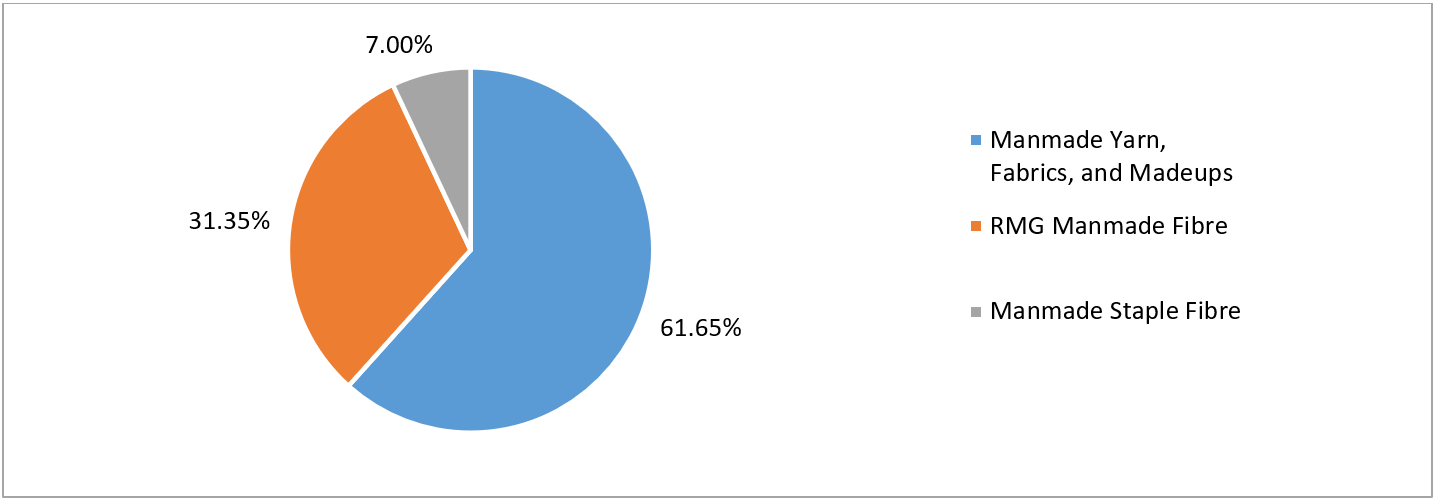
Segment-wise share of India's MMF textile exports FY27*
Source: The Synthetic and Rayon Textile Export Promotion Council (SRTEPC),
FY27* include April-June 2026
As of date, India produces all types of synthetic fibers. India produces fiber, yarn, fabrics, made ups, and home textiles. The MMF fabrics hold a majority share in the segment exports, followed by made ups and yarn. India is completely self-dependent across the value chain, from raw materials to garments. The industry constitutes of two types-polyester and viscose which account for ~94% (in volume terms). In this, polyester accounts for around 77.5%, and viscose has the remaining share. During FY27 (April-June 2026), Manmade Yarn, Fabrics, and Made-ups dominated exports with a 61.65% share, followed by RMG Manmade Fibre at 31.35%. In comparison, Manmade Staple Fibre accounted for a relatively smaller share of 7.00%.
Export Trend
India's Manmade Fiber Textiles Exports Trend (US$ billion)
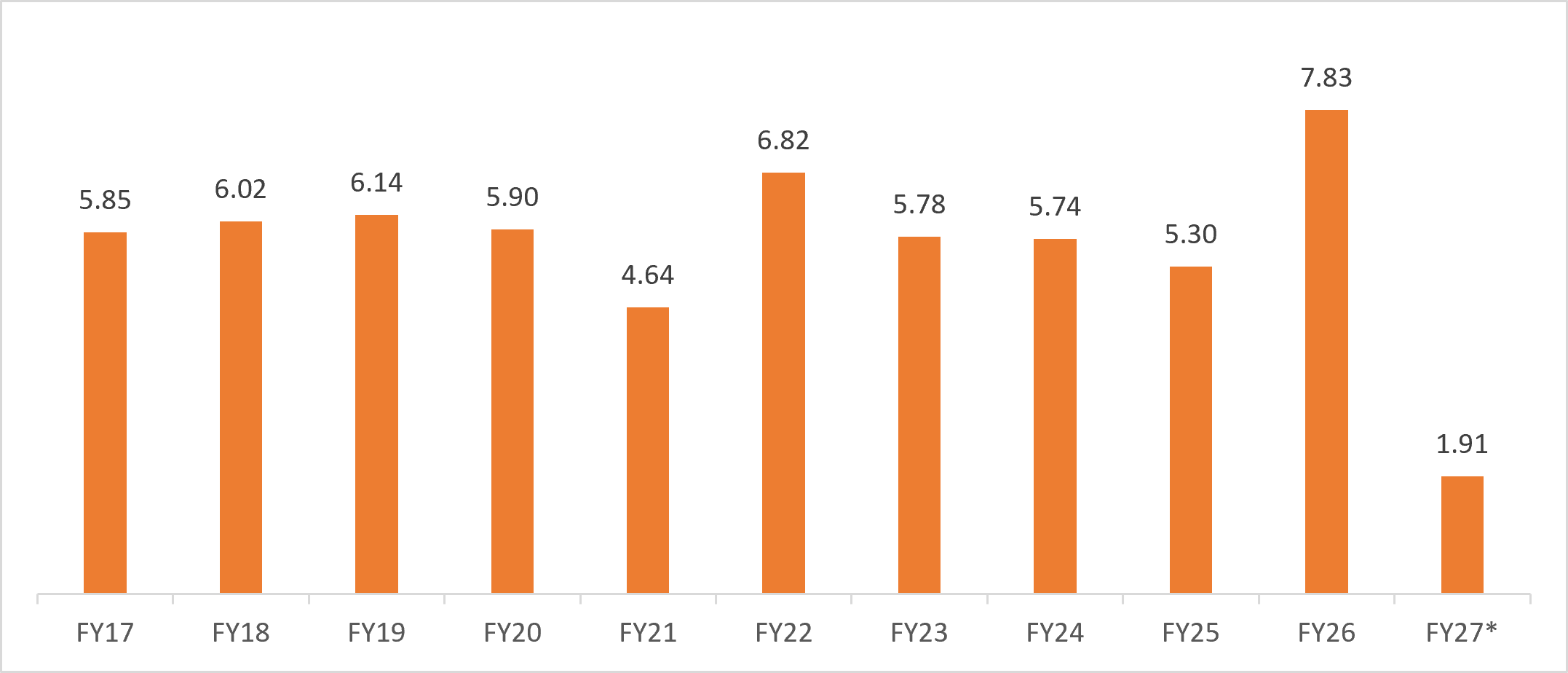
Source: Ministry of Commerce, FY27* April-June 2026
India exports polyester, viscose, and other types of fibers, polyester yarns, spun filaments, rope, blankets, bed linen, fishing nets, motifs, and furnishing articles. India’s exports of manmade textiles during April-June FY27 reached US$ 1.91 billion, reflecting a diversified product mix led by value-added segments. Among product categories, manmade yarn, fabrics, and made-ups dominated exports with a 61.65% share, followed by RMG manmade fibres at 33.15%, while manmade staple fibre accounted for a relatively smaller share of 7.00%.
The export structure indicates a clear shift toward higher value-added downstream products, particularly fabrics and made-ups, which continue to drive overall export performance. Readymade garments of manmade fibres also maintain a strong position, highlighting sustained global demand for synthetic apparel. In contrast, exports of raw materials such as staple fibre remain limited, reinforcing India’s positioning as a value-added exporter rather than a raw material supplier in the manmade textile segment.
The demand for MMFs will be further boosted by factors like evolving consumer trends, including a growing focus on fitness and hygiene, rising brand consciousness, rapidly changing fashion trends, and increasing women's participation in the workforce. These trends will work positively for the Indian synthetic and rayon textiles industry.
Export Destinations
The USA remained the largest destination for India’s man-made textile exports in FY27 (April-June 2026), with exports valued at US$ 350.8 million, accounting for 18.3% of total exports. Turkey ranked second with exports of US$ 112.4 million, followed by the UK at US$ 109.2 million. The UAE (US$ 97.5 million) and Spain (US$ 83.7 million) completed the top five export destinations, reflecting strong demand for Indian man-made textile products across North America, Europe and the Middle East.
Other significant export markets included Germany (US$ 81.8 million), Bangladesh (US$ 71.0 million), the Netherlands (US$ 56.1 million), Italy (US$ 53.2 million) and Brazil (US$ 52.1 million). The broad distribution of exports across these markets highlights the diverse global demand for India’s man-made textile products, spanning man-made staple fibre, man-made yarn, fabrics and made-ups, and ready-made garments made from man-made fibres.
Country-wise share of India's MMF products exports (FY27*)
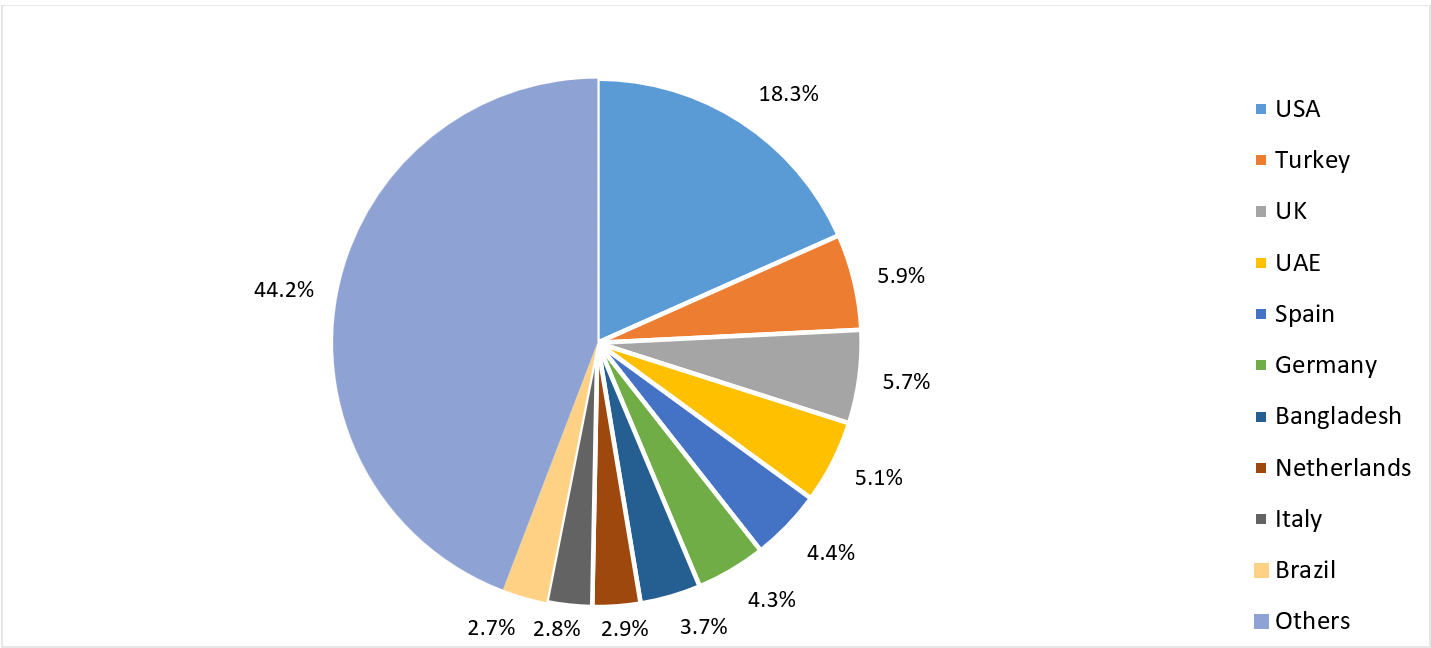
Source: Man-made and Technical Textiles Export Promotion Council (MATEXIL), FY27* April-June 2026
Government Initiatives
The Synthetic and Rayon Textile Export Promotion Council of India provides financial assistance to exporters under the Market Development Assistance (MDA) Scheme. Under the Market Access Initiative (MAI), financial aid is provided to the exporters for marketing, capacity building, research, and project development.
Export Promotion Programmes
The Government is doing its best to promote the exports of MMF textiles through benefits and incentives. To promote exports to international markets, CCEA launched a scheme (in January 2021) for the Remission of Duties and Taxes on Exported Products (RoDTEP). This would make the exported products cost-competitive in global markets and generate better employment prospects in export-oriented manufacturing industries.
Efforts to support the industry
India has withdrawn the anti-dumping duty on Purified Terephthalic Acid (PTA), the primary raw material for manufacturing man-made fiber and yarn. India has also abolished the anti-dumping duty on viscose staple fibers and key raw materials for man-made fiber.
PLI Scheme for Textiles is another step (launched in 2021) taken by the Government to bolster the MMF industry. It specifically focuses on expanding the textiles value chain's MMF and technical textiles segments. Incentives worth Rs. 10,683 crore (US$ 1.34 billion) will be offered over five years for manufacturing notified products of MMF fabrics and MMF apparel.
Under the Production Linked Incentive (PLI) Scheme for Textiles, the Government has approved 170 companies across various states. As of March 31, 2026, these companies had made actual investments of Rs. 8,117.64 crore (US$ 918.91 million) and generated 33,427 new jobs.
Among the states, Gujarat accounted for the highest number of approved companies at 46, followed by Maharashtra (24) and Madhya Pradesh (22). In terms of actual investment, Gujarat led with Rs. 1,903.38 crore (US$ 215.46 million), followed by Karnataka at Rs. 1,515.99 crore (US$ 171.55 million) and Goa at Rs. 1,355.87 crore (US$ 153.43 million). Tamil Nadu recorded the highest employment generation at 7,930 jobs, followed by Karnataka (5,611 jobs) and Madhya Pradesh (4,970 jobs).
Governing Body
Man-made and Technical Textiles Export Promotion Council (MATEXIL)
Formed in 1954, the Man-made and Technical Textiles Export Promotion Council (MATEXIL) formerly known as The Synthetic and Rayon Textiles Export Promotion Council (SRTEPC) is one of India's oldest export promotion councils. The main roles of the council are to inculcate export culture and promote the exporters of Indian manmade fiber and textiles. The services of SRTEPC are to introduce buyers to exporters, information dissemination, undertake export promotion programs, conduct market studies, provide financial subsidies, create and maintain data banks, and advise the government. The council provides various services to Indian exporters such as introducing exporters to appropriate overseas buyers, providing the latest information & market entry service by sponsoring delegations, conducting market studies and surveys, etc.
FAQs
Man-made yarn, fabrics, and made-ups account for the largest share of India's man-made fibre (MMF) textile exports, followed by readymade garments made from man-made fibres. During April–June FY2027, yarn, fabrics, and made-ups accounted for 61.65% of exports, while readymade garments contributed 31.35%.
The man-made fibre (MMF) industry contributes 16% of India's textile exports, making India the world's sixth-largest exporter of MMF textiles. Exports of man-made textiles reached US$ 7.83 billion in FY2026, supported by demand for value-added fabrics, made-ups, and garments.
The USA was India's largest market for man-made textile exports in FY2026, accounting for US$ 1.45 billion (18.5%), followed by the UAE at US$ 614.8 million (7.9%) and the UK at US$ 437.1 million (5.6%). Germany and Spain were other major export destinations.
The Production Linked Incentive (PLI) Scheme for Textiles supports the expansion of India's man-made fibre (MMF) and technical textiles segments. By encouraging manufacturing investments and strengthening the textile value chain, the scheme aims to enhance domestic production capabilities and export potential.
Gujarat, Maharashtra, and Madhya Pradesh are among the states with the highest numbers of companies approved under the PLI Scheme for Textiles, with 46, 24, and 22 companies, respectively. Gujarat, Karnataka, and Goa recorded the highest actual investments under the scheme.
India's MMF textile exports are increasingly driven by value-added products, including fabrics, made-ups, and readymade garments, rather than raw materials. The country's self-sufficiency across the value chain, from raw materials to garments, supports its competitiveness in international markets.
Government initiatives such as the Remission of Duties and Taxes on Exported Products (RoDTEP), Market Development Assistance (MDA), and Market Access Initiative (MAI) support export competitiveness and market expansion. The PLI Scheme for Textiles provides incentives worth Rs. 10,683 crore (US$ 1.34 billion) over five years for eligible MMF fabrics and apparel manufacturing.
India produces a wide range of synthetic fibres, including polyester, acrylic, and polypropylene, alongside cellulosic fibres such as viscose. Investments under the PLI Scheme for Textiles support the expansion of MMF and technical textile manufacturing capabilities, strengthening the industry's production base.
Demand for man-made fibre textiles is supported by evolving consumer preferences, including growing interest in fitness and hygiene, rising brand consciousness, rapidly changing fashion trends, and increasing women's workforce participation. These trends are creating opportunities for synthetic apparel and other MMF textile products.
India's man-made fibre textile exports are expected to increase by 75% to reach US$ 11.4 billion by 2030. Growth opportunities are supported by expanding value-added manufacturing, rising global demand for synthetic apparel, and government incentives for MMF and technical textile production.
RELATED SITES

1 - Resham Bhavan
78, Veer Nariman Road
Mumbai - 400020
Maharashtra
India
Tel.:+91-22-22048797/22048690
Fax: +91-22-22048358
Email: srtepc@vsnl.com
Website: www.srtepc.org
Partners