India could see a record equity supply of Rs. 2-3 trillion in FY22: Jefferies
- IBEF
- June 2, 2021
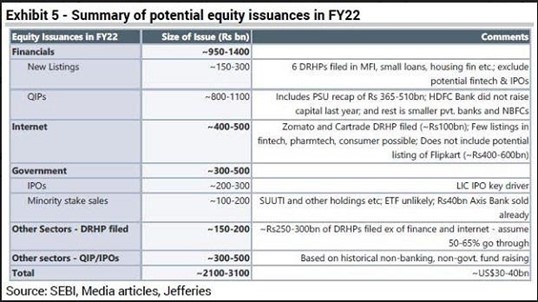
According to Jefferies, equity markets in India are experiencing good growth and the equity supply is expected to reach Rs. 2-3 trillion (US$ 30-40 billion) in FY22 with 40% of the supply raised through IPOs (initial public offers). The institutional flows would drive corporate equity supply and is expected to attract new investors.
In a co-authored report written by Mr. Mahesh Nandurkar, Managing Director at Jefferies and Mr. Abhinav Sinha, “Nearly 1% of market-cap is attributable to traditionally large financial issuers, government's disinvestment program and India's internet sector. Our assessment recommends that in the past the net equity supply has exceeded 1% in robust bull markets. Similarly, it is estimated that net / gross equity issuance can record ~US$ 30-40 billion in FY22.”
According to Jefferies, in FY21, the net equity supply was at US$ 24 billion, highest in three years.
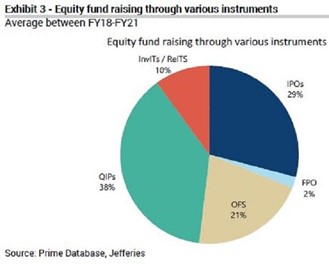
Over the past decade, the IPOs contributed ~ 27% to raising equity fund. This trend is expected to change considering the maturing internet space in India and expected listing of Paytm and Zomato in FY22.
Other players such as PolicyBazaar, online insurance firm in India is also planning for an IPO and is expected to raise funds worth Rs. 4,000 crore (US$ 551.65 million) via an IPO. Also, Zomato has already recorded its DRHP (draft red herring prospectus) with the SEBI (Securities and Exchange Board of India) and is expected to raise Rs. 8,250 crore, ( > US$ 1.1 billion) via the IPO route. Mr. Shobit Singhal of Anand Rathi, said, “The part of raised funds would be leveraged for inorganic and organic growth. And remaining amount would be used for corporate and other objectives. The IPO will be a test drive of Indian investors’ enthusiasm for unicorns.”
By end-2021, Paytm intends to raise US$ 3 billion (~ Rs. 22,000 crore). On completion, the raised IPO is expected to be the biggest IPO by an Indian firm, surpassing Coal India’s record of Rs. 15,475 crore (US$ 2.13 billion) in 2010.
Financial sector
According to Jefferies, between FY18-21, the financial sector was the leading equity raiser, attributing ~ 47-62% of the total equity supply. Other sectors are also there who contribute to the equity supply. Key sector are real estate, infrastructure, etc. However, Jefferies believes, a few of these could be subject to renewing / capex-cycle uptick in progress.
Mr. Nandurkar and Mr. Sinha said, “Fund raising by financial sector is expected to increase to US$ 13-20 billion with state-owned banks contributions at US$5-7 billion, large private banks at US$3-4 billion and US$ 3-4 billion contribution from smaller private banks / non-bank finance companies, or NBFCs. Further, US$ 2-4 billion is expected to be raised by new listings of some insurance-related firms, small finance banks, microfinance firms.”
The next issuance amount is expected through the government's divestment agenda of Rs. 1.75 trillion (US$ 24.13 billion) in FY22 that appears to reduce stakes in potential players such as Air India, Bharat Petroleum Corporation Limited (BPCL), and Life Insurance Corporation of India (LIC).
According to Jefferies, "Along with minority exits or few other stake sales (e.g., sale of Axis Bank stake worth Rs. 40 billion (US$ 551.65million)), disinvestment is expected to contribute US$ 4-7 billion to the equity supply.”
Disclaimer: This information has been collected through secondary research and IBEF is not responsible for any errors in the same.
Partners