SEARCH
RECENT POSTS
Categories
- Agriculture (39)
- Automobiles (21)
- Banking and Financial services (36)
- Consumer Markets (57)
- Defence (6)
- Ecommerce (21)
- Economy (72)
- Education (14)
- Engineering (9)
- Exports (22)
- Healthcare (25)
- India Inc. (10)
- Infrastructure (31)
- Manufacturing (33)
- Media and Entertainment (17)
- Micro, Small & Medium Enterprises (MSMEs) (16)
- Miscellaneous (31)
- Perspectives from India (37)
- Pharmaceuticals (5)
- Railways (5)
- Real Estate (20)
- Renewable Energy (19)
- Research and Development (12)
- Retail (1)
- Services (7)
- Startups (16)
- Technology (66)
- Textiles (8)
- Tourism (16)
- Trade (9)
Authors






Handicraft in India Rising Through Digital Expansion and Global Demand
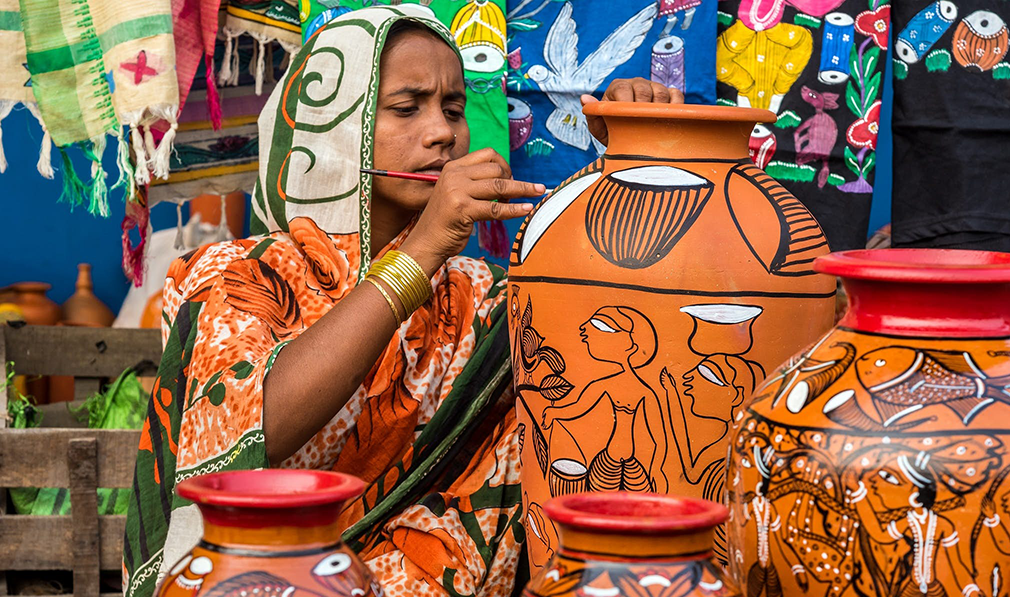
India’s handicraft sector represents a powerful blend of economic livelihood, cultural heritage and export potential. Deeply embedded in rural and semi-urban regions, the sector supports millions of artisans while preserving centuries-old craft traditions. In recent years, Indian handicrafts have witnessed renewed momentum, driven by rising global demand for handmade and sustainable products, increased digital adoption, and sustained government support aimed at formalisation, skill development and market access.
With 318 GI-tagged handicraft products and around 455 formally classified craft categories, India’s handicraft landscape reflects exceptional regional diversity. Traditionally characterised by decentralised, small-scale and home-based production, the sector is now transitioning towards wider market integration. Digital platforms, export facilitation and cluster-based development are enabling artisans to reach national and international buyers directly, improving income stability and long-term sustainability. With rising awareness of ethical and sustainable consumption, these crafts are increasingly being recognized as a symbol of India’s soft power and creative economy.
Industry Scale and Market Outlook

As per IMARC Group, the handicrafts market in India accounted for Rs. 40,500 crore (US$ 4.56 billion) in 2024 and is projected to reach Rs. 72,900 crore (US$ 8.19 billion) by 2033, with a compound annual growth rate (CAGR) of 6.39% during the period of 2025-2033. The market growth in India is driven by significant improvements in the accessibility of handicraft products on various online platforms. Additionally, the surge in travel and tourism within the country is driving a notable increase in the popularity of handicrafts. Tourists are increasingly investing in souvenirs and other crafted items, thereby creating opportunities for local artisans and craftsmen to develop and market their high-quality handicrafts efficiently. Furthermore, the integration of digital payment systems and logistics solutions has also made it easier for artisans to reach national and international markets, boosting both sales and visibility.
As of August 2025, India had an estimated 64.66 lakh handloom and handicraft artisans, with significant concentration in states such as Uttar Pradesh, Rajasthan, Assam, Odisha, West Bengal and Tamil Nadu. The sector demonstrates strong gender inclusion, with women accounting for 71% of handloom weavers and 64% of total artisans, underlining its importance for women’s economic participation.
Export Performance and Global Demand
India is among the world’s important suppliers of handicraft products, benefitting from a wide product base and skilled artisan workforce. Despite global trade uncertainties, India’s handicraft exports have shown robust long-term growth. In FY25, exports of handicrafts (excluding hand-knotted carpets) reached Rs. 33,122.79 crore (US$ 3.72 billion).
Key export categories during FY25 included woodwares Rs. 8,524 crore (US$ 958 million), embroidered and crocheted goods Rs. 4,350 crore (US$ 488 million), art metal wares Rs. 4,386 crore (US$ 492 million), handprinted textiles Rs. 3,217 crore (US$ 361 million) and imitation jewellery Rs. 1,511 crore (US$ 170 million). The United States accounted for around 37% of exports, while 61% were shipped to other major international markets, highlighting diversified global reach.
From Physical Markets to Digital Platforms

Policy and Institutional Support
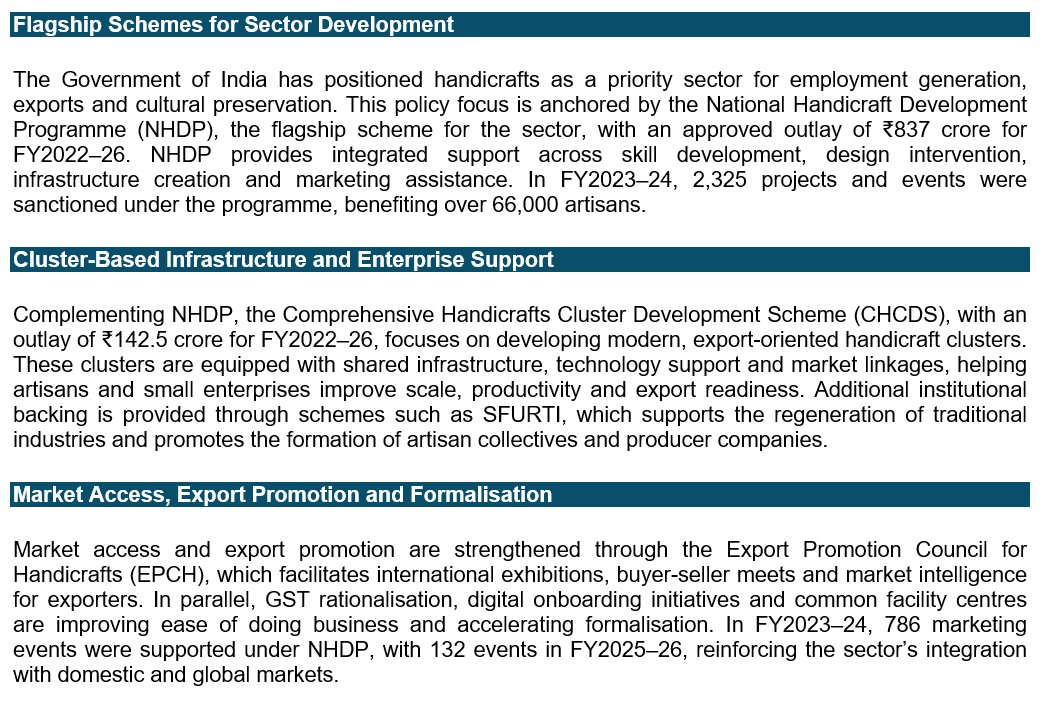
The Government of India has consistently recognised handicrafts as a priority sector for employment, exports, and cultural preservation.
The Road Ahead
India’s handicrafts industry stands at a pivotal juncture. The convergence of digital platforms, supportive government policy, and rising global demand for handmade and sustainable products offers a strong growth pathway. Over the coming years, deeper integration with e-commerce, greater focus on design innovation, cluster-based infrastructure development, and improved logistics connectivity are expected to enhance the sector’s competitiveness. With continued institutional support and responsible market expansion, Indian handicrafts can strengthen their position not only as cultural artefacts but as globally competitive lifestyle products.
FAQs
Why is India’s handicrafts sector gaining renewed global attention?
India’s handicrafts sector is benefiting from rising global demand for handmade, ethical and sustainable products, supported by its diverse craft base, skilled artisans and expanding digital and export channels.
How are digital platforms transforming the handicrafts industry in India?
Digital platforms enable artisans to access national and international markets directly, improve price realisation through D2C models, build brand identity and reduce dependence on intermediaries.
What is the current size and growth outlook of India’s handicrafts market?
As per IMARC Group, the handicrafts market in India accounted for Rs. 40,500 crore (US$ 4.56 billion) in 2024 and is projected to reach Rs. 72,900 crore (US$ 8.19 billion) by 2033, with a compound annual growth rate (CAGR) of 6.39% during the period of 2025-2033.
Which countries are the major export destinations for Indian handicrafts?
The United States is the largest export market, accounting for around 37% of exports, followed by Europe and other major global markets, reflecting India’s diversified international reach.
How does government policy support artisans and exporters?
Government schemes such as NHDP, CHCDS and SFURTI, along with export promotion through EPCH, focus on skill development, cluster infrastructure, market access and sector formalisation to improve artisan incomes and competitiveness.
Partners