SEARCH
RECENT POSTS
Categories
- Agriculture (37)
- Automobiles (20)
- Banking and Financial services (36)
- Consumer Markets (57)
- Defence (6)
- Ecommerce (21)
- Economy (72)
- Education (14)
- Engineering (9)
- Exports (22)
- Healthcare (25)
- India Inc. (10)
- Infrastructure (31)
- Manufacturing (32)
- Media and Entertainment (16)
- Micro, Small & Medium Enterprises (MSMEs) (16)
- Miscellaneous (31)
- Perspectives from India (37)
- Pharmaceuticals (5)
- Railways (4)
- Real Estate (20)
- Renewable Energy (19)
- Research and Development (12)
- Retail (1)
- Services (7)
- Startups (16)
- Technology (66)
- Textiles (8)
- Tourism (16)
- Trade (9)
Authors






How AI and Smart Classrooms are Changing the Education System in India
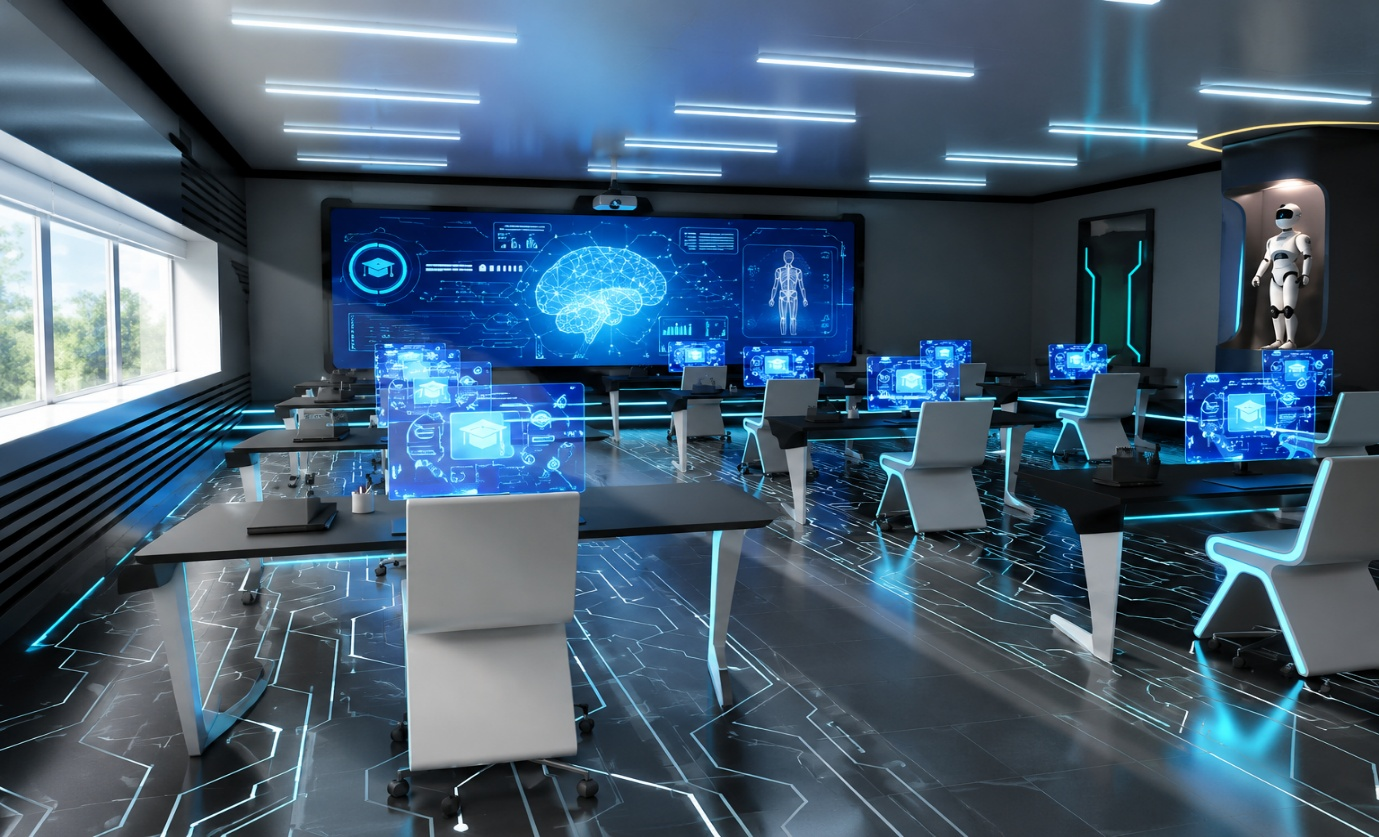
Education serves as an important pillar in the socio-economic development of India, contributing to the formation of human capital, innovations, and economic growth. Being one of the biggest education systems of the world, India made considerable progress in ensuring the access of people to quality education in various spheres of education – schools, higher education, and skill development. Education sector helps in forming a future-oriented skilled labor force and supports the goal of the country to become a developed nation until 2047. As per UDISE+ 2024-25, the school education system of India includes 14.71 lakh schools that educate 24.69 crore students, having more than one crore teachers. Along with the development of educational sector, the government makes great efforts to improve learning outcomes, digital accessibility, and employability. The National Education Policy (NEP) 2020 serves as a transforming tool that promotes multidisciplinary learning, flexibility, digitization, and skill-based education. Being accompanied by other initiatives such as PM SHRI, Samagra Shiksha, DIKSHA, and Skill India, the reforms help in creating the strong education sector and increasing the access to education opportunities. Due to the rapid technology adoption and changing industry needs, the Indian education sector is able to contribute to the innovations, productivity, and sustainable economic growth.
India's Education Landscape
The Indian education sector has achieved considerable success over the last decade because of the implemented reforms, developed infrastructure, and focus on the improvement of learning outcomes. As reported in the NITI Aayog report published in May 2026, the school education system of India consists of 14.71 lakh schools that educate over 24.69 crore students, which makes the Indian education system one of the biggest worldwide. Based on the data provided by UDISE+ 2024-25, PARAKH Rashtriya Sarvekshan 2024 and ASER 2024, the report indicates that there were some improvements in such areas as access, infrastructure, equity, inclusiveness, and digital integration. There are considerable improvements regarding the access to such services as electricity and functional sanitation in the schools as well as inclusive infrastructure. The increased number of digital learning materials, which includes internet access, computers, and smart classrooms, makes the learning process even better. Moreover, the report indicates such encouraging trends as the increased educational inclusiveness, where there is greater engagement of girls and increased enrolment of SC/ST students. Furthermore, learning outcomes have demonstrated recovery after the pandemic due to the introduction of such initiatives as NEP 2020, NIPUN Bharat Mission and Samagra Shiksha.
Source: PIB
National Education Policy (NEP) 2020: Reshaping Learning Outcomes
National Education Policy (NEP) 2020 can be described as a game-changing policy aimed at modernising India's education system according to changing requirements of the 21st century's economy. NEP 2020 will change the nature of learning outcomes through flexibility and promotion of multidisciplinary education, skill development and technology.
- First, NEP 2020 provides for multidisciplinary and holistic learning when the student can take courses in different subjects regardless of his or her academic stream. NEP 2020 also promotes vocational training from an early age to provide the learner with practical skills and enhance his or her chances of finding a job.
- Second, NEP 2020 proposes vocational training, internships and other types of learning that will help the learner acquire relevant skills in demand.
- Third, technology plays an important role in NEP 2020. The policy envisages increased use of digital platforms such as DIKSHA, SWAYAM and SWAYAM Prabha. NEP 2020 also proposes creating the National Educational Technology Forum (NETF), which will assist in efficient integration of artificial intelligence, machine learning, virtual learning platforms and other emerging technologies in the education sector.
- Fourth, NEP 2020 promotes development of foundational literacy and numeracy, teacher development and provision of better access to education. The initiatives include NIPUN Bharat and digital learning programme implemented under NEP 2020.
Digital Transformation of Education
Education ecosystem in India is undergoing transformation driven by policies, technology and public investments in school education, higher education and vocational training. According to a NITI Aayog report published in May 2026, India's school education sector includes 14.71 lakh schools and 24.69 crore learners. Based on the data provided by UDISE+, PARAKH Rashtriya Sarvekshan 2024, NAS and ASER, the report describes changes in access, infrastructure, inclusion, digitalisation and learning outcomes brought about by technology.
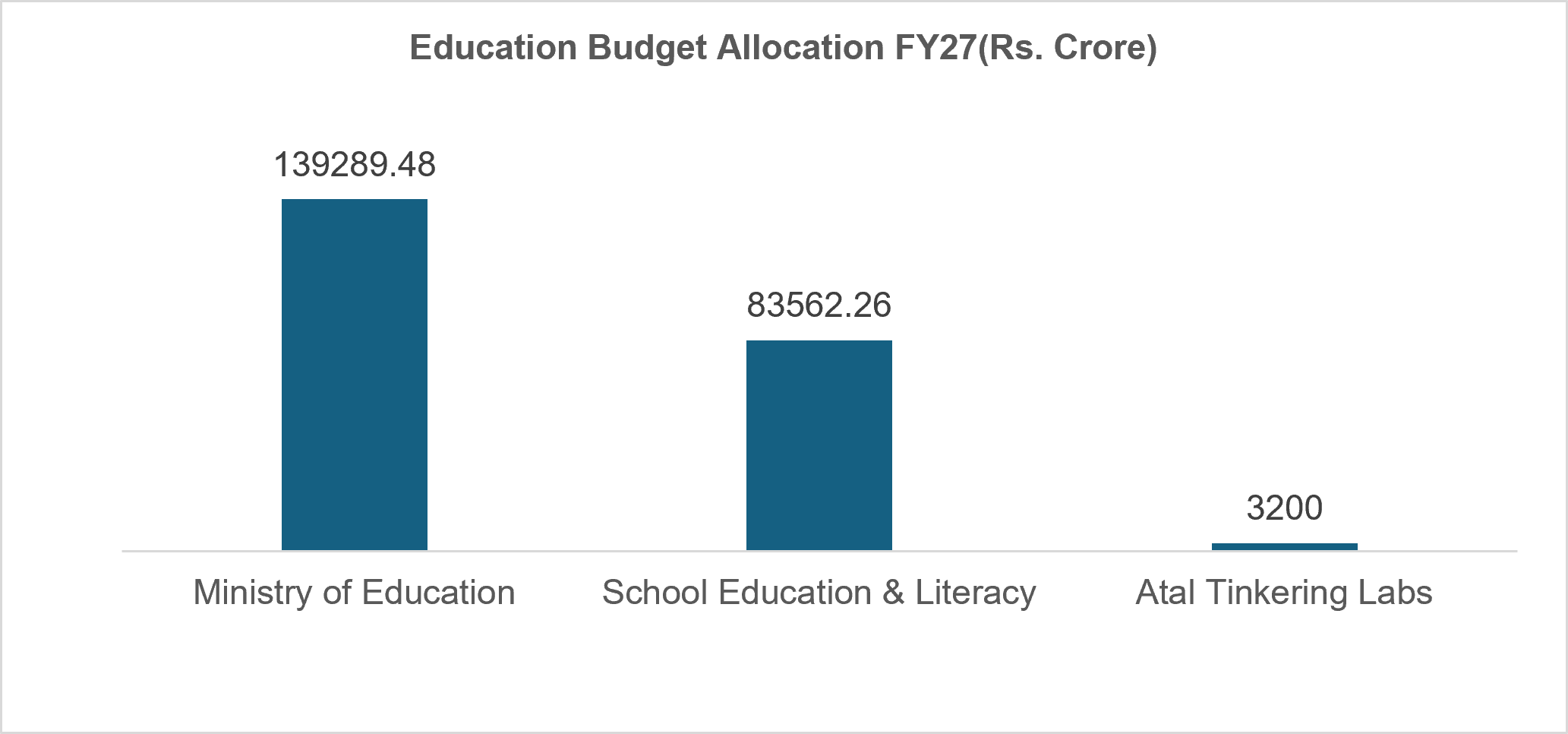
The Union Budget 2026-27 continued to contribute to the transformation. The Ministry of Education was allocated Rs. 1,39,289.48 crore (US$ 14.60 billion). Additionally, the Department of School Education and Literacy was allocated Rs. 83,562.26 crore (US$ 8.76 billion), which was its highest ever budget allocation. The Budget further called for the establishment of a High-Powered 'Education to Employment and Enterprise' Standing Committee to study the effect of artificial intelligence on employment and skill requirements and propose a way forward to incorporate artificial intelligence into education at all levels. Also, an amount of Rs. 3,200 crore (US$ 335.36 million) has been set aside for setting up of Atal Tinkering Labs. Meanwhile, 15,000 secondary schools and 500 colleges have been identified to establish AVGC Content Creator Labs for promoting digital skills through creativity.
Artificial intelligence is shaping up to be an important factor in promoting educational innovations in India. Launched in March 2024, the IndiaAI Mission has an outlay of Rs. 10,372 crore (US$ 1.09 billion). This mission will aim to promote AI infrastructure development, indigenous AI models, and digital skilling. As per figures as on February 2026, over 38,000 GPUs have been onboarded and 12 teams have been shortlisted for the development of indigenous foundational models and Large Language Models (LLMs). India is also enhancing its international cooperation in the domain of education and innovation. In 2026, India and France launched the India-France Innovation Roadmap 2030 that would focus on artificial intelligence, research, start-ups, higher education, and emerging technologies.
Growth Drivers and Key Trends
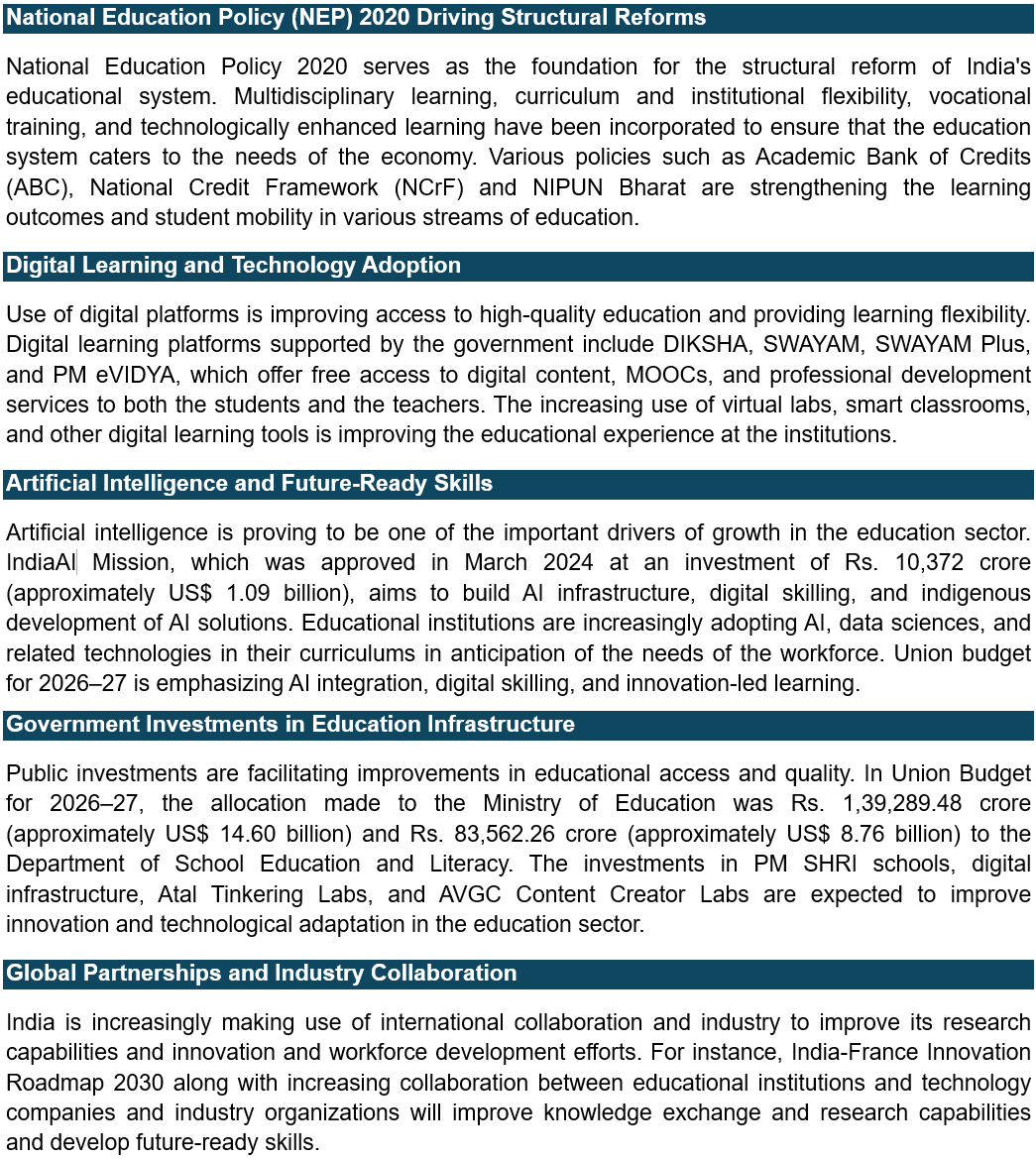
The following factors are driving rural digital transformation and accelerating connectivity across India’s villages.
Outlook and Road Ahead
The Indian education sector is currently experiencing significant transformation based on policy reforms, digitization, and focus on future skills. The NEP 2020 sets out a framework for a more flexible, multidisciplinary, and technology-enabled educational landscape, while efforts such as PM SHRI, NIPUN Bharat, DIKSHA, SWAYAM, and Academic Bank of Credits help in improving the accessibility, quality, and effectiveness of education at different levels. With Viksit Bharat 2047 in mind, India is expected to place greater focus on improving the quality of education, building better digital infrastructure, and aligning education to the needs of industries. The IndiaAI Mission, NDEAR, Skill India Digital Hub, and consistent support to research and innovation from the government are among the efforts that are likely to facilitate further transformation in the field of education. While dealing with challenges related to learning inequities, digital divide, and skill mismatches will be important going forward, efforts towards development of artificial intelligence solutions, development of digital learning platforms, teacher training programs, and partnerships between industries and academia will continue to improve the educational ecosystem. Going ahead, technology will shape the future of the workforce, and therefore, the Indian education sector is set to play a critical role in preparing a competent human capital for future.
FAQs
How is technology transforming India's education sector?
Technology is improving access, flexibility and learning outcomes across India's education ecosystem. Digital platforms such as DIKSHA, SWAYAM and SWAYAM Plus, along with emerging technologies such as artificial intelligence, are enabling personalised learning, digital assessments and greater access to educational resources.
What is the role of the National Education Policy (NEP) 2020 in education reform?
NEP 2020 aims to create a flexible, multidisciplinary and skill-oriented education system. The policy promotes vocational education, digital learning, academic mobility and the integration of emerging technologies to improve learning outcomes and workforce readiness.
What is the IndiaAI Mission and how does it support education
Approved in March 2024 with an outlay of US$ 1.09 billion (Rs. 10,372 crore), the IndiaAI Mission seeks to strengthen AI infrastructure, digital skilling and indigenous AI development. The initiative is expected to support AI-enabled learning, research and innovation across educational institutions.
Which government initiatives are supporting digital education in India?
Key initiatives include DIKSHA, SWAYAM, SWAYAM Plus, PM eVIDYA, NIPUN Bharat, PM SHRI Schools, the Academic Bank of Credits (ABC) and the National Digital Education Architecture (NDEAR). These programmes aim to improve educational access, quality and digital inclusion.
What are the major growth drivers for India's education sector?
The key growth drivers include the implementation of NEP 2020, increasing adoption of digital learning technologies, government investments in education infrastructure, AI-led innovation, industry-academia collaboration and international partnerships focused on research and skill development.
Partners