SEARCH
RECENT POSTS
Categories
- Agriculture (37)
- Automobiles (20)
- Banking and Financial services (35)
- Consumer Markets (57)
- Defence (6)
- Ecommerce (21)
- Economy (72)
- Education (14)
- Engineering (8)
- Exports (21)
- Healthcare (25)
- India Inc. (10)
- Infrastructure (31)
- Manufacturing (32)
- Media and Entertainment (16)
- Micro, Small & Medium Enterprises (MSMEs) (16)
- Miscellaneous (31)
- Perspectives from India (37)
- Pharmaceuticals (5)
- Railways (4)
- Real Estate (20)
- Renewable Energy (19)
- Research and Development (12)
- Retail (1)
- Services (7)
- Startups (16)
- Technology (66)
- Textiles (8)
- Tourism (16)
- Trade (8)
Authors






How Bharat Electronics Limited Strengthens India’s Defence Capabilities

- Jun 17, 2026, 11:10
- India Inc.
- IBEF
As India has progressed rapidly in adopting new technology, the national capacity to defend against threats from abroad has changed significantly. The electronics, data systems and automation that make up the foundation of a country's defence preparedness have also shifted significantly from traditional, hardware-based capabilities towards technologically integrated systems. Electronic warfare solutions, radar systems, secure encrypted communication systems and AI represent important technologies that support the addition of these newer capabilities.
BEL (Bharat Electronics Limited), a Navratna public sector enterprise under the Ministry of Defence, is involved in the design, development, and integration of electronic systems that enable the Indian defence forces to achieve operational objectives for land, air and sea operations.
As India pursues self-sustaining growth in its defence sector, BEL is one aspect of a larger trend toward the development of domestic operational capabilities and achieving a degree of technical self-sufficiency.
Significance: Defence Electronics as a Strategic Enabler
Modern defence systems increasingly depend on their electronic architecture to be effective. Surveillance systems, sensor networks, communication platforms, and electronic warfare capabilities work together to provide the ability for forces to detect, respond to and control threats more effectively.
India's defence readiness is improved using advanced air surveillance and situational awareness systems offered by BEL. Defence organisations will be able to locate and track potential targets faster, coordinate their actions better and accurately execute more complicated operations by integrating these systems.
In addition, the ability to develop these systems domestically rather than relying on foreign suppliers is strategic development as it enables customization based on operational needs. Therefore, there are two aspects to combat readiness - long-term readiness through indigenous production and maintaining technological capabilities in support of national security objectives.
Financial Overview
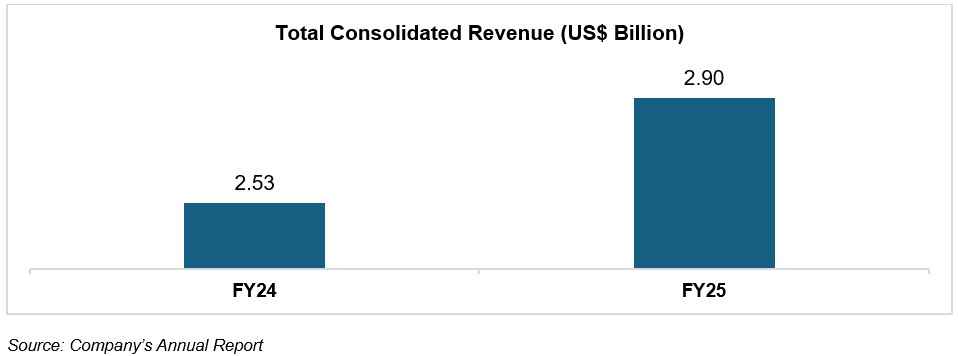
In the third quarter of the FY26, the company reported strong financial results, with operational revenues reported at US$ 791.33 million (Rs. 7,121.98 crore). Profitability remained robust during the quarter, with profit before tax (PBT) reaching US$ 238.63 million (Rs. 2,147.68 crore), while profit after tax (PAT) was recorded at US$ 176.67 million (Rs. 1,590.06 crore). Reflecting sustained business momentum and strong execution capabilities, the company’s order book as of January 1, 2026, stood at US$ 8.11 billion (Rs. 73,015 crore), providing healthy revenue visibility for the coming quarters.
Most of Bharat Electronics Limited's (BEL) FY25 revenue came from its core defence businesses as the defence business segment made up 89.75% of BEL's total revenue. This continues to show BEL's confidence in being positioned in India's defence electronics ecosystem and the company's continued alignment with the government's plans to indigenise the country and modernise our defence capabilities. The non-defence (civilian) business segment was only 5.75%, indicating that BEL is slowly diversifying its businesses to include civilian applications, to some extent, such as rail and metro systems, e-mobility, homeland security, and communication systems. Exports make up 3.87% of the overall revenue, which shows BEL's growing global footprint. This will give BEL a good opportunity to continue generating revenue from outside India, along with other revenue from other sources totalling only 0.63%.
The overall revenue from the sale of products made from manufacturing is 90.47% of overall revenue, which shows that the company's business model is still based on manufacturing-led growth, whereas revenue from the sale of services is 9.53% of total revenue, which suggests that BEL is starting to emphasise on maintenance, lifecycle support and upgrades and systems integration services. Overall, the way BEL generates its revenue profile is strong, as it shows the company has a solid operational base and has continued growth potential for both domestic and international markets.
Government Initiatives and Policy Support
The Indian government has implemented several policies such as the Atmanirbhar Bharat and Make in India initiatives to enhance indigenous defence production by encouraging domestic manufacturing, developing technology and collaborating with industry. On November 24, 2025, Bharat Electronics Limited, in partnership with Safran Electronic & Defence, signed a joint venture corporation agreement for the indigenous production of the HAMMER Smart Precision Guided Air-to-Guard Weapon in India, marking a significant milestone under the Government of India’s Aatmanirbhar Bharat and Make in India initiatives.
The activities pursued by BEL are consistent with the government's policy goals, particularly with respect to indigenous system designing and integrating.
A significant milestone in this context was the visit of Defence Minister Mr. Rajnath Singh to BEL’s Bengaluru facility on February 16, 2026. The visit highlighted several key developments:
- Inauguration of the Missile Integration Facility
- Flagging off, Akash 3rd and 4th Regiment Combat systems
- Unveiling of the Mountain Fire Control Radar
- Launch of BEL’s Artificial Intelligence Policy
- Remote inauguration of the Centre of Excellence for Artificial Intelligence (CoE-AI) in Pune
The event was attended by Shri Sanjeev Kumar, IAS, Secretary (Defence Production) and Shri A Anbarasu, Additional Secretary & DG (Acquisition), underlining the institutional importance of these developments.
BEL’s work is also aligned with major national defence programmes, including QRSAM, LCA Mk II, AMCA, Project Kusha and Counter Drone Systems.
Indigenous systems developed for various applications like air defence and counter-drone technologies have been used successfully in real life situations and have improved confidence in domestic capabilities, examples of successful use include Operation Sindoor.
These developments further illustrate that BEL's technologies are incorporated within operational systems, thereby improving combat effectiveness and reducing dependency on foreign-sourced solutions.
Growth Drivers and Key Trends
The following factors are shaping the trajectory of Bharat Electronics Limited’s contribution to India’s defence capabilities:
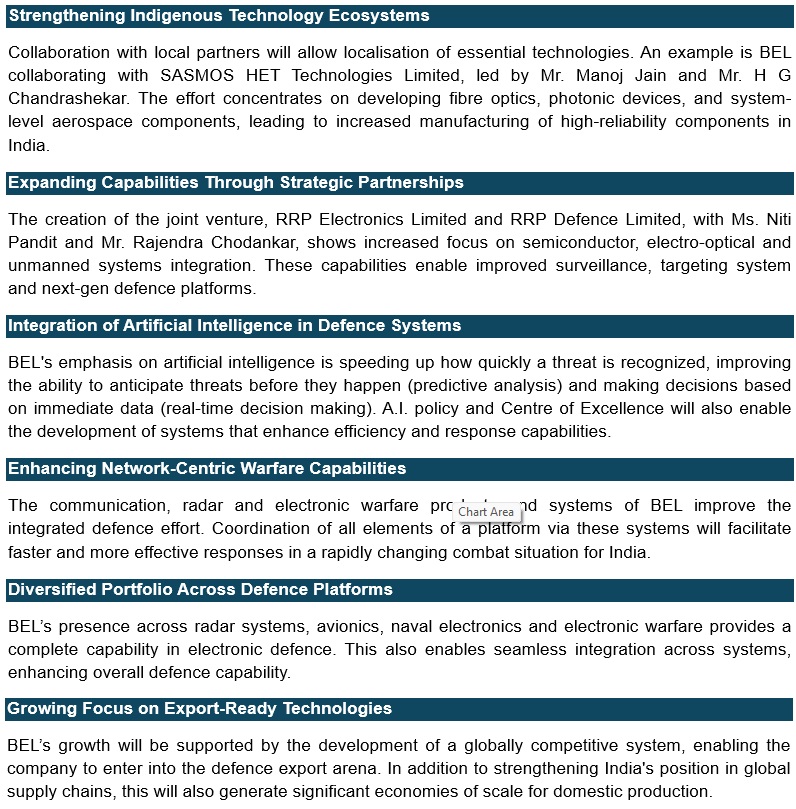
These factors further demonstrate the benefits of BEL's capabilities, as they allow the armed forces to benefit from enhanced surveillance, response systems, and enhanced network-centric operations.
Outlook and Road Ahead
The future direction of India's defence industry will see growing technological capability, with a focus on electronic equipment, automated systems and digital technologies. The increasing sophistication of platforms will mean that integrated defence electronics will have a greater impact.
With a strong order book, technical credentials and alignment with national priorities, BEL is well positioned to continue its role as a major player in the defence sector's transition to enhanced technological capabilities. Continued investment in R&D and collaboration with industry partners will be key to future success.
The defence sector will also need to adapt to rapid changes in technology, dynamic threat environments and increasing reliance on specialised component supply chains. Developing innovative ecosystems and accelerating development timelines will be necessary to remain competitive.
BEL will not only support the development of the Indian defence ecosystem but will also improve the operational capability of the Indian defence forces using indigenous technology; enhancing operational readiness, responsiveness and strategic independence.
FAQs
How does BEL strengthen India’s defence capabilities?
BEL strengthens India’s defence capabilities by enabling surveillance, communication, electronic warfare and AI-driven systems that improve operational readiness and decision-making.
What are BEL’s key technology areas?
BEL’s technological areas are Radar systems, electronic warfare, avionics, missile electronics, communication networks and artificial intelligence.
How strong is BEL’s order pipeline?
BEL has an order book exceeding Rs. 73,000 crore, ensuring strong future growth visibility.
What role does BEL play in defence indigenisation?
BEL supports indigenisation through domestic design, manufacturing and partnerships that reduce dependence on imports.
Why is defence electronics becoming critical for India’s security strategy?
Defence electronics are essential for modern warfare as they enable surveillance, threat detection, secure communication, and precision targeting, forming the backbone of effective and coordinated defence operations.
Partners




