SEARCH
RECENT POSTS
Categories
- Agriculture (39)
- Automobiles (20)
- Banking and Financial services (36)
- Consumer Markets (57)
- Defence (6)
- Ecommerce (21)
- Economy (72)
- Education (14)
- Engineering (9)
- Exports (22)
- Healthcare (25)
- India Inc. (10)
- Infrastructure (31)
- Manufacturing (33)
- Media and Entertainment (17)
- Micro, Small & Medium Enterprises (MSMEs) (16)
- Miscellaneous (31)
- Perspectives from India (37)
- Pharmaceuticals (5)
- Railways (4)
- Real Estate (20)
- Renewable Energy (19)
- Research and Development (12)
- Retail (1)
- Services (7)
- Startups (16)
- Technology (66)
- Textiles (8)
- Tourism (16)
- Trade (9)
Authors






MSME Digitisation: Unlocking Productivity and Market Access

- Sep 01, 2026, 16:10
- Micro, Small & Medium Enterprises (MSMEs)
- IBEF
The Micro, Small and Medium Enterprises (MSMEs) make an important constituent of the Indian economy and are referred to as the engines of growth, job creation, and socio-economic development. According to the Union Budget of 2026-27, there are 7.47 crore MSMEs in India which employ 32.82 crore people, thereby making the segment the second-largest employer in the country after agriculture. The contribution made by MSMEs to the economy is around 35.4% of manufacturing production, 48.58% exports, and 31.1% of GDP of India, thus highlighting their importance for economic development and competitiveness. In light of the move towards becoming a digitally enabled economy, the adoption of technology by MSMEs becomes an essential part of the process as far as enhancing productivity, competitiveness, and market reach is concerned. This is facilitated by the quick adoption of digital payment methods, e-commerce platforms, cloud computing, automation, and big data solutions by enterprises. Programs initiated by the government like Udyam Registration, Udyam Assist Platform (UAP), the Open Network for Digital Commerce (ONDC), the Government e-Marketplace (GeM), and Digital India facilitate the integration of businesses in the formal economy and the search for new opportunities. Taking into account the strategic importance of the segment, the Union Budget 2026-27 highlighted the need to focus on MSMEs for economic growth by creating a three-pronged approach to equity support, liquidity and professional assistance. With increasing digitalization and wider use of emerging technologies such as artificial intelligence, the digitization of MSMEs is expected to open new avenues for innovation, increased productivity, and participation in value chains.
Digital Maturity: Current State of Indian MSMEs
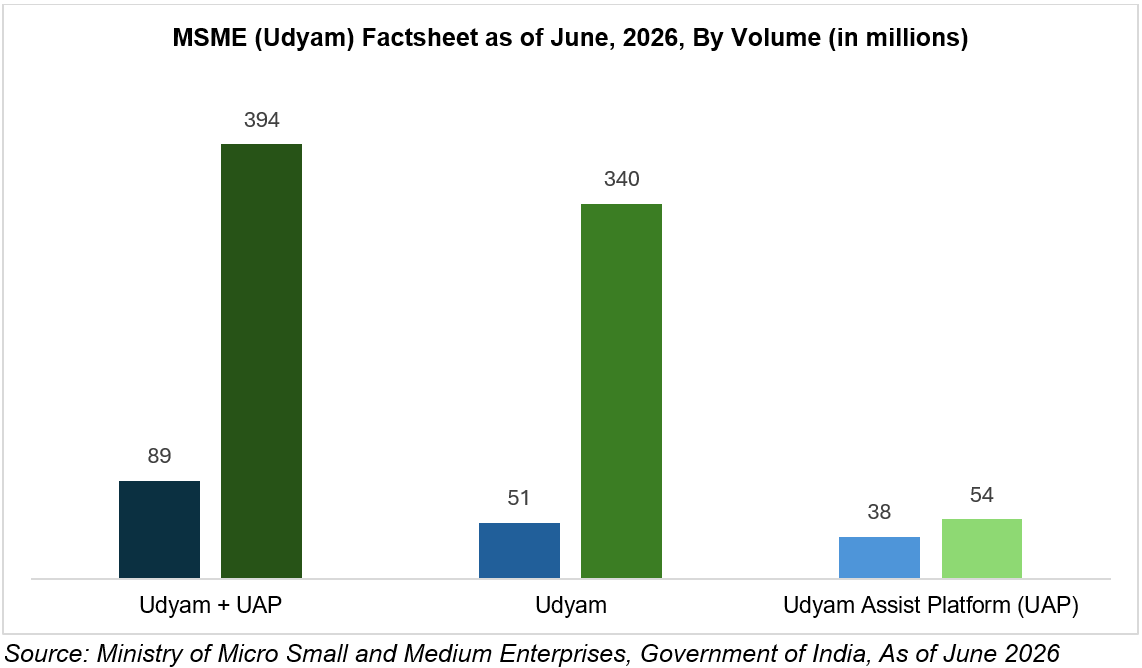
Micro Small Medium Enterprise (MSME) in India is progressing towards a higher level of digitalization driven by increased formalization and development of digital infrastructure. In June 2026, there were over 8.66 crore enterprises registered on the Udyam Registration Portal and the UAP which provided employment to more than 38.44 crore people. These initiatives helped millions of micro and small enterprises become part of formal economy, and increased their access to credit facilities, government schemes and digital business solutions.
Increased use of digital payments, online commerce, cloud computing and other digital business solutions change the operational model and communication methods used by MSMEs. Digitalization helps to increase efficiency, improve finance management and provide better access to the markets beyond geographically confined areas. At the same time, increased participation of MSMEs in online commerce platforms allows them to become an integral part of organized production chains and formal market environment.
Formalization of MSMEs increased substantially in recent years. During July 2020 and December 2025, more than 7.30 crore enterprises were registered on the Udyam Registration Portal and the UAP, including 4.37 crore enterprises registered on Udyam and 2.92 crore enterprises registered on UAP. This means that increased number of small businesses adopts the use of digital platforms for registration. As digital infrastructure spreads throughout the country, more MSMEs start using business models based on the use of modern technologies to increase efficiency.
Union Budget 2026-27 Measures
The Union Budget for the fiscal year 2026-27 fosters the development of MSME digital ecosystem based on the threefold approach, namely equity, liquidity, and professional assistance. In order to allow the rise of future leaders among MSMEs, a fund amounting to Rs. 10,000 crore (US$ 1.13 billion) was introduced as 'Fund of SME Growth, whereas another Rs. 2,000 crore (US$ 226.31 million) was allocated to the Self-R Reliant India (SRI) Fund in order to improve the access to growth capital. Besides, the scope of activities of the Trade Receivables Discounting System (TReDS) has been broadened by integration with GeM and credit guarantee facilities provided for invoice discounting, which helps to acquire better and cheaper digital financing from the side of MSMEs. Furthermore, the abolition of the Rs. 10 lakh (US$ 11,316) per consignment limit on the exports through couriers will benefit cross-border e-commerce opportunities of small enterprises, artisans, and start-ups. By FY26, the TReDS helped to unlock over Rs. 7 lakh crore (US$ 79.21 billion).
Government Initiatives Supporting MSME Digitisation
Governmental measures are very important for the acceleration of digitalisation of the Indian MSME sector through the process of formalisation, market access, credit availability and participation in digital commerce. With the help of Udyam Registration Portal and Udyam Assist Platform (UAP), many enterprises could formalise themselves and get access to the governmental initiatives. Up to June 2026, the registration of more than 8.66 crore enterprises via Udyam Registration Portal and UAP led to the creation of jobs for 38.44 crore people.
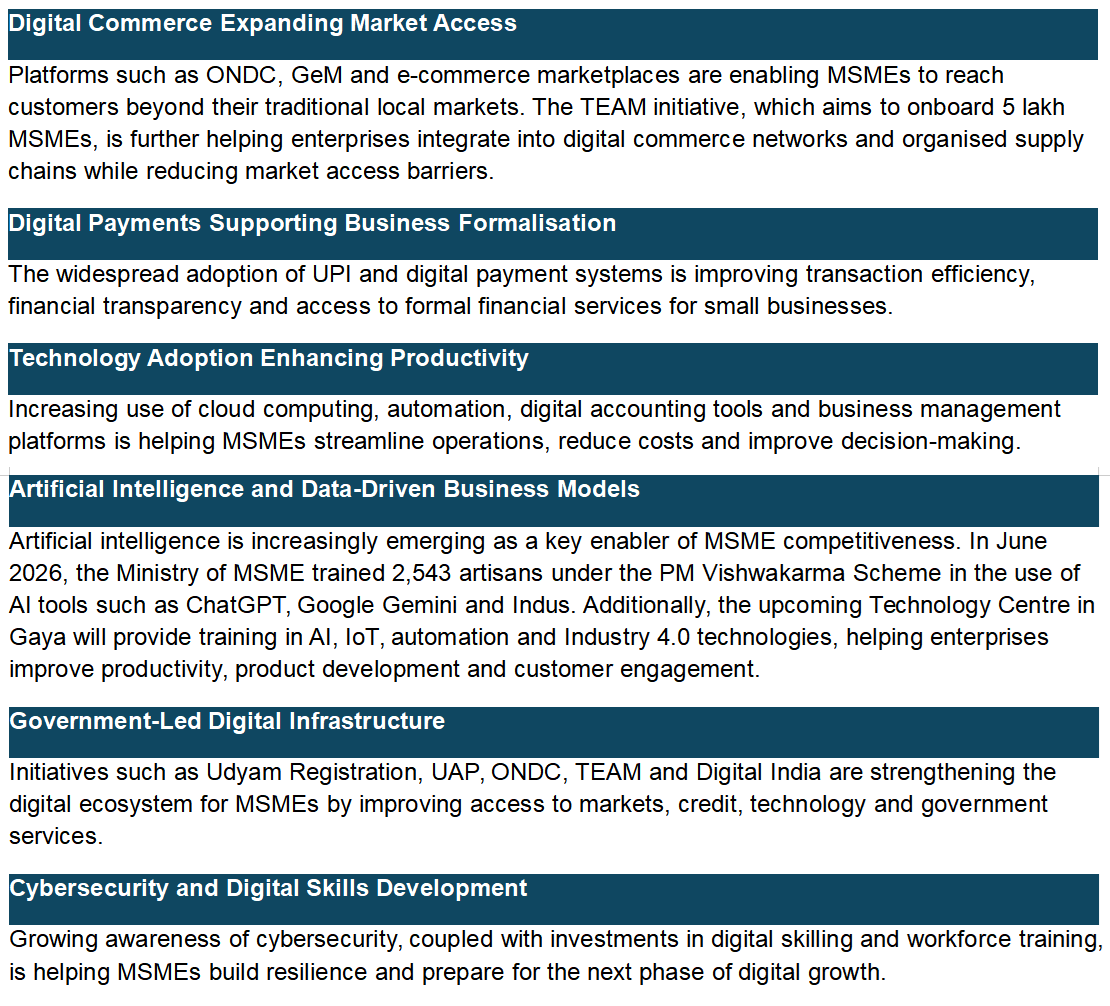
Access to digital markets has been facilitated through the ONDC (Open Network for Digital Commerce) and TEAM (Trade Enablement and Marketing) Initiative. The TEAM initiative aims at onboarding 500,000 micro, small and medium enterprises (MSMEs) onto digital commerce networks to enable them to reach out to larger customer base and get integrated into formal supply chains. Government e-Marketplace (GeM) is another major procurement platform for MSMEs. In the financial year 2025 (FY25), government departments and central public sector enterprises (CPSEs) purchased goods and services worth Rs. 93,017.08 crore (US$ 10.52 billion) from Micro and Small Enterprises representing 43.58% of total procurement. Other initiatives that are supporting the digital transformation include Online Dispute Resolution (ODR) Portal, Credit Guarantee Scheme for Micro and Small Enterprises (CGSMSE) and PM Vishwakarma Scheme. In addition to this, artisans and micro-enterprises can participate in the digital markets and resolve disputes in online mode through these schemes. As part of yet another move towards the digital world, Ministry of MSMEs trained 2,543 artisans under the PM Vishwakarma Scheme in June 2026 in the usage of artificial intelligence tools like ChatGPT, Google Gemini and Indus. Branding, product designing, digital marketing, packaging and AI based management were the areas covered in training the artisans who benefited in terms of improved market access and productivity.
Technology adoption among MSMEs was boosted through the creation of a Technology Center in Gaya by Ministry of MSME in June 2026 in collaboration with Government of Bihar with an investment of Rs. 170 crore (US$ 19.24 million). This technology center is expected to train about 7,000 students and industrialists every year and would support over 1,000 MSMEs every year through Industry 4.0 labs, artificial intelligence, IoT, automation, manufacturing technologies and business advisory services.
Growth Drivers and Key Trends
The following factors are driving the expansion and shaping the evolution of MSME digitisation in India:
Outlook and Road Ahead
Digitization of MSMEs is likely to play a crucial role in enhancing competitiveness, productivity, and participation in value chains both within the country and internationally. Digital payments, e-commerce, cloud-based solutions, and business management solutions are likely to help firms improve efficiency, save costs, and enter into new markets. Initiatives such as the Udyam Registration, ONDC, TEAM, GeM, and the Digital India Programme have established an ecosystem that helps in fostering digital commerce, formalization, and financial inclusion in enterprises. The Union Budget for 2026-27 supports the transformation of MSMEs through measures that aim to increase digital finance, participation in e-commerce, and access to growth finance. Artificial Intelligence, data analytics, automation, and cyber security are likely to become increasingly important technologies for MSMEs to enhance productivity and customer engagement. Sustained investments in digital infrastructure, technology adoption, and digital skill-building will continue to be important for bridging capability gaps and building resilience in enterprises. The current investments in Technology Centres, artificial intelligence-based skilling programs, digital commerce networks, and Industry 4.0 infrastructure are likely to accelerate technology adoption by MSMEs and help transform them into globally competitive enterprises. As India moves towards becoming a digitally-enabled economy, MSMEs are likely to play a crucial role in innovating, creating jobs, exporting, and developing the economy inclusively.
FAQs
Why is digitisation important for Indian MSMEs?
Digitization is expected to help reduce the operational cost of MSMEs, increase customer engagement, increase financial transparency, help gain access to new markets, and help participate effectively in domestic and global value chains. Digitization also allows firms to have increased access to finance and government support programmes.
How is the Government supporting MSME digitisation?
Initiatives such as the Udyam Registration Portal, Udyam Assist Platform (UAP), Open Network for Digital Commerce (ONDC), Government e-Marketplace (GeM), Trade Enablement and Marketing (TEAM) initiative, and Digital India Programme are being promoted by the Government.
What role does ONDC play in MSME growth?
ONDC enables MSMEs to connect with digital commerce platforms independent of any marketplace. It enables small businesses to reach a larger customer base, reduces platform dependency, and helps in integrating into formal supply chains.
What were the key MSME digitisation measures announced in Union Budget 2026-27?
The Union Budget aims to make GeM-TReDS integration, credit guarantee support to invoice discounting in TReDS, and removal of the Rs. 10 lakh limit per consignment for couriers used in exports, thus increasing the MSMEs access to digital finance and international e-commerce.
How does PM Vishwakarma support digital inclusion?
The PM Vishwakarma initiative aims to train, financially assist, and digitally enable artisans and craftspeople and onboards them onto digital platforms like GeM and other e-commerce platforms.
Partners




