SEARCH
RECENT POSTS
Categories
- Agriculture (38)
- Automobiles (20)
- Banking and Financial services (36)
- Consumer Markets (57)
- Defence (6)
- Ecommerce (21)
- Economy (72)
- Education (14)
- Engineering (9)
- Exports (22)
- Healthcare (25)
- India Inc. (10)
- Infrastructure (31)
- Manufacturing (32)
- Media and Entertainment (16)
- Micro, Small & Medium Enterprises (MSMEs) (16)
- Miscellaneous (31)
- Perspectives from India (37)
- Pharmaceuticals (5)
- Railways (4)
- Real Estate (20)
- Renewable Energy (19)
- Research and Development (12)
- Retail (1)
- Services (7)
- Startups (16)
- Technology (66)
- Textiles (8)
- Tourism (16)
- Trade (9)
Authors






Why India Is Emerging as a Global Hub for Biotechnology Innovation

- Jun 30, 2026, 12:30
- Research and Development
- IBEF
The Indian bio sector has experienced notable transformation, and this includes a transition from the manufacturing of drugs to innovation and production of more innovative products. Biotechnology is not confined only to the medical industry but also used in agriculture where the manufacture of goods made out of natural resources takes place while the ecosystem remains protected. The government of India is also contributing towards the expansion of the biotechnology industry by introducing favourable policies, making business easier and investing in the research and development sector. India aims at establishing a growing biotechnology sector worth US$ 300 (Rs. 27.6 lakh crore) billion by 2030.
Significance: Biotechnology as a Strategic Sector
Biotechnology is increasingly regarded as a vital factor in promoting growth in the economy of the entire globe. It has great importance in healthcare provision, food security, and sustainability. India is well positioned to benefit from the expansion of this sector, supported by its distinct advantages. India is one of the leading countries in terms of the biotechnology market and possesses robust vaccine and biopharmaceutical manufacturing expertise. India’s ability to supply a significant share of the world’s vaccines highlights its importance in the global healthcare ecosystem.
Industry Overview
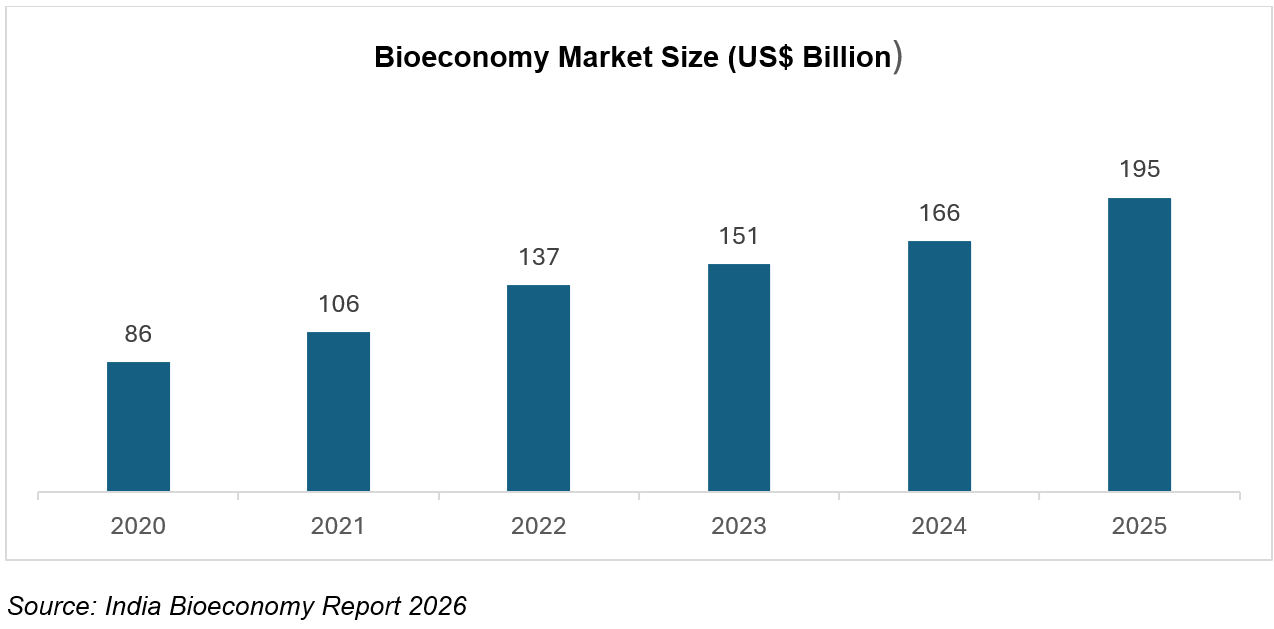
The Indian bioeconomy market grew from US$ 86 billion (Rs. 6.3 lakh crore) in 2020 to US$ 195 billion (Rs. 17.9 lakh crore) in 2025, registering a CAGR of 17.8%. This strong momentum is further reflected in an 18% growth recorded between 2024 and 2025. The contribution of the bioeconomy in India amounts to 4.8% of the nation's gross domestic product. The number of bio-tech startups is over 11,855 and operates in the fields of Therapeutics, Diagnostics, Agritech, Biocatalyst/Enzymes Industrial, Digital Life Sciences, and others. The major sectors include BioIndustrial (46%), BioPharma (33%), BioServices (13%), and BioAgriculture (8%).
Government Initiatives and Policy Support
The government has been instrumental in establishing a large-scale biotechnology ecosystem in India to support the emergence of a biotechnology sector characterised by innovation and scalability with global competitiveness.
One of the most significant recent developments has been the introduction of the BioPharma SHAKTI programme, which includes an initial investment of US$ 1.2 billion (Rs. 10,000 crore) to develop India's capacity to produce next-generation biopharmaceuticals, as well as develop infrastructure for conducting clinical research in India. In addition, the RDI Fund provides support for developing innovative technologies that fall under the category of deep tech across several different sectors, including biotechnology. The total fund will amount to US$ 11.6 billion (Rs. 1 lakh crore).
The BioE3 Policy (Biotechnology for Economy, Environment and Employment) is a critical strategy aimed at promoting sustainable biomanufacturing, developing solutions that are resilient to the impacts of climate change on the environment as well as job creation. In turn, this will enhance India’s position in emerging technologies like precision biotherapeutics and bio-based industrial products.
Department of Biotechnology (DBT), established in 1986, is the key organisation responsible for undertaking scientific research and innovation in the biotechnology sector, whereas BIRAC is the council that helps in developing start-ups by offering financial assistance for incubation and commercialization.
The PLI scheme offers support for establishing manufacturing capabilities within the country and reducing dependency on imports for high value manufacturing. Other targeted schemes like biomanufacturing clusters and research infrastructure are also helping the biomanufacturing industry enhance its capabilities and scaling up.
Genome India project has made a remarkable progress in the field of genomics by sequencing around 10,000 genomes, thus helping establish an infrastructure for precision health care systems in India.
Growth Drivers and Key Trends
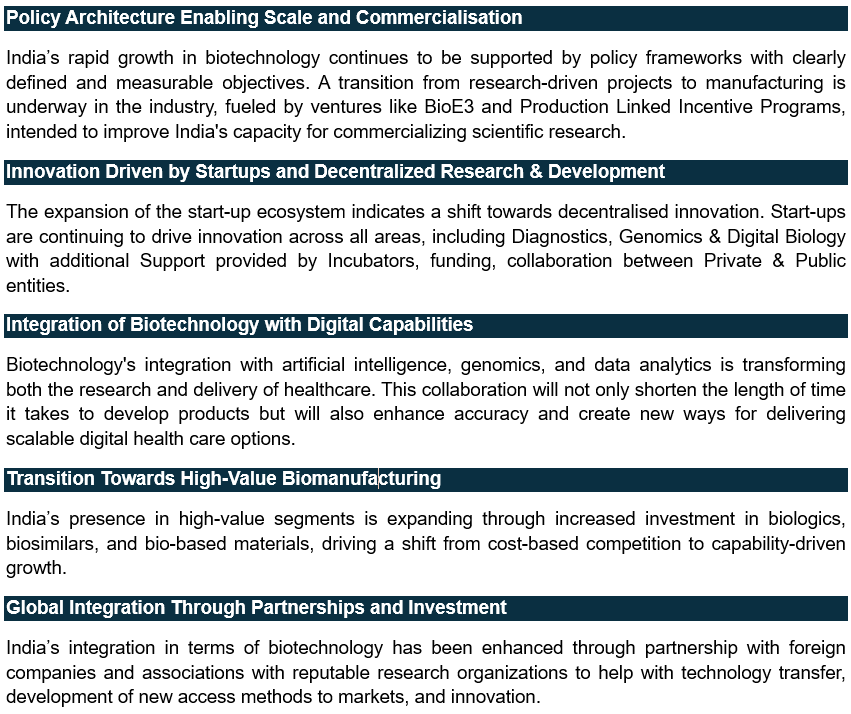
The growth of India’s biotechnology sector is supported by several policy, technological and market-driven factors, as discussed below.
Biotechnology Clusters Driving Regional Growth
India’s biotechnology industry is driven by a cluster of biotechnology regions that combine research, production and innovation:
- Genome Valley (Hyderabad): A leading biopharmaceutical hub, with the Telangana government targeting investments of around Rs. 1 lakh crore (US$ 10.76 billion) and the creation of nearly five lakh jobs by 2030.
- Mumbai–Pune corridor: Contributes 25-30% of pharmaceutical output and hosts a large share of R&D centres in the corridor.
- Ahmedabad–Vadodara cluster: Over 100 bulk drug producers and 400+ manufacturing units.
- Bengaluru: More than 1,300 biotech firms supported by strong IT-biotech convergence.
- Chennai (Taramani): Focus on biologics and biosimilars with strong academic linkages.
These clusters reflect the geographically distributed nature of India’s biotechnology growth, supported by state-level policies and infrastructure.
Outlook and Road Ahead
The biotech industry of the country is expected to expand owing to various factors, such as government policies, technological innovations, and global demand for products linked to biotechnology. The synergy between biotechnology and information technology would result in demand, owing to the innovations occurring due to R&D efforts.
Sustained growth in the future can be ensured with more investment in R&D activities, better regulation policies, coordination among business entities and educational institutions. Efficient commercialization activities will become crucial in the successful marketing of innovations.
With a strong scientific base, government fiscal support, and expanding manufacturing capacity, India is well positioned for sustained growth in the biotechnology sector, India has great potential to develop into a global biotechnology centre, as stated by Union Minister Dr. Jitendra Singh Rana, "Biotechnology will form a key part of India's development strategy, connecting innovation to economic growth and sustainability."
FAQs
What is the current size of India’s biotechnology sector?
The market size of bioeconomy is estimated at about US$ 195 billion (Rs. 17.9 lakh crore) for 2025.
What is the target growth rate of the sector?
The sector is expected to reach US$ 300 billion (Rs. 27.6 lakh crore) by 2030
What role does government policy play?
Policies such as BioE3, PLI and DBT-led initiatives support innovation, manufacturing and ecosystem development.
How many biotech startups are there in India?
India has over 10,000 biotechnology startups supported by incubators and research institutions.
What are the key growth drivers?
Policy support, manufacturing strength, digital integration, startup ecosystem growth and global partnerships.
Partners