SEARCH
RECENT POSTS
Categories
- Agriculture (37)
- Automobiles (20)
- Banking and Financial services (36)
- Consumer Markets (57)
- Defence (6)
- Ecommerce (21)
- Economy (72)
- Education (14)
- Engineering (9)
- Exports (22)
- Healthcare (25)
- India Inc. (10)
- Infrastructure (31)
- Manufacturing (32)
- Media and Entertainment (16)
- Micro, Small & Medium Enterprises (MSMEs) (16)
- Miscellaneous (31)
- Perspectives from India (37)
- Pharmaceuticals (5)
- Railways (4)
- Real Estate (20)
- Renewable Energy (19)
- Research and Development (12)
- Retail (1)
- Services (7)
- Startups (16)
- Technology (66)
- Textiles (8)
- Tourism (16)
- Trade (9)
Authors






Why Jute Products Are Important for Sustainable Packaging

- Jun 29, 2026, 14:30
- Miscellaneous
- IBEF
The global packaging industry is undergoing a structural shift as businesses increasingly replace their single-use plastic products with biodegradable and reusable packaging solutions. The transition is accelerating due to rising environmental concerns, stricter plastic waste regulations, and the increasing adoption of environmentally friendly packaging solutions by businesses. The global packaging industry adopts circular economy principles which a focus on product reuse, recyclability and material waste reduction. Jute has emerged as a strategically vital natural fibre due to its compostable, renewable and strong durability properties. India stands as one of the world’s leading raw jute and jute product manufacturers which creates an advantage for the country because it possesses both agricultural resources and a developed manufacturing sector. Jute products have expanded their applications beyond foodgrain and sugar sacks to become reusable shopping bags and branded retail packaging and environmentally friendly export packaging which makes them a scalable solution for sustainable packaging needs.
The Journey: From Traditional Sacks to Modern Eco-Packaging
India’s jute packaging sector reflects a clear shift from traditional commodity use to diversified value-added applications. The sector maintains its original foundation, with the government continuing to mandate 100% foodgrain and 20% of sugar packaging in jute bags according to the Jute Packaging Material (Compulsory Use in Packaging Commodities) Act, 1987, which creates continuous demand for foodgrain sacks and agriculture bags. The National Jute Board has built its work based on historical foundation by promoting various jute products through its Jute Mark India program which includes reusable retail bags and other jute-based products. Meanwhile, the campaigns associated with the ban on single-use plastics have resulted in people adopting packaging forms in their shopping, gifting, and online shopping activities. This process has slowly resulted in the gradual transformation of jute from being an industrial commodity to becoming a sustainable packaging material.
Market Outlook and Industry Overview
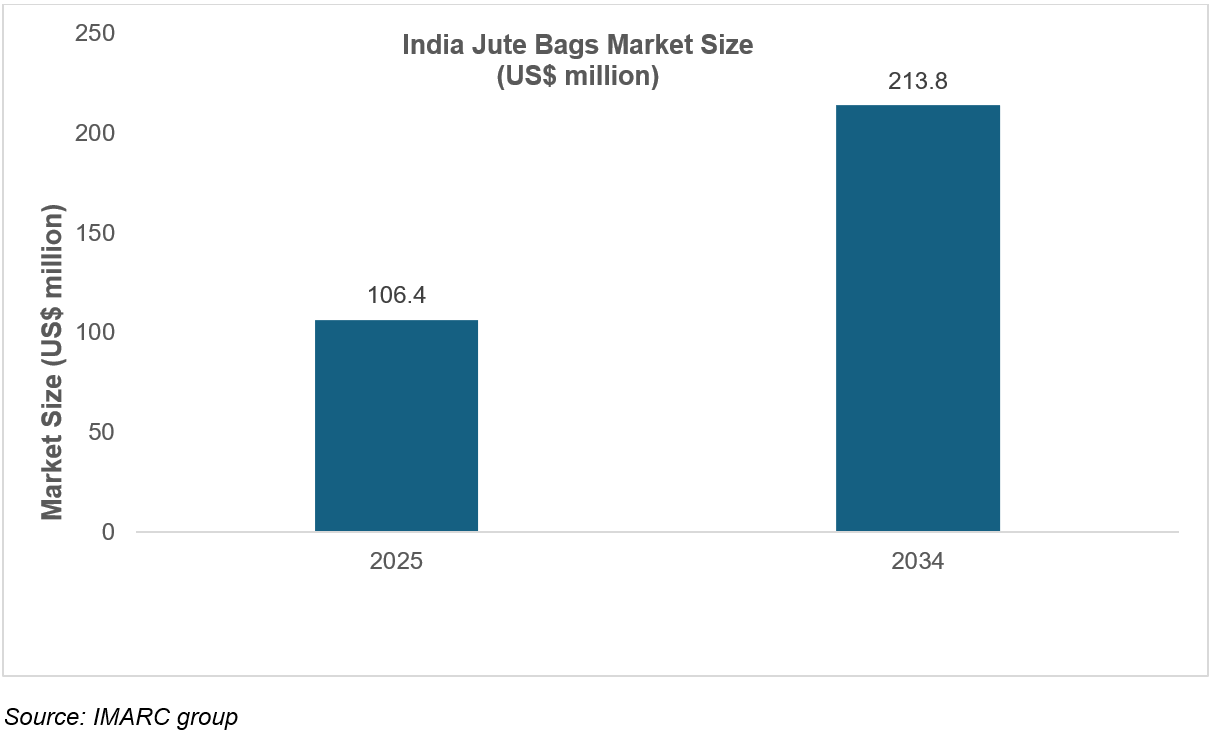
The jute packaging ecosystem of India is currently experiencing a strong growth phase, supported by rising demand for sustainable materials and the country’s leadership in natural fibre production. India remains one of the world’s largest producers of raw jute while also being the world’s foremost jute goods manufacturer which provides the country with a strategic advantage for environmentally friendly packaging solutions. The India jute bags market reached US$ 106.4 million (Rs. 983.56 crore) in 2025 and is projected to reach US$ 213.8 million (Rs. 1,976.24 crore) by 2034, registering a CAGR of 7.82% during 2026-2034, driven by increasing retail adoption, exports and government packaging mandates.
Why Jute Matters in Sustainable Packaging
Jute’s importance in sustainable packaging lies in its ability to combine environmental performance with functional efficiency. The recent TERI study of jute bags in India demonstrates that jute functions as 100% recyclable natural material which provides better environmental benefits than polymer-based products because it requires less fossil fuel and generates minimal waste. The material for circular packaging systems due to its ability to decompose through composting processes establishes its value where reuse and safe disposal are increasingly becoming procurement procedures.
Jute offers strong packaging performance through its high tensile strength and durable properties which enable natural airflow to package foodgrain, pulses, sugar, seeds, and other agricultural products that need moisture control and ventilation. Jute provides an environmentally friendly packaging option which boosts social and economic progress by supports farmers income, creating jobs at mills and in rural communities.
Government Initiatives and Policy Support
The development of jute as a sustainable packaging material in India received its main support through government policies. The Jute Packaging Materials (Compulsory Use in Packing Commodities) Act of 1987 institutionalised mandatory use for essential commodities which created a continuous market demand for the industry. The framework has been updated multiple times since its creation with the 2025 notification that continues 100% reservation for foodgrain packaging and 20% sugar packaging requirements ensuring long-term demand visibility for mills and farmers.
The National Jute Development Programme (NJDP) has emerged as the key modern policy lever beyond mandatory packaging. In February 2026, the Ministry of Textiles announced its ongoing support for jute diversification, including financial assistance for plant and machinery and export participation at international trade exhibitions and the marketing of lifestyle and packaging products through an investment of US$ 13.40 million (Rs. 124.45 crore) which spanned the past five years. The combination of India’s anti-single-use plastic initiative together with its export promotion programmes is accelerating the shift towards diversified retail, premium and eco-friendly packaging applications.
Key Growth Drivers and Emerging Trends
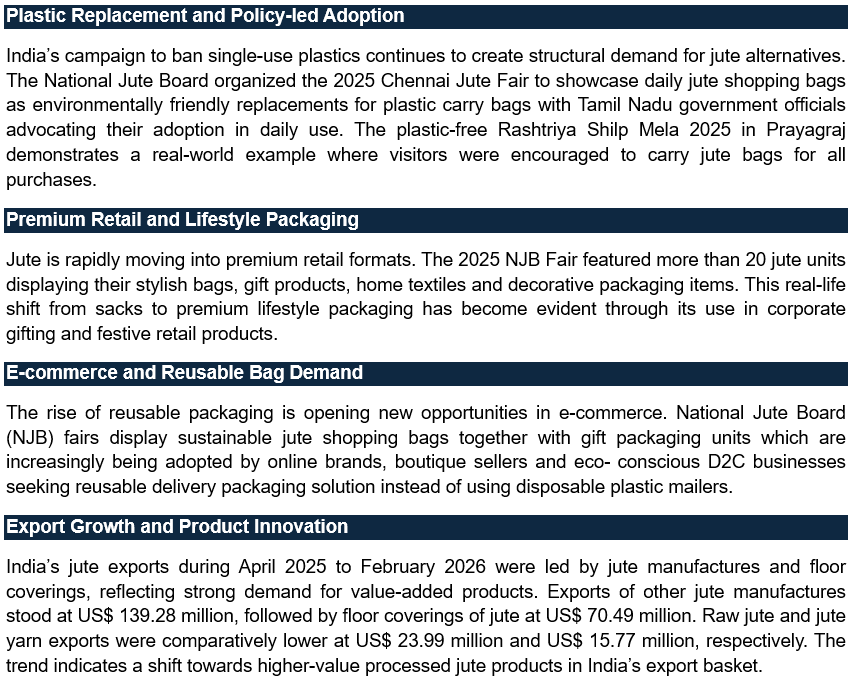
India's jute industry is entering a new phase of demand expansion driven by sustainability requirements and high-end retail businesses and export-driven product development. In FY26 growth period is increasingly being shaped by policy-backed which support plastic alternatives, reusable packaging and modern lightweight jute products in both domestic and international markets.
Competitive Landscape
West Bengal serves as a hub for jute production in India as it contains 86 out of 116 jute mills which operate as complete jute manufacturing facilities. The ecosystem is increasingly supported by MSMEs, cottage units and women-led rural enterprises which produce reusable shopping bags, decorative packaging and lifestyle products for export. The government Raw Jute MSP assessment for 2025-26 states that the industry directly employs 4 lakh workers while it supports approximately 40 lakh agricultural households which demonstrates its economic impact on society. The National Jute Development Programme (NJDP) has led to smaller manufacturing facilities which produce diverse products value addition in branded retail packaging and environmentally sustainable export packaging solutions. The combination of organised mills with decentralised cottage production and export-related MSMEs creates a competitive advantage for the cluster which enhances rural economic growth while positioning India as a scalable hub for environmentally friendly jute packaging solutions.
Outlook and Road Ahead
India's jute industry is well positioned to emerge as a strategic pillar which supports worldwide progress toward environmentally sustainable packaging and circular economy. The increasing global demand for biodegradable products creates a major opportunity for sustainable packaging which uses reusable retail systems and green logistics solutions as India has strong fibre resources and manufacturing facilities that meet export standards. The National Jute Development Programme provides ongoing policy support which enables recent advancements in lightweight jute bags and various blended applications to enhance product competitiveness while creating new usage opportunities. Jute will evolve from its role as a common packaging material into a premium, innovation-driven circular economy solution as global brands are increasingly adopting environmentally friendly purchasing practices.
FAQs
Why are jute products important for sustainable packaging?
Jute products are biodegradable, reusable, compostable and recyclable, making them a strong alternative to single-use plastics in circular packaging systems.
Which industries are driving demand for jute-based packaging?
Demand is expanding across foodgrain storage, agriculture, FMCG retail, gifting, e-commerce, export packaging and premium lifestyle products.
What government initiatives are supporting jute packaging growth?
The Jute Packaging Materials Act, mandatory foodgrain packaging norms, the National Jute Development Programme and anti-single-use plastic regulations remain the key policy drivers.
How is innovation improving jute packaging competitiveness?
Recent innovations such as lightweight jute bags, blended applications and diversified product formats are improving logistics efficiency and branded packaging use cases.
What is the medium- to long-term outlook for jute packaging?
The sector is expected to benefit from ESG-led procurement, global green demand, export opportunities and the expansion of branded sustainable packaging solutions.
Partners