Lakshadweep
Lakshadweep contributes around 14% of India's annual tuna landings, highlighting its strong potential for the fisheries and seafood processing industry.
Lakshadweep is the India's smallest Union Territory, known for its chain of coral islands. There are 36 islands (three reefs and six submerged sandy banks) in all, of which 10 are inhabited and scattered in the Arabian Sea at 220-440 kms off the west coast of Kerala.
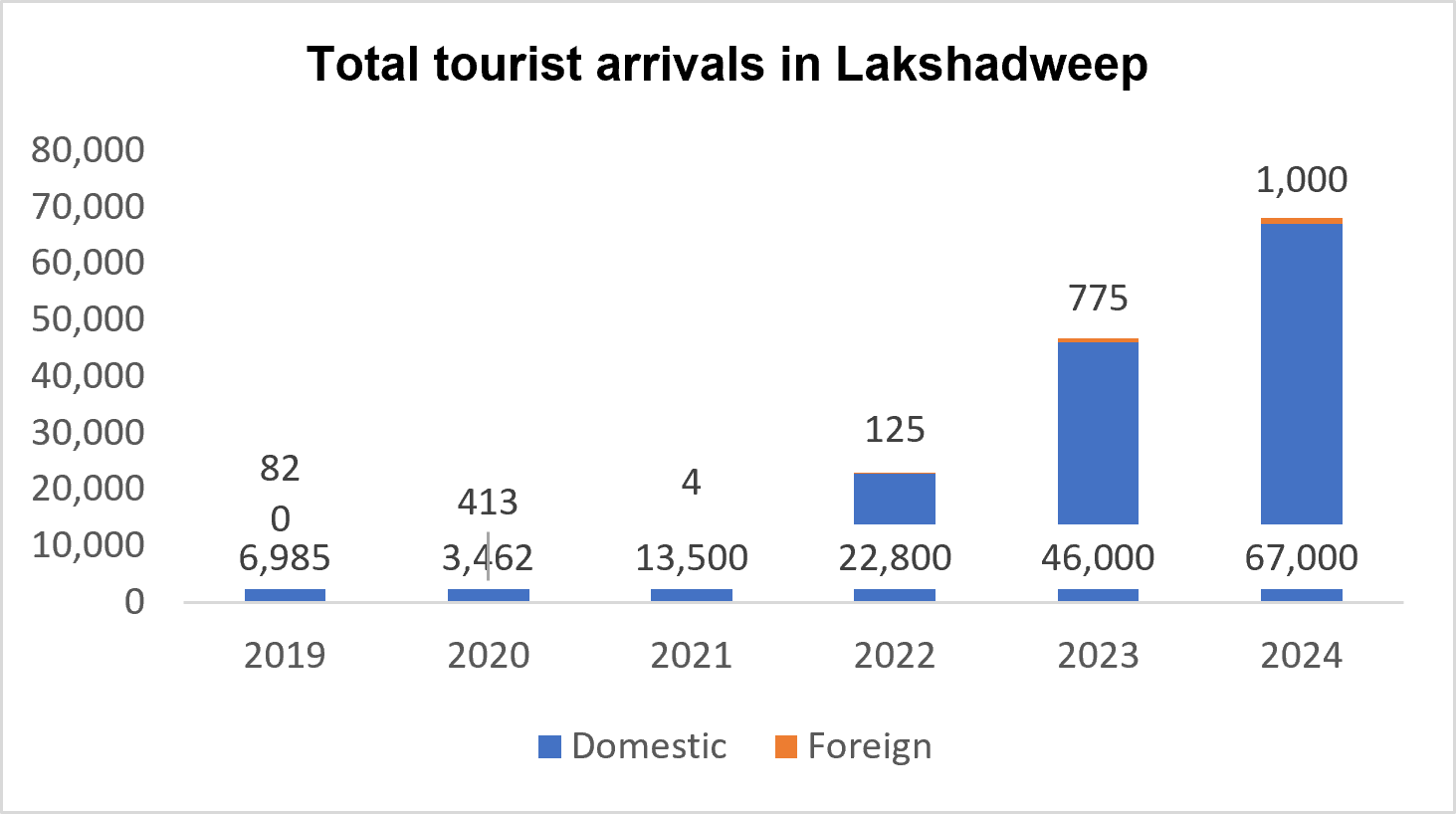
In Lakshadweep, tourism is one of the few areas that can play a vital role in generating revenue, jobs and overall island growth. Lakshadweep is already recognised as a tourist destination because of its isolated islands and scenic beauty. In Budget 2026-27, Rs. 2.09 crore (US$ 232,222) were made towards tourism development in Lakshadweep, including a capital outlay of Rs. 1.31 crore (US$ 145,556).
Bangaram is forecasted to be a key international tourism destination because of its abundant marine fauna and activities like water sports such as scuba diving, windsurfing, snorkelling, surfing, kayaking, canoeing, water skiing, yachting, and evening trips to the sea.
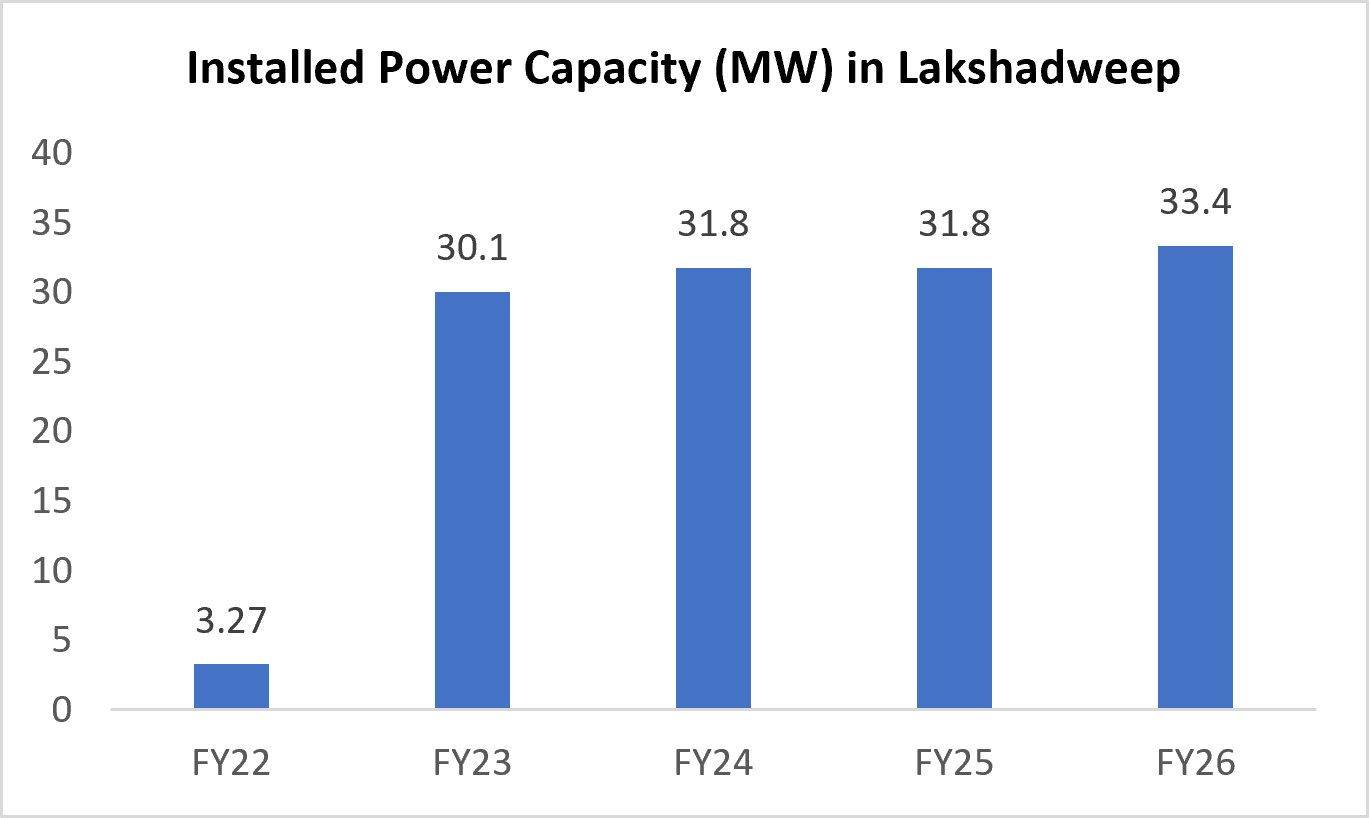
As on April 2026, Lakshadweep had a total installed power generation capacity of 33.40 MW. With the SunSource Energy power plant project, Lakshadweep is witnessing its largest solar project that will power four different islands - Agatti, Kavaratti, Bangaram and Thinnakara.
Below are some of the major initiatives taken by the Government to promote Lakshadweep as an investment destination:
- The Department of Fisheries organized the first-ever Investors’ Meet in Lakshadweep in December 2025 to unlock investment opportunities in fisheries, aquaculture and the blue economy. More than Rs. 500 crore (US$ 55.56 million) worth of investment proposals were envisaged during the Investors’ Meet to support the development of Lakshadweep’s blue economy ecosystem.
- As noted on June 10, 2025, the Ministry of Ports, Shipping and Waterways is strengthening Lakshadweep’s marine infrastructure with Rs. 1,664.88 crore (US$ 194.60 million) for new jetties and port facilities, along with proposals worth Rs. 2,128.86 crore (US$ 248.80 million) for beachfront development, roads, and coastal protection across key islands.
- In May 2025, Lakshadweep has signed an MoU with the Solar Energy Corporation of India (SECI) to accelerate its shift towards renewable energy.
- On August 22, 2025, Kerala announced that seaplane services from Kochi to Lakshadweep would launch the following month after completing successful trial runs.
- On January 13, 2025, Lakshadweep saw its first-ever high-speed craft vessel berth at Amini Island’s newly completed western jetty, marking a major improvement in safe and reliable connectivity.
- Starting in 2025, construction activities across key islands like Kalpeni, Kadmath, and Androth will commence, with Cochin Port Authority as project management consultant and Assystem India Limited responsible for detailed project reporting.
- Budget 2025–26 emphasizes sustainable deep-sea fishing in India’s 20 lakh sq. km EEZ, focusing on Lakshadweep and A&N Islands to unlock the 53 lakh tonne marine potential, especially high-value tuna, through capacity building and support for resource-specific fishing vessels.
- The Ministry of Tourism has revamped the Swadesh Darshan Scheme as Swadesh Darshan 2.0 (SD 2.0) with the objective to develop sustainable and responsible tourism destinations, following a destination & tourism-centric approach and has notified 57 destinations in the country including Lakshadweep for development under SD 2.0.
- Prime Minister, Mr. Narendra Modi inaugurated, development projects worth more than Rs. 1,150 crore (US$ 138.06 million) in Kavaratti, Lakshadweep. The development projects cover a wide range of sectors including technology, energy, water resources, healthcare and education.
- The government of India has outlined a comprehensive Rs. 3,600 crore (US$ 432.17 million) infrastructure upgrade plan aimed at transforming the Lakshadweep islands into a premier tourist destination.
Lakshadweep, India’s smallest Union Territory, comprises 36 islands strategically located in the Arabian Sea, giving India a vast exclusive economic zone rich in fisheries, especially high-value tuna. The islands hold strong strategic importance for maritime security and surveillance in the western Indian Ocean. Economic activity is driven by fisheries, eco-tourism and renewable energy. Connectivity is improving through submarine optical fibre links, upgraded jetties, high-speed vessels and proposed seaplane services. Lakshadweep is emerging as a model for sustainable development with initiatives in solar power, ocean thermal energy, desalination, seaweed farming and low-impact tourism, while preserving its fragile marine and island ecosystems.
FACTFILE
Capital
KavarattiGeographical Area (sq km)
32State Language
Malayalam, Mahl, Bengali, Oriya, Tamil, Urdu and HindiLiteracy Rate
92.28 per centAdministrative Districts
1Key Industries:
Fishery
Agriculture
Tourism
Related News
MOREPartners