SEARCH
RECENT POSTS
Categories
- Agriculture (39)
- Automobiles (20)
- Banking and Financial services (36)
- Consumer Markets (57)
- Defence (6)
- Ecommerce (21)
- Economy (72)
- Education (14)
- Engineering (9)
- Exports (22)
- Healthcare (25)
- India Inc. (10)
- Infrastructure (31)
- Manufacturing (33)
- Media and Entertainment (17)
- Micro, Small & Medium Enterprises (MSMEs) (16)
- Miscellaneous (31)
- Perspectives from India (37)
- Pharmaceuticals (5)
- Railways (4)
- Real Estate (20)
- Renewable Energy (19)
- Research and Development (12)
- Retail (1)
- Services (7)
- Startups (16)
- Technology (66)
- Textiles (8)
- Tourism (16)
- Trade (9)
Authors






Digital India to AI India: The Next Transformation Wave

- May 19, 2026, 16:00
- Technology
- IBEF
Rapid growth in digital connectivity, infrastructure and technology startups have driven India’s digital transformation over the past decade. The development of digital services in India in the areas of governance, commerce, finance and services has been achieved through Digital India initiatives.
India is progressing to its next phase of technological development through continued advancement in digital systems, driven by Artificial Intelligence (AI). The recent period has shown that artificial intelligence serves as a transformative technology that can change the entire economic structure of the nation.
The AI India Impact Summit 2026, held in New Delhi on February 16-21, 2026, marked one of the first such international gatherings on artificial intelligence at such a large scale globally. The Prime Minister of India, Mr. Narendra Modi, stated that the nation has the potential to transform its entire technology sector, which includes Information Technology (IT), into a US$ 400 billion (Rs. 37 lakh crore) industry by the year 2030 during his speech at the AI-India Impact Summit held in February 2026.The event reinforced India’s position as an emerging international force in shaping global artificial intelligence regulations, while demonstrating its commitment to inclusive and socially beneficial AI development.
Significance: Why the AI Transition Matters
The implementation of artificial intelligence creates a basic shift that alters both the economic benefits of digital technologies and the operational methods used by governments. The previous digitalisation waves required the establishment of digital service connectivity, but artificial intelligence now provides various industries with intelligent automation and predictive analytics along with data-driven decision-making capabilities.
India stands to gain significant economic benefits from AI technologies. The Economic Times reports that AI will contribute US$ 1.7 trillion (Rs. 157.14 lakh crore) to India's economy by 2035, which demonstrates its ability to enhance productivity across manufacturing, services, healthcare and financial sectors.
India places special emphasis on inclusive growth through its AI development strategy. The policy dialogue has shifted its main emphasis toward creating pathways that allow people to obtain fundamental services which include healthcare and education and financial services. According to a NITI Aayog report, AI technologies have the potential to benefit 490 million informal sector workers by enhancing their productivity and providing them access to information and economic security.
Industry Overview
India’s technology sector offers an excellent platform for AI-led growth. The technology sector of India has witnessed tremendous growth, and it is estimated that the revenues of the sector will reach US$ 282.6 billion (Rs. 25.88 lakh crore) in FY25 and around US$ 300 billion (Rs. 27.82 lakh crore) in FY26 according to Nasscom. This is due to an increase in demand for software services, cloud computing and digital solutions globally. The sector has also witnessed tremendous support from an increased and strong workforce, as more than six million professionals work in India’s technology and AI sector.
This immense talent pool has also helped India become a key location for global technology operations. It has over 1,800 Global Capability Centres (GCCs) set up by MNCs, with over 500 of them focused on AI and advanced analytics, supporting global product development and research.
Indian startup ecosystem demonstrates quick growth in terms of AI innovation since the country boasts of having 1.8 lakh startups and 89% of these startups use AI technology in their products/services.
Government Initiatives and Policy Support
The IndiaAI Mission, which received approval from the Union Cabinet in March 2024, serves as the complete policy framework that guides AI developments in India. The mission intends to create a advanced AI system throughout India which will operate through a budget of approximately US$ 1.25 billion (Rs. 10,371.92 crore) for five years.
A significant part of the mission is focused on augmenting the capacity of AI computing infrastructure in the country. Currently, there are around 38,000 high-performance Graphics Processing Units (GPUs) deployed in the country that are available at subsidized rates of Rs. 65 per hour, which is one-third of the global average. In addition, there are multiple pillars of the mission that are focused on the development of AI compute infrastructure, application development in specific sectors, the AIKosh Datasets Platform, foundation model development, startup finance, future skills, and responsible AI governance. In addition, there are dedicated Centres of Excellence in specific domains. Moreover, there are over 3,000 datasets and over 240 AI models in 20 different sectors on the AIKosh Datasets Platform.
Growth Drivers and Key Trends
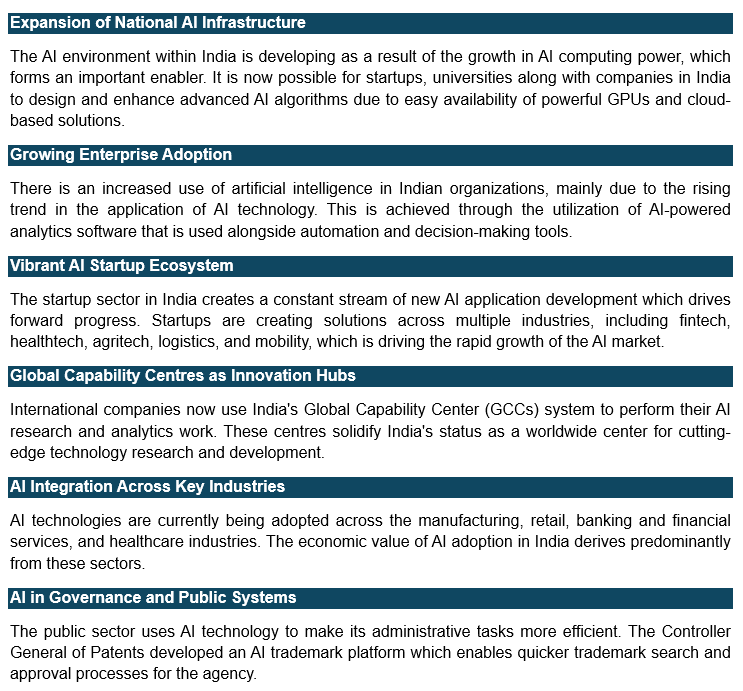
The adoption process for artificial intelligence technology across different industries is being accelerated by current key trends and developments which also develop India's artificial intelligence ecosystem.
Outlook and Road Ahead
India will advance to its next technological development stage when it transitions from Digital India to AI-based innovations. The country will experience growth in its computing infrastructure investments and startup research developments, which will help India establish itself as a global competitor in artificial intelligence research. India is likely to witness more than US$ 200 billion (Rs. 18.49 lakh crore) in AI-driven investments within the next two years due to the interest of global investors in India’s digital infrastructure and innovations in deep technology along with the development of the AI stack.
International assessments from late 2025 and early 2026 prove that India has grown into one of the leading global technology centers for AI development because the country consistently ranks among the top 3-4 countries worldwide for its AI development capabilities. The number of AI projects developed by Indian developers on GitHub establishes India as the second largest country in this field.
FAQs
What is the IndiaAI Mission?
The IndiaAI Mission is a national initiative announced in 2024 with an outlay of approximately US$ 1.25 billion (Rs. 10,371.92 crore), aimed at developing AI infrastructure, fostering innovation, and enhancing skills in India.
How large is India’s technology sector today?
India’s technology industry is likely to reach US$ 282.6 billion (Rs. 25.88 lakh crores) in FY25.
How much could AI contribute to India’s economy?
Artificial intelligence has the potential to contribute around US$ 1.7 trillion (Rs. 157.14 lakh crore) to the Indian economy by 2035.
How many AI computing resources has India deployed?
India has deployed around 38,000 GPUs under the IndiaAI Mission to support AI research, startups and enterprise innovation.
Why is India considered a strong player in AI development?
India combines a large digital economy, strong STEM talent, a thriving startup ecosystem, and supportive government policies, positioning it among the leading global AI innovation hubs.
Partners