SEARCH
RECENT POSTS
Categories
- Agriculture (37)
- Automobiles (20)
- Banking and Financial services (36)
- Consumer Markets (57)
- Defence (6)
- Ecommerce (21)
- Economy (72)
- Education (14)
- Engineering (9)
- Exports (22)
- Healthcare (25)
- India Inc. (10)
- Infrastructure (31)
- Manufacturing (32)
- Media and Entertainment (16)
- Micro, Small & Medium Enterprises (MSMEs) (16)
- Miscellaneous (31)
- Perspectives from India (37)
- Pharmaceuticals (5)
- Railways (4)
- Real Estate (20)
- Renewable Energy (19)
- Research and Development (12)
- Retail (1)
- Services (7)
- Startups (16)
- Technology (66)
- Textiles (8)
- Tourism (16)
- Trade (9)
Authors






India's Push for Self-Reliance in Advanced Technology Sectors
- Aug 14, 2026, 19:25
- Technology
- IBEF
Strategic priority on technological self-reliance in high-tech sectors is a new trend in India. The implementation of the Atmanirbhar Bharat Abhiyan since 2020 became a catalyst for the strengthening of domestic technological capabilities, and the agenda of technology self-reliance in India turned into an integrated concept covering semiconductors, artificial intelligence, electronics manufacturing, telecommunications, defence, space technology, and clean energy. This goal goes beyond the substitution of the imports and is focused on developing of indigenous innovation, reliable technology chains and competitive production ecosystems that can contribute to the country's economic development.
Growing importance of the issue of technological self-reliance was highlighted by supply chain disruptions, geopolitical challenges, and increasing competition in critical technologies. Dependency of India on imports in areas such as semiconductors, electronics components, energy technologies, and advanced manufacturing demonstrates the need to develop domestic competencies in strategic technology chains. In this regard, the Government has launched several initiatives, such as India Semiconductor Mission, IndiaAI Mission, National Green Hydrogen Mission, Production Linked Incentives schemes, Digital India, and Startup India. Having considerable investments, active startup ecosystem, advanced digital infrastructure, and large domestic market, India is positioning itself as a global hub of innovation, advanced manufacturing, and emerging technologies. With the growing movement toward the goal of Viksit Bharat 2047, technological self-reliance is expected to become an important tool for the economic and strategic independence of the country in the future.
Building Domestic Manufacturing Capabilities
India is building up domestic manufacturing capabilities in such areas as semiconductors and electronics. India Semiconductor Mission (ISM) established in December 2021 for Rs. 76,000 crore ($ 9.17 billion) is designed to create a domestic semiconductor ecosystem that includes manufacturing, advanced packaging, testing, and design of chips. Until December 2025, the program has supported 10 semiconductor projects worth Rs. 1.60 lakh crore ($ 18.11 billion) in 6 states. As for the development of semiconductor manufacturing in India, the government has already launched the program until 2026-2027 worth Rs. 8,000 crore ($ 86.96 million).
India's electronics manufacturing sector has witnessed rapid growth under initiatives such as Make in India, Atmanirbhar Bharat and the Production Linked Incentive (PLI) Scheme.
Electronics became India’s third-largest export category in FY25, rising from seventh place in FY22, with exports reaching Rs. 1,96,193.04 crore (US$ 22.2 billion) in H1 FY26, reflecting the sector’s strong growth momentum.
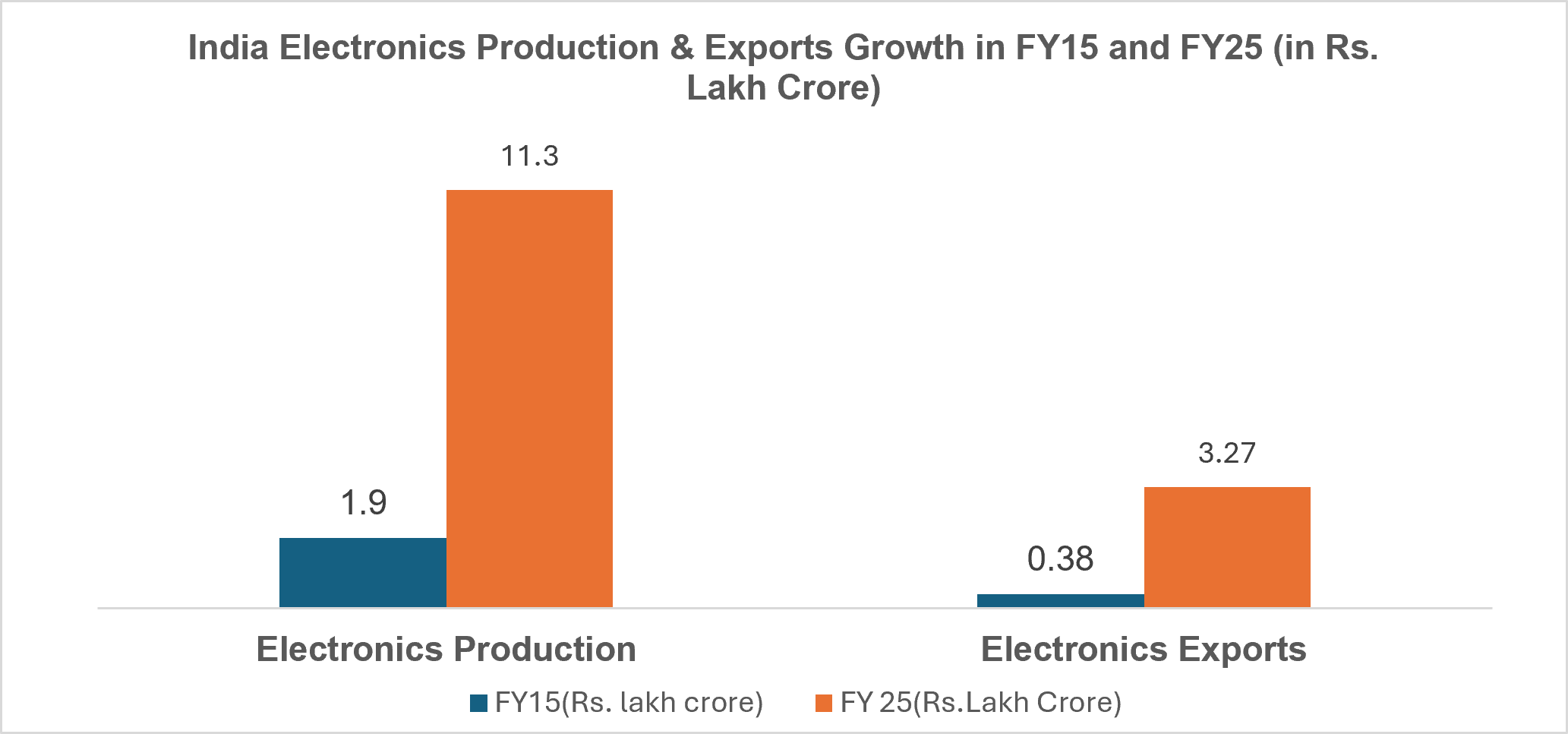
Electronics production increased from Rs. 1.9 lakh crore (US$ 22.95 billion) in FY15 to Rs. 11.3 lakh crore (US$ 127.86 billion) in FY25, while exports rose from Rs. 38,000 crore (US$ 4.59 billion) to Rs. 3.3 lakh crore (US$ 37.34 billion) during the same period.
Mobile phone production expanded from Rs. 18,000 crore (US$ 2.17 billion) to Rs. 5.5 lakh crore (US$ 62.24 billion), while mobile phone exports reached Rs. 2 lakh crore (US$ 22.63 billion) in FY25. In the first five months of FY26, smartphone exports touched Rs. 1 lakh crore (US$ 11.32 billion), representing a 55% increase compared with the corresponding period of the previous year. In calendar year 2025, smartphones emerged as India's largest exported product category, with exports valued at US$ 30.13 billion.
Supported by schemes such as PLI, SPECS, EMC 2.0 and the Electronics Components Manufacturing Scheme, whose outlay was increased to Rs. 40,000 crore (US$ 4.35 billion) in Union Budget 2026-27, India is increasingly positioning itself as a global hub for electronics manufacturing and advanced technology production.
Source: PIB
Artificial Intelligence and Digital Technologies
Artificial intelligence forms one of the key pillars of India's strategy to be self-reliant in technology, backed up by governmental funding for indigenous development of AI, computing capacity, and skills development. The IndiaAI Mission launched in March 2024 entails a budget allocation of Rs. 10,372 crore (US$ 1.17 billion) and aims to build an end-to-end ecosystem of AI around research, innovation, skilling and domestic AI solutions development.
As of February 2026, more than 38,000 GPUs have been onboarded as part of the mission, ensuring affordable access to high-performance computing for startups, researchers, and educational institutes. The Government has also shortlisted 12 teams to develop indigenous foundation models and Large Language Models (LLMs), thereby enabling India's goal of building AI solutions catering to Indian language use cases. All these efforts, coupled with India's Digital Public Infrastructure ecosystem, lay the foundations for a self-reliant digital economy.
Strategic Technologies: Defence, Space and Telecom
India has made great strides towards becoming self-reliant in strategic technologies through building domestic capacities in defence, space, and telecom sectors. Defence production achieved a record-high level of Rs. 1.50 lakh crore (US$ 16.97 billion) in FY25, while defence exports touched an all-time high of Rs. 23,622 crore (US$ 2.67 billion). By 2029, the government aims to achieve a defence production level of Rs. 3 lakh crore (US$ 33.95 billion) and defence exports of Rs. 50,000 crore (US$ 5.66 billion), enabled through defence industrial corridors, indigenisation drives, and increased private sector participation. India's space industry is growing on the back of increasing private sector participation and indigenous technologies. The size of India's space economy is expected to reach Rs. 4,04,800 crore (US$ 44 billion) by 2033 owing to various reforms introduced through IN-SPACe and the involvement of private players in satellite manufacturing, launches, and space-based applications. Meanwhile, India is developing indigenous 4G and 5G technologies, boosting telecom manufacturing, and establishing digital infrastructure under the Digital India program.
Clean Energy and Emerging Technologies
India has been making strides towards self-reliance in the realm of technologies related to the generation of clean energy by investing in renewable energy, green hydrogen, advanced battery storage, electric mobility, and nuclear power. Several government programs like National Green Hydrogen Mission, PLI schemes for solar photovoltaic modules, and Advanced Chemistry Cells (ACC) battery storage are helping the nation improve its manufacturing base without increasing the reliance on imports. India has committed to 100 GW of nuclear energy capacity by 2047, highlighting the need for 24/7 energy supply for emerging sectors like artificial intelligence, data centers, and advanced computing systems. Additionally, rising adoption of electric vehicles, development of charging infrastructure, and securing critical minerals like lithium, cobalt, and rare earth minerals are other means of developing a robust ecosystem of clean energy.
Government Initiatives Supporting Technology Self-Reliance
The Indian Government's policies have been key in advancing the technology self-reliance agenda of the country through the creation of a conducive environment for innovation, research and development, advanced manufacturing, and commercialization of technologies. Several policies like Atmanirbhar Bharat, Make in India, and Digital India have helped enhance the country's capability, encouraged the private sector, and improved the ease of doing business in strategic sectors. The reforms, infrastructure development, investment incentives, and public-private cooperation have contributed to the formation of a resilient ecosystem for technologies while decreasing the reliance on supply chains from abroad. India is also scaling up its research and development base and innovations capabilities through greater support to science, technology, and entrepreneurship. In July 2026, the Government launched Vigyan Dhara which is an integrated umbrella program of the Department of Science and Technology with an allocation of Rs. 10,579.84 crore (US$115.00 million) for 2021–26 to enhance scientific research and technology development and human resource development.
Growth Drivers and Key Trends
Outlook and Road Ahead
The pursuit of self-reliance through advanced technology industries is expected to be crucial for boosting India’s economic competitiveness, innovation, and resilience in the long run. Investments in semiconductors, artificial intelligence, telecommunication, defence technologies, clean energy, and deep tech are likely to result in building up the capacities of domestic industry along technology value chains. Government programmes, such as India Semiconductor Mission, India AI Mission, National Green Hydrogen Mission, and various Production-Linked Incentive (PLI) programs provide a strong base for industrial growth in the sphere of technologies as well as draw global investments and nurture innovation in the country. In the future, cooperation between the government, industry, universities, and startups will become critical in terms of accelerating research, innovation and technology adoption. Enhancing R&D capacities, developing talent, digital infrastructure, and emerging technologies will additionally reinforce India’s position in global technology ecosystems. With the diversification of global value chains taking place, India has all the chances to become an advanced manufacturing and technological innovation hub thus contributing to the goals of Atmanirbhar Bharat and Viksit Bharat 2047.
FAQs
What does technology self-reliance mean for India?
Technology self-reliance means the ability of India to produce the necessary technologies within the country's borders and reduce its dependence on technology imports.
What are the key sectors driving India's technology self-reliance agenda?
India is striving for technology self-reliance mainly in strategic sectors such as semiconductors, artificial intelligence, electronics manufacturing, telecommunications, defense, space technologies, renewable energy, green hydrogen, and battery storage.
How is the Government supporting technology self-reliance?
For the sake of technology self-reliance, India implements various governmental initiatives such as Atmanirbhar Bharat, Make in India, Digital India, IndiaAI Mission, India Semiconductor Mission, National Green Hydrogen Mission, Startup India, PLI schemes. These projects offer financial incentives and infrastructural support and help people develop skills.
What is the IndiaAI Mission?
IndiaAI Mission was approved in March 2024 with budgeting of Rs. 10,372 crore (about $1.09 billion) and aims to improve the infrastructure of AI, create local AI models, enhance computing power, promote skills of AI and innovation in health, agriculture, education, and governance.
What role do startups play in India's advanced technology ecosystem?
Indian startups are actively developing in fields such as artificial intelligence, semiconductors, biotechnologies, space technologies, clean energy, and other advanced technologies
Partners