SEARCH
RECENT POSTS
Categories
- Agriculture (37)
- Automobiles (20)
- Banking and Financial services (35)
- Consumer Markets (56)
- Defence (6)
- Ecommerce (21)
- Economy (72)
- Education (14)
- Engineering (8)
- Exports (21)
- Healthcare (25)
- India Inc. (10)
- Infrastructure (31)
- Manufacturing (32)
- Media and Entertainment (16)
- Micro, Small & Medium Enterprises (MSMEs) (16)
- Miscellaneous (31)
- Perspectives from India (37)
- Pharmaceuticals (5)
- Railways (4)
- Real Estate (20)
- Renewable Energy (19)
- Research and Development (12)
- Retail (1)
- Services (7)
- Startups (16)
- Technology (66)
- Textiles (8)
- Tourism (16)
- Trade (8)
Authors






Government Policies for an Open, Safe and Trusted Internet in India

- Jun 15, 2026, 16:15
- Technology
- IBEF
The digital ecosystem of India has experienced rapid growth which has made the internet essential for driving economic development, government operations and social inclusion efforts. India has more than 969.10 million internet users who have their roots in rural areas which make up almost 57% of the total user base.
The internet functions as essential infrastructure which supports multiple industries including e-commerce and digital payments and education and healthcare among other fields. Organizations face new dangers from cyber threats and misinformation while they deal with the challenges of deepfake technology. The Government of India uses an Internet policy framework which protects users by making the web space open and secure while building trust to support business growth and technological progress.
Overview of India’s Internet Sector
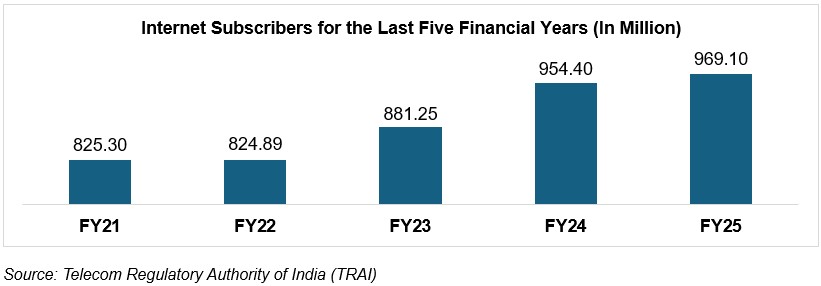
The data shows that internet subscribers in India increased steadily from 825.30 million in FY21 to 969.10 million in FY25 while experiencing a slight decline during FY22. The ongoing upward trend shows that more people in the country use digital technology because of better internet access and expanded service availability in both city and rural areas which results in stronger growth for the digital network system throughout the nation.
The internet domain of India shows increasing user activity, together with multiple digital activities that consumers follow. The wired and wireless home internet industry in India will experience continuous market expansion, since its revenue is expected to increase from US$ 12.8 billion (Rs. 1,09,632 crore) in 2024 to US$ 16.5 billion (Rs. 1,41,323 crore) in 2029, which represents a compound annual growth rate (CAGR) of 5.2%.
Digital services, which people use to communicate online through social media and digital payment systems and streaming platforms, have led to increased user engagement across digital platforms. The internet has become an essential part of everyday life, since both urban and rural people access it regularly throughout their day.
The previous policy measures which established telecom liberalisation and broadband expansion created better access, cheaper services and more market competition for customers. The digital ecosystem which exists today resulted from dedicated efforts which established digital infrastructure and created policies to operate through private businesses.
India's digital economy will keep growing due to higher investment levels, ongoing technological breakthroughs and supportive government regulations.
Government Initiatives and Policies
- India establishes its framework for maintaining an open and secure and trustworthy internet through legislative measures and regulatory oversight and institutional mechanisms.
- The Information Technology Act, 2000 establishes the legal framework for digital governance and cybersecurity and electronic transactions. It enables authorities to instruct intermediaries and data centres and service providers about security standards which they must follow, while penalties for non-compliance serve to ensure accountability.
- The Indian Computer Emergency Response Team (CERT-In) operates as the national organization that tracks cyber threats and sends alerts and manages cyber incident responses, according to this framework. The organization creates guidelines and advisory documents which help various sectors develop better cybersecurity practices.
- The Information Technology (Intermediary Guidelines and Digital Media Ethics Code) Rules, 2021 establish platform accountability through their implementation. The rules require intermediaries to conduct due diligence, establish grievance officers, and create systems for managing illegal content, which results in better protection for users.
- The National Cyber Security Policy, 2013 complements this framework by focusing on protecting critical information infrastructure, enhancing resilience and building trust in digital systems.
- The CERT-In Cyber Security Directions (April 2022) enhance enforcement through their requirements for organizations to report cyber incidents immediately and keep system logs and improve operational cooperation with other service providers.
- The government has issued advisories that instruct social media platforms about new threats, which include deepfakes and misinformation, while promoting proper platform behaviour.
- The Digital India initiatives which include BharatNet and the Public Internet Access Programme have successfully expanded connectivity to rural and remote areas which now have access to internet services.
The combined efforts of these initiatives demonstrate an integrated method for internet governance that achieves a balance between open access and secure systems while building user confidence and improving system durability.
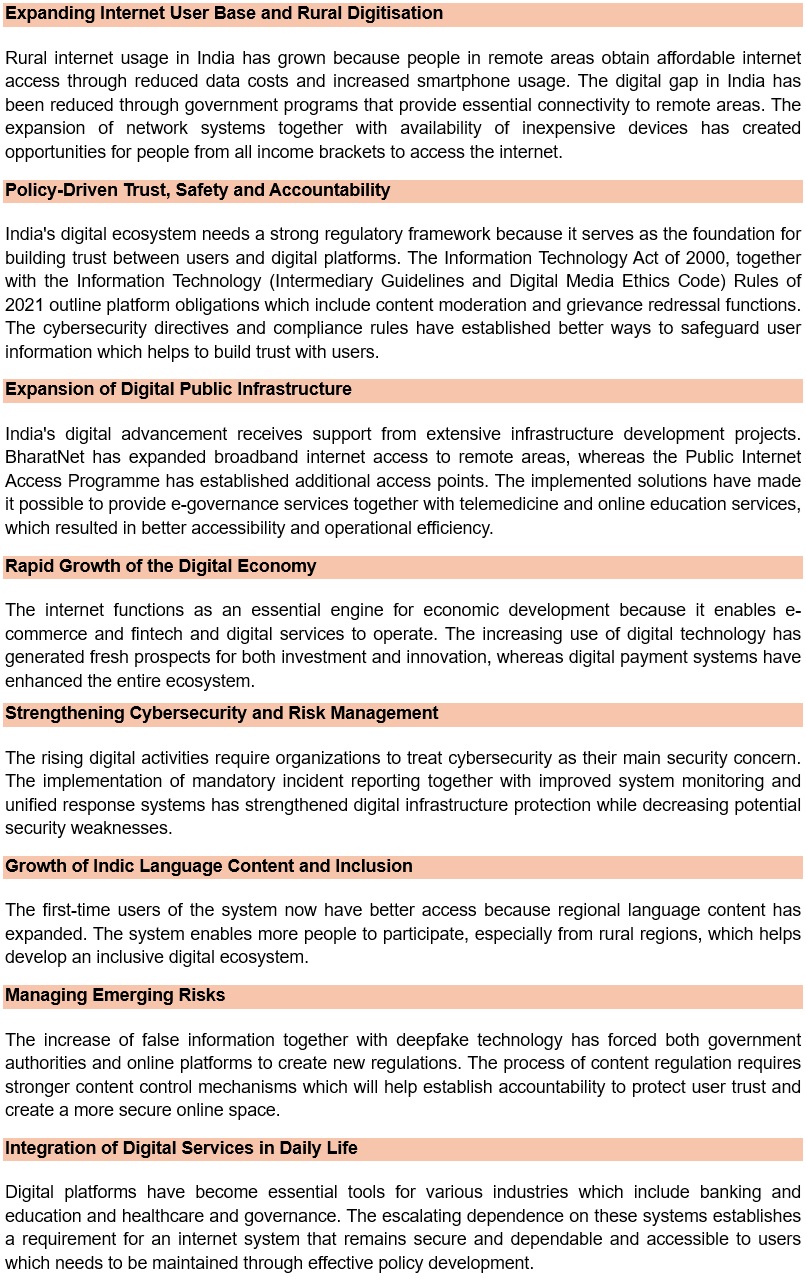
Growth Drivers and Trends
The Road Ahead
India will develop its internet governance system through upcoming technological developments and rising digital usage. Future policy directions are expected to focus on areas such as data protection, artificial intelligence governance and cross-border digital frameworks.
The organization will continue to prioritize two objectives which include improving cybersecurity and increasing regulatory transparency and holding digital platforms responsible for their actions. The organization requires ongoing infrastructure development and digital education funding to achieve sustainable development for all its members.
The digital ecosystem presents increasing complexity which requires organizations to find solutions that protect security while promoting innovation and maintaining system accessibility. India uses its policy-driven framework to take advantage of digital opportunities while protecting both user data and system security.
FAQs
What is meant by an open, safe and trusted internet?
It refers to an internet ecosystem that promotes accessibility while ensuring safety, data protection and accountability.
Which law governs internet regulation in India?
The Information Technology Act, 2000 is the primary law governing digital activities.
What are the Intermediary Rules, 2021?
The Information Technology (Intermediary Guidelines and Digital Media Ethics Code) Rules, 2021 require digital platforms to follow due diligence, appoint grievance officers and ensure accountability for user content.
What is the role of CERT-In?
CERT-In monitors cyber threats, issues advisories and coordinates responses to cyber incidents.
How is the government improving internet access?
The government is improving internet access through initiatives such as BharatNet and the Public Internet Access Programme.
What is the future of internet governance in India?
Future policies will focus on data protection, AI regulation and strengthening cybersecurity frameworks.
Partners