SEARCH
RECENT POSTS
Categories
- Agriculture (39)
- Automobiles (20)
- Banking and Financial services (36)
- Consumer Markets (57)
- Defence (6)
- Ecommerce (21)
- Economy (72)
- Education (14)
- Engineering (9)
- Exports (22)
- Healthcare (25)
- India Inc. (10)
- Infrastructure (31)
- Manufacturing (33)
- Media and Entertainment (17)
- Micro, Small & Medium Enterprises (MSMEs) (16)
- Miscellaneous (31)
- Perspectives from India (37)
- Pharmaceuticals (5)
- Railways (5)
- Real Estate (20)
- Renewable Energy (19)
- Research and Development (12)
- Retail (1)
- Services (7)
- Startups (16)
- Technology (66)
- Textiles (8)
- Tourism (16)
- Trade (9)
Authors






How Data Centres Are Becoming the Backbone of India’s Digital Economy

- Jun 04, 2026, 18:35
- Technology
- IBEF
India’s digital transformation over the past decade has been driven by three key factors: widespread internet access, a mobile-first consumption pattern, and the rapid expansion of digital public infrastructure. However, a less visible but critical enabler of this transformation is data centres. They provide the common infrastructure for cloud platforms, digital payments ecosystems, OTT services, enterprise applications, and artificial intelligence workloads. As digital economy expands, data centres are shifting from being supporting infrastructure to critical national infrastructure, with reliability, security and scalability directly affecting economic outcomes.
Significance of Data Centres
Data centres serve as the fundamental components that maintain digital system operations and entire digital infrastructure. The data centres maintain responsiveness to citizens because it supports high-traffic services, including payments, content delivery and e-governance services. The data centres help businesses adopt cloud services while providing analytics and software delivery at large scale, reduces the risk of downtime while enhancing their system reliability. The economic impact of data centres extends beyond their operations because they attract investments into power, fibre and real estate while creating new needs for specialized engineering, operations. cybersecurity skills. In parallel, data governance is tightening. India’s Digital Personal Data Protection Act, 2023, strengthens trust in data processing and cross-border transfers, increasing the importance of compliant and well-governed hosting environments.
Market Outlook and Industry Overview
Around the world, data centres have become a big source of investment and economic growth. United Nations Conference on Trade and Development (UNCTAD) reports that in 2025, data centres made up over 20% of the total value of new global projects, with planned investments of around US$ 270 billion (~Rs. 25 lakh crore). As demand for AI computing and data-heavy digital services increases, countries are competing more aggressively to attract these data centre investments.
Data centres, particularly those designed for AI workloads, have become a critical component of modern digital infrastructure. In India, nearly US$ 70 billion (Rs. 6.48 lakh crore) worth of data centre projects are currently under development, with an additional US$ 90 billion (Rs. 8.33 lakh crore) announced. This underscores the rapid growth of the sector and the scale of its upcoming expansion.
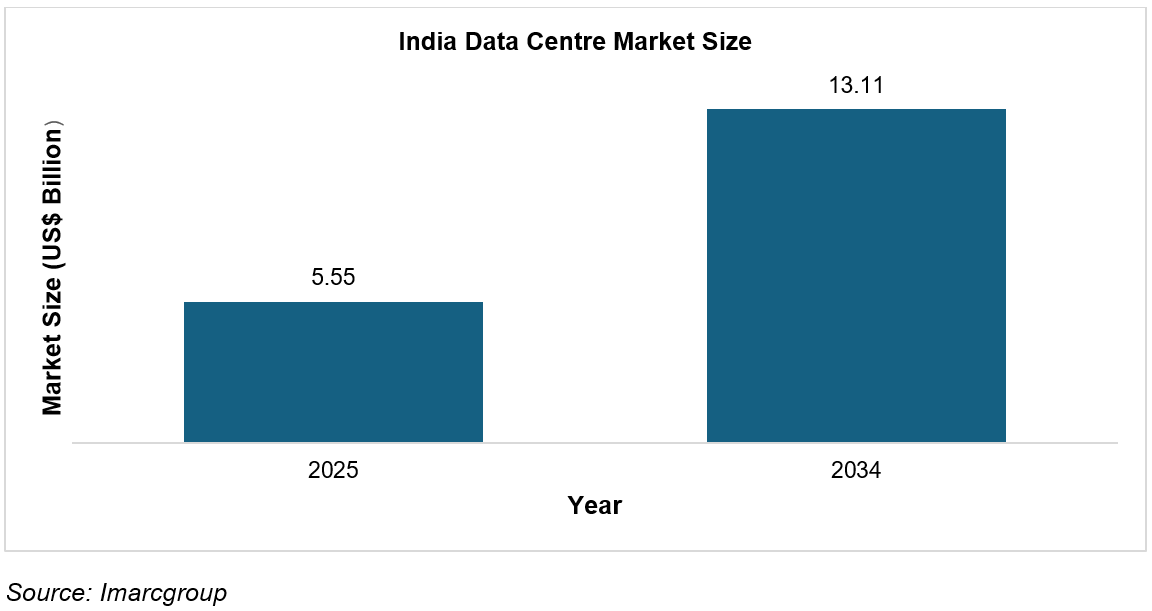
The India data centre market was valued at US$ 5.55 billion (Rs. 46,065 crore) in 2025 and is projected to reach US$ 13.11 billion (Rs. 108,813 crore) by 2034, growing at a CAGR of 10.01% during 2026–2034. India’s IT load capacity is estimated at around 1.2-1.3 GW and is expected to expand significantly as demand for cloud computing, data storage and Artificial Intelligence (AI) applications increases. Commercial real estate and infrastructure advisors similarly emphasise that accelerating cloud adoption and AI use cases are drawing global interest and positioning India as a priority market for data centre investment.
Government Initiatives and Policies
In the Union Budget FY27, the Government announced a major step to boost India’s digital infrastructure. Since cloud computing, AI data centres and advanced electronics are becoming essential for economic growth, the Government has introduced a tax holiday up to 2047 for foreign cloud service companies that operate through data centres located in India. This move aims to attract more global players and strengthen India’s role as a leading digital hub. As the global need for AI computing power grows quickly, many countries are trying to attract large data centre investments. India’s tax holiday until 2047 is designed to give long-term stability and confidence to foreign cloud companies. This policy aims to draw major global providers to set up operations in India and ensure that important digital infrastructure stays within the country. The tax exemption applies from FY27 to FY47, giving global cloud companies a long period of tax stability and making India a more attractive destination for data centre investments.
The Budget has announced India Semiconductor Mission (ISM) 2.0, expanding on previous efforts to build semiconductor manufacturing capability within the country. The new phase focuses on strengthening India’s core electronics ecosystem and supporting the technologies that power digital infrastructure. For FY27, the Government has allocated around US$ 108 million (Rs 1,000 crore) for ISM 2.0. This initiative aims to boost semiconductor and electronics production critical components required for data centres, AI systems and advanced computing.
Data centres are becoming critical to public policy due to their role in the nexus between digitization, data management, and national security. The Government has considered data centres as central pillars of India’s digital infrastructure and linked their expansion to rising demand for cloud computing and Artificial Intelligence (AI) and Machine Learning (ML). The Telecom Regulatory Authority of India (TRAI) has dedicated its regulatory efforts to developing the data centre ecosystem while reducing regulatory barriers to infrastructure development. The Digital Personal Data Protection Act, 2023 provides a legal framework for regulating personal data and cross-border data flows, thereby building investor confidence. The synergy between policy directions, regulatory advice, and data protection laws enhances predictability for investments in data centre facilities.
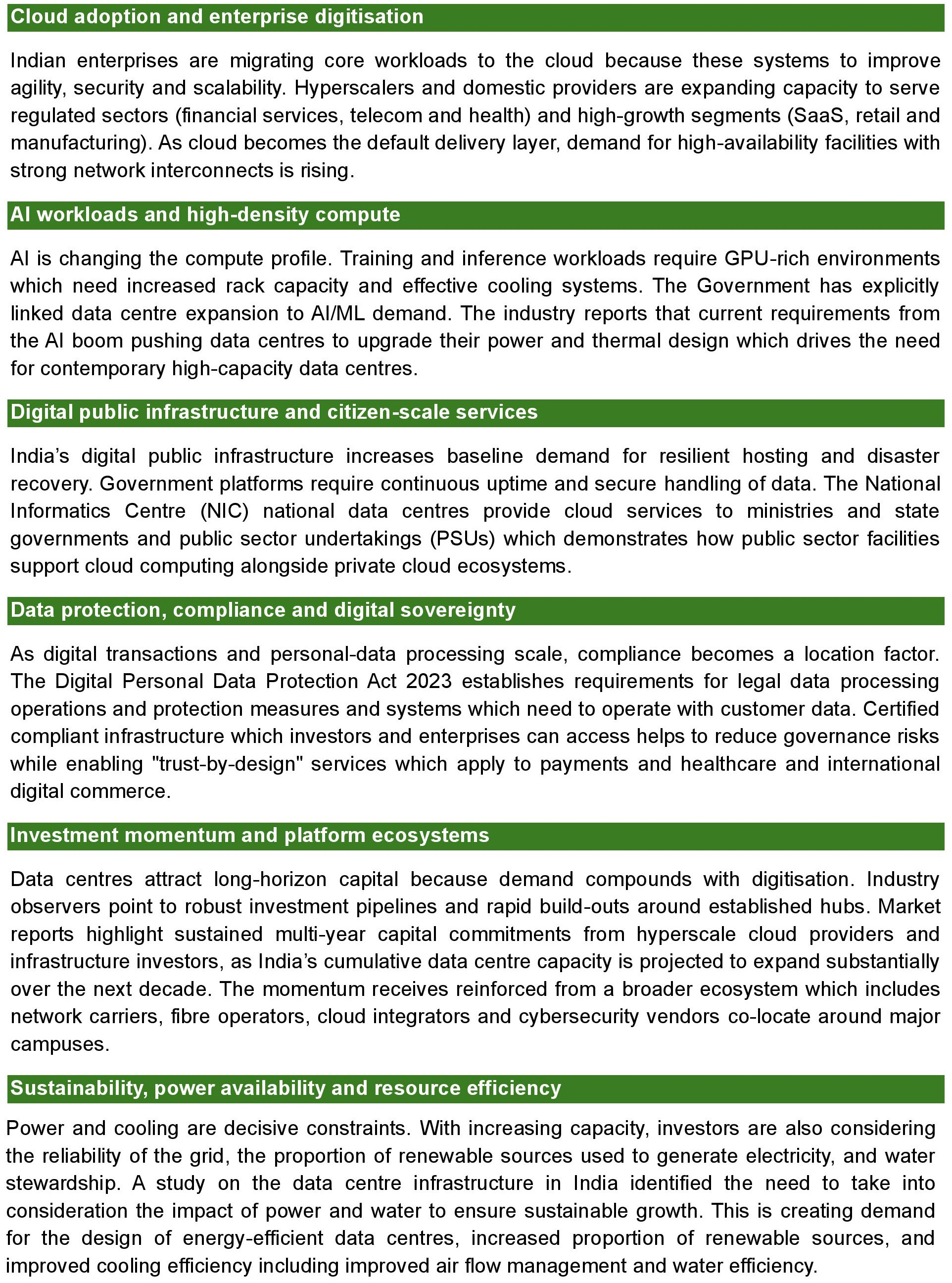
Factors Driving Growth of Data Centres
The Road Ahead
India's upcoming digital expansion will rely on artificial intelligence implementation and cloud-first business operations and instant payment systems and advanced media technology. The evaluation of data centres will progress to recognize them as essential infrastructure components which determine their operational efficiency and service reliability and customer confidence. The current focus of the organization is to expedite the process of obtaining regulatory approvals while preparing utilities for operations and developing extended fibre networks and enhancing grid capacity and renewable energy systems to support high-density campuses. The development of infrastructure will eventually spread from major cities to new areas which possess suitable land and electricity and networking resources needed for edge computing and local redundancy. The establishment of data centres in India will support secure and sustainable and competitive digital economy growth if infrastructure development matches increasing digital demands.
FAQs
Why are data centres described as the backbone of the digital economy?
Data centers are referred to as the backbone of the digital economy, considering that applications like cloud computing, digital payments, electronic governance systems, streaming, and artificial intelligence require a robust computing and storage infrastructure.
What is India’s data centre market size?
IMARC estimates the Indian data centre market at US$ 5.55 billion in 2025, projected to reach US$ 13.11 billion by 2034.
What policy signals support data centre growth?
The growth of data centers is associated with the demand for cloud, storage, and artificial intelligence/machine learning, whereas TRAI has made recommendations to enhance the ecosystem and minimize infrastructure friction.
How does DPDP 2023 affect data centres?
The Digital Personal Data Protection Act, 2023, increases the importance of compliant hosting and accountable data processing, strengthening demand for well-governed infrastructure.
What is the biggest constraint to rapid scaling?
Power and cooling. Sustainable scaling requires reliable grid supply, renewable integration and resource-efficient cooling and water management.
Partners