SEARCH
RECENT POSTS
Categories
- Agriculture (38)
- Automobiles (20)
- Banking and Financial services (36)
- Consumer Markets (57)
- Defence (6)
- Ecommerce (21)
- Economy (72)
- Education (14)
- Engineering (9)
- Exports (22)
- Healthcare (25)
- India Inc. (10)
- Infrastructure (31)
- Manufacturing (32)
- Media and Entertainment (17)
- Micro, Small & Medium Enterprises (MSMEs) (16)
- Miscellaneous (31)
- Perspectives from India (37)
- Pharmaceuticals (5)
- Railways (4)
- Real Estate (20)
- Renewable Energy (19)
- Research and Development (12)
- Retail (1)
- Services (7)
- Startups (16)
- Technology (66)
- Textiles (8)
- Tourism (16)
- Trade (9)
Authors






Electric Vehicle Charging Infrastructure: The Key to Mass EV Adoption in India
- May 15, 2026, 18:00
- Renewable Energy
- IBEF
India’s electric vehicle (EV) sector has progressed beyond the testing phase. Electric two-and three-wheelers, and even electric buses, have become a common sight across India. Passenger EVs are gaining momentum, driven by manufacturers’ increasing focus on the price-sensitive segment and advancements in faster charging technologies. Enhanced accessibility and convenience of charging infrastructure are emerging as key enablers for EV adoption among potential buyers.
Why Charging Infrastructure Matters for EV Adoption
The confidence in the ecosystem of electric vehicles depends greatly on the presence of appropriate charging infrastructure. Consumers are concerned about the availability and reliability of charging infrastructure, which may lead to fears of being stranded without sufficient charge. As a result, studies indicate that fleet operators may take longer to adopt electric vehicles, while financiers may perceive higher investment risks in the sector. Road transportation serves as the primary mode for 90% of India's population and 64% of its goods movement. Therefore, decarbonising mobility relies heavily on scaling EVs and grid-ready charging stations.
Market Outlook and Industry Overview
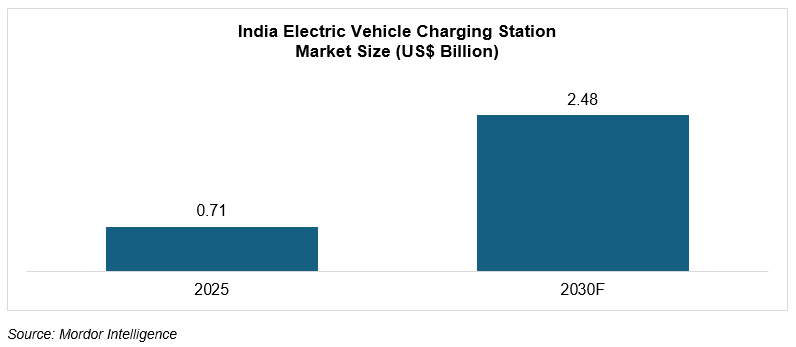
The India electric vehicle charging station market was valued at US$ 0.71 billion (Rs. 6,139 crore) in 2025 and is predicted to reach US$ 2.48 billion (Rs. 21,940 crore) by 2030F, expanding at a CAGR of 28.50% from 2025 to 2030F.
The installation of electric vehicles' charging stations in India has grown rapidly in recent years because of the electric mobility solutions prioritized by the country. According to CareEdge Ratings, the number of public EV charging stations increased from 5,151 in 2022 to 26,367 in the beginning of FY25, indicating the compounded annual growth rate of approximately 72%. India faces a significant shortfall of charging stations that are required for providing an adequate number of charging points for electric vehicles operating in the country.
In October 2024, the total number of charging stations in India was around 25,000, the majority of which were located in the state of Karnataka, followed by Maharashtra and Delhi. At the end of December 2025, the Indian government published data, stating that there were 29,151 EV charging stations installed in the past five years. This included 8,805 fast chargers and 20,346 slow chargers. The charging types used in India indicate that mostly two and three-wheelers utilize AC chargers, whereas commercial vehicles require fast DC chargers.
The charging network is developing at a fast pace, but the infrastructure needs further investment together with strategic development to match the rising demand from electric vehicle adoption in India.
Under FAME II, the Department of Heavy Industry sanctioned 2,636 charging stations across 62 cities in 24 states and union territories. Separately, a Rajya Sabha reply (via published annexure) noted that 1,576 charging stations have been sanctioned across nine expressways and 16 highways under FAME II. On the demand side, the affordable segment dominates India’s car market, with budget vehicles accounting for around 65% of annual sales of 4.6 million cars. However, low EV penetration highlights the need for mass-market offerings and expanded charging infrastructure.”
Policy Framework Supporting Charging Infrastructure
The process of establishing regulations has progressed at a constant pace throughout time. The Ministry of Power framework permits private companies to establish public charging stations because it classifies this activity as a non-licensed operational activity, which enables private companies to build charging stations according to existing regulations. The updated consolidated guidelines and their amendments, which the Bureau of Energy Efficiency published, have developed better standards and operational compatibility.
The New Electric Vehicle Policy 2024 establishes a new major direction that will help global electric vehicle manufacturers to establish their operations through a reduced customs duty system which requires them to meet certain minimum investment and local value creation requirements. Localisation improvements in vehicle manufacturing will help reduce system expenses while making additional market segments accessible and enhancing charging station performance.
The funding and programme design processes are undergoing changes. The government reported in December 2025 that 9,097 charging stations had been installed under FAME II, and 479 charging stations had been installed under FAME I. The government allocated US$ 240 million (Rs. 2,000 crore) under the PM E-DRIVE scheme to support nationwide deployment according to operational guidelines which were released on September 26, 2025. The current transition indicates that the charging ecosystem is entering its next phase, characterized by the expansion of standardized solutions and a stronger focus on practical implementation.
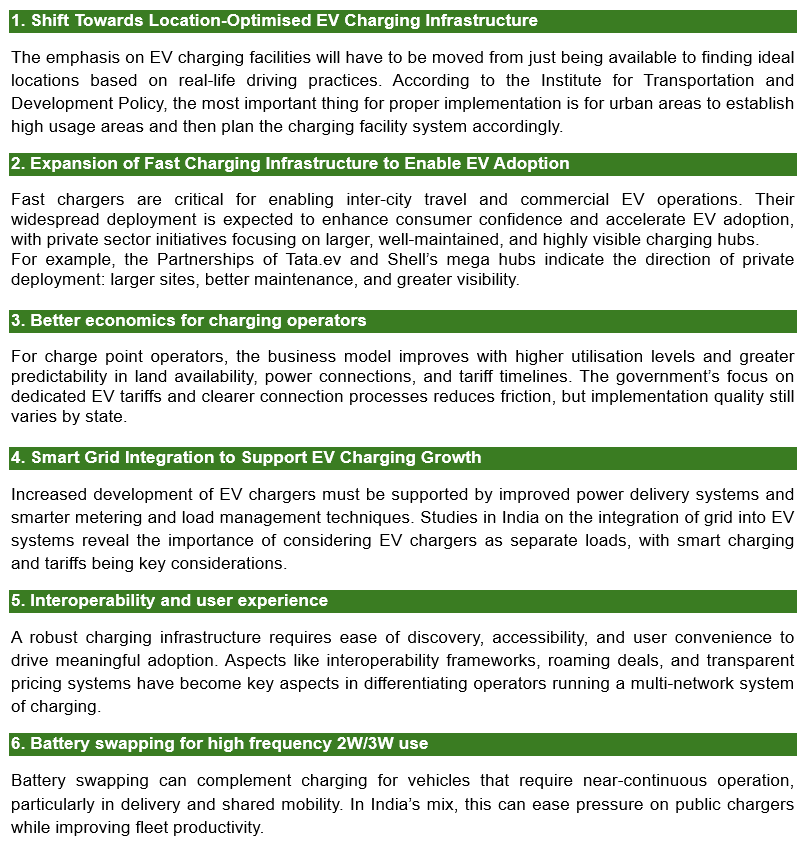
Key Growth Drivers and Emerging Trends
Outlook and Road Ahead
Some of the most important factors enabling mass adoption include the provision of easy-to-use, widely available, reliable, and reasonably priced charging systems. Direction through policies suggests that India is heading in the direction of large-scale development and standardization, with PM E-DRIVE being considered as the next stage of development.
As electric vehicle sales increase, charging infrastructure is expected to transition from being viewed as a cost centre to an investment opportunity. Making the process of charging seamless, available, predictable, and affordable will be one of the major enablers of widespread acceptance. The policy direction suggests that India is on track to achieving economies of scale and standardization in this area. There is a considerable potential for growth, which is dictated by the necessity to ensure the availability of a comprehensive system of charging infrastructure, covering hardware, software, services, green energy and charging in depot and urban centres. The focus here is on the creation of AC infrastructure of charging stations in residential areas and parking lots at workplaces. At the same time, it is essential to focus on the adequate distribution and effective management of fast-charging infrastructure along highways. The next phase is likely to involve strengthening grid capacity, supported by measures such as time-of-use pricing, demand response technologies, and intelligent charging infrastructure The future of the charging ecosystem in India will play a role of a key driver of economic growth.
FAQs
How many EV charging stations does India have?
In December 2025, the total EV charging station stood at 29,151.
How many charging stations are planned under government schemes?
Under FAME II, 2,636 stations were sanctioned across 62 cities, and 1,576 were sanctioned across nine expressways and 16 highways.
Are private companies allowed to set up charging stations?
Yes. Government guidance treats EV charging as a delicensed activity, allowing private players to install public charging stations in accordance with the Ministry of Power's guidelines.
Why do slow chargers still matter if fast charging is expanding?
Slow and moderate AC charging is often the most practical solution for 2W/3W users and for overnight residential charging. Fast charging is vital for highways and fleets, but AC density solves daily convenience.
What is the market outlook for EVs in India?
The Indian EV market was valued at US$ 2.36 billion (Rs. 21,476 crore) in 2024 and is projected to grow to US$ 164.42 billion (Rs. 14.96 lakh crore) by 2033, at a CAGR of 57.23%.
Partners




