SEARCH
RECENT POSTS
Categories
- Agriculture (40)
- Automobiles (21)
- Banking and Financial services (36)
- Consumer Markets (59)
- Defence (6)
- Ecommerce (21)
- Economy (72)
- Education (14)
- Engineering (9)
- Exports (22)
- Healthcare (25)
- India Inc. (11)
- Infrastructure (31)
- Manufacturing (34)
- Media and Entertainment (17)
- Micro, Small & Medium Enterprises (MSMEs) (16)
- Miscellaneous (31)
- Perspectives from India (37)
- Pharmaceuticals (5)
- Railways (5)
- Real Estate (20)
- Renewable Energy (19)
- Research and Development (12)
- Retail (2)
- Services (8)
- Startups (16)
- Technology (66)
- Textiles (8)
- Tourism (16)
- Trade (9)
Authors






From Imports to Innovation: How Indian Businesses Are Building More Local Supply Chains
- Nov 06, 2026, 18:30
- India Inc.
- IBEF
Indian companies have been able to substitute their imports with locally made products, thanks to a policy framework that incentivizes local value additions as opposed to assembling only. Indian manufacturing makes up for about 16-17% of India’s GDP and employs 27 million people. The most noticeable feature of this growth story is the emergence of local sourcing of inputs in electronics, pharma, defense, automobile and solar energy industries, where before India was importing a significant amount of its needs.
Through the Production Linked Incentives (PLIs) for 14 sectors worth of Rs. 1.97 lakh crore (US$ 26.91 billion), India has managed to generate investments of over Rs. 2.40 lakh crore (US$ 27.16 billion), export proceeds of more than Rs. 15.20 lakh crore (US$ 171.99 billion) and over 14.15 lakh direct and indirect jobs as of March 31, 2026. A new set of PLIs in 2025 and 2026 that includes the Electronics Components Manufacturing Scheme (ECMS), Mobile Phone Manufacturing Scheme (MPMS), Semicon India Programme 2.0 and rare earth permanent magnet scheme has targeted component manufacturing upstream in the value chain.
A Policy Architecture Built Around Domestic Value Addition
The outlay of the ECMS increased from Rs. 22,919 crore (US$ 2.59 billion) when it was launched in April 2025 to Rs. 40,000 crore (US$ 4.22 billion) in the Union Budget 2026-27, which also announced the India Semiconductor Mission 2.0 with emphasis on equipment, materials and full-stack Indian intellectual property and proposed rare earth corridors in Odisha, Kerala, Andhra Pradesh and Tamil Nadu.
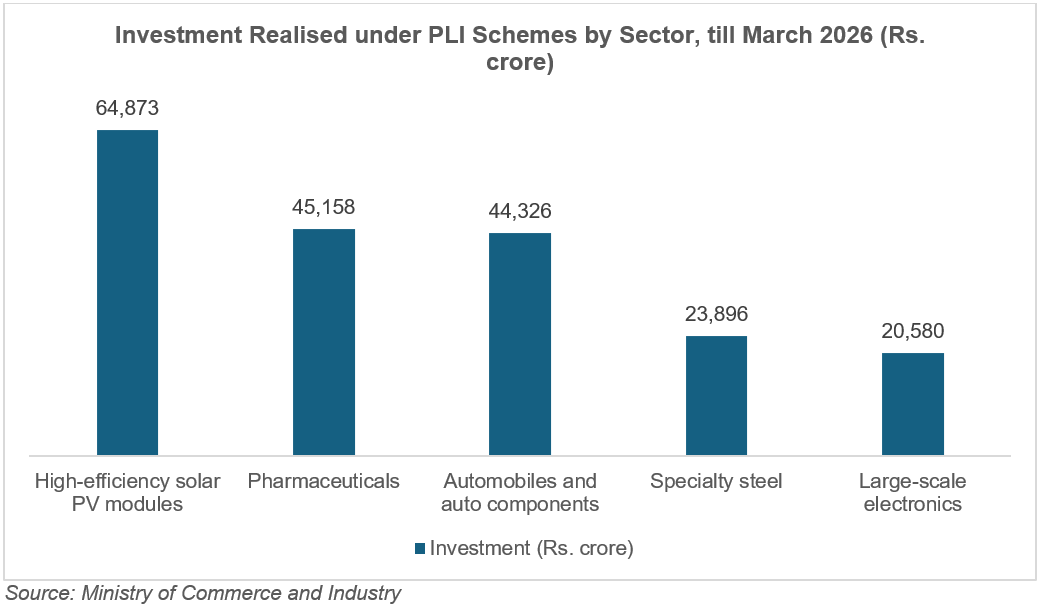
The MPMS, approved by the Union Cabinet on July 15, 2026, with an outlay of Rs. 62,500 crore (US$ 6.60 billion) for 2026-27 to 2030-31, illustrates this shift in design: it provides base incentives of 2.25-5% on eligible sales besides additional incentives up to 1.5% for sourcing of key components/sub-assemblies from domestic manufacturers and 3% for product design and research and development (R&D). The PLI scheme for automobiles and auto components, which requires a minimum of 50% domestic value addition, had attracted investment of Rs. 44,326 crore (US$ 5.02 billion) and created 67,820 jobs by March 2026 against an outlay of Rs. 25,938 crore (US$ 3.49 billion).
Electronics: From Assembly to Components
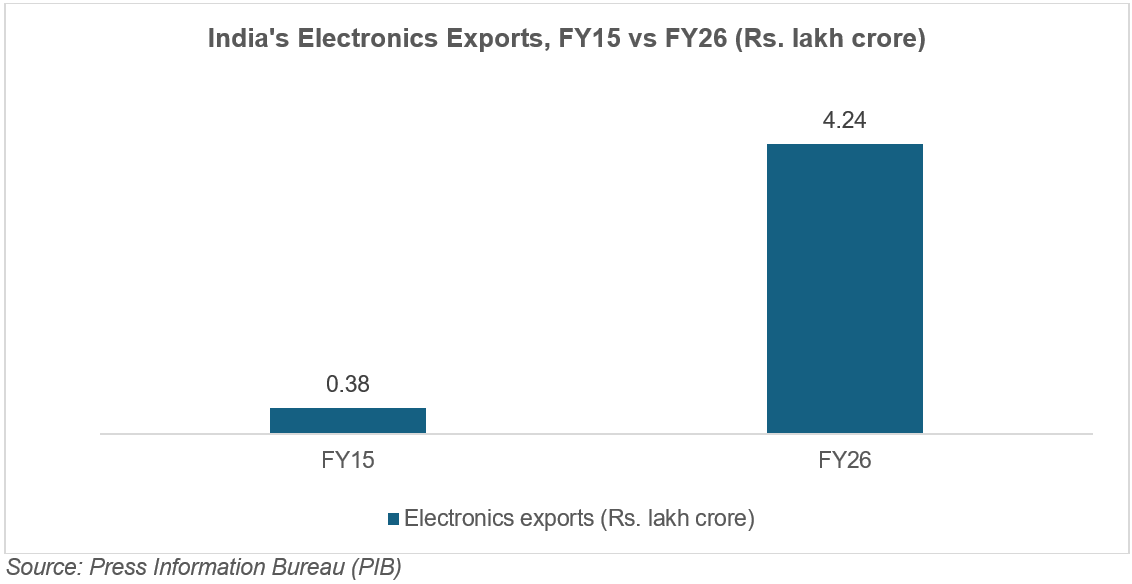
Electronics is the clearest example of the transition from imports to local manufacturing. Electronics production rose from about Rs. 1.90 lakh crore (US$ 31.07 billion) in FY15 to Rs. 13.11 lakh crore (US$ 148.34 billion) in FY26, while exports grew 11-fold from about Rs. 38,000 crore (US$ 6.21 billion) to Rs. 4.24 lakh crore (US$ 47.98 billion) over the same period. Mobile phones, which were largely imported a decade ago, are now manufactured domestically for 99.2% of the Indian market, with production of Rs. 6.27 lakh crore (US$ 70.95 billion) and exports of Rs. 2.59 lakh crore (US$ 29.30 billion) in FY26.
The subsequent step is to increase domestic value addition from the level of about 23% in FY24 for mobile phones through manufacturing of the components that used to be imported. Under the ECMS, 106 projects with investment of Rs. 69,548 crore (US$ 7.34 billion) and expected production of Rs. 5,34,101 crore (US$ 56.39 billion) had been approved across 15 states until August 17, 2026, creating 74,628 direct jobs, and 38 plants have already started manufacturing.
Pharmaceuticals: Securing Critical Inputs
India is the third-largest producer of pharmaceuticals by volume and supplies 20% of the world's generic medicines. The pharmaceutical industry is now developing domestic capacity for inputs such as active pharmaceutical ingredients (APIs) and key starting materials (KSMs), which were historically imported. Three PLI schemes for the pharmaceutical industry, with a combined outlay of Rs. 25,360 crore (US$ 3.46 billion), have received investment of Rs. 51,997 crore (US$ 5.88 billion) and have achieved cumulative sales of Rs. 3.88 lakh crore (US$ 43.90 billion) with exports worth over Rs. 2.43 lakh crore (US$ 27.50 billion) until August 2026.
Through the PLI scheme for pharmaceuticals, over 190 APIs and drug intermediates are being manufactured for the first time in India, while the PLI scheme for bulk drugs has sanctioned 48 projects for 33 critical drugs with investments worth Rs. 4,814 crore (US$ 544.72 million) against an initial commitment of Rs. 4,322 crore and avoiding imports worth about Rs. 2,190 crore (US$ 247.81 million). Penicillin and clavulanic acid, which were entirely imported until recently, are now manufactured locally and have begun to be exported.
Defence, Automobiles and Solar: Scaling Indigenous Capacity
Defence manufacturing has moved from import dependence to a growing export base. Indigenous defence production grew from Rs. 1,54,071 crore (US$ 18.22 billion) in FY25 to Rs. 1.78 lakh crore (US$ 20.14 billion) in FY26, a growth of 15.6%. The share of the private sector in domestic production was 24%, and defence exports increased from Rs. 686 crore (US$ 113.39 million) in FY14 to Rs. 38,424 crore (US$ 4.35 billion) in FY26, reaching more than 80 countries. Ten Positive Indigenisation Lists covering 5,521 items had been notified until May 2026, and every item has a specified timeline after which it can be procured only from Indian industry.
Within the automobile sector, there was an increase in production from 22.65 million units in FY21 to 31.03 million units in FY25. In the domain of solar power, the solar module manufacturing capacity in terms of ALMM has grown from 2.3 GW in 2014 to 100 GW by August 2025. There was an increase in the cell manufacturing capacity from below 1.2 GW in 2014 to 25 GW by March 2025 through the help of PLI scheme for high-efficiency solar modules that awarded 48 GW of capacity against Rs. 24,000 crore (US$ 3.05 billion) of total allocation.
Critical Materials and Quality Standards
Availability of critical materials and quality standards within the local supply chain are also crucial. The scheme for integrated manufacturing of sintered rare earth permanent magnets, approved on November 26, 2025, with an outlay of Rs. 7,280 crore (US$ 823.76 million), will create 6,000 tonnes per annum of capacity across five beneficiaries selected through global competitive bidding, addressing a requirement that is currently met mostly through imports and is expected to double by 2030.
Quality Control Orders introduced through the Bureau of Indian Standards along with carefully calibrated import tariffs have changed the dynamics of sourcing in consumer industry segments. In toys, where a Quality Control Order was introduced in 2020 and import duty was raised to 70% in 2023, imports fell by 79% from Rs. 2,125 crore (US$ 304 million) in FY19 to Rs. 538 crore (US$ 65 million) in FY24 and exports increased by 40% to Rs. 1,258 crore (US$ 152 million), making India a net exporter of toys, according to a Punjab National Bank research report.
Outlook and Road Ahead
India's supply chains are expected to deepen further as second-generation schemes move from approval to production. The domestic sourcing incentives embedded in the MPMS and the 50% value addition threshold in the automobile PLI will continue to direct new capacity towards components rather than assembly. The foreign direct investment in the electronics sector from 2020-21 till date stands at over Rs. 35,350 crore (US$ 4 billion), out of which 70% comes from PLI beneficiaries. The combination of the policies, standards and investments makes India capable of meeting its demand through domestic production and participating in the value chain not as a product supplier but component/materials supplier.
FAQs
What has the PLI scheme achieved so far?
According to the Ministry of Commerce and Industry, the investment created in the 14 different sectors through the PLI scheme till 31st March 2026 stood at over Rs. 2.40 lakh crore (US$ 27.16 billion), while the export performance stood at more than Rs. 15.20 lakh crore (US$ 171.99 billion), and creation of jobs stood at 14.15 lakh direct and indirect jobs.
What is the Electronics Components Manufacturing Scheme (ECMS)?
ECMS was launched in April 2025 and further increased to Rs. 40,000 crore (US$ 4.22 billion) in Union Budget 2026-27. It aims at promoting the manufacture of electronics components, sub-assemblies and supply chain inputs and as on August 2026, there have been sanctioning of 106 projects worth investment of Rs. 69,548 crore (US$ 7.34 billion).
How far has India reduced its dependence on imported mobile phones?
Around 99.2% of the mobile phones used in India are now manufactured in the country, and mobile phone production increased from around Rs. 18,000 crore (US$ 2.94 billion) in FY15 to Rs. 6.27 lakh crore (US$ 70.95 billion) in FY26 with the export value of Rs. 2.59 lakh crore (US$ 29.30 billion).
How is India building local supply chains in pharmaceuticals?
Under the PLI schemes related to the pharmaceutical industry, over 190 APIs and drug intermediates are being manufactured in India for the first time; 48 bulk drug projects of 33 critical drugs have been approved along with the development of three bulk drug parks in Andhra Pradesh, Gujarat and Himachal Pradesh.
What is the rare earth permanent magnet scheme?
The rare earth permanent magnet scheme was approved on November 26, 2025, with an outlay of Rs. 7,280 crore (US$ 823.76 million), and will set up manufacturing capacity of 6,000 tonnes per annum of rare earth permanent magnets.
Partners