SEARCH
RECENT POSTS
Categories
- Agriculture (39)
- Automobiles (21)
- Banking and Financial services (36)
- Consumer Markets (58)
- Defence (6)
- Ecommerce (21)
- Economy (72)
- Education (14)
- Engineering (9)
- Exports (22)
- Healthcare (25)
- India Inc. (10)
- Infrastructure (31)
- Manufacturing (33)
- Media and Entertainment (17)
- Micro, Small & Medium Enterprises (MSMEs) (16)
- Miscellaneous (31)
- Perspectives from India (37)
- Pharmaceuticals (5)
- Railways (5)
- Real Estate (20)
- Renewable Energy (19)
- Research and Development (12)
- Retail (1)
- Services (8)
- Startups (16)
- Technology (66)
- Textiles (8)
- Tourism (16)
- Trade (9)
Authors






Growth of Decorative Construction Materials in India’s Real Estate Sector
- Jun 08, 2026, 11:00
- Real Estate
- IBEF
The growth of India's decorative construction materials market which includes paints, ceramic tiles and interior surface materials is expanding steadily due to rising demand for residential construction and renovation projects. For instance, The India paints & coatings industry was valued at US$ 10.46 billion (Rs. 93,094 crore) in 2025 and is projected to reach US$ 16.38 billion (Rs. 1,45,782 crore) by 2030. The decorative paints market holds the biggest market share driven largely by demand from residential construction and home improvement activities. Housing construction and interior renovation work drive the rapid growth of ceramic tiles which represent a decorative materials segment. For Instance, India’s ceramic tile industry was valued at approximately US$ 6.99 billion (Rs. 62,000 crore) in FY24, supported by domestic consumption of nearly 200 crore square meters valued at around US$ 4.73 billion (Rs. 42,000 crore), while exports accounted for about 59 crore square meters with a value of US$ 2.25 billion (Rs. 20,000 crore). Residential projects accounted for over 70% of tile demand in the country highlighting the strong linkage between decorative materials demand and the housing sector.
Significance: From Functional Housing to Aspirational Living
The decorative construction materials market shows continuous growth reflects a fundamental change that has occurred in India's residential construction industry. Interior and finishing materials have become essential elements of construction budgets because consumers now value aesthetic design together with long-lasting products and technological features in their home environments.
Deloitte report titled “Building Beyond Basics: Innovations Transforming India’s Living Spaces,” almost 86 percent of consumers would rather purchase building material from branded stores or experience centers. Most consumers are ready to spend extra on green, customized, and branded goods. Additionally, with increasing disposable income and the expanding middle-class population, there is a rising requirement for goods such as vinyl floors, designer and luxury paints, engineered wood panels, high value tiles, and modular fittings.
The decorative construction materials market now operates under sustainability principles as its main business driver. Developers are rapidly adopting low-VOC decorative paints, eco-friendly laminates and energy-efficient glazing systems to meet green building standards such as GRIHA, IGBC and LEED. The materials create visually appealing interiors which support energy efficiency and environmental performance improvements in contemporary buildings.
Industry Overview
Based on a report quoted by Economic Times, Avendus Capital estimates that the dominant segment within construction materials, such as paints, tiles, wood boards, and electricals, is expected to reach about US$100 billion (Rs. 9.25 lakh crore) by 2030 with a CAGR growth of 10-12%.
Category-level Trends in Decorative Construction Materials
- The rising demand in the country's growing real estate sector also benefits several decorative materials segments such as floorings, roofings, etc.
- The decorative paints and coatings section of India’s paints market represents its largest section makes up 70-75% of total paint sales, driven by residential building projects and repainting work.
- With a market value of approximately US$ 10.8 billion (Rs. 93,000 crore) in FY25 and forecasted to reach about US$ 19.3 billion (Rs. 1,67,000 crore) by 2030, the tiles and bathware market will be fuelled by an increase in residential and commercial construction projects, urbanisation, and demand for superior aesthetics.
- Currently, the wood panels segment stands at a market value of around US$ 6.2 billion (Rs. 53,500 crore) in FY25 and is forecasted to be valued at approximately US$ 10.3 billion (Rs. 88,500 crore) by FY30. Rising demand for modular furniture, high urbanisation rates, and plywood being substituted by engineered wood will drive the market forward. Market share of MDF rose from 20% in FY20 to 30% in FY25 and is forecasted to reach 45% in FY30.
Urbanisation remains the main driving force behind decorative material demand. The United Nations projects that 38% of India's population will reside in urban areas by 2030 which will create ongoing demand for residential building and interior home improvement projects. The design of houses now prioritizes both aesthetic appeal and functional performance which will increase the use of decorative building materials inside contemporary residential spaces. The increasing usage of smart home technologies is creating a higher requirement for decorative building materials. Residential design trends currently involve the installation of smart lights along with sensor switch automation and automatic interior control, resulting in an increasing demand for smart house in India.
Government Initiatives and Policy Support
India's focus on improving housing and upgrading urban infrastructure has steadily increased demand for decorative building materials. There has been rapid growth in house constructions due to the implementation of programs like Pradhan Mantri Awas Yojana (PMAY). According to the Ministry of Housing and Urban Affairs, there have been over 2.8 crore sanctioned homes constructed using this policy, thereby fueling demands for interior finishing products like tiles, paint, and sanitary ware.
Urban Infrastructure Schemes play an essential role in promoting the Real Estate Industry in Urban Areas through UIDF scheme aimed at developing infrastructure in Tier-2 & Tier-3 Cities; this leads to developments of houses, which in turn results in a huge demand for building materials as well as interior finishing products.
Regulatory changes made by RERA act bring a lot of transparency into the housing industry by ensuring that construction materials used by developers are up to brand standards. The government spending on infrastructure continues to help the real estate industry. As per Invest India, the Government of India has allotted US$ 133 billion (Rs. 12.29 lakh crore) for capital expenditure in FY25; which is 3.4% of GDP.
Growth Drivers and Key Trends
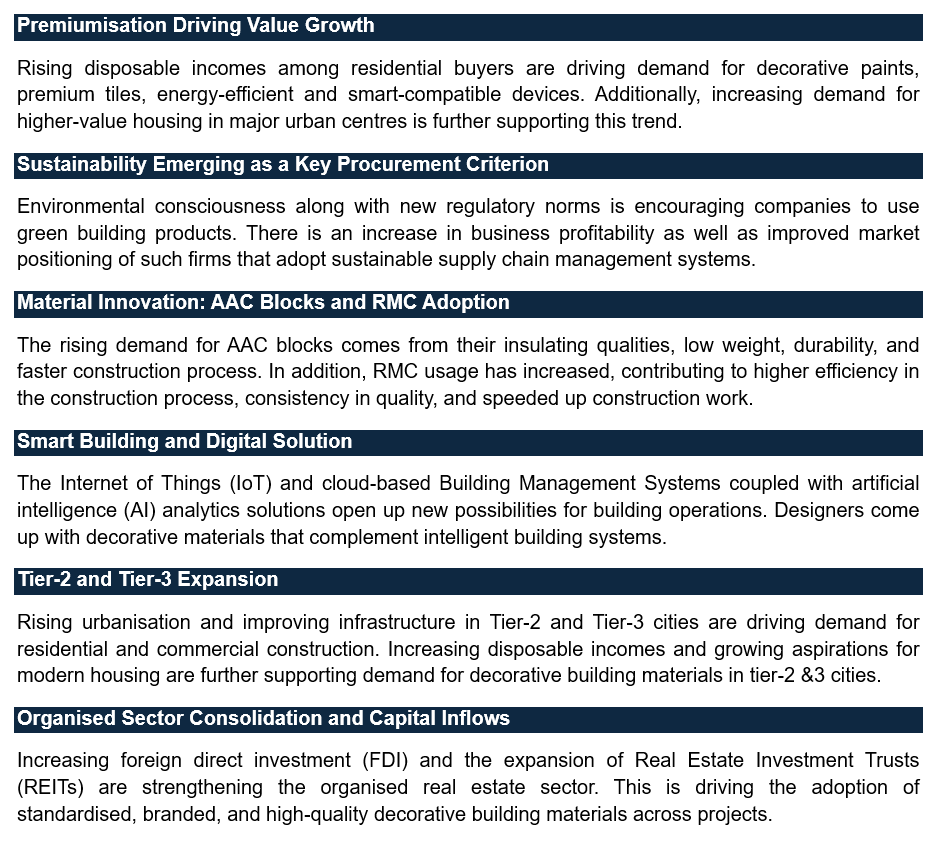
The following factors have emerged as key growth drivers shaping the expansion of decorative construction materials within India’s evolving real estate landscape:
Outlook and Road Ahead
The market for decorative building materials is growing in India due to the emphasis in architecture design placed on aesthetic aspects and improved living experience rather than the need for functionality. Growth in residential buildings and overall volume of building materials market can contribute towards greater use of decorative materials which will result in a higher percentage of their cost in the projects’ budget.
Indian manufacturers are expanding their domestic presence while simultaneously developing their export capacity due to increasing urbanization as well as a shift towards sustainable sourcing of materials. Innovative companies that have quality control as well as sustainable principles in place can enjoy benefits from further expansion in the sector, thereby contributing to sustainable infrastructure.
FAQs
What is driving growth in decorative materials?
There has been an emergence of premiumization, consumer brand preferences, installation in smart homes, and sustainability.
How is premiumisation impacting the decorative materials market?
Premiumisation is driving consumers toward higher-quality products that enhance the overall value of their projects, leading to increased usage and a higher share of decorative building materials.
How can Tier-2 and Tier-3 cities influence growth?
Tier-2 and Tier-3 cities are witnessing increasing urbanization, infrastructure development, and rising income levels, which are driving demand for building construction and, consequently, decorative building materials.
Which innovations are reshaping construction?
Ready-Mix Concrete and AAC blocks improve efficiency, insulation and execution speed.
How are government initiatives supporting the sector?
Government initiatives focused on housing development and urban infrastructure are boosting construction activity, thereby supporting demand for decorative building materials.
Partners