SEARCH
RECENT POSTS
Categories
- Agriculture (39)
- Automobiles (21)
- Banking and Financial services (36)
- Consumer Markets (57)
- Defence (6)
- Ecommerce (21)
- Economy (72)
- Education (14)
- Engineering (9)
- Exports (22)
- Healthcare (25)
- India Inc. (10)
- Infrastructure (31)
- Manufacturing (33)
- Media and Entertainment (17)
- Micro, Small & Medium Enterprises (MSMEs) (16)
- Miscellaneous (31)
- Perspectives from India (37)
- Pharmaceuticals (5)
- Railways (5)
- Real Estate (20)
- Renewable Energy (19)
- Research and Development (12)
- Retail (1)
- Services (7)
- Startups (16)
- Technology (66)
- Textiles (8)
- Tourism (16)
- Trade (9)
Authors






How Battery Technology Is Transforming the Electric Vehicles Market
- Oct 21, 2026, 17:55
- Automobiles
- IBEF
Battery technology is emerging as a critical driver of India’s electric vehicle (EV) market. Due to the increasing popularity of EVs, technological developments in battery science and production costs have become more important in relation to vehicle affordability and performance, and creation of domestic EV supply chain.
Over the past few years, an increasing trend of registration of EVs in India has taken place starting from 0.456 million units in FY22 to 2.536 million units in FY26.The focus is now extending beyond EV sales to the development of a broader battery ecosystem. Investments in cell manufacturing, alternative battery chemistries, critical mineral processing and battery recycling are strengthening different parts of the value chain. In addition to government schemes like the ACC Production Linked Incentive, efforts to build domestic manufacturing capabilities have been strengthened.
Hence, batteries are becoming increasingly important not just for the development of India’s EV industry, but also for the country's clean mobility and energy storage ambitions in general.
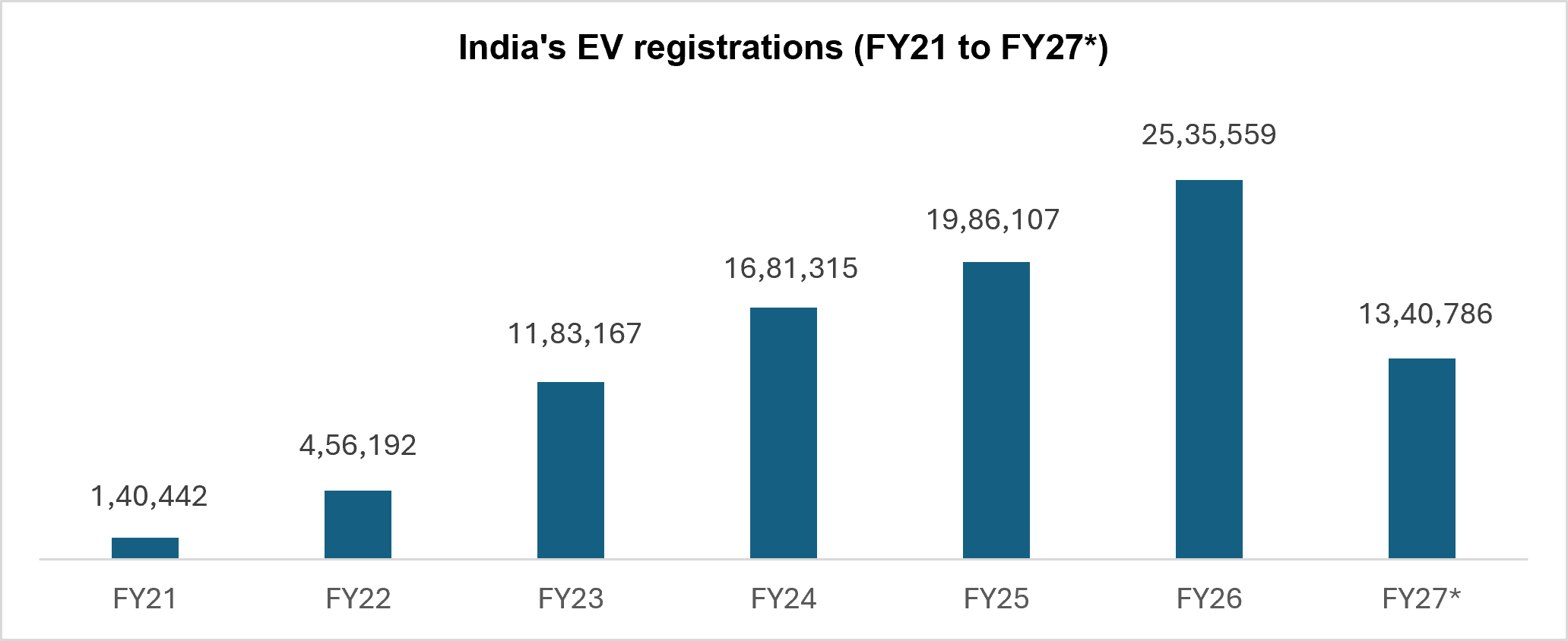
Source: Vahan Dashboard, Note: * - Till August 2026
Why Battery Technology Sits at the Centre of the EV Story
Batteries form a considerable part of the total cost associated with electric vehicles, implying that battery costs and innovations are fundamental factors determining the cost and adoption of EVs. Global lithium-ion battery pack prices fell to an all-time low of Rs. 9,413.28 per kWh (US$ 108 per kWh) in 2025, reflecting an 8% decline compared to 2024, according to reports published by BloombergNEF. This fall in the cost of lithium-ion batteries is because of overproduction, increasing competition, and the use of cheaper battery technologies like LFP batteries.
The Indian EV battery market is also forecasted to witness significant growth, increasing from Rs. 23,707.52 crore (US$ 2.72 billion) in 2025 to Rs. 1.50 lakh crore (US$ 15.90 billion) by 2034, which translates into a compound annual growth rate of 21.70%. It becomes vital for India to build its own domestic capability along the battery value chain to facilitate its burgeoning EV market.
There is growing focus on developing a domestic battery ecosystem through investments in cell manufacturing, battery components, and battery recycling. The PLI scheme for batteries, through the ACC, has helped develop domestic manufacturing of batteries, with at least 10 manufacturers planning their battery manufacturing capacity to about 178 GWh in the next five years.
Government Initiatives and Policies Driving Change
A layered set of policies is trying to pull India's battery ecosystem in the same direction: cheaper cells, more of them made domestically, and a system for recovering critical minerals once batteries reach the end of their life.
- Advanced Chemistry Cell (ACC) PLI Scheme: launched by the Ministry of Heavy Industries in October 2021 with an outlay of Rs. 18,100 crore (US$ 2.43 billion), the scheme aims to build 50 GWh of domestic cell manufacturing capacity. As of March 2026, 40 GWh of capacity had been awarded to four beneficiary firms, while 1 GWh of capacity had been installed. The scheme had attracted cumulative investment of Rs. 5,180 crore and generated direct employment for 1,277 people as of May 31, 2026. In addition to the above, the Ministry of Heavy Industries had released a tender to establish 10 more gigawatt hours of ACC manufacturing capacity in July 2026.
- Exemptions on import of critical minerals from customs duties: The Government of India had announced that the 25 critical minerals would be exempt from customs duties, while a reduction in basic customs duty would apply to another two minerals in the budget 2024-25. The critical minerals include those required for the clean energy and advanced manufacturing sectors, such as lithium and cobalt.
- PM E-DRIVE Scheme: launched with a Rs. 10,900 crore (US$ 1.23 billion) outlay, this scheme extends demand-side incentives beyond the earlier FAME-II programme to e-ambulances, e-trucks and public charging infrastructure, with a dedicated Rs. 2,000 crore (US$ 227.20 million) allocated specifically for public EV charging stations.
- Rules for Waste Batteries Management, 2022: The Rules for Waste Batteries Management, 2022, issued by the Ministry of Environment, Forest and Climate Change, lay down the framework for the EPR system for the collection, recycling and/or refurbishing of waste batteries, including EV batteries. Producers have an obligation to perform their Extended Producer Responsibility (EPR) obligations, and the minimum proportion of domestic recycled content used for producing new batteries will be enforced for EV batteries from FY28.
- GST cut: GST on electric vehicles has been cut to 5%, and the same rate will be charged on EV chargers and charging stations, making it affordable to own electric vehicles.
Technology Trends Reshaping the Battery Landscape
Apart from the aggregated production capacity of the battery manufacturers, what is more pertinent for India is the battery chemistry and technology options that are trending, and the reasons behind the selection of these technologies being different from the rest of the world. Lithium iron phosphate (LFP) batteries have started gaining popularity all over the world due to cost savings and safety benefits of such technology. It was also stated that in the year 2025, the usage of LFP batteries in global EV batteries constitutes 55% of all the batteries. In addition, LFP batteries are 40% less expensive than NMC batteries. This makes the use of LFP batteries even more pertinent considering the fact that affordability of the batteries is very important in making the EVs affordable.
India is developing its battery cells manufacturing capacity as a part of the Production-Linked Incentive (PLI) Scheme for Advanced Chemistry Cells (ACC). As of February 2026, at least 10 manufacturers have announced their production capacities of 178 GWh in the subsequent five years' period, helping to create the Indian battery industry.
India is exploring the opportunities of sodium-ion battery technology as a part of its energy storage and battery innovation ecosystem. The Ministry of New and Renewable Energy has conducted the assessment of the global sodium-ion battery market and its potential for applications in India in the framework of the India-UK ASPIRE programme. The use cases for sodium-ion technology include stationary battery storage and selected mobility applications.
The ACC PLI Scheme, budgeted at Rs. 18,100 crore (US$ 2.43 billion) aims to create 50 GWh ACC manufacturing capacity in India. Battery recycling becomes an important element of the ecosystem of critical minerals and clean energy in India. Within the framework of the National Critical Mineral Mission, the Government of India has approved a Rs. 1,500 crore (US$ 158.93 million) scheme to support recycling of critical minerals recovered from sources such as lithium-ion batteries. As of April 2026, 58 companies have become eligible for the scheme, taking the pledged recycling capacity to 850 KTPA and investments to around Rs. 5,000 crore (US$ 529.77 million).
Outlook and Road Ahead
India's battery ecosystem is expected to gain further momentum, supported by the continued growth of EV adoption and expanding domestic manufacturing capacity. EV registrations reached 25.36 lakh units in FY26, while the ACC PLI Scheme is supporting the development of 50 GWh of domestic Advanced Chemistry Cell manufacturing capacity.
Initiatives from the government such as PM E-DRIVE, investment in critical minerals and recycling of batteries have helped strengthen various sections of the battery value chain. Investments in cell production along with advances in new technologies like sodium-ion batteries and development of a recycling ecosystem are helping create an integrated industry in the field of batteries and energy storage in India.
FAQs
How much has India's EV market grown, and what role have batteries played?
India's EV registrations increased from 4.56 lakh units in FY22 to 25.36 lakh units in FY26, reflecting the rapid expansion of electric mobility in the country. Falling global battery pack prices, which reached US$ 108 per kWh in 2025, along with improvements in battery technology, have supported the growing affordability and adoption of EVs.
What is the ACC PLI Scheme, and how is it supporting battery manufacturing in India?
The Advanced Chemistry Cell (ACC) PLI Scheme, with an outlay of Rs. 18,100 crore, aims to establish 50 GWh of domestic ACC manufacturing capacity. The scheme is supporting investments in cell manufacturing and helping strengthen India's battery manufacturing ecosystem.
Why is India exploring sodium-ion battery technology?
India has negligible lithium reserves but is a major producer of soda ash, the key input for sodium-ion India is exploring sodium-ion batteries as part of its broader battery innovation and energy storage ecosystem. The technology offers opportunities for applications such as stationary energy storage and selected mobility segments, complementing India's growing battery technology landscape.
How is India managing end-of-life EV batteries?
India's Battery Waste Management Rules, 2022 establish an Extended Producer Responsibility framework for the collection and recycling or refurbishment of waste batteries. The Government is also supporting critical-mineral recycling, helping strengthen India's circular economy for battery materials.
Why does battery technology matter for India's EV growth?
Battery technology plays a central role in EV affordability, performance and safety. Technologies such as LFP batteries, along with growing investments in domestic cell manufacturing, advanced battery technologies and recycling, are supporting the development of India's electric mobility and energy storage ecosystem.
Partners