SEARCH
RECENT POSTS
Categories
- Agriculture (37)
- Automobiles (20)
- Banking and Financial services (35)
- Consumer Markets (56)
- Defence (6)
- Ecommerce (21)
- Economy (72)
- Education (14)
- Engineering (8)
- Exports (21)
- Healthcare (25)
- India Inc. (10)
- Infrastructure (31)
- Manufacturing (32)
- Media and Entertainment (16)
- Micro, Small & Medium Enterprises (MSMEs) (16)
- Miscellaneous (31)
- Perspectives from India (37)
- Pharmaceuticals (5)
- Railways (4)
- Real Estate (18)
- Renewable Energy (19)
- Research and Development (12)
- Retail (1)
- Services (7)
- Startups (15)
- Technology (66)
- Textiles (8)
- Tourism (16)
- Trade (8)
Authors






How Skill India Measures Success Through Skill and Employment Data

Economic growth in India is becoming more dependent on the productivity of the workforce. The Skill India Mission has changed from a simple training program to a data-based model that measures its performance using employment outcomes, industry relevance, and livelihood creation. With the expansion of the skilling ecosystem across industries and geographies, the focus of the Skill India Mission gradually changed from participation levels to the evaluation of whether the skills are leading to employability or workforce integration.
The use of data is now at the middle of the evaluation of the Skill India Mission programs. The performance of the programs is now measured using outcomes such as the number of certifications earned, the number of apprentices engaged, digital engagement levels, and digital inclusion levels instead of the number of people enrolled into the programs. This is a step towards the overall goal of developing a skilling ecosystem that offers scale along with accountability and outcome-based performance that enhances productivity.
As the Indian economy continues its growth journey through technological changes and sectoral shifts, the outcome-based measurement of the Skill India Mission programs would help the government align the skill programs with the changing industry requirements, identify skill gaps, and increase the efficiency of investments. At the same time, the transparency of the data would also help the industry develop more trust in the skills imparted. Thus, the performance of the Skill India Mission programs is now evaluated not just on the number of people trained but also on the number of skills converted into employability or productivity.
From Training Outputs to Employment Outcomes
When India created the Ministry of Skill Development and Entrepreneurship (MSDE) in 2014, the country had an expanding workforce, yet the workforce had access to fewer vocational training opportunities. The agenda was purely about training more numbers of the workforce and certifying them. However, over time, it became apparent that it’s not the numbers of training attempts that need to measure the success of the workforce, but rather the ability of the workforce to provide jobs, the rate of absorption by industries, etc., conducted in the form of a skill or employment figure.
The path of Pradhan Mantri Kaushal Vikas Yojana (PMKVY) also resonates with the mentioned shift. In fact, under PMKVY 4.0, over 27.08 lakh candidates have been trained in 38 sectors of the Indian economy, comprising 36 states and 732 districts. Also, more than 7.5 lakh trainees would be enrolled between April 2024 to December 2025. It has been more focused on linking labour markets with key industries like IT-ITeS, Aerospace, Agriculture, etc.
The scheme includes futuristic skills with the inclusion of 102 future skill job roles and 77 customized courses on various subjects like artificial intelligence, Industry 4.0, and green jobs. Over 600 jobs are created for emerging jobs, including more than 4.3 lakhs being trained in cutting-edge skills. The training across 15,500+ institutions, including 7,000+ Skill Hubs, demonstrates institutional preparedness and the integration of vocational education with the mainstream education system. From April 2024 to September 2025, the expenditure incurred was Rs. 1,652.89 crore (US$ 185.72 million).
Most importantly, though, its evaluation measures have moved beyond enrolment and certification. It looks for outcomes like linkages to placements, apprenticeship progressions, industry engagement and finally, employability. Improvements to quality are an important part of it, with 34,505 trainers and 13,844 assessors being certified between April 2024 and November 2025. This means the success of skilling initiatives is going to be measured not by training figures but by participation and engagement with high-growth sectors.
As a result, Skill India’s evaluation framework today incorporates multiple quantitative indicators beyond training outputs:
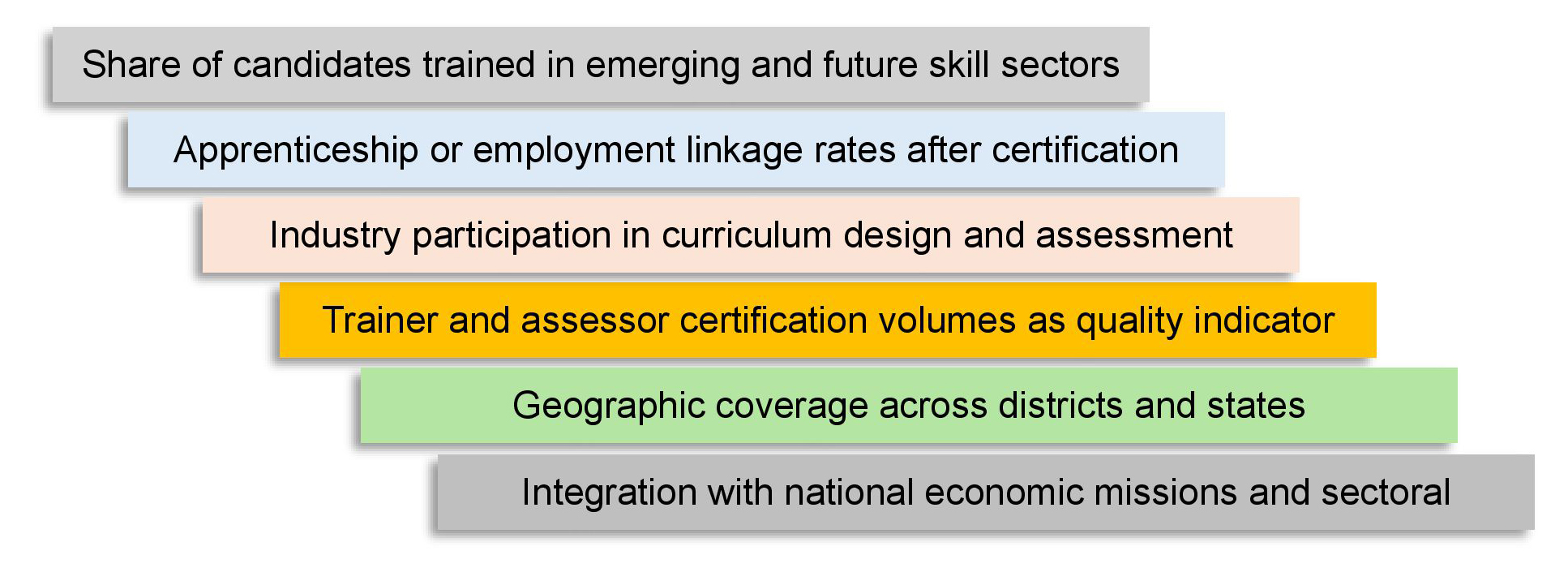
This reflects the broader shift toward outcome-based measurement within India’s skilling ecosystem.
Digital Infrastructure as the Foundation of Measurement
The government’s policies have ensured the skilling environment in India moves from capacity development to achieving real results with greater emphasis on quality, transparency, and the strong relationship with employment outcomes. The skilling environment continues to benefit from increasing investment and ongoing institutional reform. In the Union Budget 2026-27, the ministry of skill development and entrepreneurship has been allocated Rs. 9,885.80 crore (US$ 1.11 billion), which includes funds for modernization of ITIs under PM SETU amounting to Rs. 6,140.50 crore (US$ 690 million), and the World Bank-assisted ITI upgradation initiative of Rs. 7,387 crore (US$ 830 million).
A milestone was achieved in September 2023 with the launch of the Skill India Digital Hub (SIDH) platform, which has placed digital at the centre of skills outcomes. At its core, SIDH consolidates candidate registration, training, testing, certification, apprenticeship, job seeking, and benefits transfer into a single platform where the learner’s journey can be completely tracked.
Its widespread nature further reinforces the position that it is a measurement backbone. The digital system recorded over 1.6 crore registrations from April 2024 to September 2025. Out of that, there were over 1 crore eKYC verified candidates who were connected to 30,000+ training centres and 6,000+ training partners. The digital system opened over 10 lakh jobs and training opportunities through the National Career Service-employment system. It also hosts 10,000+ courses through 64 learning partners and supports multilingual options. The digital system has so far recorded over Rs. 1,100 crore (US$ 123.60 million) worth of Direct Benefit Transfers.
By plugging into national digital platforms such as Aadhaar, DigiLocker, GSTN, and e-Shram, SIDH facilitates real-time tracking from enrollment to employment, creating an entire ecosystem as a cohesive system of skilling governance.
From the governance point of view, the digital convergence facilitates measuring across several layers:
- Training Effectiveness by Sectors and Regions, with Particular Emphasis on In-Demand and Under-Performing Trades
- Benchmarking of training providers and assessment agencies by using data on completion rates, certification, and placements
- Real-time job matching results, which indicate how well supply and demand match in the labour market
- Certification authenticity and portability: the skills must be certified within the national arena. - Financial accountability via digital monitoring of benefits transferred and scheme usage
Apprenticeships, Inclusion and Livelihoods: Measuring the Transition from Skills to Economic Outcomes
One of the most reliable measures of this translation towards actual work is represented through the concept of apprenticeships. It is the juncture that brings together formal training with actual experience gained at the workplace. The National Apprenticeship Promotion Scheme (NAPS) plays a central role in the translation of skills towards actual employment. Since the year 2016, more than 49 lakh apprentices have been engaged in various industries such as manufacturing, automobiles, electronics, etc., thereby underlining the importance of apprenticeships under the Skill India initiative.
For example apprenticeship engagement, completion, and certification, provides policymakers with actionable insights into various industry participation, learning efficiency within the industries, and gender participation as well as industry-specific absorption trends. Skill India programs provide a clear link between learning and workforce entry, thus enabling policymakers to measure training effectiveness within these contexts.
Yet, the focus of Skill India extends beyond just employment. The scope of Skill India, which includes livelihood, entrepreneurship, and socio-economic inclusiveness, has been exemplified through the implementation of schemes such as Jan Shikshan Sansthan, PM Vishwakarma, and entrepreneurship, which extend to measures such as creation of enterprises, enhancing earnings, and involving marginalized groups, as this extends employment results to cover aspects beyond just wage employment.
This is the structure of India’s current labour market, which sees a vast role played by self-employment/micro enterprises in the creation of jobs. Entrepreneurship drive by the Ministry of Skill Development and Entrepreneurship (MSDE) has enabled the training of over 12 lakh learners and the creation of thousands of new ventures, changing the yardstick for measuring success from merely job placement to the creation of sustained livelihoods.
The Road Ahead
Skill India has now transcended beyond just measuring hours of training to data-based judgments on the effectiveness of training. The measure of success now is outcomes or what has been achieved. This includes jobs created, apprentices engaged, new business created, quality of certifications, etc., along with digital tracking. This is a move towards outcome-based governance.
Data on skills and employment will be more central to assessing accountability, flexibility, and responsiveness of skilling initiatives as India continues to move towards its long-term development goals. In the future, better measurement of employment outcomes in terms of wages and employment duration will be extremely critical to ensure that training scales up to create jobs.
FAQs
What is the objective of the Skill India Mission?
The mission aims to improve employability and productivity by equipping individuals with industry-relevant skills and linking training outcomes with employment and entrepreneurship opportunities.
How is success measured under Skill India?
Success is measured through outcome-based indicators such as employment and apprenticeship linkages, certification quality, industry participation, digital engagement and inclusion metrics rather than enrolment numbers alone.
How many candidates have been trained under PMKVY 4.0?
As of December 2025, over 27.08 lakh candidates have been trained under PMKVY 4.0 across 38 sectors in 36 States and 732 districts.
What is the role of the Skill India Digital Hub (SIDH)?
SIDH integrates training, certification and employment linkages on a single platform, enabling real-time tracking of learner progress and improving transparency and outcome measurement.
How much funding is allocated to MSDE in Union Budget 2026–27?
The Union Budget 2026–27 allocated Rs. 9,885.80 crore (US$ 1.11 billion) to MSDE, including Rs. 6,140.50 crore (US$ 690 million) billion) for ITI modernisation under PM-SETU, alongside a Rs. 7,387 crore (US$ 830 million) World Bank-supported upgrade programme.
Partners