SEARCH
RECENT POSTS
Categories
- Agriculture (39)
- Automobiles (20)
- Banking and Financial services (36)
- Consumer Markets (57)
- Defence (6)
- Ecommerce (21)
- Economy (72)
- Education (14)
- Engineering (9)
- Exports (22)
- Healthcare (25)
- India Inc. (10)
- Infrastructure (31)
- Manufacturing (33)
- Media and Entertainment (17)
- Micro, Small & Medium Enterprises (MSMEs) (16)
- Miscellaneous (31)
- Perspectives from India (37)
- Pharmaceuticals (5)
- Railways (4)
- Real Estate (20)
- Renewable Energy (19)
- Research and Development (12)
- Retail (1)
- Services (7)
- Startups (16)
- Technology (66)
- Textiles (8)
- Tourism (16)
- Trade (9)
Authors






What Drives Foreign Direct Investment Decisions in the Indian Market

Foreign Direct Investment (FDI) has emerged as a strong support in the transformation of the Indian economy. In the case of Multinational Corporations (MNCs), FDI are considered as a strategic move with assets as the primary determinant for investments. Investments in India are made with the potential of the market as the core factor. It is true India is growing as one of the fastest-growing large economies in the world. That means it has the power of refocusing investments towards itself.
The FDI experience in India can be traced to a combination of its domestic economic reforms and macro-level economic strength. According to the Department for Promotion of Industry and Internal Trade (DPIIT), India's cumulative FDI inflow stood at Rs. 99.08 lakh crore (US$ 1.12 trillion) between April 2000-September 2025, indicating sustained investment confidence through several rounds.
Nowadays, India draws international investment due to its scale in consumer reach along with growing roles in output, invention, and integration within worldwide distribution networks. Factors like population patterns, fast-paced digitization, wider transport and utility systems, alongside easing regulations have opened paths for funding across industries including making goods, providing services, clean power, and digital tools. With shifting flows of money around the world, attention turns toward core economic traits, government frameworks, and evolving setups shaping FDI in India.
Significance of Foreign Direct Investment in India
FDI is the engine of India’s growth through the build-up of capital, the generation of employment, the expansion of exports, and the advancement of technology. Unlike portfolio investment, FDI signals long-term commitments, as they bring in physical assets, a more developed supplier base, and a thriving ecosystem. For a developing country with grand aspirations in infrastructure and manufacturing, this type of investment is most important.
India has recorded an increase in FDI attractiveness over the years. For the FY25, gross FDI inflows amounted to Rs. 7,21,256 crore (US$ 81.04 billion), reflecting an increase of 14% as compared to Rs. 6,34,392 crore (US$ 71.28 billion) of FDI inflows in FY24. In terms of historical perspective, FDI inflows to India have more than doubled, increasing from Rs. 2,18,103 crore (US$ 24.51 billion) in FY14 to over Rs. 7,12,000 crore (US$ 80 billion) in FY25.
Fueled by demand for tech-driven solutions, the services sector still leads foreign investment shares contributing 19% of the FDI, followed by computer software and hardware, drawing close to 16%, a sign of how deeply digital infrastructure now underpins growth. Year on year, manufacturing attracted more capital, FDI climbing 18% to reach Rs. 1,69,456 Crore (US$ 19.04 billion) during FY25. That upward trend reflects growing confidence in locally made goods destined for global markets.
Also, FDI shapes regional growth patterns, most capital flows into leading economic zones- Maharashtra, Karnataka, Delhi. These three dominate overall equity receipts simply because roads, networks, and factories exist more reliably, projects move faster when transport links are solid, operations run smoothly, people with training can be hired easily.
Starting from technology sharing, overseas investors lift local productivity by linking firms to worldwide supply networks. In India’s case - where expanding factories and boosting shipments are key goals - foreign funds help sharpen production skills while lifting performance in multiple industries. Though often overlooked, such investments quietly reshape how businesses operate, pushing standards beyond prior limits.
Government Initiatives and Policies
Policy environment and regulations are still the foremost drivers of foreign direct investments. India continues to liberalize its FDI policy, allowing 100% foreign ownership via the automatic route for almost all sectors.
Initiatives such as Make in India, the Production Linked Incentives, and sectoral reforms have certainly raised the confidence of investors significantly. The objective is to enhance the domestic capability to produce while allowing scope for investment-intensive sectors. The encouragement given to manufacturing localisation has certainly helped boost FDI growth in sectors that are manufacturing intensive.
Ease of business and digital governance initiatives have also reduced the obstacles facing foreign businesses. Currently, more than 90% of FDI equity investment is through the automatic route. This reflects a better regime of liberalization and efficient administration.
The scope of investment destinations has also increased as a result of sectoral reforms. For example, insurance, defence production, infrastructure, and space sectors have been opened up to foreign investment. These sectors, earlier considered off-limits to foreign investors, now permit foreign investment. For example, insurance sector attracted Rs. 50,778 crore (US$ 5.71 billion) of FDI over nine years. These policies, taken together, help reduce one of the major concerns of foreign investors, i.e., regulatory risk, making India more attractive as an investment destination as compared to other new economy hubs.
From this perspective, recent policy changes illustrate targeted liberalization paths in critical areas, including the automatic route for grant of new licenses on achieving up to 74% of FDI in defence manufacturing, 100% FDI in the telecom sector, and an enhanced insurance cap of up to 74% subject to conditions. These guidelines also provide further impetus to investment on lines aligned with export competitiveness, wherein preference is given to Free Trade Association countries, including EFTA.
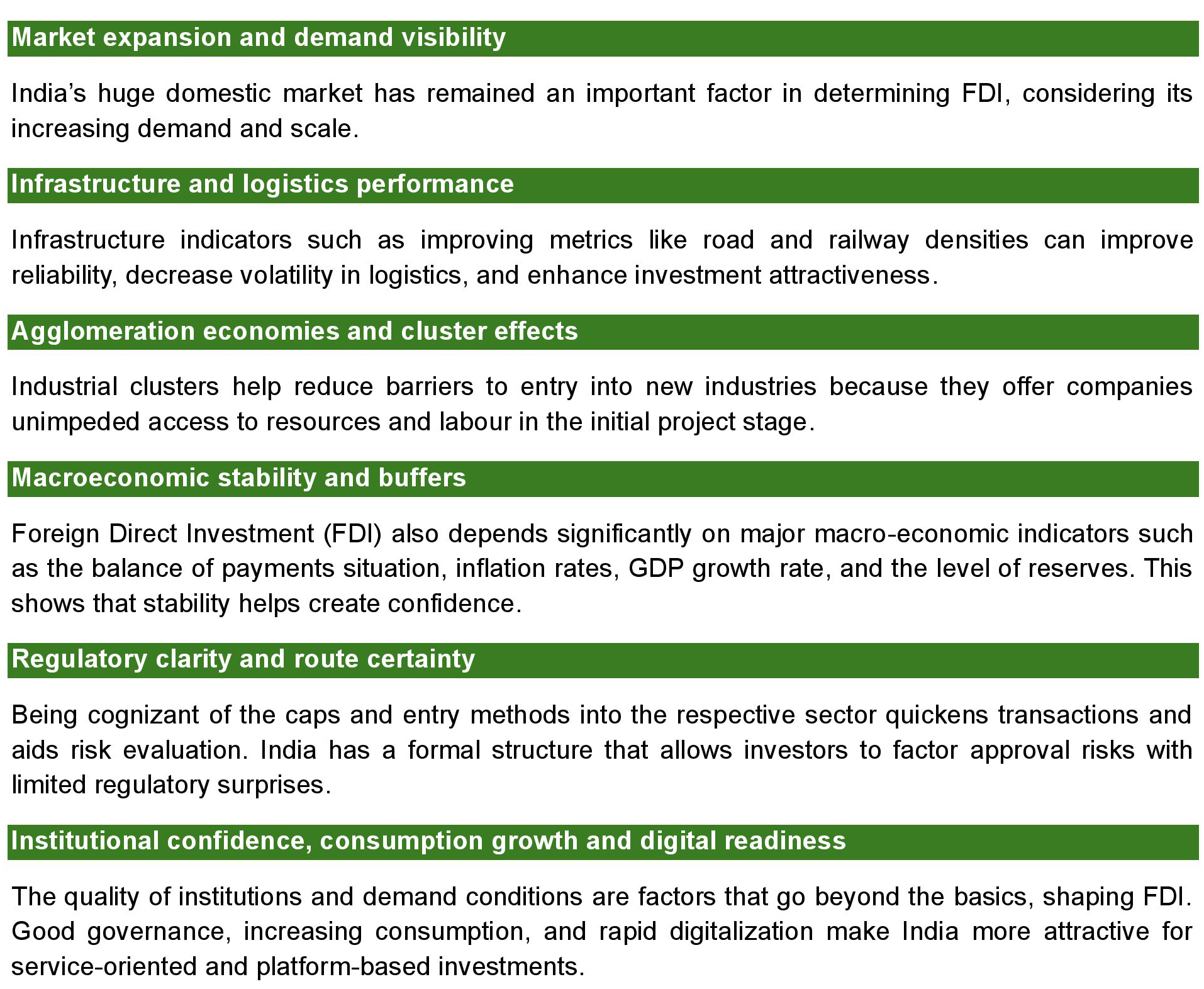
Growth Drivers and Trends
The Road Ahead
India’s outlook for FDI will depend on its consistent ability to translate its openness into implementation credibility. Although its liberalization and facilitative measures have enriched its framework, its next steps will rest on its ability to shorten project implementation timelines, simplify business at the sub-national level, and deepen its dispute resolution mechanisms. The state-level experiences reveal that infrastructure standards and institutional efficiency are the key thresholds against which intentions need to be converted into implementation outcomes.
In the current geopolitical environment, as global firms reassess and rebalance their supply chains, India promises FDI positions steady and solid bet as it balances scale and stability. This implies growth and development of clusters beyond the already established ones, as well as trade policies being accommodative and conducive to investment. Further, in the long term, FDI competitiveness would rely not just on attracting FDI, but also on ensuring that it grows and innovates.
FAQs
What are the primary factors that drive foreign investors to choose India as an FDI destination?
Foreign investors typically evaluate market size, demand growth, regulatory clarity, infrastructure readiness, labour availability, and long-term macroeconomic stability. India’s large domestic consumption base, expanding digital economy, and policy liberalisation collectively reduce investment risk and improve long-term return visibility.
How do government policies influence FDI decision-making in India?
Policy stability and sectoral liberalisation directly affect investor confidence. Measures such as automatic route approvals, Production Linked Incentive (PLI) schemes, and sector-specific reforms reduce entry barriers and improve project viability, enabling faster investment execution.
Why are industrial clusters and specific states more successful in attracting FDI?
Agglomeration effects reduce operational costs by providing access to suppliers, skilled labour, logistics infrastructure, and established ecosystems. States with stronger institutional capacity and infrastructure tend to convert investment intent into realised projects more effectively.
How much FDI does India currently receive annually?
India recorded gross FDI inflows reached Rs. 7,21,256 crore (US$ 81.04 billion) in FY25, registering a 14% year-on-year increase from Rs. 6,34,392 crore (US$ 71.28 billion) in FY24.
How did FDI in manufacturing change year-on-year in FY25?
FDI in manufacturing increased by 18% year-on-year, reaching Rs. 1,69,456 crore (US$ 19.04 billion) in FY25, reflecting growing confidence in locally manufactured goods for global markets.
Partners