SEARCH
RECENT POSTS
Categories
- Agriculture (37)
- Automobiles (20)
- Banking and Financial services (35)
- Consumer Markets (57)
- Defence (6)
- Ecommerce (21)
- Economy (72)
- Education (14)
- Engineering (8)
- Exports (21)
- Healthcare (25)
- India Inc. (10)
- Infrastructure (31)
- Manufacturing (32)
- Media and Entertainment (16)
- Micro, Small & Medium Enterprises (MSMEs) (16)
- Miscellaneous (31)
- Perspectives from India (37)
- Pharmaceuticals (5)
- Railways (4)
- Real Estate (20)
- Renewable Energy (19)
- Research and Development (12)
- Retail (1)
- Services (7)
- Startups (16)
- Technology (66)
- Textiles (8)
- Tourism (16)
- Trade (8)
Authors






India’s Aspirational Districts: Stories of Progress and People-Led Change

- Feb 06, 2026, 17:00
- Perspectives from India
- IBEF
India’s Aspirational Districts Programme (ADP) was launched in January 2018 by NITI Aayog to transform 112 of the country’s most under-developed districts through a “whole-of-government” approach. Its core principles are convergence (ensuring schemes work together), collaboration (across ministries, states, and partners) and competition (healthy rivalry to improve outcomes). Building on ADP’s success, the Aspirational Blocks Programme (ABP) was launched in 2023 to extend this model to 500 blocks (sub-districts) across 329 districts. The goal is the same: improve key indicators in health, education, agriculture, skill, and infrastructure by empowering people at the grassroots. According to NITI Aayog, inclusive growth “must reach every corner of the country.” It recognises that development begins at the village level. Both programmes emphasise real-time data, local innovation, and community leadership ensuring that residents, especially women, youth and the marginalised take ownership of change.
Why the programme matters
For decades India’s growth has been uneven. Aspirational Districts and Blocks address gaps in health, education, livelihoods, water, and infrastructure. By concentrating resources where needs are the greatest, the programmes have redefined service delivery in challenging geographies. For example, ADP/ABP combine national schemes with local solutions to simultaneously tackle malnutrition, drop-out rates, and poor connectivity. They bring together district officials, panchayats, self-help groups, and NGOs in every village. This collaborative model is helping bridge historic divides: rebuilding dilapidated schools, upgrading under-staffed clinics, and promoting new farming practices. As the aspirational framework makes clear, the focus is not just on building roads or hospitals, but on ensuring people can use them.
Data-backed outcomes
The results so far have been striking. Since 2018, most Aspirational Districts have registered double-digit improvements in core indicators. Key examples include:
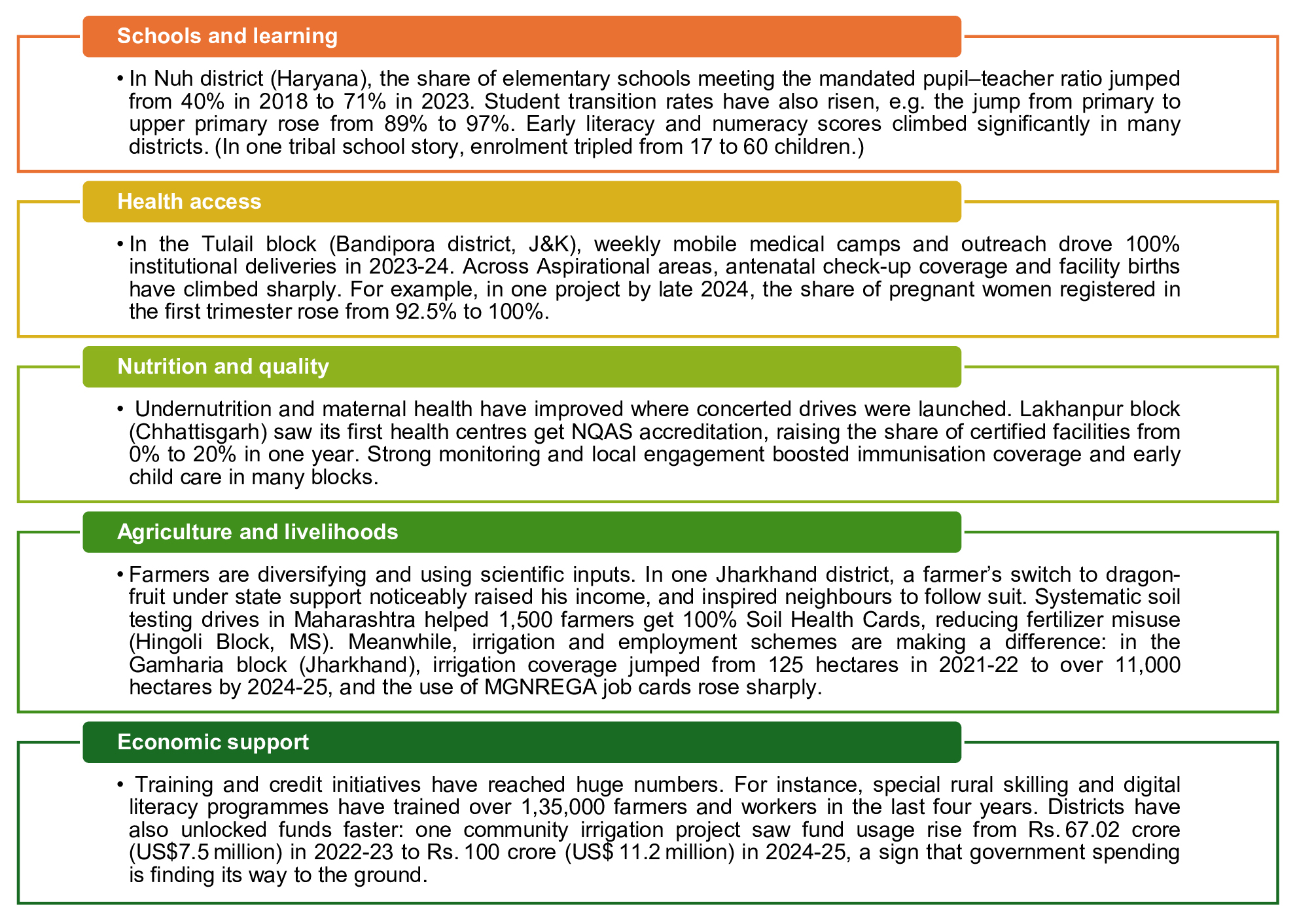
Together, these outcomes enabled higher teacher availability, more clinic births, certified hospitals, increased crop output, thus driving down inequality.
District-level stories of progress
- From 17 to 60 students: A Tribal School Turnaround (Maharashtra). In Kawada Lilakpada village (Palghar district), a remote hamlet with only 17 enrolled children, teacher Mr. Dnyaneshwar Sarak volunteered for a posting in May 2024 and completely transformed the local Zilla Parishad school. He repaired classrooms with local materials, painted colourful murals to make learning joyful, and set up group learning and breakfast schemes to draw children in. He even went door-to-door and sent WhatsApp updates (in tribal languages) to gain parents’ trust. The results were dramatic: by mid-2025 enrolment had tripled (from 17 to over 60 students) and daily attendance stabilised at ~100%. Children who once did not attend school learned to read, write and count. The school won a national award for innovation, and the community now maintains the school and supports a second teacher, showing how one teacher’s initiative ignited a wider improvement in learning.
- Tribal ASHAs bring mothers to clinics (J&K). In the Achgoza block of Pulwama district (Jammu & Kashmir), many villages are remote and tribal. Under the ABP, local health authorities engaged Tribal ASHAs (community health activists) who spoke the local dialect and lived in these hamlets. The ASHAs canvassed door-to-door to register pregnancies early, ran women’s camps and vaccination drives, and guided expectant mothers to government health centres. Within a few months, home births gave way to clinic births, institutional deliveries became the norm. By strengthening outreach, newborn immunisation reached “near saturation” in those villages.
- Dragon-Fruit farming lifts a Jharkhand family. In Murkum Panchayat, Seraikela-Kharsawan (Jharkhand), farmer Mr. Satish Devgam was barely breaking even on traditional crops. With guidance from the local Agricultural Technology Management Agency, he tried dragon-fruit, a high-value horticulture crop. Soil testing and balanced fertilisers (from the Soil Health Card scheme) boosted his yields. The result: Mr. Satish’s annual income rose, enabling him to send his children to better schools and invest in family health.
- Water on WhatsApp: Smart irrigation (Jharkhand). A village innovation is playing out in the same Seraikela-Kharsawan region. Under the Kharsawan Lift Irrigation Scheme, 43 villages in the Gamharia block formed Water Panchayats and registered farmers’ mobile numbers. Using WhatsApp groups, the committee now schedules exactly when water from a new canal lift system will be delivered to each field. This simple digital tweak, combining traditional water co-operatives with mobile messaging, means every farmer knows the exact day and time their irrigation will arrive. As a result, the net cropped area under veggies and oilseeds has exploded (from 125 ha to over 11,000 ha in three years). Unused land shrank and farmers diversified into vegetables, mustard and even duck-farming (thanks to recharged ponds). Children’s attendance at schools also improved, as migrations fell when farms became more productive.
Each of these stories involves ordinary people. They illustrate how people-led change lies at the heart of the ADP/ABP success.
Role of community and people-led change
ADBs are built on community involvement. Instead of top-down schemes, every village is mobilised. Local Self-Help Groups (SHGs) involving women, youth clubs (Nehru Yuva Kendras), village committees and panchayats all pitch in. Health campaigns, for instance, were often led by ASHAs and members of local women SHGs and youth bodies. One district health drive reports: “Awareness campaigns and outreach were led by ASHAs, SHGs, YMA (youth) and church groups,” ensuring trust in public clinics. SHGs have become grassroots influencers, running nutrition awareness sessions and even community kitchens and helping staff identify pregnant women for check-ups. In one block’s screenings, 500+ villagers were covered because SHGs and Gram Sabhas stepped forward as co-organisers.
Use of technology
Technology amplifies these efforts in simple ways. Mobile apps, dashboards, and telemedicine have become tools of last-mile delivery. For example, rural health clinics have started using the government’s e-Sanjeevani telemedicine platform: one Primary Health Centre in Kerala reported linking its staff with specialist doctors in the city via video calls. Similarly, a digital portal called “Virucare” was launched in Virudhunagar (Tamil Nadu) to log antenatal check-ups and flag high-risk pregnancies, so health workers could follow-up more closely. Every district now uses real-time dashboards, often the Champions of Change online portal to track indicators daily. Digital record-keeping has streamlined services: one field report says e-health platforms “have streamlined patient records and referrals.”
Even routine payments and registration have gone online. Health workers use apps like RCH (Reproductive Child Health) portal and ANMOL to register beneficiaries on tablets. This means money-from-maternal benefit schemes, or scholarships, reaches bank accounts directly, often within days, rather than getting lost en route. In education, many schools now show student attendance on weekly digital trackers, helping officials spot and help dropouts sooner.
The road ahead
India’s Aspirational Districts and Blocks model has already shown how inclusive development can lift even the most remote communities. The initiative has become a blueprint for participatory growth across the country. The government is now expanding the effort: more districts have signed up as “Aspirational,” and ABP will roll out in additional blocks. States are mainstreaming successful pilots (for example, making the Lilakpada school model a template). The emphasis remains on sustained local ownership, whether through more federated cooperatives, women’s producer groups, or village monitors, so that improvements endure.
As India marches towards Viksit Bharat (a developed India), these stories show what is possible when every citizen is counted. Homes that once lacked basic services are catching up quickly. Rural entrepreneurs, trained youth, and vibrant women’s groups are becoming agents of change. With continued data-driven support, the Aspirational Districts Programme promises to keep underdeveloped areas moving forward. This people-powered progress is building a more equitable India one village at a time as the nation moves toward a developed future.
FAQs
What is the Aspirational Districts Programme (ADP)?
The Aspirational Districts Programme is a national initiative launched in January 2018 by NITI Aayog to improve development in 112 under-developed districts. It focuses on better outcomes in health, education, agriculture, skill, and infrastructure through a whole-of-government approach. The programme uses real-time data, local solutions, and community participation to raise the quality of life.
How is the Aspirational Blocks Programme (ABP) different from ADP?
The Aspirational Blocks Programme was launched in 2023 to expand the aspirational model to 500 blocks across 329 districts. While ADP works at the district level, ABP focuses on sub-district units. Both aim to improve service delivery, close development gaps, and strengthen community leadership.
Why are Aspirational Districts and Blocks important for India’s growth?
These programmes reduce long-standing gaps in health services, schooling, farming support, water access, and basic infrastructure. By directing resources and flexibility to regions with the greatest needs, they improve learning levels, strengthen clinics, increase farm income, and boost local livelihoods.
What types of improvements have been seen in Aspirational Districts?
Most Aspirational Districts have recorded strong gains in key indicators since 2018. Examples include higher school attendance, more births in clinics, better newborn immunisation, stronger teacher availability, and increased farm output.
How do community participation and technology support these programmes?
Local communities such as SHGs, youth clubs, ASHAs and panchayats play an active role in awareness drives, health outreach, and school activities. Technology strengthens this work through telemedicine, real-time dashboards, digital health records, and mobile-based monitoring.
Partners