SEARCH
RECENT POSTS
Categories
- Agriculture (38)
- Automobiles (20)
- Banking and Financial services (36)
- Consumer Markets (57)
- Defence (6)
- Ecommerce (21)
- Economy (72)
- Education (14)
- Engineering (9)
- Exports (22)
- Healthcare (25)
- India Inc. (10)
- Infrastructure (31)
- Manufacturing (32)
- Media and Entertainment (16)
- Micro, Small & Medium Enterprises (MSMEs) (16)
- Miscellaneous (31)
- Perspectives from India (37)
- Pharmaceuticals (5)
- Railways (4)
- Real Estate (20)
- Renewable Energy (19)
- Research and Development (12)
- Retail (1)
- Services (7)
- Startups (16)
- Technology (66)
- Textiles (8)
- Tourism (16)
- Trade (9)
Authors






India’s B2B Digital Marketplaces: Connecting Manufacturers to Global Buyers

- Mar 31, 2026, 11:40
- Technology
- IBEF
India’s manufacturing sector is undergoing a structural transformation, driven by digitisation, global supply chain realignment and the growing need for efficient market access. In this context, B2B digital marketplaces have emerged as a critical enabler, connecting Indian manufacturers directly with global buyers across industries such as engineering goods, chemicals, textiles, pharmaceuticals, agriculture and industrial components. These platforms are not only improving discovery and transaction efficiency but are also helping small and medium enterprises (SMEs) overcome traditional barriers related to scale, credibility and international reach. As India strengthens its position as a global manufacturing hub, B2B digital marketplaces are becoming integral to export growth and cross-border trade facilitation.
Historically, Indian manufacturers relied on physical trade fairs, distributors and export agents to access overseas markets. While effective for large enterprises, this model limited participation from SMEs due to high costs and fragmented information. The rapid expansion of internet penetration, digital payments and logistics infrastructure has enabled the rise of B2B digital platforms that aggregate demand and supply at scale.
Over the past decade, India has witnessed the emergence of both horizontal and vertical B2B marketplaces. Horizontal platforms cater to a wide range of products and industries, while vertical platforms focus on specific sectors such as metals, chemicals, agri-inputs or industrial machinery. These marketplaces have evolved from simple listing portals into end-to-end ecosystems offering product discovery, price discovery, quality verification, payment protection and logistics support.
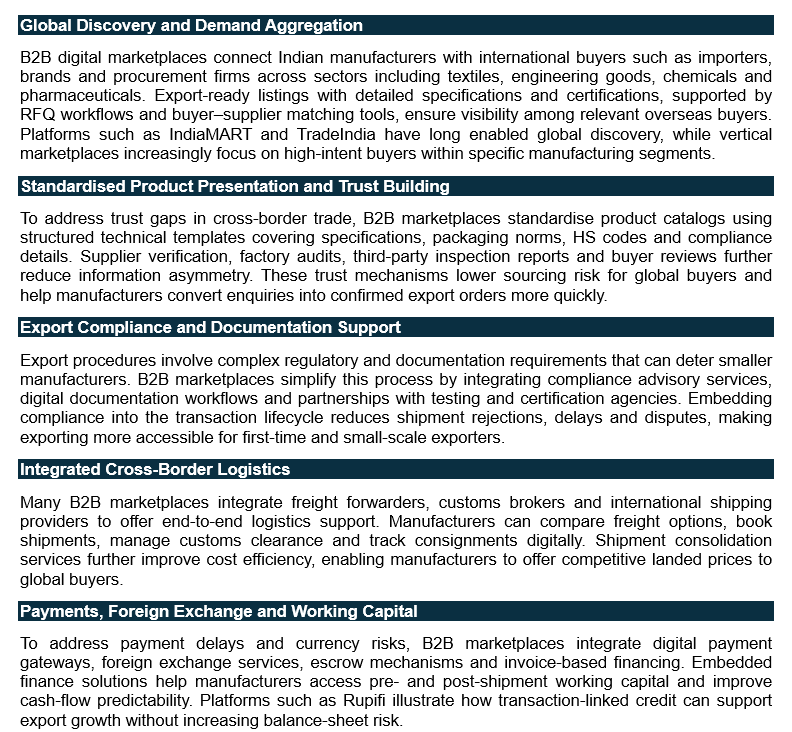
How B2B Digital Marketplaces Enable Global Buyer Access
Role of Technology and Data Analytics
Advanced technologies are at the core of modern B2B digital marketplaces. Artificial intelligence and data analytics are used to match buyers and sellers based on product specifications, order volumes and historical transaction behaviour. This improves conversion rates and enhances user experience for both sides.
Digital cataloguing, virtual product demonstrations and real-time communication tools further reduce transaction friction. In addition, platform-level analytics provide manufacturers with insights into buyer preferences, seasonal demand patterns and export market trends, enabling more informed strategic decisions.
Cybersecurity and data protection are also gaining importance, particularly as platforms handle sensitive commercial information and cross-border payment data. Leading marketplaces are investing in robust security frameworks to build long-term trust among users.
Policy Support and the Broader Digital Ecosystem
The growth of B2B digital marketplaces in India is supported by a favourable policy and ecosystem environment. Government initiatives focused on ease of doing business, digital infrastructure and export promotion have indirectly strengthened the B2B e-commerce landscape. Improved broadband connectivity, widespread adoption of digital payments and the formalisation of logistics networks have reduced transaction costs for manufacturers.
In addition, export-oriented schemes and trade facilitation measures have encouraged SMEs to explore international markets. B2B platforms often act as intermediaries, helping manufacturers navigate regulatory requirements, product standards and documentation norms in target export markets.
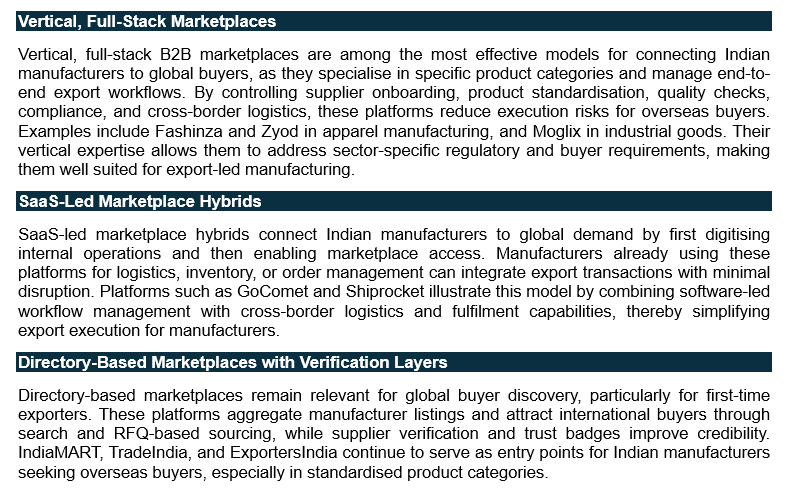
Export-Oriented B2B Marketplace Models in India
The Road Ahead
Looking ahead, B2B digital marketplaces are set to play a more strategic role in positioning Indian manufacturers within global supply chains. As international buyers increasingly adopt digital sourcing models, platforms that combine buyer discovery with compliance, logistics and financing will become the preferred route to market. Greater verticalisation is expected, with marketplaces deepening sector-specific capabilities to meet stringent quality, sustainability and traceability requirements.
The integration of advanced analytics and AI will further improve buyer–seller matching and demand forecasting, enabling manufacturers to plan exports more efficiently. Policy support for digital trade, export facilitation and MSME participation is likely to reinforce this momentum. Over time, B2B marketplaces are expected to evolve from transaction platforms into long-term trade partners for manufacturers. For Indian producers, especially SMEs, sustained engagement with these platforms will be critical to achieving scale, resilience and global competitiveness..
Frequently Asked Questions (FAQs)
What are B2B digital marketplaces?
B2B digital marketplaces are online platforms that enable businesses to buy and sell goods or services while integrating discovery, pricing, logistics, payments and compliance support within a single digital ecosystem.
How do B2B digital marketplaces help Indian manufacturers access global buyers?
They provide international visibility, standardised product presentation, buyer–supplier matching tools and integrated export services, allowing manufacturers to reach overseas buyers without relying on physical trade fairs or intermediaries.
Why are B2B marketplaces important for SMEs and mid-sized manufacturers?
B2B marketplaces lower entry barriers by offering shared infrastructure for trust-building, export compliance, logistics and financing, helping SMEs participate in global trade at lower cost and risk.
Do B2B digital marketplaces support export compliance and logistics?
Yes, many platforms integrate compliance advisory services, export documentation workflows, freight forwarding, customs clearance and shipment tracking, simplifying cross-border trade execution.
How do B2B marketplaces address payment and working capital challenges?
They integrate digital payments, foreign exchange services, escrow mechanisms and invoice-based financing, helping manufacturers manage payment risks and improve cash-flow predictability.
Partners