SEARCH
RECENT POSTS
Categories
- Agriculture (40)
- Automobiles (21)
- Banking and Financial services (36)
- Consumer Markets (59)
- Defence (6)
- Ecommerce (21)
- Economy (73)
- Education (14)
- Engineering (9)
- Exports (22)
- Healthcare (25)
- India Inc. (11)
- Infrastructure (32)
- Manufacturing (34)
- Media and Entertainment (17)
- Micro, Small & Medium Enterprises (MSMEs) (16)
- Miscellaneous (31)
- Perspectives from India (37)
- Pharmaceuticals (5)
- Railways (5)
- Real Estate (21)
- Renewable Energy (19)
- Research and Development (12)
- Retail (2)
- Services (8)
- Startups (16)
- Technology (67)
- Textiles (8)
- Tourism (16)
- Trade (10)
Authors






India's Deep-Tech Startup Wave: Beyond Fintech and E-commerce

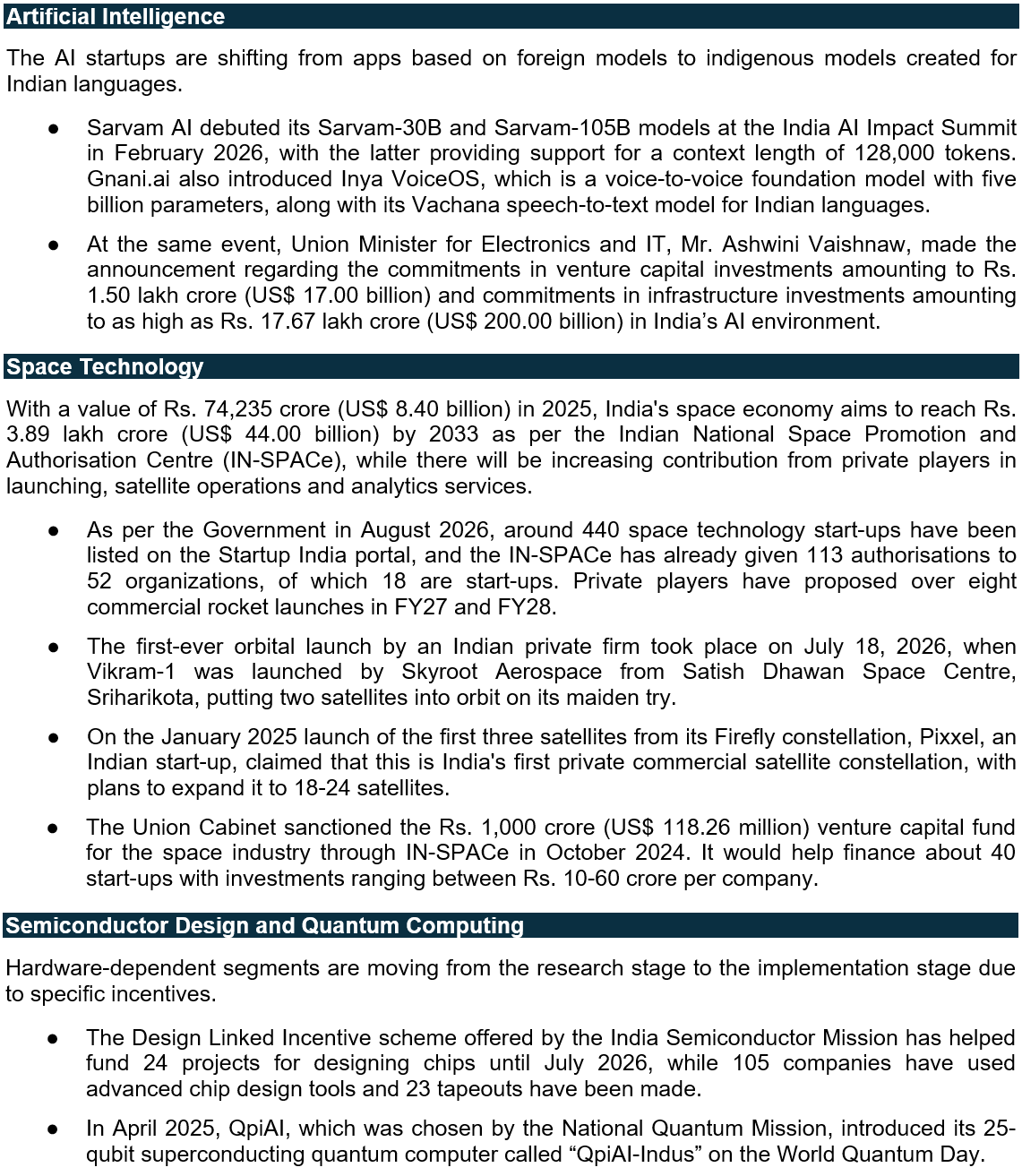
The Indian start-up eco-system, traditionally known for its focus on digital payments and e-commerce companies, is now branching out to include deep tech start-ups, which are involved in developing cutting-edge technology. These deep tech start-ups are working in areas such as artificial intelligence (AI), space technology, quantum computing, semiconductor design, robotics and materials science.
The shift is helped by an abundance of engineers, a research community that has become more involved in industrial activities, and governmental programmes that offer patient capital, shared infrastructure and access to public facilities. These trends together are placing India in the position of being a major producer of technology products on the world stage, rather than just a consumer of technologies.
India's Deep-Tech Start-up Ecosystem
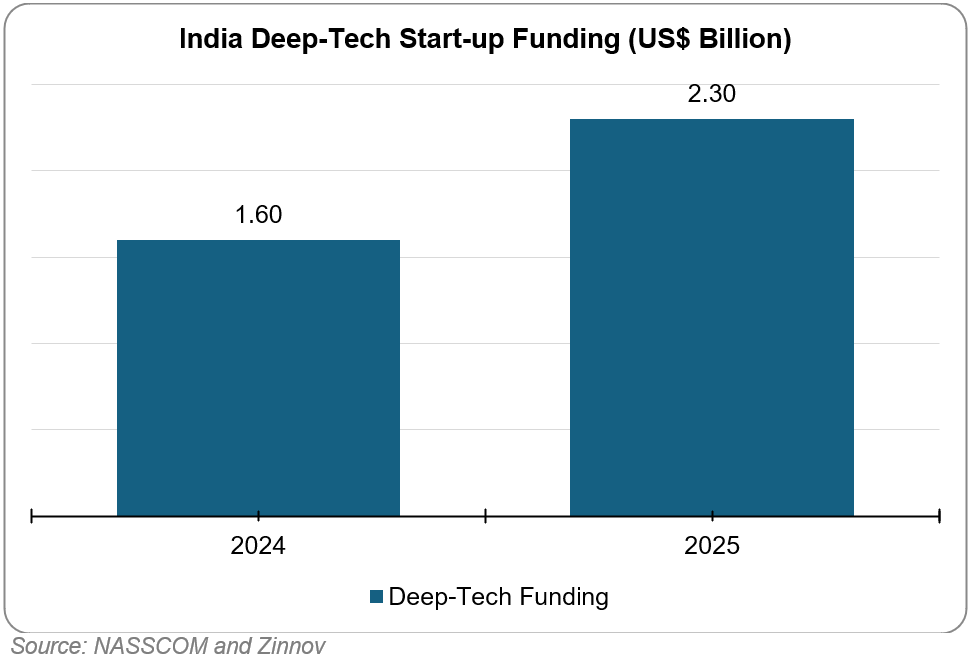
Deep tech start-ups in India saw 37% growth in investments in 2025 compared to 2024 with a total investment worth Rs. 20,047 crore (US$ 2.30 billion), according to data from NASSCOM and Zinnov. Nearly one-fourth of the total investments in technology start-ups in India was received by the deep tech start-ups in 2025 amounting to Rs. 79,316 crore (US$ 9.10 billion), up 23% from the last year.
Today’s ecosystem consists of over 4,200 start-ups with deep tech, including over 550 companies launched in 2025. The lion’s share of deep tech start-ups (84%) and investment (91%) is in the area of artificial intelligence. Other categories include space tech, quantum computing, semiconductors, robotics, and biotech.
Policy Architecture Supporting Deep-Tech Innovation
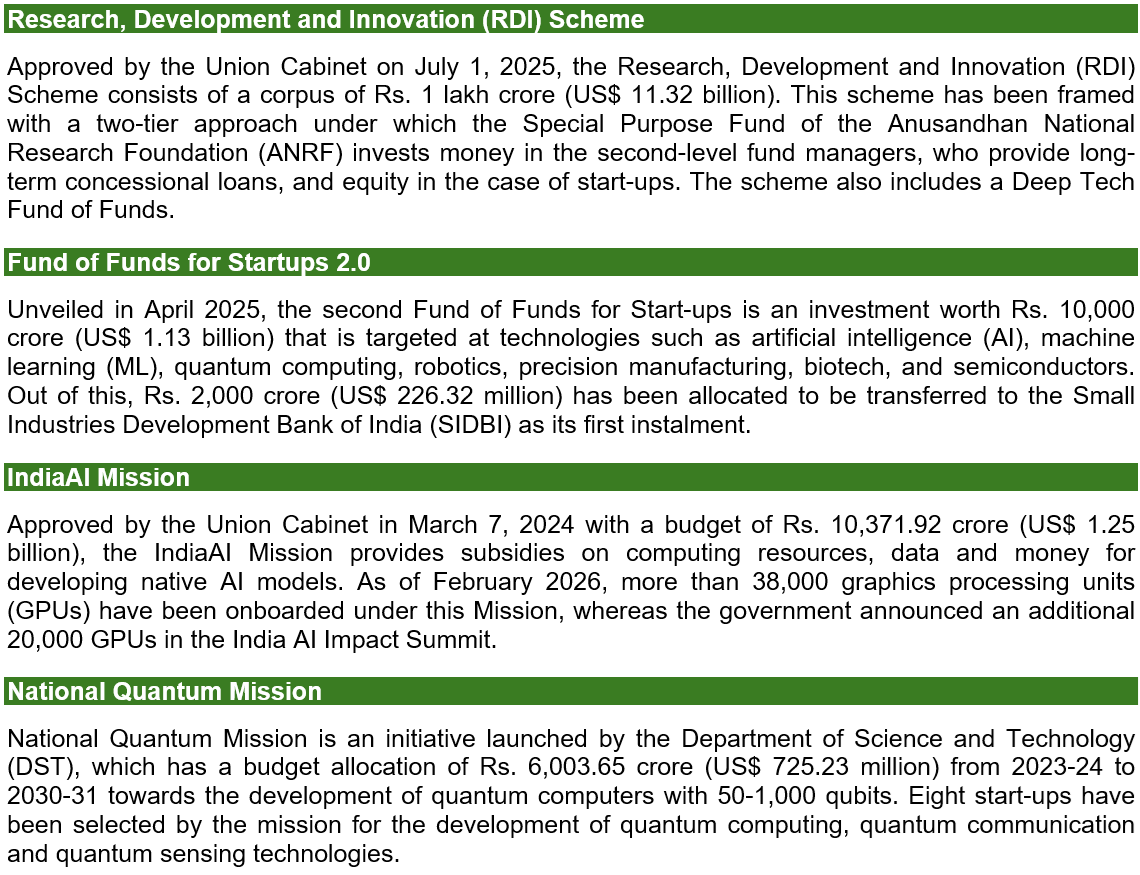
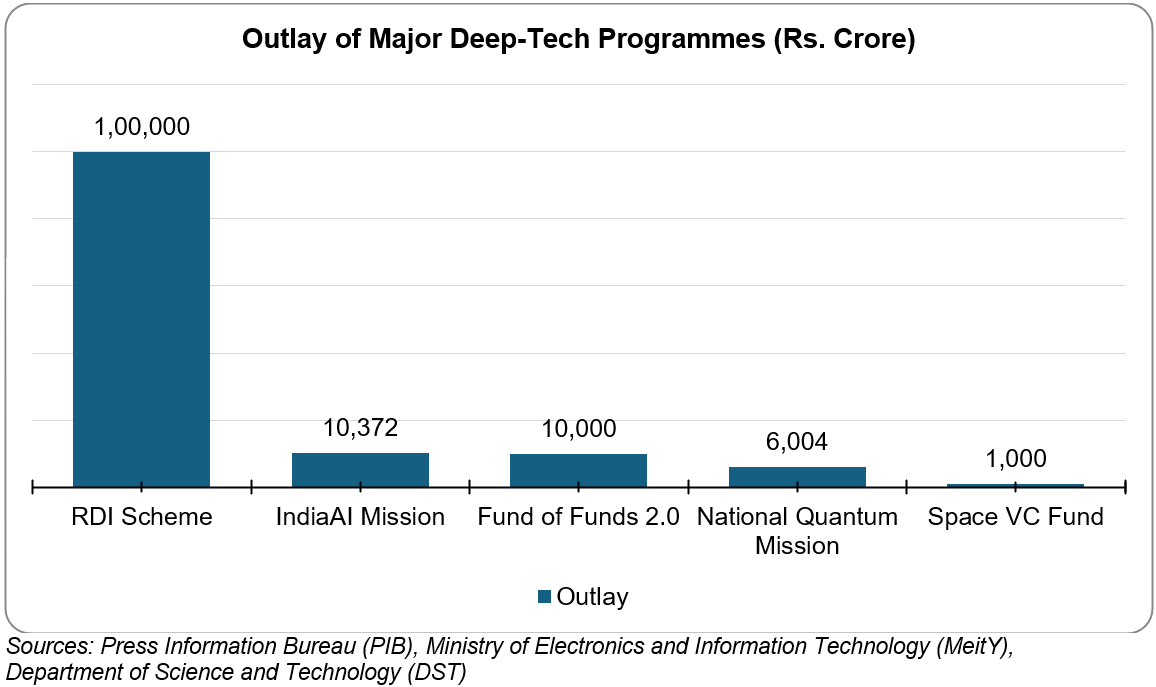
A series of national programmes now ensures deep technology companies access to long-term financing, subsidised computational hardware, and mission-oriented research funding.
Deep-Tech Segments Gaining Momentum
Outlook and Road Ahead
India’s deep tech landscape is forecasted to grow more in the coming years given the fact that the RDI Scheme, the Fund of Funds for Startups 2.0, and the second stage of India Semiconductor Mission will unlock long-term capital for research-driven businesses. The increasing amount of funding available along with the increase in the number of startups working on AI, space technologies, semiconductors, and quantum technologies shows that India’s start-up ecosystem is widening its scope far beyond fintech and e-commerce.
FAQs
How much funding did Indian deep-tech start-ups raise in 2025?
Indian deep tech start-ups raised Rs. 20,047 crore (US$ 2.30 billion) in 2025, up by 37% from 2024, according to NASSCOM and Zinnov.
How many deep-tech start-ups are there in India?
There are over 4,200 deep-tech start-ups in India with over 550 start-ups created in 2025, and AI accounts for 84% of the total.
What is the Research, Development and Innovation (RDI) Scheme?
RDI Scheme sanctioned in July 2025 has a corpus of Rs. 1 lakh crore (US$ 11.32 billion). It offers long-term concessional loans and equity to support research and innovation in sunrise and strategic sectors via ANRF and fund managers of second level.
What has the IndiaAI Mission achieved?
Up until February 2026, IndiaAI Mission had onboarded more than 38,000 GPUs, and another 20,000 were announced. It had also selected 12 organisations, such as Sarvam AI and BharatGen, for developing foundation models.
What are the major recent milestones in India's private space sector?
The first orbital mission conducted by a private Indian entity took place in July 2026 through Skyroot's Vikram-1 while Pixxel launched the first satellites of its Firefly constellation in January 2025.
Partners